
What if you pick a “chill” specialty, sacrifice prestige and pay… and still end up miserable with your schedule?
Let’s be blunt: a lot of students quietly think, “If I don’t match derm, radiology, or anesthesiology, at least I can fall back on something less competitive and have a life.” That assumption is half-true at best and dangerously wrong at worst.
Let me walk you through what actually happens.
The Myth: Less Competitive = Easier Life
There’s this unspoken ladder in med school:
- Top of the prestige/competitiveness ladder: derm, plastics, ortho, ENT, rad onc, some surgical subspecialties.
- Middle: EM, anesthesia, rads, gas/crit care, OB, neuro, some IM subs.
- Bottom (in terms of competitiveness): family medicine, psych (though rising), peds, PM&R in some regions, pathology, preventive medicine, maybe neurology depending on the year.
Students then make a lazy jump: “If it’s easier to match, it must be easier to live with.”
That logic breaks for three reasons:
- Competitiveness is mostly about applicant demand vs. positions, not lifestyle alone.
- Within a single specialty, lifestyle can swing wildly based on practice setting.
- Some of the “least competitive” fields actually have brutal call or soul-crushing clinic volume in certain jobs.
So no, least competitive specialties do not automatically have better work–life balance. Some do. Some absolutely do not. You have to zoom in.
What “Better Work–Life Balance” Actually Means
Before we go specialty by specialty, define your terms. When you say “work–life balance,” what do you actually care about?
For most residents/attendings I’ve talked to, it boils down to:
- Hours per week (and how predictable they are)
- Nights/weekends/holiday burden
- Call type (home vs. in-house, frequency, how often you actually get called)
- Emotional load (death, high acuity, conflict, burnout)
- Control (can you say no, block off time, go part-time, change jobs)
- Geographic flexibility (can you move closer to family or live in a lower cost-of-living area and still have work)
Different specialties score differently on each of these. And that matters more than the “how hard is it to match” label.
To frame this, here’s a rough comparison using typical attending roles (not academic unicorns or disaster jobs).
| Specialty | Avg Hours/Week | Nights/Weekends | Emotional Load | Schedule Predictability |
|---|---|---|---|---|
| Family Medicine | 45–55 | Light–Moderate | Moderate | Moderate |
| Pediatrics | 45–55 | Light–Moderate | High (emotion) | Moderate |
| Psychiatry | 40–50 | Low–Moderate | Moderate–High | High |
| Pathology | 40–50 | Very Low | Low | Very High |
| PM&R | 40–50 | Low–Moderate | Moderate | High |
Is this perfect? No. But it kills the idea that they’re all “easy” in the same way.
Specialty-by-Specialty: Where Lifestyle Actually Shows Up
Family Medicine: “Chill Primary Care” That Often Isn’t
Med students love to imagine clinic FM: 8–5, no nights, happy patients.
Reality: total mixed bag.
Pros:
- Can design an outpatient-only, fairly predictable schedule.
- Good long-term continuity, lots of flexibility in practice style (rural full-scope vs. suburban outpatient vs. concierge).
- Huge geographic flexibility. Someone always needs a family doc.
Cons:
- Volume can be insane: 20–30+ patients a day, constant inbox messages, refills, prior auths. That charting doesn’t do itself.
- Many jobs quietly expect some evenings, some weekends, maybe urgent care shifts.
- Emotional load from chronic disease, social determinants, noncompliant patients, burnout from “hamster wheel” medicine.
Balance verdict:
FM can absolutely be a good lifestyle — if you’re ruthless about the job you accept. I’ve seen FM docs with 4-day workweeks and real lives. I’ve also seen FM attendings so crushed by RVU targets they’re charting until 11 pm every night.
Less competitive? Yes. Automatically “good lifestyle”? No. Depends on how hard you’re willing to push back against the default system.
Pediatrics: Better Hours, Heavier Heart
People think peds = happy kids and cute stickers.
There’s some of that. But there’s also:
- Sick kids. Dying kids. Terrified parents.
- Families that don’t follow up. CPS issues. Chronic disease in 8-year-olds you can’t “fix.”
Hours-wise, outpatient pediatrics is often similar to FM but with slightly fewer procedures and somewhat lower pay. Inpatient peds and NICU can be brutal from an emotional and schedule standpoint.
Lifestyle upsides:
- Plenty of outpatient options that are relatively predictable.
- Many group practices with rotating call and shared weekend coverage.
- Often more collegial environments; peds teams tend to be less toxic than some adult services.
Lifestyle downsides:
- Emotional load can be rough, especially in subspecialty peds or oncology.
- Lower compensation for similar hours compared with adult medicine in many markets.
- Increasingly complex patients with fewer resources.
Balance verdict:
Peds can offer a kind schedule, but the emotional cost is not trivial. If your definition of work–life balance includes emotional bandwidth outside of work, you need to account for this.
Psychiatry: The “Lifestyle Specialty” That’s Quietly Getting Intense
Psych used to be the go-to “chill” option. It’s still relatively lifestyle-friendly compared with many fields, but demand is sky-high now. That means:
- More jobs than people. You have leverage.
- A flood of high-need, complex patients.
- Productivity pressures are creeping in.
Common setups:
- Outpatient psych: 8–5-ish, 4–5 days/week, minimal actual emergencies. Documentation-heavy, emotionally draining some days, but pretty predictable.
- Inpatient psych: shift-based, more nights/weekends, higher acuity, more safety issues, but still often better than surgical fields for hours.
Tradeoffs:
- Emotional and cognitive fatigue from constant serious pathology (suicidality, psychosis, personality disorders).
- Risk and liability concerns.
- But: you can very realistically build part-time, tele-psych, or niche practices that give you huge control over lifestyle.
Balance verdict:
Psychiatry is one of the few “less competitive historically” fields that genuinely can offer top-tier work–life balance for many people, if you’re okay with the mental load. This is one of the few places where the stereotype isn’t totally wrong.
Pathology: High on Lifestyle, Low on Visibility
Path is the classic under-the-radar lifestyle specialty. Very few med students truly understand what pathologists do day-to-day. That’s part of why it’s less competitive.
Reality of the job:
- Most are in labs or offices, not seeing patients.
- Hours in many private groups: roughly 8–5, relatively rare overnight emergencies, occasional frozen sections or transplant call.
- Stressors are more about diagnostic uncertainty, rare cancers, and turnaround time than patient volume directly.
Upsides:
- Very little direct night/weekend work in many paths jobs.
- Predictable schedule. No clinic. No family drama in your face.
- Many people actually go home on time.
Downsides:
- Few jobs in some geographic areas; bigger mismatch between where you want to live and where the jobs are.
- Intense cognitive workload. Tiny misses can have big consequences.
- Some labs are short-staffed and push dangerous volumes of cases.
Balance verdict:
If you like the work and can land in a decent group, pathology probably has one of the best work–life balance profiles in medicine. Here, “less competitive specialty” and “better lifestyle” actually align more often than not.
PM&R: Underrated, Varied, and Often Livable
Physical Medicine and Rehabilitation (PM&R) is a weird hybrid: some musculoskeletal, some neuro, some pain, some inpatient rehab.
Attending life options:
- Inpatient rehab units: call can be home-based and light; days are busy but not typically crazy overnight.
- Outpatient MSK/pain/spine: clinic-based, procedure-heavy if you want, usually predictable hours.
- Interventional pain tracks can turn into very lucrative but busier practices.
Balance upsides:
- Generally fewer true emergencies.
- Work is structured and schedule-based; you can often design your template the way you like.
- Meaningful functional improvement can be very satisfying, which buffers burnout.
Balance downsides:
- Some inpatient jobs have frequent weekend rounds.
- RVU pressure in MSK/pain clinics can get heavy.
- Compensation varies widely by region and focus.
Balance verdict:
PM&R tends to land in that sweet spot of “not insanely competitive” and “pretty good lifestyle potential.” But again, the specific job you sign matters far more than the match statistics.
Reality Check: Many Competitive Specialties Have Decent Lifestyle Too
Here’s the other side students tend to miss: some competitive specialties are lifestyle-friendly in practice:
- Radiology: Lots of shift-based, remote, and part-time work emerging. Nights/weekends rotate, but when you’re off, you’re off.
- Anesthesia: OR days can be long, but call structures vary; some groups have excellent balance.
- Dermatology: Outpatient, mostly daytime. The gold standard for lifestyle, which is why it’s competitive.
- Ophthalmology: Clinic + OR combo, often predictable with few real emergencies.
So the logic “I’ll pick something easier to match so I can have a life” ignores that many top-competitive fields are competitive because they have great lifestyle and pay.
The Four Real Drivers of Work–Life Balance (More Than Specialty Name)
If you’re serious about lifestyle, focus on these four levers. Specialty is just step one.

| Step | Description |
|---|---|
| Step 1 | Choose Specialty |
| Step 2 | Choose Practice Setting |
| Step 3 | Choose Geography |
| Step 4 | Negotiate Job Terms |
| Step 5 | Actual Work Life Balance |
| Step 6 | Inpatient Focus |
| Step 7 | Outpatient Focus |
Practice setting
Academic vs. community. Hospital-employed vs. private group vs. concierge vs. telemedicine. A family med doc in a concierge practice and one in a high-volume FQHC live completely different lives.Inpatient vs. outpatient mix
More inpatient = more nights, weekends, and unpredictability on average. A psych hospitalist and an outpatient psych in private practice both “do psych” but live very different weeks.Geography and job market
Oversupplied area? You’ll take whatever schedule they offer. Underserved region? You suddenly have leverage: 4-day weeks, no call, remote days.Your boundaries and tolerance for income tradeoff
You can buy back your time in almost every field by:- Working fewer clinic days
- Taking lower RVU or salary
- Avoiding leadership roles that balloon hours
But most people don’t want to give up the money, prestige, or security. That’s not a specialty problem. That’s a tradeoff problem.
So, Should You Target a “Least Competitive” Specialty for Lifestyle?
If your plan is: “I’ll pick something easy so I guarantee better work–life balance,” that’s a bad strategy.
Better strategy:
Be brutally honest about what you hate:
- Overnight chaos?
- High emotional intensity?
- Procedures?
- Crushing clinic volume? That will narrow fields more effectively than looking up match rates.
Look inside each specialty for the specific practice models that match your lifestyle goals.
Example: outpatient psych, pathology group job, PM&R clinic, outpatient-only FM or peds with flexible schedule.Ask attendings and residents these questions directly:
- “What time did you leave yesterday?”
- “How often does work come home with you?”
- “What would you have to change to work 20% less?”
Remember: You can course-correct.
Even if you pick a less competitive specialty and end up in a bad job, you are not locked in. Most “lifestyle fixes” happen by changing jobs, not changing specialties.
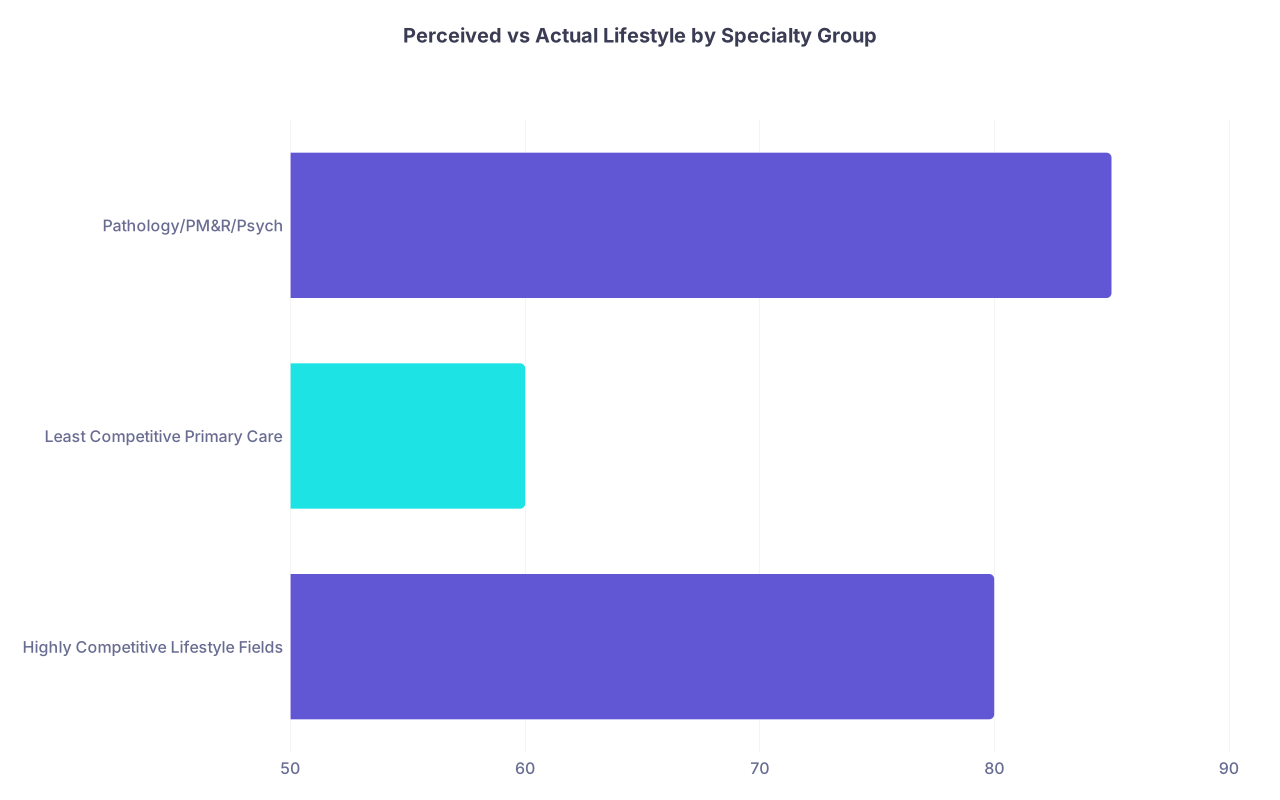
| Category | Value |
|---|---|
| Highly Competitive Lifestyle Fields | 80 |
| Least Competitive Primary Care | 60 |
| Pathology/PM&R/Psych | 85 |
(Think of those numbers as “overall lifestyle satisfaction” on a 100-point scale from surveys and what I’ve seen anecdotally. Notice: least competitive primary care is not automatically top of the list.)
Bottom Line
Least competitive specialties don’t inherently have better work–life balance. They have:
- More entry points.
- More geographic flexibility in some cases.
- Good lifestyle potential if you’re intentional about setting, job, and boundaries.
But some of the best lifestyles in medicine are in very competitive specialties. And some of the worst, soul-sucking grinds are in supposedly “easy” ones like outpatient primary care—when done in the wrong system.
If you remember nothing else:
- Competitiveness is about supply and demand, not how “nice” the hours are.
- Practice setting and job structure matter at least as much as the specialty label.
- You can usually buy better lifestyle with either geographic flexibility or income tradeoff—regardless of specialty.