
The idea that any residency specialty is “easy” to match is a lie.
Some fields are less competitive on paper, sure. But people still go unmatched in every single one of them every year — including FM, IM, psych, peds, and pathology. If you treat these like backups you don’t have to respect, you’re exactly the kind of applicant who gets burned.
Here’s what you actually want to know:
“For the most common low-competition specialties… how competitive am I really?”
Let’s break that down in a way you can actually use.
The Big Picture: What “Low-Competition” Really Means
Low-competition does not mean:
- “Anyone can match here.”
- “I don’t need to care about scores or letters.”
- “I don’t need a real story for why I want this field.”
Low-competition does generally mean:
- The field has more positions than enthusiastic applicants.
- Programs are more forgiving of lower scores, gap years, non-traditional paths, or less research.
- Bread-and-butter programs (especially community and mid-tier university) are realistic for many average applicants.
The main “lower competition” core specialties most people ask about are:
- Family Medicine (FM)
- Internal Medicine (IM)
- Pediatrics (Peds)
- Psychiatry (Psych)
- Pathology (Path)
We’ll hit all five. I’ll give you:
- A quick competitiveness snapshot
- Where your Step/COMLEX scores land you
- What really matters besides scores
- A blunt “If this sounds like you, you’re OK / borderline / in trouble” section
First, quick comparison.
| Specialty | Overall Difficulty | Score Sensitivity | Research Importance |
|---|---|---|---|
| Family Med | Low | Low | Low |
| Internal Med | Low–Moderate | Moderate | Moderate |
| Pediatrics | Low–Moderate | Moderate | Low–Moderate |
| Psychiatry | Moderate now | Moderate–High | Moderate |
| Pathology | Low | Low–Moderate | Low |
Step 1: Know Where Your Scores Actually Put You
You can’t talk competitiveness without numbers. You don’t have to love that, but programs live in spreadsheets.
Here’s a rough positioning map for less competitive specialties if you’re a US MD or DO (IMGs: shift expectations up one notch — you usually need more).
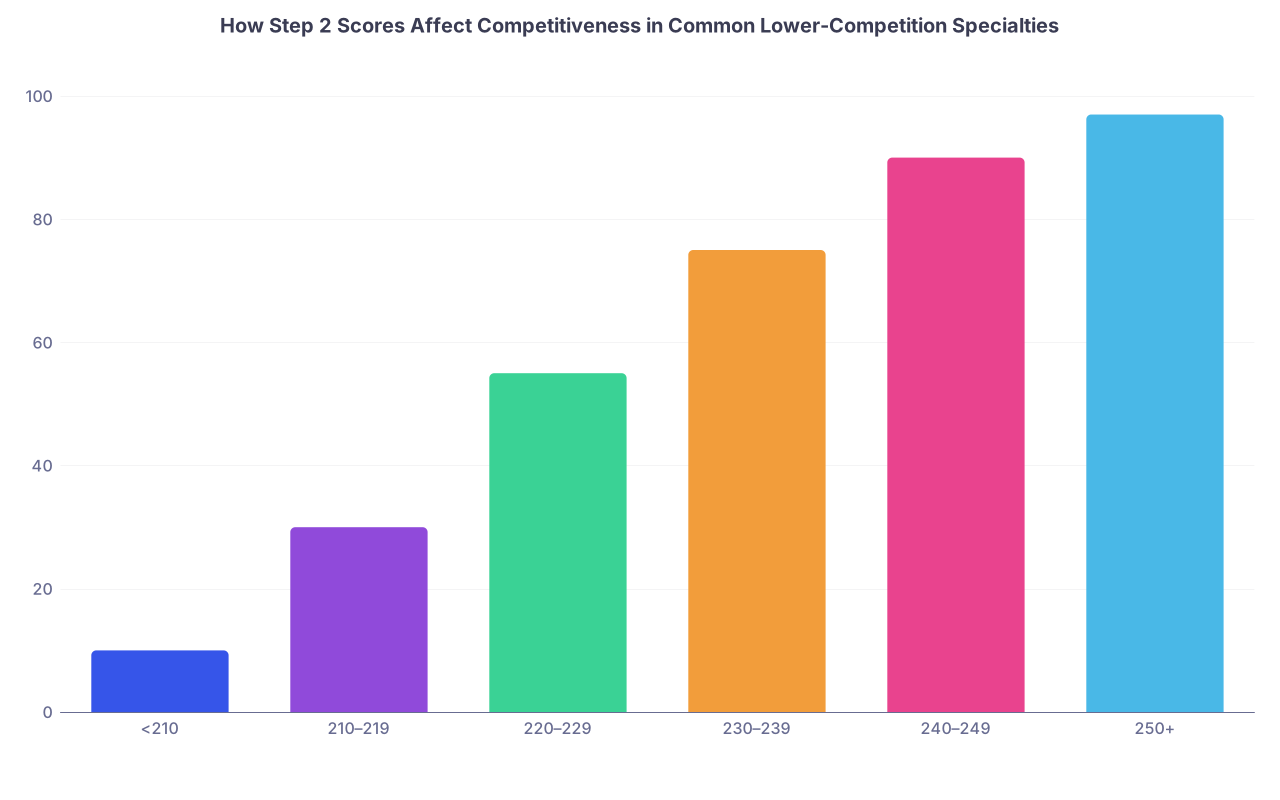
| Category | Value |
|---|---|
| <210 | 10 |
| 210–219 | 30 |
| 220–229 | 55 |
| 230–239 | 75 |
| 240–249 | 90 |
| 250+ | 97 |
That bar chart is a loose “chance you’re reasonably competitive for some program” across FM/IM/Peds/Psych/Path, assuming:
- Normal number of applications (not 20, not 200)
- No catastrophic red flags
- Decent letters and personal statement
Let me give you a working translation:
Step 2 < 210 (COMLEX < ~430)
You are in the danger zone. Even for low-competition fields, you need:- Very broad application list
- Heavy focus on community and lower-known programs
- Strong explanation and evidence of improvement
210–219 (~430–460)
You can match FM and path, often peds, sometimes IM and psych — but you must apply smart and broad. Your clinical grades, letters, and interview skills matter a lot.220–229 (~460–490)
You’re in range for almost all FM, peds, path, and many IM and psych programs, especially community and mid-tier. Academic “name” programs are hit-or-miss.230–239 (~490–520)
You’re solid. For these fields, you’re more limited by red flags, poor letters, and weak fit than raw scores.240+ (~520+)
Your scores will rarely keep you out of any of these fields. Now it’s about your story: why you want this specialty and whether your app looks lazy.
Now, let’s go specialty by specialty.
Family Medicine: The Safety Net That Still Rejects People
Family med is still one of the least competitive fields. But every year, I see people go unmatched in FM who thought “FM always has spots, I’ll be fine.” They were wrong.
You’re generally competitive for FM if:
- Step 2 ≥ ~215 (COMLEX ≥ ~440) as US MD/DO
- Step 2 ≥ ~225+ as an IMG (COMLEX equivalent ~460+)
- You’ve got at least average clinical evaluations and a couple of decent letters
What programs care about more than numbers:
- Consistent interest in primary care (clinic time, continuity clinic, FM elective, community work)
- Ability to handle outpatient + inpatient + behavioral + OB exposure
- Whether you’re someone they can trust to sit in a room with vulnerable patients all day
Red flags that hurt even in FM:
- Repeated failures (Step/COMLEX, courses, repeated years)
- Really poor communication skills or professionalism notes
- Totally generic “I love all ages, cradle to grave” statements with nothing specific
Rough guide:
- Step 2 210–219:
You’re competitive for many FM programs if you:- Apply broadly (40–60+ programs if US MD/DO, more if DO/IMG)
- Have solid FM letters and a clean professionalism record
- Step 2 220–235:
You’re fine for most FM programs, including many university-affiliated. - Step 2 235+:
You’re overqualified for a lot of community FM; they’ll still rank you, but they may suspect you’re using them as a backup.
Internal Medicine (Categorical): Wide Range, Wide Variability
Internal medicine is deceptive. It has tons of spots, so it looks “easy.” But it also contains some of the most competitive residencies in the country (think big-name academic places, physician-scientist tracks).
You’re probably not asking if you’re competitive for MGH or UCSF IM. You’re asking if you can match somewhere reasonable.
You’re generally competitive for non-elite IM if:
- Step 2 ≥ ~220 (COMLEX ≥ ~460) as US MD/DO
- Step 2 ≥ ~230–235+ as IMG
- You have solid medicine clerkship performance and at least one strong IM letter
What IM directors actually look at:
- Medicine clerkship grade (high pass/honors matter more here than in FM)
- Evidence you can do inpatient medicine (sub-I, acting internship, ICU or wards-heavy rotations)
- Research is “nice” but not mandatory for typical community or mid-tier university programs
Internal medicine has tiers. Let’s be blunt:
- Top-tier academic IM (big names):
Step 2 245+, strong research, honors, strong letters, often AOA. - Solid university + strong community IM:
Step 2 ~230–240+, OK research or QI, good clinical performance. - Most community IM programs:
Step 2 ~220–230 is usually fine if the rest of your app is clean.
If your Step 2 is 210–219:
- You’re not out, but you need:
- Broad list of community programs
- No significant professionalism issues
- Clear upward trajectory and solid medicine letters
Pediatrics: Friendly, But Not a Freebie
Peds attracts a certain personality. Programs care whether you can actually deal with parents at 3 a.m. more than whether you cured cancer in undergrad.
But don’t confuse “nice people” with “not selective.”
You’re generally competitive for peds if:
- Step 2 ≥ ~220 (COMLEX ≥ ~460) as US MD/DO
- Step 2 ≥ ~230+ as IMG
- You have at least some real pediatrics exposure (core rotation + maybe an elective/sub-I)
What matters for peds:
- Peds clerkship performance and comments (teamwork, communication, adaptability)
- Any demonstration you actually like kids and adolescents (doesn’t have to be pediatrics-only research; could be camp, teaching, mentoring)
- Being someone faculty feel parents will trust
Where scores bite:
- Top children’s hospitals and high-profile academic peds programs absolutely care about Step 2
- NICU-heavy or fellowship-focused programs may quietly screen harder
If you’re:
- 210–219: You can still match peds, especially at community and regional programs. Apply broad.
- 220–235: This is “typical” peds territory. You’ll be OK with reasonable geographic flexibility.
- 235+: You’re competitive for most peds programs; the rest is about fit and story.
Psychiatry: Used To Be Easy, Now… Not So Much
Psych became trendy. Lifestyle, outpatient options, tele-psych, decent money, growing need — everyone suddenly “discovered” it. Competitiveness climbed.
It’s still not derm or ortho, but it’s not the backup it used to be.
You’re generally competitive for psych if:
- Step 2 ≥ ~225 (COMLEX ≥ ~470) as US MD/DO
- Step 2 ≥ ~235+ as IMG
- You have at least one solid psych letter and no glaring behavior issues
Psych programs care a lot about:
- Interpersonal skills (do you listen? can you reflect? or do you monologue and miss cues?)
- Genuine interest in psychiatry (electives, inpatient psych, CL, substance use, etc.)
- Professionalism and stability — they’re wary of applicants with major unaddressed issues
Red flags that hurt especially in psych:
- Unexplained leaves of absence or big performance swings
- Vague or evasive responses about your own mental health or conduct issues
- Rotations where attendings commented on lack of insight or poor boundaries
Rough psych competitiveness by Step 2:
- <220: You need to be strategic and broad, probably emphasizing community programs and regions with less demand.
- 220–229: You’re viable but not “auto-interview” at many places. Good letters and a strong narrative are mandatory.
- 230–240: Solid shot at most non-top-tier psych programs.
- 240+: You’ll get looks almost everywhere outside the absolute elite, as long as you’re not weird in the interview.
Pathology: Low Competition, High Risk If You Don’t Understand It
Pathology remains objectively one of the less competitive fields. But it’s also one of the easiest to misunderstand and regret if you pick it for the wrong reason (“no patients!” is not a good enough reason).
You’re generally competitive for path if:
- Step 2 ≥ ~215–220 (COMLEX ≥ ~440–455) as US MD/DO
- Step 2 ≥ ~225–230 as IMG
- Someone can vouch that you actually know what pathology is like (electives, research, shadowing)
Programs care about:
- Genuine exposure to pathology (autopsy, surgical path, heme path, lab)
- Your ability to work carefully and consistently without missing small details
- Whether you can function well without needing constant patient interaction as validation
For path, the bigger danger is:
- Matching into a field you don’t actually like and burning out
- Having weak job prospects later if you pick a weak residency and never develop strong subspecialty skills
Score-wise:
- 210–219: You still have a realistic shot, especially if you’ve spent time in path departments and can show commitment.
- 220–235: Very comfortable for nearly all path programs.
- 235+: You’re at or above average for the field; doors are open.
How To Quickly Self-Rate: Am I Competitive, Borderline, or At Risk?
Let’s combine everything into a simple self-check.
You’re LIKELY COMPETITIVE for at least one of these less competitive specialties if:
- You have:
- Step 2 ≥ 220 (US MD/DO) or ≥ 230 (IMG)
- No exam failures
- Mostly passes/high passes, a few honors is a plus
- At least 2 strong letters in your intended field or closely related fields
- And you’re willing to:
- Apply broadly (30–60+ programs depending on specialty and status)
- Be flexible about geography and “prestige”
You’re BORDERLINE if:
- Step 2 is 210–219 (US) or 220–229 (IMG)
- OR you have:
- A Step/COMLEX failure
- A leave of absence or professionalism concern
- But:
- You’ve shown recent improvement
- You have strong, specific letters
- You’re targeting FM, path, some community IM/peds
You’re HIGH RISK FOR UNMATCH even in low-competition fields if:
- Step 2 < 210 or COMLEX < ~430 AND:
- You have red flags (failures, repeated years, major gaps)
- You refuse to be geographically flexible
- You apply to 15–20 programs and assume it’ll “work out”
If you’re in that high-risk group, the right move is not magical thinking. It’s:
- Huge application list
- Early outreach to programs
- Very tight personal statement and letters
- Possibly a backup SOAP plan

| Step | Description |
|---|---|
| Step 1 | Know Step 2 or COMLEX score |
| Step 2 | Likely competitive for low competition fields |
| Step 3 | Borderline - need broad apps and strong letters |
| Step 4 | High risk - consider major strategy changes |
| Step 5 | Step 2 220 or higher? |
| Step 6 | Red flags? |
| Step 7 | Step 2 210 to 219? |
What To Do Today
Open a note on your laptop and write three things:
- Your exact Step/COMLEX scores and attempt history
- The specialty (or two) you’re most realistically considering from this list
- Whether — based on everything above — you’re:
- Clearly competitive
- Borderline
- High risk
Then for your chosen specialty, do one of these today:
If you’re clearly competitive:
Identify 5–10 programs (mix of community + mid-tier university) and save them to a shortlist with basic notes: location, size, any connections.If you’re borderline:
Email one faculty member or mentor in that specialty and ask:
“Here’s my score profile and background. Do you think this field is realistic for me, and how broad would you recommend I apply?”If you’re high risk:
Draft a one-paragraph explanation of your biggest red flag (low score, failure, LOA) that:- Takes responsibility
- Shows what you changed
- Points to better performance since
This paragraph becomes the backbone of how you address it in your personal statement and interviews.
Don’t just think “I’ll be fine, it’s a low-competition specialty.”
Pull up your actual numbers and proofread the story your application is telling — and fix what you still can.
FAQ (Exactly 7 Questions)
1. Is there any Step 2 score that guarantees I’ll match in FM/IM/peds/psych/path?
No. There’s no guaranteed score. A 250 with terrible professionalism or a bizarre interview can still go unmatched. High scores just mean programs will look at you. They don’t guarantee they’ll like what they see.
2. I failed Step 1 or COMLEX Level 1. Can I still match a low-competition specialty?
Yes, but it’s uphill. You’ll usually need:
- A clearly higher Step 2/Level 2 score relative to your first exam
- A concise, mature explanation of what went wrong and what changed
- Strong clinical performance and letters
FM and path are the most forgiving, then peds and some community IM. Psych may be cautious if the failure suggests chronic instability.
3. Do I need research for these less competitive specialties?
For most FM, peds, path, and many community IM programs, no. It can help, but it’s not make-or-break. For psych and academic IM, research is more valuable, especially if it’s aligned with mental health or internal medicine topics. If you have zero research, it’s not a dealbreaker for non-elite programs.
4. How many programs should I apply to if I’m borderline?
Borderline US MD: 30–50 programs in FM/peds/path, 40–60 in IM/psych.
Borderline DO or IMG: often 60–80+ in IM/psych and 50–70+ in FM/peds/path, with a strong focus on community programs and areas with less regional competition. Underapplying is the classic way borderline applicants end up in the SOAP.
5. Does being a DO hurt me in these lower-competition specialties?
Less than in surgical or hyper-competitive fields. DOs match very well into FM, IM, peds, psych, and path. The main issues: some academic IM and psych programs still prefer MDs, and some university programs don’t take many DOs. But for the majority of community and many university-affiliated programs, a strong DO applicant is absolutely competitive.
6. I’m an IMG with a Step 2 of 230. Which of these fields is most realistic?
Most realistic: FM and pathology.
Next realistic: peds and community internal medicine.
Psych is possible but more selective for IMGs now, and you’ll need strong letters, clear interest, and a smart, broad list. Your visa status, years since graduation, and clinical experience in the US will matter a lot too.
7. My scores are fine, but my clinical evals are mediocre. Does that tank me?
Not automatically, but it changes what matters. For low-competition specialties, programs want to see you can function on a team, communicate, and follow through on tasks. Good interviews, strong letters from people who actually know you, and a solid sub-I can balance “meh” clerkship comments. But if your evals highlight attitude or reliability issues, that will hurt more than a few missed honors.