
Last March, I watched a dean meet with a devastated fourth-year. Mid-tier MD school, solid clerkship comments, Step 2 in the 230s, applied to a so‑called “safe” specialty. Zero matches. Not even a prelim. And yes—this was in one of those specialties everyone online tells you is a ‘backup.’
He’d done what his classmates told him. What Reddit told him. What his advisor casually implied. And it still blew up. Let me tell you why that actually happens, because the public narrative about “easy” specialties is dangerously incomplete.
The Myth of the “Easy” Specialty
Here’s the first uncomfortable truth: there is no such thing as an easy specialty. There are only less competitive on average, and “competitive for you.”
When people say “easy” or “least competitive,” they’re usually pointing at fields like:
- Family Medicine
- Psychiatry
- Pediatrics
- Internal Medicine (community-heavy, non‑prestige programs)
- Pathology
- PM&R at some programs
- Neurology at many community places
Are these easier than plastics or derm? Obviously. But here’s what you do not see on the marketing brochure:
Even in these fields, there are two very different markets:
- The national NRMP statistics that show high match rates
- The real game at specific programs and specific applicant profiles
Let’s anchor this with some perspective.
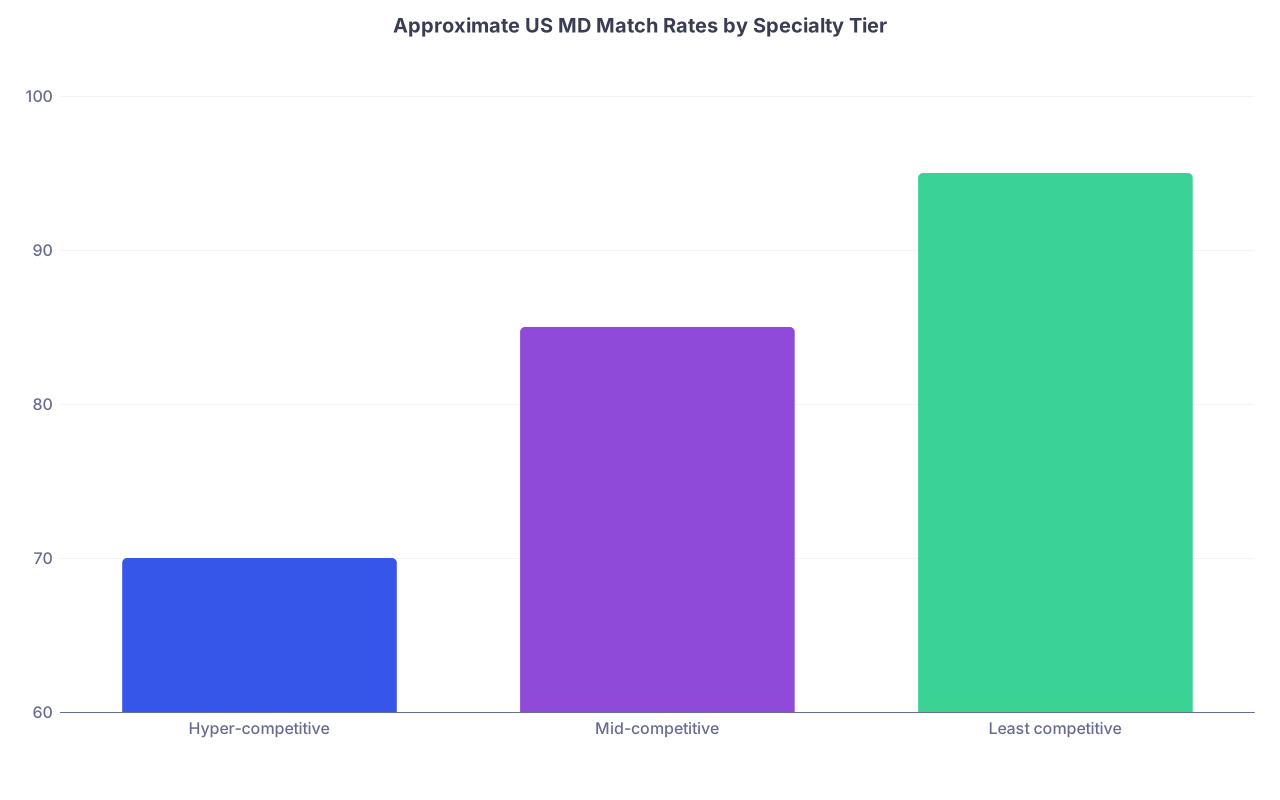
| Category | Value |
|---|---|
| Hyper-competitive | 70 |
| Mid-competitive | 85 |
| Least competitive | 95 |
Those “least competitive” numbers look comforting—until you realize they’re averages. When we sit in rank meetings, nobody is saying, “Let’s make sure we maintain that 95% national match rate.” They’re saying, “Would I actually want this person in my call room at 2 a.m.?”
And that’s where a lot of “safe” applicants quietly get filtered out.
How Programs Actually Sort Applicants in “Easy” Specialties
Let’s pull the curtain back on what really happens when faculty at these programs sit around the table with your file up on the screen.
They’re not thinking, “We’re a backup specialty, let’s scoop up everyone who didn’t match ortho.” They’re thinking three brutal questions:
- Will this person show up, do the work, and not destroy morale?
- Will they actually come here if we rank them?
- Are they going to be a long-term problem— professionalism, burnout, complaints, lawsuits?
In practice, that translates into some patterns that applicants underestimate.
The “Backup Vibe” Problem
I’ve watched this play out in Family Medicine, Psychiatry, and IM multiple times.
Faculty flip through your application and see:
- Two away rotations in ortho or ENT
- Personal statement that reads like it was lightly edited from a surgery essay
- Research all in neurosurg or cardiothoracic
- ERAS list with 10 ortho programs and 6 “just in case” FM or Psych
You think you’re being strategic. They think you’re using them as a life raft.
And here’s the insider part: even “easy” specialties hate being backups. There is real resentment there. They will absolutely pass on a “better” candidate who clearly doesn’t want their field in favor of a “weaker” candidate who looks all‑in.
At several community FM programs, I’ve seen the PD literally say:
“Skip him. He’s ortho‑hurt. He’ll be miserable here and we’ll lose him to a re‑app cycle.”
If your whole file screams “I settled for you,” don’t be surprised when they don’t fight to rank you.
The Hidden Academic Cutoffs That No One Admits Publicly
Programs in less competitive specialties rarely publish true score or GPA cutoffs. But internally? They absolutely use them—especially to manage volume.
Here’s a simplified view of how many community‑heavy “easy” specialties quietly stratify applicants:
| Filter Type | Common Quiet Thresholds |
|---|---|
| Step 2 CK | < 215–220 often hard cut |
| Number of Fails | > 1 exam fail = major red flag |
| Clerkship Grades | Multiple below‑passes hurt |
| Gaps/Leaves | > 1 year forces extra scrutiny |
| Number of Apps | < 20–30 programs = risky |
Do exceptions get made? Yes—but rarely for the applicant with:
- No strong home advocacy
- No explanation for poor performance
- No clear connection to the region or program
Students hear that FM or Psych “take lower scores” and misunderstand what that means. It means they will consider you with a 210 or some blemishes if the rest of your file makes sense and you fit their mission. Not that any random, unfocused 210 is safe.
I’ve sat in on meetings where the PD goes down a list:
“Below 215, no home letter, no FM rotation here, out of region. Next.”
You never even made it to the “weaker field” generosity phase. You just died at the sorting gate.
The Fit Problem: When Your Story Doesn’t Match the Specialty
This is where “easy” goes to die for a lot of applicants.
In specialties like Derm or Ortho, your story often revolves around prestige, procedures, research. In least competitive specialties, the currency shifts.
Family Medicine programs are asking:
Does this person actually like continuity, outpatient medicine, broad undifferentiated complaints, and often underserved populations?
Psychiatry is asking:
Does this person understand that psych is messy, slow, full of non‑adherence, and not just “cool brain stuff”?
Pediatrics is asking:
Can this person handle anxious parents, constant colds, and less swagger, more patience?
If your entire application screams:
- “I love the OR”
- “I am obsessed with procedures and high acuity”
- “I only did research in skull base tumors or CABGs”
Then pivoting at the last minute and telling a FM program that “continuity of care has always been my passion” does not land. They’ve been reading real FM‑focused applications all season. They can tell who pivoted two weeks after a weak Step score and who actually meant it.
I’ve watched faculty scroll through a personal statement and say out loud:
“This reads like a surgery application with ‘family medicine’ pasted in three times.”
Rejected. Often without even discussing your board scores.
Geography and “Unspoken” Preferences
Another quiet killer: geography.
In these “less competitive” specialties, geographic ties matter more than applicants realize, especially in community and regional programs.
Here’s the backstage logic:
- They know their location isn’t “sexy” (rural Midwest, small Southern city, Rust Belt)
- They’ve been burned by people who rank them as a backup and then complain about being stuck there
- They desperately want residents who will not immediately plan an escape route
So they overvalue any sign that you might actually stay:
- Grew up in that state or region
- Family within driving distance
- Med school close by
- Multiple rotations in the region
- A personal statement that specifically mentions why that region or setting
Applicants underestimate how often this exact calculus gets said aloud:
“She’s from California, no midwest ties, no mention of cold weather anywhere, no rotation here. If Mayo or Loyola decides to rank her, we’ll lose her anyway. Pass.”
And then they rank the “less shiny” candidate who grew up two towns over and actually wants to work there after residency.
The Red Flag Tax in “Easy” Specialties
Another nasty little truth: “least competitive” specialties don’t mean “most forgiving of red flags.”
In fact, sometimes they’re less tolerant, because they have less institutional buffer if you blow up.
Think about it: a massive academic surgical department can absorb one problematic resident with layers of chiefs, APDs, and institutional prestige. A small community FM program with 6 residents per year? One toxic or non‑functional person can set the culture on fire.
So what do they quietly blacklist?
- Multiple exam failures with hand‑wavy explanations
- Documented professionalism issues (late notes, disrespect, no‑shows)
- Poor narrative comments on core clerkships, especially IM/FM/Psych/Peds
- Vague, impersonal letters that read like the writer was being diplomatic
I’ve seen applicants told by their dean, “Just apply broadly to FM, you’ll be fine,” while the local FM PD already knows:
“We’re not touching him. He almost failed IM, had a warning on his MS3 eval, and the chair’s letter was lukewarm at best.”
“Easy” does not mean “we’ll take on known headaches.”
Volume, Sloppiness, and the “Spray and Pray” Trap
Here’s where a lot of backup‑strategy applicants really shoot themselves in the foot.
They panic late. They scatter applications to 40+ programs in FM, Psych, or Peds. And then:
- Generic personal statement sent to every program
- No program‑specific signals that they’ve even read the website
- Vague or no mention of why that region or population
- No tailored experiences highlighted (community work, primary care clinic, etc.)
Meanwhile, they’re still mentally married to Ortho, so the interview prep for the “backup” field is half‑baked.
Faculty notice this. We all notice this.
I’ve watched FM interviewers roll their eyes after a Zoom call:
“He couldn’t answer why FM, didn’t know anything about our patient population, and could barely describe what an outpatient day looks like. He just wants a job.”
Applicants mistake high volume for safety. Programs interpret high sloppiness as low interest.
The Data Story Applicants Get Wrong
Let’s talk about how people misuse match data, because this is where false security comes from.
You’ll see a chart like this and relax:
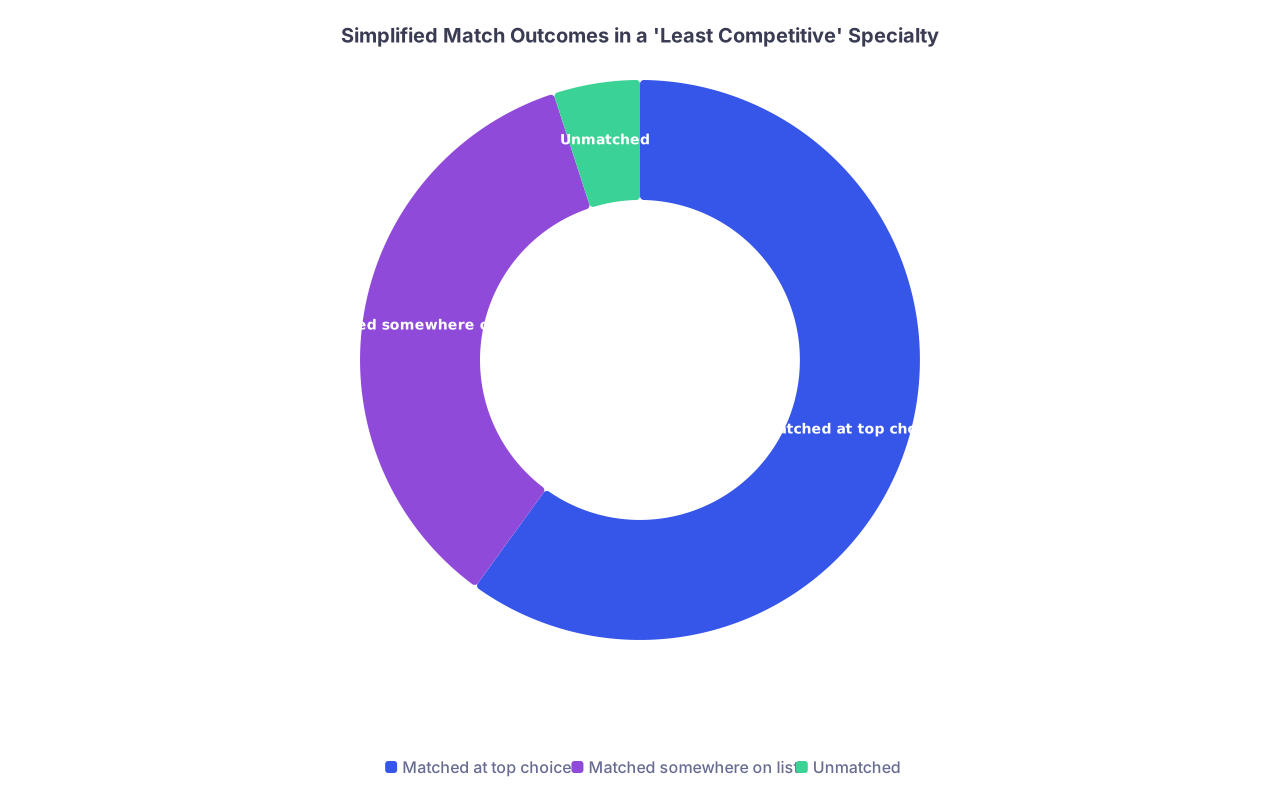
| Category | Value |
|---|---|
| Matched at top choice | 60 |
| Matched somewhere on list | 35 |
| Unmatched | 5 |
What you don’t see:
- The 5% unmatched often cluster in specific risk groups
- Many “matched somewhere” are at programs the applicant did not truly understand or want
- The numbers look better for US MDs, worse for DOs and IMGs, and far worse for those with red flags
You’re not competing against “everyone.” You’re competing against your sub‑cohort:
- US MD with clean record, average scores, no major red flags? Very high odds.
- DO with lower scores, a few fails, and no geographic tie applying mostly university programs? Much lower than the headline suggests.
- IMG without US clinical experience? The “easy” specialty label means almost nothing.
When I see unmatched applicants from least competitive specialties, they almost always fall into one of the following groups:
- Backup strategy with zero real commitment to the field
- Significant academic or professionalism concerns without a tight narrative
- Geographic mismatch and no clear tie
- Under‑applied (15–20 programs in FM/Psych from a weak position)
- Very late pivot with no time to build a coherent story
The statistics never told them which group they were actually in.
How the Rank Meeting Conversation Really Sounds
Let me pull you straight into a real‑world scene. Small community FM program. 8 faculty around a table. ERAS list on the projector. We’re building the rank list.
Applicant 1: US MD, Step 2 222, no fails, strong FM rotation, did a sub‑I at the program, from one state over. Personal statement clearly FM‑focused.
Comments:
“Solid. Not a superstar, but solid.”
“Good team player.”
“Would absolutely fit here.”
Rank: High.
Applicant 2: US MD, Step 2 242, honors in surgery and IM, applied ortho last year, now applying FM. No FM sub‑I here. No mention of the city or region.
Comments:
“Honestly he wants ortho.”
“He’s going to reapply. We’ll be his safety net and he’ll bail on us.”
“Do we really want someone who will resent being here?”
Rank: Low or not at all.
Applicant 3: DO, Step 2 226, one COMLEX fail early, strong explanation in MSPE, excellent FM letters, did rural rotations, grew up 45 minutes from program.
Comments:
“He gets rural.”
“I liked him a lot. Realistic expectations.”
“That fail was years ago and everything since looks good.”
Rank: Mid to high.
This is how the supposed “easy” specialty is playing its game. Nuanced, biased toward fit, suspicious of backups.
A Quick Reality Check Flow: Will You Actually Be Safe?
If you’re worried you’re the one who might get burned in a “safe” specialty, walk yourself through this:

| Step | Description |
|---|---|
| Step 1 | Considering an easy specialty |
| Step 2 | Reassess primary specialty or timeline |
| Step 3 | Build real experiences and narrative |
| Step 4 | Get strong advocacy and explanations |
| Step 5 | Expand list and target realistic regions |
| Step 6 | You are likely a strong candidate |
| Step 7 | Is this truly acceptable to you? |
| Step 8 | Does your story fit this field? |
| Step 9 | Any major red flags? |
| Step 10 | Applying broadly enough with geographic logic? |
Notice the first branch: “Is this truly acceptable to you?” Programs can smell when the honest answer is no.
The IMG and DO Squeeze in “Easy” Specialties
Let’s be blunt. For DOs and IMGs, “least competitive” does not mean “wide open.” It means “you have a shot here if you play it smart.”
Here’s the pattern I’ve seen over and over:
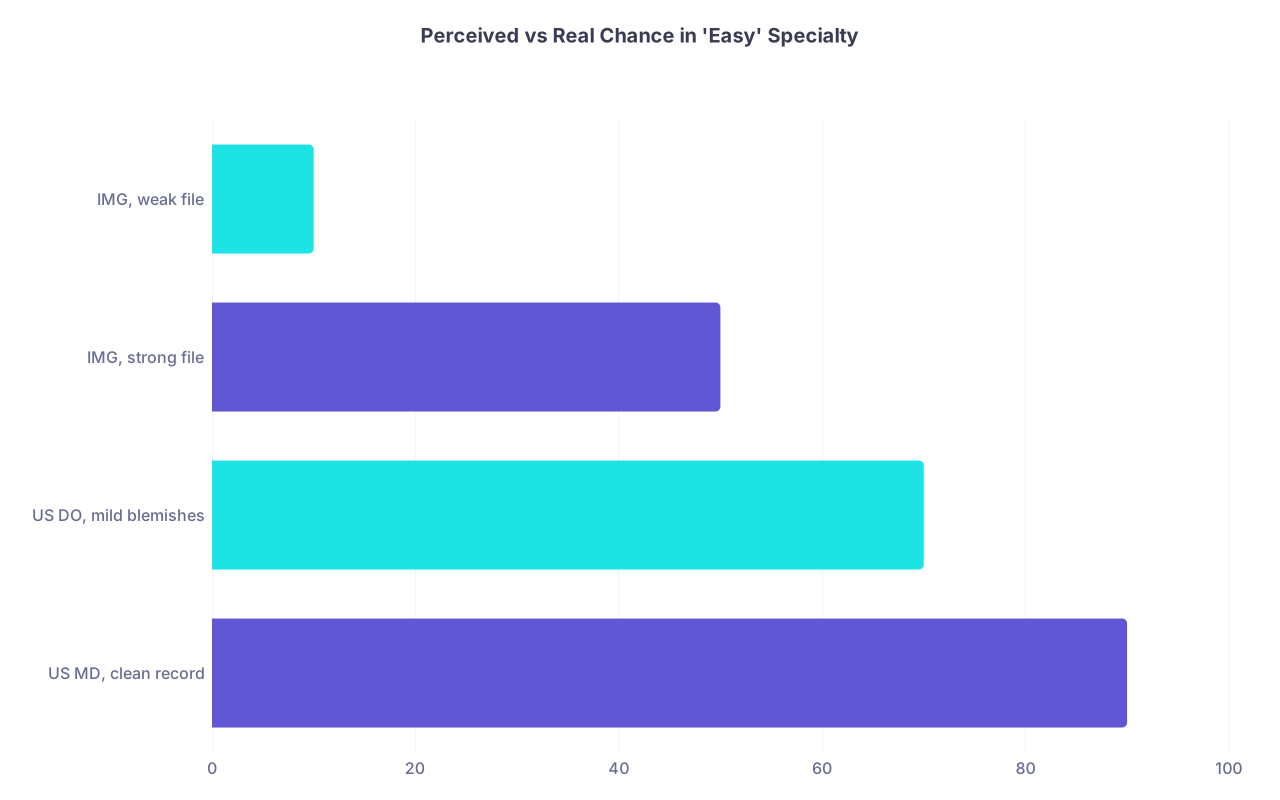
| Category | Value |
|---|---|
| US MD, clean record | 90 |
| US DO, mild blemishes | 70 |
| IMG, strong file | 50 |
| IMG, weak file | 10 |
The IMG with a 245 and US clinical experience in FM plus strong letters? Very real shot.
The IMG with 215 and only observerships, generic statements, and applying only to big university programs in New York and California? That 10% is generous.
Same for DOs trying to jump into academic‑heavy urban programs that already have plenty of MD applicants. They rarely dip into the risk pool if they don’t have to.
You’re not playing on the same board as the average US MD whose advisor says “FM is safe.” You’ve got to think like a chess player, not a gambler.
Four Things That Quietly Rescue “Borderline” Applicants
I’ve seen applicants with pretty ugly files still land in “easy” specialties. Not because the field is easy, but because they did four things right:
They picked one backup specialty and fully committed to the story.
No hedging in the statement. No mixed signals. Their CV, experiences, and interview answers all aligned with that field.They used geography aggressively.
They targeted regions where they had any plausible tie—and then actually spelled it out in the application and interviews.They got real advocacy.
I’ve watched a single, brutally honest but supportive chair letter override a weak Step score or old fail. Faculty still listen to people they know and trust.They respected the specialty.
They did not treat FM or Psych or Peds like a consolation prize. They showed they understood the reality of that field, not the Instagram version.
I’ve sat in those rooms when someone said, “I know his score is low, but he is exactly what we do here, and he will stay in this community.” That’s how borderline turns into matched.
FAQ (Exactly 4 Questions)
1. If I pivot late to a “less competitive” specialty, is my application automatically doomed?
No, but a lazy pivot will kill you. If you’re changing course after a bad test score or failed application cycle, you need to rebuild your narrative, not just swap out a personal statement header. That means getting at least one meaningful rotation or experience in the new field, securing fresh letters from that specialty, and being brutally honest (but composed) in your interviews about why you’re changing. Faculty are remarkably forgiving when the story is authentic and well‑thought‑out. They’re unforgiving when it looks like pure desperation.
2. How many programs do I actually need to apply to in an “easy” specialty?
For most US MDs with clean records applying to FM/IM/Peds/Psych, 20–30 solid, well‑chosen programs can be enough—if you’re a good fit and you interview decently. For DOs and IMGs, or for anyone with red flags, you usually need to push that number higher (40–60+), but intelligently: target a mix of community and mid‑tier academic programs in regions where you can credibly say you’d live. The disaster group is applicants with risk factors applying to 15–20 mostly “name” programs and assuming the specialty is “easy.”
3. I’m an IMG with strong scores. Why am I still not getting interviews in FM or IM?
Because scores are just the first gate. A lot of IMG files die on lack of meaningful US clinical experience, generic letters that say nothing specific, or no clear reason to believe you’ll actually come to and stay in their location. Programs have also been burned by visa uncertainty or past performance issues from other IMGs, so they tend to lean heavily on personal connections, direct rotations, or trusted referrers. If you’re strong on paper and still striking out, your next move is not “apply to more programs”—it’s “get a real foothold somewhere with US rotations and advocacy.”
4. Is it better to rank a “bad fit” program low or not rank it at all?
If you truly cannot see yourself functioning there for three years without imploding, do not rank it. You’re not doing yourself or the program a favor by matching into a toxic mismatch. But be honest with yourself: a lot of applicants label programs “bad fit” simply because they’re not in a glamorous city or have weaker name recognition. Those programs can be outstanding training environments. Look at resident happiness, faculty stability, and how they talk about their graduates. I’ve seen people turn “backup” community programs into fantastic careers—because they went in ready to work, not sulk.
Key points: “Easy” specialties aren’t easy. They’re just easier for the right story, right geography, and right risk profile. And programs in those fields care deeply about fit, commitment, and reliability—sometimes more than the “competitive” specialties do. Treat them like a consolation prize, and they’ll often treat you like a liability.