
The fear that “less competitive” means “no job later” is flat-out wrong.
You’re not crazy for worrying about it, though. The way people talk about specialties, it sounds like if you’re not in derm, ortho, or ENT, you’re signing up for unemployment and regret.
You hear:
- “Oh, that’s just a fallback specialty.”
- “Those people are going to get replaced by NPs and PAs.”
- “Good luck finding a job in that in 10 years.”
And now you’re sitting there thinking:
“If I match into a less competitive field, am I screwing Future Me out of a job?”
Let me walk through this like someone who’s also lying awake at 2 a.m. spiraling through worst-case scenarios… but who’s actually looked at the numbers and talked to people on the other side.
What “Less Competitive Specialty” Really Means (And What It Doesn’t)
First harsh truth: competitiveness ≠ job security. At all.
People act like:
- Competitive = safe, prestigious, high-paying, always in demand
- Less competitive = replaceable, saturated, desperate for work
Reality is messier. Some “super competitive” fields have major job bottlenecks. Some “backup” fields have insane job flexibility.
Let’s put some examples on the table. When people say “less competitive,” they usually mean stuff like:
- Family Medicine
- Internal Medicine (categorical, no guaranteed fellowship)
- Pediatrics
- Psychiatry (less true now, but still easier than the surgical big guns)
- PM&R
- Pathology (varies, but not Step 270 territory)
- Neurology
- Some community-track programs in these fields
Here’s the part no one tells you because it’s not sexy: a lot of these are exactly the specialties holding the healthcare system together. And systems don’t like losing their backbone.
But I get the specific anxiety:
“Yeah, yeah, ‘in demand,’ but will I actually get a job I want?”
Let’s look at job prospects vs competitiveness without the prestige noise.
| Specialty | Match Difficulty | Job Market (General) | Geographic Flexibility |
|---|---|---|---|
| Family Medicine | Low | Strong | Very High |
| Pediatrics | Low-Mid | Moderate | High |
| Psychiatry | Low-Mid | Very Strong | High |
| Pathology | Low-Mid | Regional/Variable | Moderate |
| Neurology | Mid | Strong (esp. subspec) | Moderate-High |
Is this perfect data? No. Is it more accurate than the “backups are dead fields” gossip in the student lounge? Yes.
The Dark Fantasies: Worst-Case Job Scenarios (And What Actually Happens)
Let’s name the specific horror movies playing in your head.
Fear #1: “I’ll finish residency and there will literally be no jobs.”
Outside of a very few niche situations, this almost never happens. What does happen:
- There are no jobs in your exact dream city, with your exact schedule, and your exact salary expectation.
- There are jobs, but:
- They’re in smaller cities or rural areas.
- They start with more call than you’d like.
- They’re hospital-employed instead of private practice (or vice versa).
People still get jobs. They just sometimes have to adjust one of three levers:
- Location
- Pay
- Lifestyle
You almost never get to max all three from day one, especially in crowded metro areas. That’s not a “less competitive specialty” thing. That’s a “being a new attending” thing.
Fear #2: “Midlevels will replace my whole specialty.”
This one is everywhere. Especially in:
- Family Med
- Pediatrics
- Psych
- EM
- Some IM outpatient roles
Yes, midlevels are expanding. Yes, some organizations push them too far. But replacement is not the real pattern. What usually happens:
- The low-complexity, bread-and-butter stuff gets shifted more to NPs/PAs.
- Physicians:
- Handle higher-acuity / more complex patients.
- Take on leadership, supervision, quality roles.
- Do the things legally or practically too risky to hand off.
You may not love the direction of the system. I don’t either. But “no one hiring physicians at all” is not the trend. Even in heavily midlevel-ized clinics, they need a doc on the org chart.
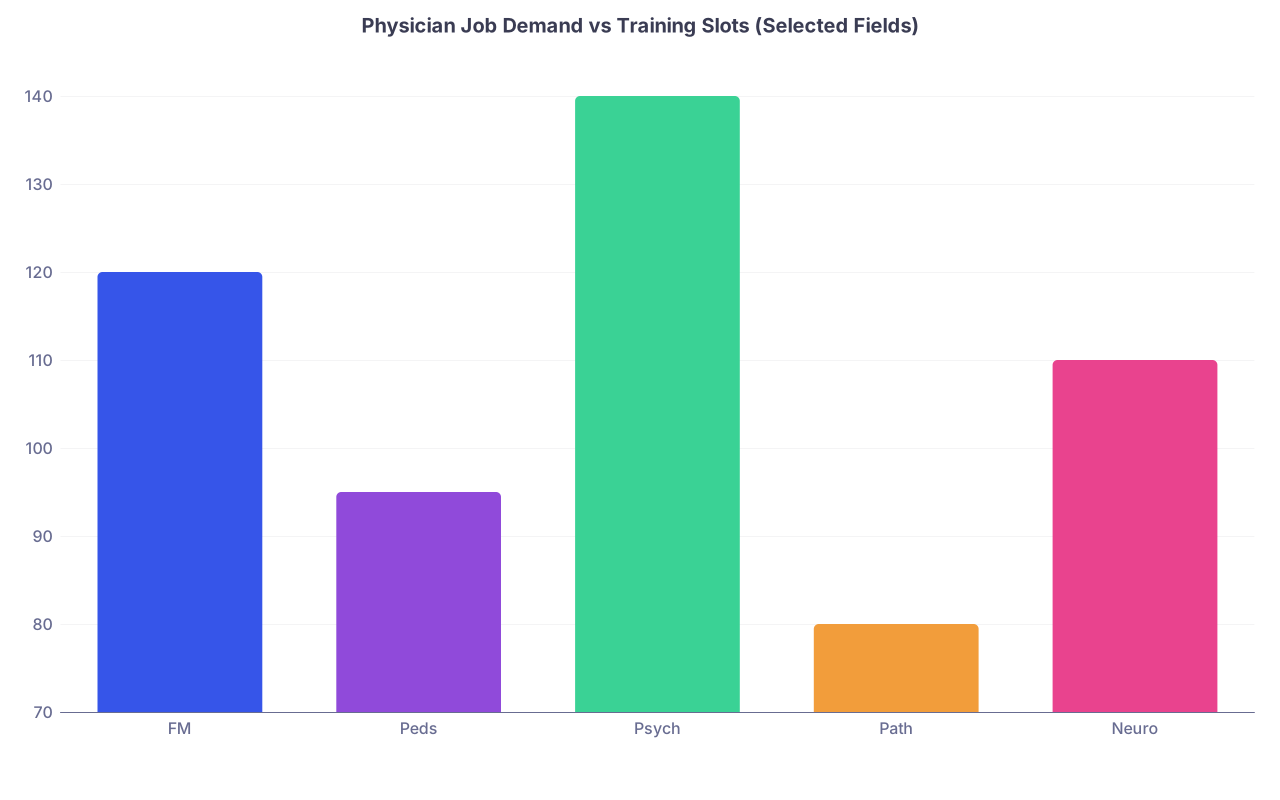
| Category | Value |
|---|---|
| FM | 120 |
| Peds | 95 |
| Psych | 140 |
| Path | 80 |
| Neuro | 110 |
(Think of 100 as “balanced.” Above 100 = more demand than supply, below 100 = tighter market. It’s an oversimplification, but it gives you an idea: several so-called “backup” specialties are in demand.)
Fear #3: “If I don’t subspecialize, I’m dead.”
This is more nuanced.
- In some areas (like adult neurology, IM, pathology), fellowship can massively improve options.
- In others (family medicine, psych), generalists are still heavily needed.
What I actually see:
Graduating residents who are geographically flexible can almost always find something decent as generalists. The ones really stressed:
- “I must be in this one expensive coastal city.”
- “I refuse hospital work.”
- “I want part-time, no call, high salary starting year one.”
That combo is just… rough, no matter your specialty.
Specialty-Specific Real Talk: Where People Actually Struggle
Let’s go specialty by specialty for some of the “less competitive” fields and talk about the actual job-market stress points, not the rumor version.
Family Medicine
Anxious thought: “Everyone says FM is flooded and midlevels are taking everything.”
Reality:
- If you’re okay with:
- Small/medium cities
- Hospital-employed or large health system jobs
- Bread-and-butter primary care
you will not be unemployed.
- The real sacrifice is often:
- RVU pressure
- High panel sizes
- Less “prestige”
But options open up fast if you add:
- OB
- Addiction medicine
- Sports med
- Geriatrics
- Leadership/admin interest
I’ve seen FM grads get multiple offers before graduation in mid-sized cities. Meanwhile, someone in a “prestige” specialty is sending out 100 CVs to find a single opening in LA.
Pediatrics
Anxious thought: “Peds pays less, and people say the market is getting tighter.”
There is some truth:
- Very saturated in certain wealthy metro areas.
- Lots of competition for highly desirable, lifestyle-focused outpatient only roles.
But:
- Community hospitals, smaller cities, underserved regions? Constant need.
- Fellowship (NICU, PICU, heme/onc, cards, etc.) changes the equation dramatically, but also changes your lifestyle.
If your dream is “affluent suburb, no call, 9–5, peds clinic,” yeah, you may wait and hustle a bit. It’s not impossible. Just not automatic.
Psychiatry
Honestly? Right now, psych is one of the safest job-market bets.
- Massive demand.
- Tele-psych expanding options.
- Huge underserved areas.
The fear here is usually: “This is too easy to match, what’s the catch?”
The “catch” is more about burnout, high-need populations, and system frustrations than job scarcity.
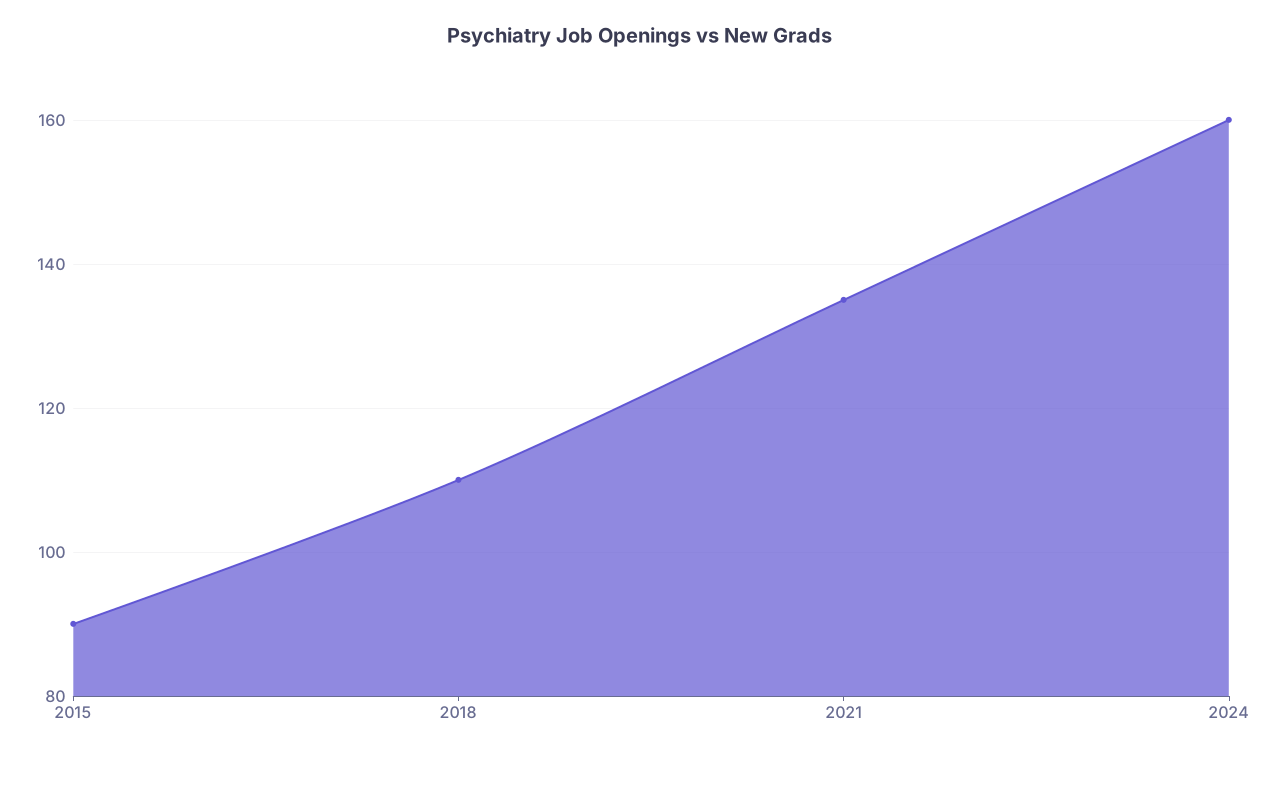
| Category | Value |
|---|---|
| 2015 | 90 |
| 2018 | 110 |
| 2021 | 135 |
| 2024 | 160 |
(Again, 100 = balanced. The point: the gap between jobs and grads has been growing.)
Pathology
Here’s where the anxiety really kicks in, and honestly, not without reason.
You’ll hear:
- “Path is dead.”
- “No one’s hiring general pathologists.”
- “AI will replace you.”
The reality is more like:
- Big-name academic jobs in cool cities? Very tight market.
- Pure general sign-out jobs in saturated urban areas? Competitive and sometimes rare.
- But:
- Smaller community hospitals often need versatile pathologists.
- Subspecialty training (hemepath, dermpath, cytopath, etc.) can help.
- Networking, reputation, and being geographically flexible matter a ton.
This is one of those fields where you really don’t want to coast. You want:
- Strong references
- Real competence
- Flexibility on location early on
Not doomed. But you do have to be intentional.
Neurology
Anxious thought: “Everyone’s going neuro, won’t it be flooded?”
Short answer: not yet, and probably not soon.
- Aging population = more stroke, more dementia, more neurodegenerative disease.
- Hospital neurology and stroke services are still hiring.
- Fellowship (stroke, epilepsy, neuromuscular, movement disorders) often leads to strong job options, especially outside NYC/SF/Boston.
The stress point again: wanting elite academic jobs in those few cities everyone wants.
The Hidden Variable: Geography Is King
You can’t talk job prospects honestly without talking location. People lie to themselves about this constantly.
There are really three profiles:
- “I’ll live basically anywhere.”
- You will get a job. Probably multiple offers.
- “I want a decent-sized city, but not picky beyond that.”
- You’ll have options. Might need to compromise on one or two things (schedule, salary), but it’s workable.
- “It must be: this specific metro, close to family/partner, strong lifestyle, high salary, minimal call.”
- You’re going to be anxious. No matter the specialty.
The job horror stories you hear often come from Category 3 people. They’re not unemployed. They’re underwhelmed and feel stuck with a job that’s “fine but not ideal.”
Not the same as no job.
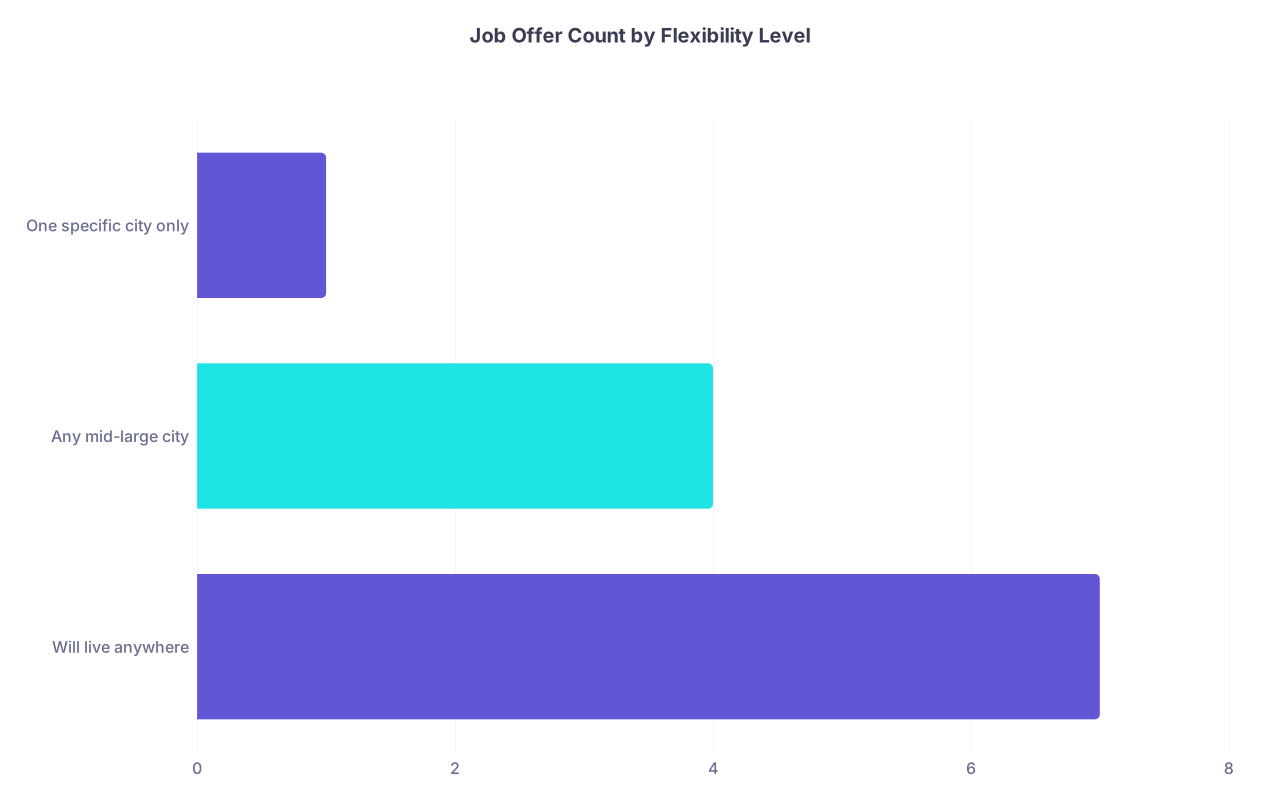
| Category | Value |
|---|---|
| Will live anywhere | 7 |
| Any mid-large city | 4 |
| One specific city only | 1 |
What You Can Actually Do Now To Protect Future You
Yes, even if you’re “just” going into a less competitive specialty. Especially then.
1. Stop thinking “backup,” start thinking “how do I become very good at this?”
Weakest combo you can have:
- Less competitive field
- And you’re mediocre at it
- And everyone knows you don’t care about it
Programs, attendings, and later employers can smell that. Better strategy:
- Pick the field you can actually tolerate learning deeply.
- Invest early: read, ask questions, take ownership.
Competent, reliable physicians in “backup” fields get recruited. Coasting stars in “prestige” fields can get stuck.
2. Build a reputation, not just a CV
Residents who get jobs easily tend to:
- Have attendings who love working with them.
- Get texts/emails from faculty saying: “Send me your CV, we have an opening.”
You want to be:
- On time
- Not a drama magnet
- Solid with patients
- Willing to help your team
Boring? Maybe. Effective? Absolutely.
3. Think early about some way to differentiate
In many “less competitive” specialties, small add-ons make a big difference:
- Family Med:
- OB, sports med, addiction, leadership experience
- Peds:
- NICU/PICU exposure, complex care, child psych interest
- Psych:
- Addiction, forensic, CL psych, telehealth experience
- Path:
- Subspecialty fellowship, informatics, quality/improvement work
- Neuro:
- Stroke, epilepsy, neuromuscular, headache
You don’t have to hyper-specialize, but you don’t want your future CV to read: “Generic resident #247.”
4. Keep your expectations grounded
Yes, shoot for a great job. But calibrate:
- First attending job is not your forever job.
- You may take a job 2–3 years that’s “good enough” to:
- Pay loans
- Build experience
- Get geographically closer to where you want to end up
You can move. People do.
Quick Reality Check: Are You Actually At High Risk Of “No Job”?
Let’s be brutally honest. Red flag combo looks more like this:
- You want:
- One extremely saturated metro area
- High salary right away
- Cushy schedule
- You’re:
- Barely engaged in residency
- Burning bridges
- Not building any niche or strong relationships
That person is in danger of being stuck with limited or bad offers.
If instead you:
- Work decently hard in residency
- Stay relatively open on location at first
- Are willing to accept some tradeoffs early on
…it is extremely unlikely you will be jobless, even in a “less competitive” specialty.
You might not love your first job. You might transition once or twice. But that’s completely normal. People do this in derm and ortho too; you just don’t hear about it because “prestige” hides a lot of anxiety.

| Step | Description |
|---|---|
| Step 1 | Residency PGY3/4 |
| Step 2 | Network with faculty |
| Step 3 | Apply broadly |
| Step 4 | Faculty referral |
| Step 5 | Cold applications |
| Step 6 | Multiple offers |
| Step 7 | Pick best available option |
| Step 8 | First job 2 to 5 years |
| Step 9 | Reevaluate and adjust |
FAQ: Nervous About Job Prospects After Training in a Less Competitive Field
1. If a specialty is less competitive now, does that mean the job market is bad?
Not automatically. Competitiveness is driven by:
- Lifestyle rumors
- Salary expectations
- Prestige cycles
- How many med students want it, not necessarily how many jobs exist
There are fields that were once seen as “fallback” (psychiatry is a good example) that now have huge job demand. You can’t just look at match stats and assume the job market is weak.
2. Is it safer to pick a competitive specialty just for job security?
Honestly, no. That’s a terrible reason to pick a field. Some highly competitive specialties have:
- Tight academic job markets
- Geographic bottlenecks
- Private groups that rarely hire
If you hate the day-to-day work, you’ll be miserable regardless. It’s much safer long-term to choose something you can tolerate doing for decades and then be good at it.
3. How much does location preference really affect my chances of getting a job?
A ton. More than almost anything else. If you say:
- “I’ll live anywhere”: almost always can find a job.
- “I want a reasonably sized city”: still very doable.
- “This one metro only, with strict lifestyle demands”: that’s when you hear “I can’t find anything.”
The problem isn’t usually the specialty. It’s the combination of extremely narrow geography plus high expectations for salary and schedule right out of residency.
4. Do I have to do a fellowship to be employable in a less competitive field?
Not always. In some specialties (IM, neuro, path), fellowships can open doors or make you more marketable, especially in desirable cities. In others (FM, psych), many people get hired directly out of residency with no extra training.
What’s more important is having some angle—whether that’s a fellowship, a niche interest, leadership work, or just being known as a very strong, reliable clinician.
5. How early in residency should I start thinking about the job market?
Earlier than most people do, but not in a panic way.
- PGY1: Focus on not drowning and being competent.
- PGY2: Start noticing what kind of work you like, and who seems well-connected.
- PGY3+: Talk to attendings, ask about job trends, and let people know your rough goals.
The residents who start having casual, low-pressure conversations about jobs in PGY2-3 are the ones who don’t freak out when graduation approaches.
6. What’s one concrete thing I can do this year to improve my future job prospects?
Pick one attending in your chosen field who you respect and:
- Show up consistently prepared for their rotation/clinic.
- Ask a few thoughtful questions.
- At the end, say: “I really like this specialty and want to build a strong career in it. Is there anything you’d recommend I focus on to be a strong job candidate later?”
That’s how mentorship and informal networking actually start. Those are the people who later email you with: “Hey, we’re hiring; want me to put in a word?”
Open a notes app right now and write down three things:
- The specialty (or top two) you actually see yourself doing daily
- Your realistic geographic flexibility (be honest, not aspirational)
- One attending you could intentionally connect with in that field this month
That’s your next step. Not changing specialties out of fear. Not doomscrolling Reddit job threads. Just those three decisions, on paper, today.