
It’s January. Your rank list is open on the screen in front of you. Your surgery mentor just wrote, “Have you finalized things yet?” in that pointed, faux-casual way surgeons do. Your medicine attending keeps saying, “With your scores, you could do anything.”
And you? You’re putting Family Medicine, Psychiatry, Pathology, maybe PM&R or Neurology at the top. Not Dermatology. Not Ortho. Not ENT.
Here’s the question that’s actually chewing at you, under all the spreadsheets and program notes:
“What are my attendings really thinking about me choosing a ‘less competitive’ specialty?”
You’re not going to get an honest answer in the workroom. I will give you the one they give each other, behind closed doors.
First, the unspoken hierarchy (yes, it’s real)
Let’s stop pretending. There’s a hierarchy. Attendings know it. Residents know it. You know it.
And it colors how your choice is perceived before anyone hears your reason.
| Tier | Example Specialties | General Perception |
|---|---|---|
| Ultra-competitive | Derm, Plastics, Ortho, ENT, Rad Onc | “Top of the heap” |
| Competitive | EM, Anesthesia, Gen Surg, Ophtho | “Strong” |
| Mid | IM, OB/GYN, Peds, Neuro | “Standard core” |
| Less competitive | FM, Psych, Path, PM&R, some Community IM/Peds | “You can always fall back on these” |
Is this fair? No. Is it how people quietly sort students in their heads during February faculty meetings? Yes.
So when you tell an attending you’re ranking a “less competitive” specialty, the reaction they say out loud and the reaction they think are often different.
Let me break down those internal reactions by attending type, because they’re not all the same.
The high-achiever subspecialist attending: “Why are you leaving points on the table?”
Think: the CT surgeon, the interventional cardiologist, the ENT hotshot, the derm researcher with three R01s.
Here’s the script they’ll rarely say directly but often think:
- “Your scores are too good for that.”
- “You’re wasting your potential.”
- “Couldn’t cut it? Or doesn’t have the stomach for the grind?”
They’re operating on a worldview where maximum competitiveness = maximum validation. Their own identity is built on climbing the steepest possible ladder. When they see you voluntarily walk off the ladder halfway up, they assume one of three things:
You’re underestimating yourself.
They think you got scared off by imagined competition, not actual limitations.You’re conflict-avoidant / soft.
They interpret choosing a “gentler” field as not wanting to be under pressure. They’ll name it “lifestyle” but internally they file it under “soft.”You don’t understand how the game is played.
They assume you don’t grasp prestige, doors opened, or how hard it is later to move into a more competitive space.
This is why you sometimes feel that subtle cooling of enthusiasm when you tell a surgically-inclined mentor, “I’m actually ranking Psych first.”
They’ll say, “Oh, interesting! Psych is very important.”
What they’re thinking: “You’re taking the easy road.”
Is that fair to Psych? No. But I’m telling you what the internal monologue sounds like.
What changes their mind with this group
They shift when they see evidence this is a decisive, informed choice, not a retreat.
You say something like:
- “I loved my medicine sub-I, but the parts that stuck with me were the complex mood/anxiety cases and the consults. Surgery never felt like ‘home’ to me the way Psych did.”
- “I spent six months on a neurosurgery pathway and could probably match there, but after seeing enough 2 a.m. post-ops, I realized I’d rather be the one managing TBI rehab and spasticity long term. That’s why I’m ranking PM&R.”
If they believe you could have gone competitive but chose not to, they reframe you from “couldn’t hack it” to “knows what they want, even if it’s different from me.”
The generalist attendings: “Finally, somebody who gets it”
Your core IM, FM, Peds, Psych, and many Neuro attendings? Completely different energy.
These are the folks who:
- Watch students chase hyper-competitive specialties for the nameplate, then burn out.
- See the fallout when someone who hates the OR forces themselves into surgery “because prestige.”
- Have had multiple co-residents later confess, “I should have done Psych / FM / Path from the start.”
When you tell them you’re ranking a “less competitive” specialty high, their internal reaction is usually:
- “Good. This one understands themselves.”
- “This might actually be a happy attending someday.”
- “We might finally get someone strong in this field instead of just leftovers.”
I have personally heard variations of this in conferences:
“He had the board scores for ortho but chose FM. We need more like that.”
“She could have gone into any surgical subspecialty, but she went PM&R. That field needs sharper people; good for her.”
They’re tired of being treated as consolation prizes. When someone with strong stats chooses them outright, they actually respect it more, not less.
The uncomfortable truth: attendings care how your choice reflects on them
Now the part almost no one will say out loud.
Attendings do not react to your choice in a vacuum. They react to what it says about their teaching, their letters, and their ability to “produce” competitive residents.
Inside faculty meetings, I’ve heard:
- “Our top student went Derm. That’s a good sign we’re still drawing talent.”
- “Our best one this year is going FM? Did they not get enough exposure to subspecialties?”
- “Why are so many of our AOA kids going into less competitive fields? Are we misadvising them?”
So when you say, “I’m ranking Psych #1,” here’s the subtext running through their heads:
- Did I push them too hard toward X and turn them off?
- Does this make our program look less ‘top-tier’ if our stars aren’t all going into high-profile fellowships?
- Will the dean ask if we’re underselling them?
Nobody admits that out loud. But it’s there.
And it cuts both ways. Sometimes your choice makes an attending proud. I’ve heard Psych faculty brag:
“Our top student turned down an Anesthesia spot because they said they couldn’t see themselves doing anything but Psych. That’s a huge win.”
So yes, your specialty choice becomes part of some attending’s internal performance scorecard. Whether that’s absurd or not doesn’t matter. It happens.
What they really think about specific “less competitive” specialties
Let’s be concrete, because the stereotypes differ by field.
Family Medicine
What they say:
“FM is so important. You’ll have such broad impact.”
What a lot of them think:
- “You’ll be underpaid and overworked, but maybe you’ll be one of the good ones.”
- “I hope you’re not doing this just because ‘I like everything’ and you’re afraid to commit.”
- “If you’re smart and driven, you can become the go-to doc in your community. Or you can cruise and just refill meds all day.”
The brutal version?
Plenty of subspecialists assume FM attracts the bottom half of the class who “didn’t have options.” So when a sharp, high-performing student chooses FM, it surprises them. In a good way, if you articulate a clear vision.
Psychiatry
What they say:
“Psych is fascinating. We need more psychiatrists.”
What they think:
- “You either deeply get people, or you’re running away from procedures and call.”
- “If you’re strong, you’ll be flooded with work and can shape your practice however you want.”
- “I hope you’re not choosing it just because you hated wards and think this will be easy. It’s not.”
Old-school attendings sometimes still think of Psych as a soft-landing specialty. The younger ones have seen enough acute psych, consult-liaison, and treatment-resistant cases to respect it more. Your seriousness about the field is what tips them one way or another.
Pathology
What they say:
“Path is the foundation of everything we do.”
What they think:
- “You didn’t like patients. Or they didn’t like you.”
- “You’re either a hardcore nerd who loves the microscope or someone hiding from clinical work.”
- “If your brain is as sharp as your test scores, you’ll be incredibly valuable. If you just want to disappear, you’ll be wallpaper.”
Yes, many clinicians see Path as the “disappear into the basement” path. When a top student clearly chooses Path because they love diagnostic puzzles and tissue, some attendings quietly envy the choice.
PM&R
What they say:
“PM&R is such an interesting, growing field.”
What they think:
- “You like procedures but not the knife. Fair.”
- “You want to be in the musculoskeletal / neuro world but don’t want to live in the OR or ICU. Reasonable.”
- “If you’re lazy, you’ll do vague back pain clinics forever. If you’re not, you’ll become indispensable.”
PM&R is one of those fields where attendings’ perception is directly proportional to whether they’ve seen a strong physiatrist in action. If they have, they’re impressed. If they haven’t, they think “glorified PT director.”
The Step score trap: “With your numbers, why…?”
This is the line that sticks with you:
“With your Step score, you could do anything.”
Here’s what that really means in faculty-brain:
“With your Step score, you could get into fields that make me feel like we produced a star.”
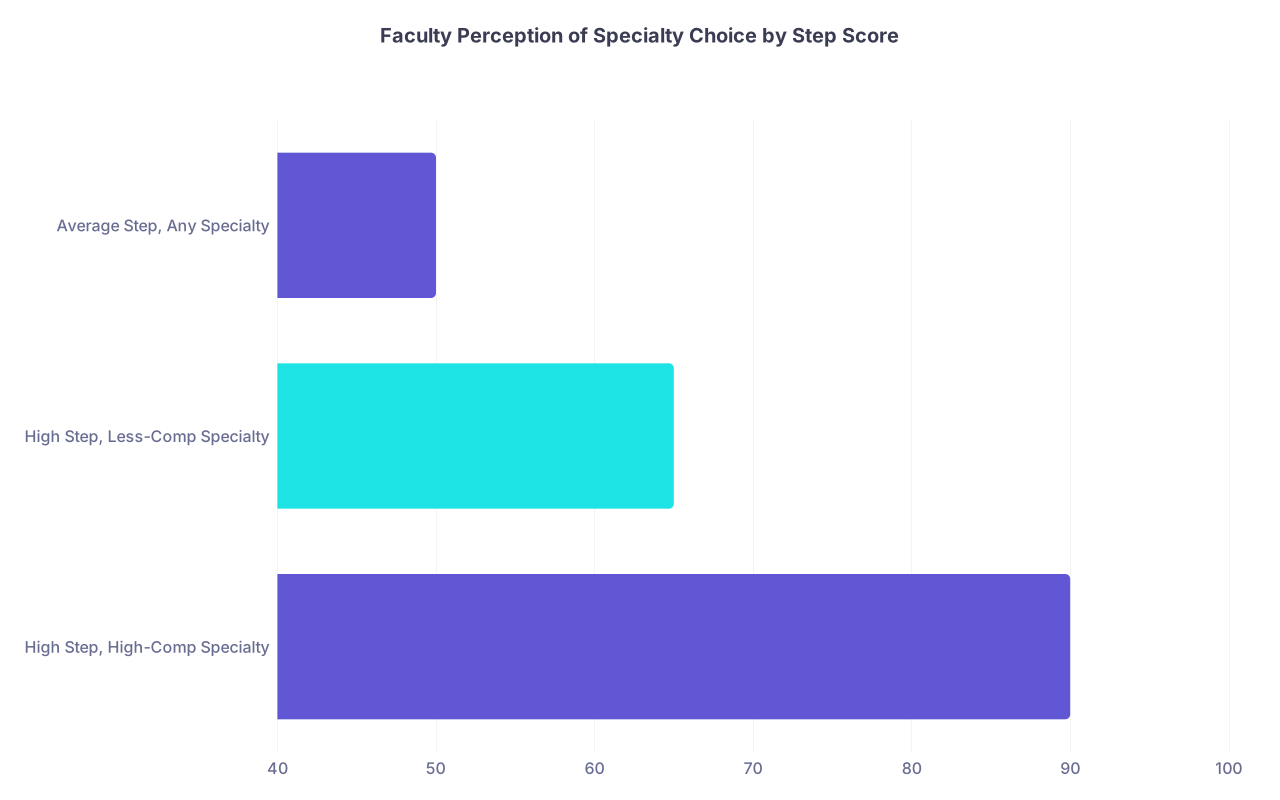
| Category | Value |
|---|---|
| High Step, High-Comp Specialty | 90 |
| High Step, Less-Comp Specialty | 65 |
| Average Step, Any Specialty | 50 |
Ask yourself seriously: are they sad for you or sad for their narrative about what ‘top’ students do?
I’ve watched this play out with a 250+ Step 2 student who chose FM. Behind closed doors:
- One attending: “What a waste.”
- Another: “Or maybe the only sane person in the class.”
The FM faculty? Ecstatic. They said, “This is what the field needs. We’re always taking students who barely passed. Imagine what this person will do.”
So no, your Step score doesn’t obligate you to chase a different life. It just messes with other people’s expectations.
How program directors in “less competitive” fields view you
This is the part students almost never hear directly, but I’ve heard it sitting in rank meetings.
When a strong applicant ranks a less competitive field high, PDs do not say, “Why didn’t they go ortho?”
They say things like:
- “This is a gift. Take them.”
- “They could easily have gone anesthesia or EM; if they want us, they’re going to be a rock.”
- “We don’t get people with that CV very often in FM/Psych/Path. Move them up.”
They’re not insulted. They’re grateful. They also look for a few specific things:

Evidence this isn’t a last-minute pivot after failing to match somewhere else.
Long-standing interest, electives, research, letters in that field.Signals you won’t be bored.
They worry top scorers will be “too good” and then resent the field. Statements like, “I know I could have gone X, but I was more energized on my Psych rotation than any other” are gold.An understanding of the field’s reality.
If you tell Psych “I want lots of time to talk, no stress,” you’re done. Same if you tell FM “I just like simple colds and wellness.” They want people who chose them with clear eyes.
In other words: PDs in these fields don’t see you as under-reaching. They see you as choosing them. There’s a big difference.
What attendings respect when you choose a less competitive specialty
There’s a pattern in who gets real respect for going “down the competitiveness ladder.”
The ones who are respected:
- Own the choice clearly: “I considered Ortho and Anesthesia. I shadowed them. They’re not my long-term life. This is.”
- Can name the tradeoffs: “Yes, I know FM pays less than most specialties I could match into. I’m okay with that.”
- Know the hard parts: “I know Psych has heavy burnout and lots of treatment resistance. I still want in.”
- Don’t apologize: “I’m going into Pathology.” Full stop. Not, “Just Pathology” or “I couldn’t really decide.”
The ones who lose respect:
- Sound like they’re hiding: “I mean, I kind of like everything, and FM is…fine.”
- Blame: “I didn’t really get exposure to the competitive things, so I’m stuck.”
- Oversell lifestyle fantasy: “Psych is chill, no nights, that’s why I picked it.” Every real psychiatrist rolls their eyes at that.
You can feel the difference in the room when a student says, “I chose Psych.” vs “I ended up in Psych.”
Attendings absolutely feel that difference too.
How to talk about your choice so attendings take you seriously
You don’t need a TED Talk. You just need a few clean lines. Here’s the structure that works, especially with skeptical attendings:
Name the alternatives you actually considered.
“I thought hard about Anesthesia and EM because I like acute care and procedures.”Name the specific experiences that changed your mind.
“But when I was on Psych consults, those were the patients I kept thinking about on my drive home.”Name one hard reality of your chosen field…and accept it.
“I know FM is dealing with too-short visits and a broken primary care system, but I want to be in that fight, not avoid it.”Say it like a decision, not an apology.
“So I’m ranking FM first.” Period. No nervous laugh. No “I hope that’s okay.”
You give that kind of answer to a hyper-competitive attending and—even if they still don’t get your choice—they’ll respect that it’s not fear-based.
Mental shift: you are not a draft pick
Here’s the core mind twist you need:
You are not an NFL prospect obligated to go in the first round because the numbers say you should. You are allowed to play a different sport entirely.
Attendings, especially academic ones, sometimes talk about students like draft capital:
- “We’ve got three ortho-level candidates this year.”
- “Only one derm-level applicant.”
- “A bunch of FM-level kids.”
That language leaks into how they perceive you choosing FM, Psych, Path, PM&R.
They think, “You’re a first-rounder choosing to play on a small-market team.”
But when you’re ten years out and actually living the life you picked, not the life you were drafted into? They’re not there. You are.
Quick reality check: what actually matters 5–10 years from now
Here’s what your future colleagues will care about once everyone is an attending:
- Are you clinically sharp?
- Do you show up and carry your weight?
- Do patients like you?
- Are you burned out and bitter—or not?
What they mostly will not care about:
- Whether you “could have gone” into something more competitive.
- Whether your specialty was top or bottom of some Step-score chart.
The irony? Some of the most respected people in a hospital are “less competitive” folks who are absolute killers in their lane: a legendary FM doc, the Psych attending who can defuse any agitated patient, the Pathologist everyone calls for tricky cases.
Nobody in the room cares how they ranked specialties in med school. They care that when stuff hits the fan, that person is the one you want.