
The belief that “any program will take me” in so‑called easier specialties is one of the fastest ways to end up unmatched, miserable, or stuck in a dead‑end training situation.
You are not exempt because you are going into family medicine, psych, peds, IM, or PM&R. A less competitive specialty does not mean the process is forgiving. It simply means the competition is more hidden and the mistakes are more avoidable—if you take them seriously.
Let me walk through the traps you are walking toward if you assume an easy specialty guarantees a spot.
The first dangerous lie: “Least competitive” means “I cannot possibly go unmatched”
That phrase “least competitive specialties” has burned more applicants than you realize.
Here is what people hear:
- “Least competitive” → “I am safe.”
- “Low average Step scores” → “My mediocre application is fine.”
- “Unfilled spots every year” → “Someone will grab me.”
What it actually means:
- Lower average metrics, yes.
- Still a hard floor on who they are willing to take.
- Massive differences between programs in the “same” specialty.
I have watched applicants with:
- Step 1 pass, Step 2 in the 220s
- No red flags
- Decent letters
- Going into family medicine or internal medicine
…go unmatched.
Not because the specialty was too competitive. Because they assumed:
- Any program, anywhere, would take them.
- Community programs “need bodies.”
- They did not need to be strategic.
They applied to 30–40 programs in IM, mostly coastal, mostly “nice city” locations, mostly academic-affiliated, and ranked 10. Then sat slack‑jawed on Match Day with nothing.
The market for “easier” specialties is not equally easy everywhere.
To underline that, here is how the competitiveness reality often looks:
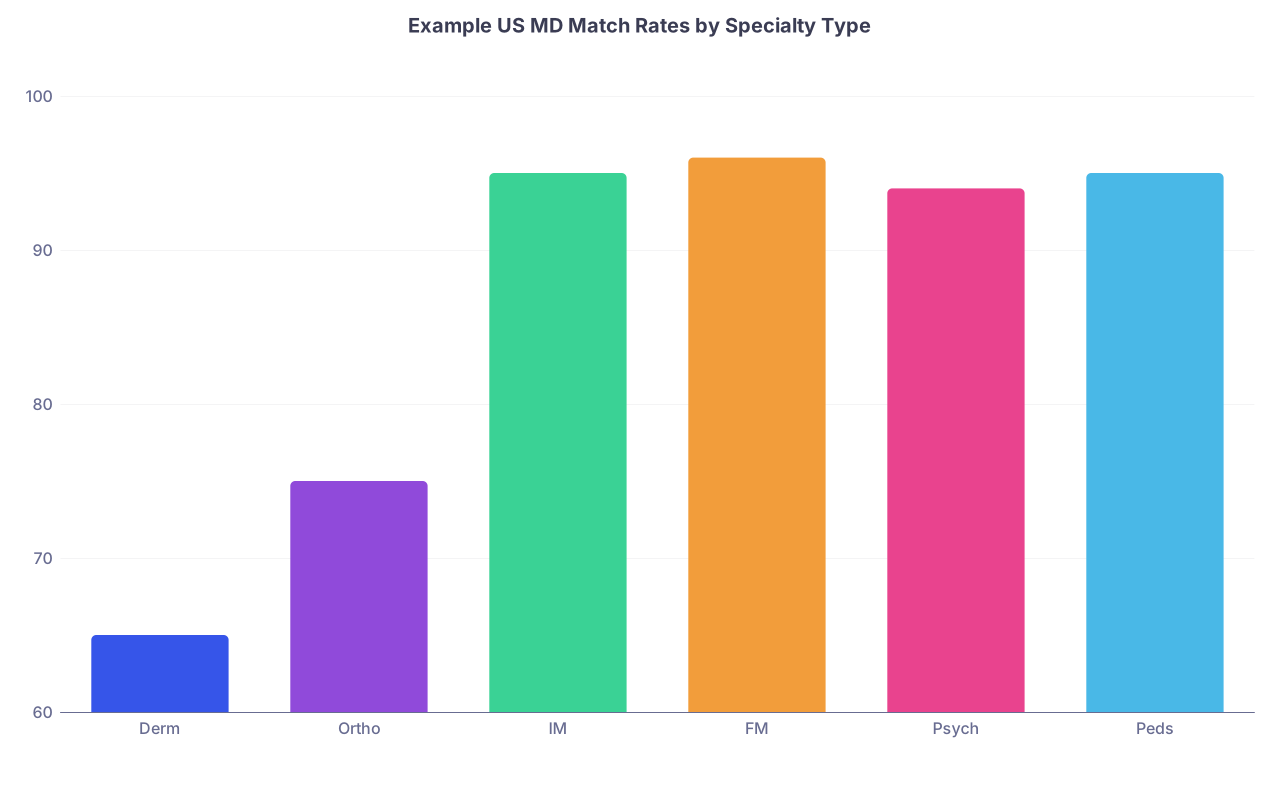
| Category | Value |
|---|---|
| Derm | 65 |
| Ortho | 75 |
| IM | 95 |
| FM | 96 |
| Psych | 94 |
| Peds | 95 |
Looks safe, right? Ninety‑plus percent match. But that remaining 4–6% are real people, and a disproportionate chunk of them were banking on “any program will take me” while behaving like they had a guaranteed seat.
Your risk is not that no one matches. Your risk is that you misjudge which “bucket” you belong in:
- Top tier: strong scores, robust experiences, no red flags → can be selective.
- Middle: mid scores, solid but not flashy CV → must be strategic.
- Vulnerable: low scores, attempts, gaps, visas, DO/IMG status → cannot be picky about geography or prestige.
The mistake: middle or vulnerable applicants acting like top tier in an “easy” field.
Mistake #1: Confusing “less competitive specialty” with “less selective program”
Programs are not generic. “Any psych program” is a fantasy category. Real‑world programs are:
- Fully funded, stable, well‑staffed, in desirable cities
- Struggling, under‑resourced, high-service, in more rural or less popular regions
- Somewhere in between
You are making a serious error if you think:
- “If I do not care about prestige, I will be fine.”
- “I am flexible, so any place is good.”
- Visa status
- Attempts on Steps/COMLEX
- Year of graduation
- Whether you rotated with them
- Letters from people they trust
- Whether you seem likely to stay and not transfer
Your “I do not care about prestige” does not magically change their risk assessment.
I have seen this exact scenario more than once:
- Applicant: US DO, 208 Step 2, COMLEX in low 400s, no failures, wants FM.
- Strategy: Applies to 25 family medicine programs, all in big cities, almost all university-affiliated.
- Attitude: “FM is super easy to match, right? I do not need to go rural.”
- Result: 3 interviews. Ranks 3. Does not match.
Then the panic scramble in SOAP for prelim medicine or a transitional year that leads nowhere.
The smarter play for that same applicant would have been:
- 70–80 applications.
- Heavy emphasis on:
- Rural FM
- Community FM
- Newer programs with stable accreditation
- Explicit openness to less competitive states: Midwest, South, certain interior regions.
Assuming that the “easiness” of FM means you can only apply where you want to live is how people end up sending me emails from a SOAP hotel lobby in March.
Mistake #2: Ignoring massive variation within “easy” specialties
Here is what is especially dangerous: within the least competitive specialties, there are tiers—huge gaps—between programs.
Family medicine is a classic example:
- Urban university‑affiliated FM in a major coastal city: not easy.
- Ultra‑rural FM in a region nobody in your class can locate on a map: easier.
- New FM program still building reputation but with solid leadership: in the middle.
Psychiatry: same story.
- Big coastal cities with strong academic psych → brutal.
- Smaller community psych programs in less dense states → far more forgiving.
Do not lump them together in your mind. Or in your ERAS list.
| Program Tier | Typical Profile |
|---|---|
| Urban academic, coastal | Higher Step 2, strong research, US grads |
| Suburban hybrid (university/community) | Mid Step scores, some research or strong clinical |
| Community, smaller city | Emphasis on clinical fit, solid but not flashy |
| Rural or newer program | More forgiving on metrics, huge focus on reliability and commitment |
If you are not in the top slice of applicants, you must intentionally reach down the tier ladder in your applications. Many do not. They believe the specialty label alone (“psych is hot but still not derm”) protects them.
It does not.
Mistake #3: Overestimating your application in an “easy” field
Another problem: people radically overestimate how they look on paper once you standardize across the national applicant pool.
They think:
- “I have a 225 Step 2, that is not terrible.”
- “I have a couple of posters, some shadowing, a few months of research.”
- “I did well in clerkships.”
Then they assume that is more than enough for peds, or IM, or PM&R.
What they forget:
- The people matching those “easier” specialties include:
- Students who changed from more competitive specialties and bring strong CVs.
- US MDs and DOs with Step 2 in the 240s–250s who simply like those fields.
- Applicants with stellar narratives, mission‑fit, and targeted experiences.
“Not terrible” becomes below average very fast.
If you are applying in a least competitive specialty and you:
- Passed Step 1 on second attempt
- Barely cleared 215–220 on Step 2
- Have no meaningful research or scholarly work
- Have only generic letters (no one knows your letter writers)
Then:
- You are not “fine because family medicine is easy.”
- You are in a vulnerable group that needs:
- Wide applications
- Geographic flexibility
- Brutal honesty with mentors about risk.
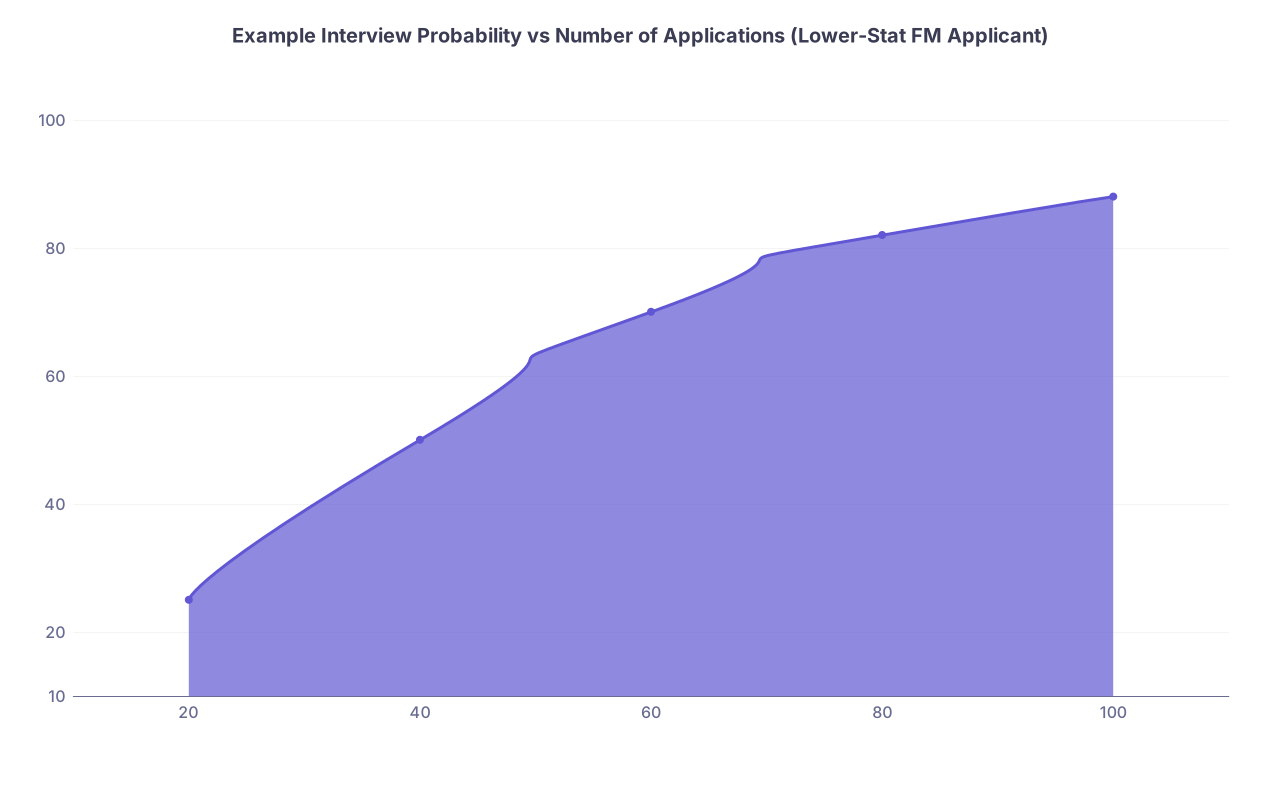
| Category | Value |
|---|---|
| 20 | 25 |
| 40 | 50 |
| 60 | 70 |
| 80 | 82 |
| 100 | 88 |
People in this vulnerable group who apply only to “places I would be happy living” often never get to live anywhere as a resident.
Mistake #4: Not understanding which “easy” specialties actually are not
Let me puncture another lazy assumption: some specialties that show “lower” average scores or broader access are still logistically or regionally constrained.
Two examples that trip people up:
1. PM&R (Physical Medicine & Rehabilitation)
Many see it as:
- Lifestyle friendly
- Less competitive than ortho or neuro
- Attractive to people who like neuro/MSK but do not want surgery
So they assume:
- “I will just do PM&R; there are plenty of spots.”
What they miss:
- PM&R has far fewer total residency positions than IM, FM, or peds.
- Programs are clustered in certain states and big academic centers.
- Many applicants are career‑switchers from surgery/ortho/neuro with strong applications.
Translation:
- The denominator is small.
- A surprisingly high proportion of applicants are strong.
- A weak PM&R applicant can absolutely go unmatched.
2. Psychiatry
Psych has become the poster child for misunderstood competitiveness.
Yes, it used to be relatively easy to match. Then mental health demand exploded, and so did student interest. The signal lagged. Your attendings may still be repeating old advice.
I have heard:
- “Oh psych? You will be fine, tons of jobs, programs need people.”
- “You do not need big scores for psych.”
In some geographies, that is still partially true. In many others:
- Psych is now solidly mid‑competitive.
- Big cities and academic programs are brutally selective.
- US MDs who miss out on radiology/derm/EM sometimes pivot to psych with stellar stats.
Thinking “I am going into psych, so I can just apply to 25 coastal university programs and coast” is how people land in SOAP, begging for prelim internal medicine.
Mistake #5: Assuming undesirable = guaranteed spot
A cynical belief I hear every year:
“If I strike out, I will just go to a low‑tier or malignant program. They always need people.”
Dangerous thinking. A few realities:
Truly malignant programs
- They do not always fill.
- They also often do not rank you if they smell flight risk or attitude issues.
- Some have ongoing citations or ACGME scrutiny and are extra cautious.
Geographically undesirable does not always mean easy
- Certain states (even if they are rural or less “glamorous”) have strong, stable programs and sponsorship pipelines.
- Those programs may be magnets for mission‑driven applicants and can afford to be picky.
New programs
- Some applicants assume: “New = desperate.”
- New programs still need residents who can pass boards and not create headaches.
- They may lean toward safer applicants: US grads, solid scores, no big gaps.
I have seen candidates with entitled attitudes say, “Fine, I will just match some bottom‑tier program if no one else wants me” and then watch those same “bottom‑tier” programs ignore them completely because the PD can read attitude from space.
If your silent plan is “worst case, some place will just be happy to have me,” you have misunderstood how much even weaker programs fear problem residents and board failures.
Mistake #6: Under‑ranking and over‑curating your list
One of the most common self‑inflicted wounds among “easy specialty” applicants:
- They get 8–10 interviews in IM, FM, psych, or peds.
- They only rank 5–6.
- They leave off:
- Places that felt “too rural.”
- Programs without glamorous fellowship pipelines.
- One program where the call schedule looked heavy.
Then they do not match.
If you are not a top‑tier candidate, this is a luxury you cannot afford.
You should be very cautious about:
- Failing to rank all programs where you could tolerate training.
- Trusting “my gut” after one interview day at 15:00 in a fake conference room.
- Believing: “If I do not match, I will just try again next year with the same specialty, same stats.”
That last thought is particularly naive. Repeat applicants without significant upgrades (fresh rotations, new scores, clear remediation of issues) are at a disadvantage.

| Step | Description |
|---|---|
| Step 1 | 10 interviews |
| Step 2 | Can be selective |
| Step 3 | Should rank all acceptable |
| Step 4 | Rank high |
| Step 5 | Rank lower but still rank |
| Step 6 | Shorter list still ok |
| Step 7 | Avoid unranking unless truly unsafe |
| Step 8 | Top applicant? |
| Step 9 | Program seemed perfect? |
Dropping programs because you did not “love” them is a move for people with robust safety nets, not for vulnerable applicants in “easier” fields.
Mistake #7: Ignoring red flags just because specialty is “easy”
Here is a harsh truth: red flags matter more in some least competitive specialties because there are many other similar applicants without those issues.
Examples:
- Failed Step 1 or Step 2
- Major professionalism concerns
- Long unexplained gaps after graduation
- Switching careers late without clear reasoning
- IMG status with older year of graduation
In derm or ortho, everyone has perfect board scores and stellar CVs; the bar is obviously high. In family medicine or internal medicine, the range is wider—but the presence of a red flag still drops you into a much riskier box.
Where people go wrong:
- They say, “FM programs are used to people with lower scores; mine will not matter.”
- Or, “Psych programs understand people with personal experiences; they will overlook my failure.”
- Or, “Plenty of IMGs get into IM and peds; being an older grad is fine.”
Instead of:
- Building a deliberate plan with:
- Heavy application numbers
- Mix of program types and geographies
- Honest conversations with PDs/mentors
- They apply like they have a clean file and then act surprised when their red flag was taken at face value.
For red‑flag applicants, least competitive specialties are where you must:
- Over‑apply.
- Over‑communicate.
- Over‑prepare.
Not coast.
Mistake #8: Misreading SOAP as a guaranteed backup
Another lazy assumption:
“If I somehow do not match, I will fix it in SOAP. FM and IM always have tons of spots.”
SOAP is not a gentle safety net. It is controlled chaos.
Common SOAP misconceptions:
- “There will always be FM/IM/peds spots” → Sometimes true, but not always in regions you want, and not always many.
- “Programs will be desperate, so they will take anyone” → They still screen and still rank.
- “I can be choosy in SOAP because I am ‘flexible’” → No, you cannot.
I have watched:
- Applicants with weak FM applications try to SOAP into a “better” location than their unmatched list.
- People refuse prelim medicine or TRI spots “because it does not fit my long‑term plan” and then never secure anything else.
- Applicants miss SOAP windows because they underestimated how fast decisions must be made.
If your entire strategy is: “Any program will take me, and if not, SOAP will,” you have built your life on a fantasy.
SOAP is for salvage, not for clever optimization.
What you should do instead: deliberate, not desperate, planning
You avoid this entire mess by refusing to view “least competitive” as “automatic.” A short list of protective behaviors:
Get a realistic read on your application early
- Ask honest mentors, not just friendly attendings.
- Get specific: “With Step 2 of 225 and a pass on Step 1, plus these experiences, how risky is psych vs IM for me?”
- Demand bluntness. If no one will give it, find someone who will.
Use data, not vibes
- Look at program websites: do they list minimum scores? US grad preferences? Visa policies?
- Check past match outcomes from your school.
- Separate:
- Desirable + realistic
- Desirable + stretch
- Realistic but less desirable
- Then actually apply across all three, not just the first.
Apply broadly enough—for your specific risk level
- Strong US MD in FM with 240 Step 2? Maybe 25–35 apps is reasonable.
- Vulnerable US DO in psych with 215 Step 2 and a remediation? You are probably looking at 60–80+ apps with heavy geographic spread.
- Older IMG in IM or peds? Triple digits is not crazy.
Be brutally pragmatic with your rank list
- Rank every place where you could safely train and not be actively harmed.
- Do not confuse “not my first choice city” with “unacceptable.”
- You can upgrade later in life. You cannot fix never becoming board‑eligible.
Have a real backup plan that you actually like
- This might mean:
- Reapplying with new rotations and improved narrative.
- Switching to a field where your profile is more aligned.
- Taking a research year with real output (not busywork).
- “I will just figure it out if I do not match” is not a plan.
- This might mean:
Final warning
Three key points, so you do not lie to yourself later:
- “Least competitive” does not mean safe. You can absolutely go unmatched in family medicine, internal medicine, pediatrics, psychiatry, or PM&R if you behave like a guaranteed admit.
- Programs—even the ones you secretly look down on—are not desperate. They will not automatically take you just because you lowered your expectations on prestige.
- The assumption that “any program will take me” is how people end up untrained, scrambling in SOAP, or trapped in a program they hate with no exit.
Respect the specialty, respect the process, and stop assuming the system will bend to your narrative. It will not.