
Low-competition does not mean low standards—and your interview answers can insult a program director in under ten seconds.
You’re not just competing against other applicants. You’re competing against their assumptions about you. Community programs. Less “prestigious” specialties. Lower average board scores. Many program directors have heard every careless, condescending, half‑prepared answer imaginable.
And they’re tired of it.
This is where people blow it: they treat least competitive specialties and lower‑tier programs like a safety net instead of a serious job interview. So their answers leak entitlement, laziness, or obvious dishonesty. PDs pick it up immediately.
Let’s walk through the most common interview answers that quietly kill you—and what to say instead.
The Context You’re Ignoring: What “Low-Competition” Programs See All Day
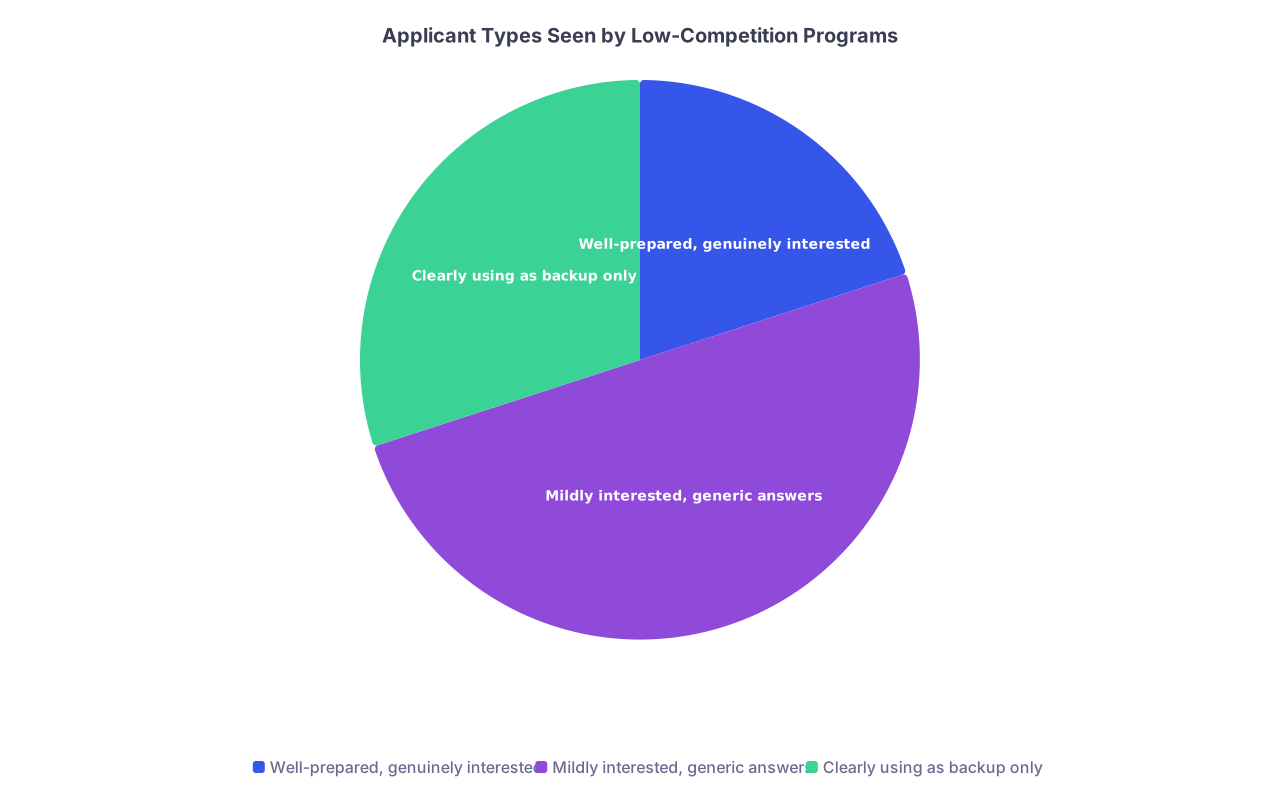
| Category | Value |
|---|---|
| Well-prepared, genuinely interested | 20 |
| Mildly interested, generic answers | 50 |
| Clearly using as backup only | 30 |
- A flood of generic applicants using them as backup
- A subset who think they can coast on “I just want to help people”
- People who clearly didn’t read the website, don’t know the patient population, and can’t explain why they’re there
So they become hypersensitive to certain phrases. They’ve heard:
- “Honestly, I just want a good work–life balance.”
- “I’ll be happy anywhere; I just want to match.”
- “I see this as a great stepping stone.”
- “I’m open to anything. I just want to be a doctor.”
You think you’re being honest or flexible. They hear: I do not care about your program or your specialty.
Answer #1: “I’ll Be Happy Anywhere / I Just Want To Match”
This one tanks people across:
- Family Medicine
- Psychiatry
- Internal Medicine at lower‑tier or community programs
- Pathology, PM&R, Neurology in some settings
The classic version:
“I’ll be happy anywhere. I just want the opportunity to train and become a good physician.”
You think: “I’m humble and grateful.”
They hear: “You are interchangeable with every other program on my list.”
Why it’s so bad:
- It confirms their worst fear: they’re just your backup.
- It tells them nothing about fit, motivation, or longevity.
- It suggests you’ve done zero research about where you’re sitting.
Program directors in less competitive specialties already fight the image that their field is a fallback. Your answer just stamped that on your forehead.
Better move: Be specific without lying.
Instead of “I’ll be happy anywhere,” try something like:
- “I’m applying broadly, but I’m particularly drawn here because of X, Y, and Z that I haven’t seen at many other programs.”
- “This program is high on my list because of your [clinic structure/patient population/early autonomy/continuity clinic model]. That fits how I want to practice.”
If you truly don’t know what set them apart? You didn’t do basic homework. That’s the mistake.
Answer #2: Overemphasizing “Lifestyle” in Lifestyle Specialties
Family med, psych, PM&R, even some community neurology and pathology programs—yes, they know they’re considered “lifestyle” specialties. That doesn’t mean they want to hear it from you.
The answer that kills you:
“I chose [specialty] because I want good work–life balance and time for my family and hobbies.”
Alone, that might be fine in a very careful context. But most applicants stop there. Zero mention of:
- Intellectual reasons
- Patient population
- Long-term professional goals
What a PD hears:
- “I care more about leaving at 3 pm than actually doing the work.”
- “This is about my lifestyle, not the patients.”
- “If things get hard here, you’re going to be the one who complains about call schedules and clinic volumes nonstop.”
There’s a big difference between:
“I value work–life balance.”
and
“I chose family medicine because I love longitudinal care and I want a career where I can see my patients through multiple stages of life. I also know this specialty can offer a sustainable lifestyle, which matters to me, but the core is continuity and community.”
The first sounds like you’re using the specialty as a lifestyle vehicle. The second sounds like you chose a clinical path that fits how you want to practice medicine and live as a human.
Don’t make “work–life balance” your headline. Make it a footnote.
Answer #3: Calling the Program a “Stepping Stone”
This one is brutal and surprisingly common, especially among people eyeing fellowships or more competitive fields.
- “I see this program as a good stepping stone.”
- “My ultimate goal is to match into a competitive fellowship like cardiology/derm/rads, so I think this is a good place to start.”
- “I want to use this as a base to move on to a bigger academic center.”
I’ve seen applicants say this at small community IM programs. You could feel the room temperature drop.
Here’s why it burns:
- It devalues them. You basically said, “You’re my temporary solution.”
- It screams flight risk.
- It tells them you don’t understand what they care about (stability, coverage, people who’ll stay local, residents who aren’t just “passing through”).
You can absolutely be interested in a fellowship or subspecialty. Just don’t frame the program as disposable.
Better framing:
- “I’m very interested in cardiology long-term. I’m looking for a strong internal medicine foundation where I can get solid clinical training, exposure to cardiology, and mentorship on the fellowship process. From what I’ve seen here with your CCU exposure and faculty, this seems like a place where I could really grow.”
You’re still honest. But you’re not calling them a rung on your ladder.
Answer #4: Fake Passion for the Specialty (They Can Tell)
Least competitive specialties see this constantly:
- The applicant who “fell in love” with psych after one two-week elective
- The med student who “always knew” they wanted family medicine… after initially applying surgery
- The IMG who changed specialties late and thinks enthusiasm can fix the lack of a story
The mistake isn’t changing your mind. The mistake is trying to sell some fake heroic narrative that doesn’t line up with your CV or your tone.
Common turn-off answers:
“I’ve always been passionate about [specialty].”
And then their application shows:
- Zero electives early on in that field
- Multiple aways in something more competitive
- No related research, QI, or meaningful exposure
Low-competition PDs have seen the “I actually always loved this specialty” speech a thousand times. They don’t buy it without some evidence or at least a believable story.
Better approach: Own the late interest. Make it coherent.
Something like:
- “I was initially drawn to [other specialty] and did a couple of rotations there. I realized I liked pieces of it, but what really stuck with me was X, which I later found more fully in [current specialty]. Once I did my rotation here, it clicked that this aligns much better with how I want to practice.”
That’s real. That’s believable. And you’re not insulting their intelligence.
Answer #5: Trash-Talking Other Specialties or Programs
This one kills you everywhere, but especially in comparatively “less competitive” fields, where there’s a chip on the shoulder.
Killer phrases:
- “I didn’t want [specialty X] because it’s too cutthroat and full of egos.”
- “I’m not like those gunners going for derm or ortho.”
- “Academic places are too political. I prefer a chill environment.”
Here’s the problem:
- It makes you sound judgmental and immature.
- They wonder what you’ll say about them when you’re unhappy.
- You look like someone who defines yourself by what you’re against instead of what you’re genuinely for.
You can prefer a certain culture without attacking another.
A safer, actually adult answer:
- “I liked my rotation in [competitive specialty], but I realized I wanted more longitudinal patient relationships and less time in the OR. [Current specialty] gives me the kind of day-to-day work I enjoy and the patient relationships that motivate me.”
Notice the focus: what you like, not what you despise.
Answer #6: Over-sharing Your Backup Plan or Rank List Strategy
Low-competition program directors already assume some of you see them as backup. They do not need you to confirm it.
High-risk lines:
- “I’m also very interested in [more competitive specialty], but I’m applying here as well to keep my options open.”
- “If I don’t match into [other field], I know I’ll still be happy in [their specialty].”
- “I ranked some university programs higher because of their research, but I think this place is good too.”
You just told them they’re Plan B… or C. Sometimes Z.
The ugly truth: a lot of PDs would rather rank a slightly weaker but committed applicant higher than a stronger one who radiates “you’re my last resort.”
You do not need to lie. You do need to stop volunteering damaging information they didn’t ask for.
If they push with something like: “Are you applying to other specialties?”
You can be honest but strategic:
- “At the start of the cycle I considered [other specialty] and explored it seriously. The more time I spent in [current specialty], the more I realized it fit me better. My focus now is finding the right home in [current specialty], and programs like this one are the kind of place I see myself thriving.”
You answered. You didn’t confess like you’re in a courtroom.
Answer #7: Vague, Generic “Why This Program?” Responses

This is where laziness destroys you.
Low-competition programs get hammered with applicants who:
- Didn’t look at their website
- Can’t name a single unique feature
- Confuse them with another hospital
Classic flop answer:
“I really like the supportive environment, the diverse pathology, and the strong teaching.”
You might as well say, “I copied this from a blog.”
PD translation: “You didn’t care enough to do any real homework.”
You need 2–3 concrete things. Not adjectives. Actual features.
Examples:
- “Your full-spectrum family medicine with OB and inpatient really stands out. I’m looking for a program where I can deliver babies, manage hospitalized patients, and still have strong outpatient training.”
- “The fact that residents here do their continuity clinic in a FQHC serving largely immigrant and underserved populations lines up with my prior work and what I want for my career.”
- “I noticed you have a geriatric psychiatry rotation built into PGY-2, which is unusual. I’m very interested in working with older adults, so that structure is a big draw.”
You don’t need to sound like a brochure. You just have to prove you cared enough to read and think.
Answer #8: “I Don’t Have Any Questions” (Or Asking the Wrong Ones)
You think you’re being low-maintenance. They think you’re disengaged.
Common fatal combo:
- Generic interview
- Generic answers
- And then: “No, I don’t have any questions. I think you covered everything.”
That screams: “I don’t care enough to dig deeper.”
On the flip side, there are questions that make you look terrible at these programs:
- “How easy is it to moonlight?” (as your first question)
- “How often do residents leave early or switch specialties?”
- “Do you think I’d be competitive to transfer to a bigger academic center from here?”
Those all say: “I’m trying to do the bare minimum or use you as a launch pad.”
Better questions for lower-competition, often community-based programs:
- “What kind of resident tends to thrive here?”
- “What changes have you made based on resident feedback in the last few years?”
- “How do graduates from this program typically practice—community, academic, mix of both?”
- “What do you think is underrated about your program that applicants might miss on paper?”
You’re trying to prove two things:
- You’re genuinely trying to figure out if you fit.
- You see this program as a serious, long-term training environment.
Answer #9: Sloppy Weakness and Conflict Answers
Programs in lower‑competition specialties are hyper‑aware of resident reliability. They can’t afford people who:
- Call out constantly
- Stir constant drama
- Need to be chased for every task
So your answers to:
- “Tell me about a weakness.”
- “Tell me about a conflict with a team member.”
- “Tell me about a time you struggled.”
…are heavily scrutinized.
Terrible, but common, answers:
- “My weakness is that I care too much.”
- “I’ve never really had a conflict with anyone.”
- “Sometimes I work too hard and forget to take breaks.”
They don’t believe you. Or worse, they think you lack insight.
Even worse is throwing someone under the bus:
“I had a conflict with a nurse who wasn’t doing their job…”
Or:
“My attending was unfair and I stood up to them.”
Now you sound like a problem.
Safer, honest structure:
- Pick a real but fixable weakness (time management, over-documenting, hesitancy to ask for help).
- Describe a brief example showing it.
- Explain what you did to improve and what’s changed.
For conflict:
- Keep it small but real (scheduling issue, miscommunication about a task).
- Own your part, even if it was just not clarifying expectations.
- End with what you learned about communicating better.
They’re not looking for perfection. They’re trying to avoid disasters.
Answer #10: Acting Like You’re Settling for a “Less Impressive” Field
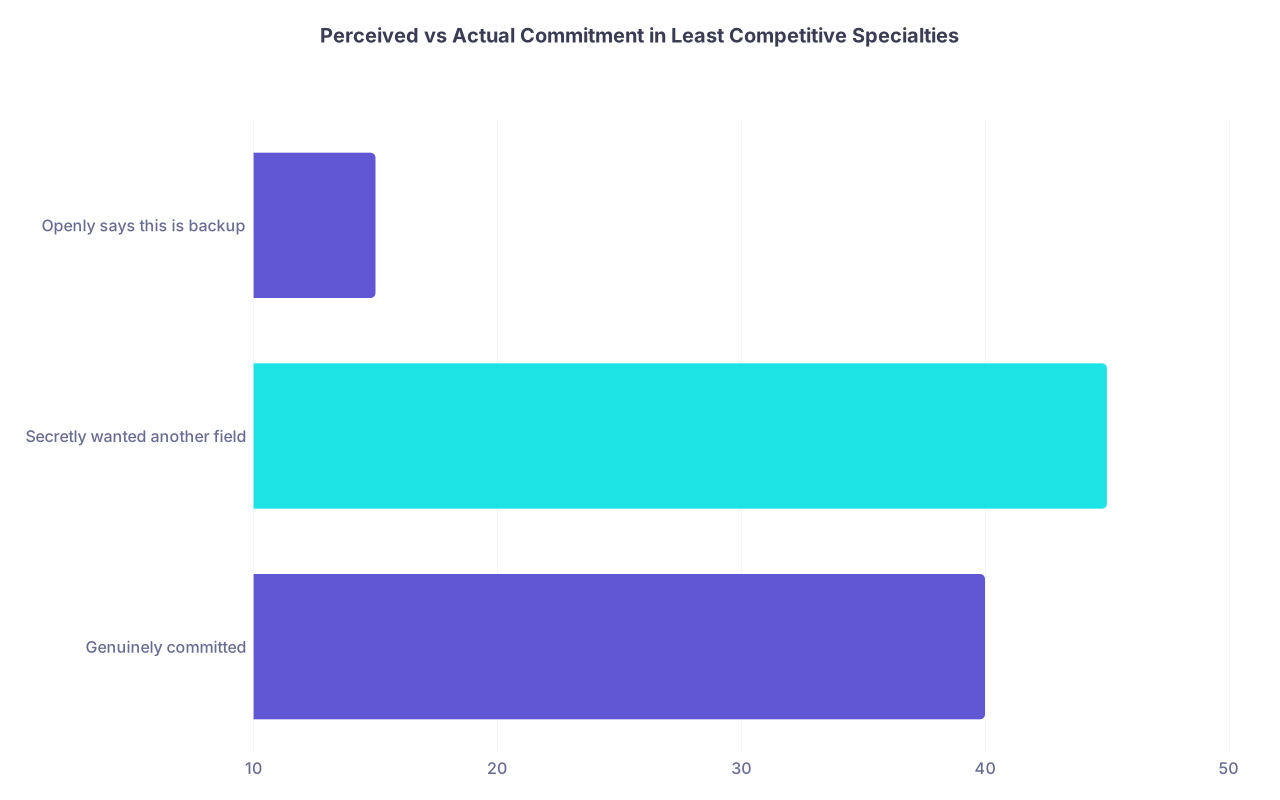
| Category | Value |
|---|---|
| Genuinely committed | 40 |
| Secretly wanted another field | 45 |
| Openly says this is backup | 15 |
Least competitive specialties get hit especially hard by this mindset:
- FM: “I didn’t get into anesthesia or EM.”
- Psych: “I wanted neurology or radiology.”
- Pathology: “I’m not competitive for direct patient care.”
- PM&R: “I couldn’t get ortho.”
If your tone is:
- Defeated
- Detached
- Mildly embarrassed to be there
They feel it. They already fight that stigma. They’re not going to invite more of it into their program.
Watch for subtle self‑insults:
- “Honestly, I didn’t expect to end up here, but I’ll make the best of it.”
- “This wasn’t my original plan, but I think I could enjoy it.”
- “I know this isn’t like the super competitive specialties, but…”
Every one of those is a slap in the face.
You can acknowledge a winding path without sounding like you lost.
Different framing:
- “My path here wasn’t linear. I initially explored [other area], but as I got more clinical exposure, I realized I was more energized by [specific parts of current specialty]. It took me a bit to see it clearly, but now it’s where I genuinely see myself long-term.”
You’re allowed to evolve. You’re not allowed to act like their whole field is your consolation prize and expect them to be excited to train you.
Quick Comparison: Phrases That Sink You vs Phrases That Help
| Situation | Bad Phrase | Better Phrase |
|---|---|---|
| Why this specialty? | “Good lifestyle, less stressful.” | “I like X type of patients and Y kind of clinical work.” |
| Why this program? | “Great teaching and diverse pathology.” | “Your [specific feature] is exactly what I’m looking for.” |
| Backup plan honesty | “I just want to match somewhere.” | “I’m looking for a program like this where I can do X.” |
| Future goals | “Use this as a stepping stone.” | “Build a strong foundation for [specific interest].” |
| Weakness | “I care too much / work too hard.” | “I used to struggle with X; here’s what I changed.” |
How to Rehearse Without Sounding Fake

| Step | Description |
|---|---|
| Step 1 | Identify Risky Questions |
| Step 2 | Write Honest Draft Answers |
| Step 3 | Remove Red Flag Phrases |
| Step 4 | Add Program Specific Details |
| Step 5 | Practice Out Loud 3 Times |
| Step 6 | Get Feedback From Mentor |
| Step 7 | Refine and Shorten Answers |
One last mistake: over‑rehearsing into robot mode.
You absolutely should:
- Outline 3–4 core stories (teamwork, conflict, failure, difficult patient).
- Know 2–3 specific reasons for each program.
- Decide in advance how you’ll talk about:
- Why this specialty
- Why this program
- Your backup thoughts without self‑sabotage
You absolutely should not:
- Memorize 3‑minute speeches.
- Stuff in every buzzword you saw on Reddit.
- Copy someone else’s “perfect” answer.
Talk it out with someone who’s blunt enough to say, “You sound fake” or “That makes it obvious this is your backup.”
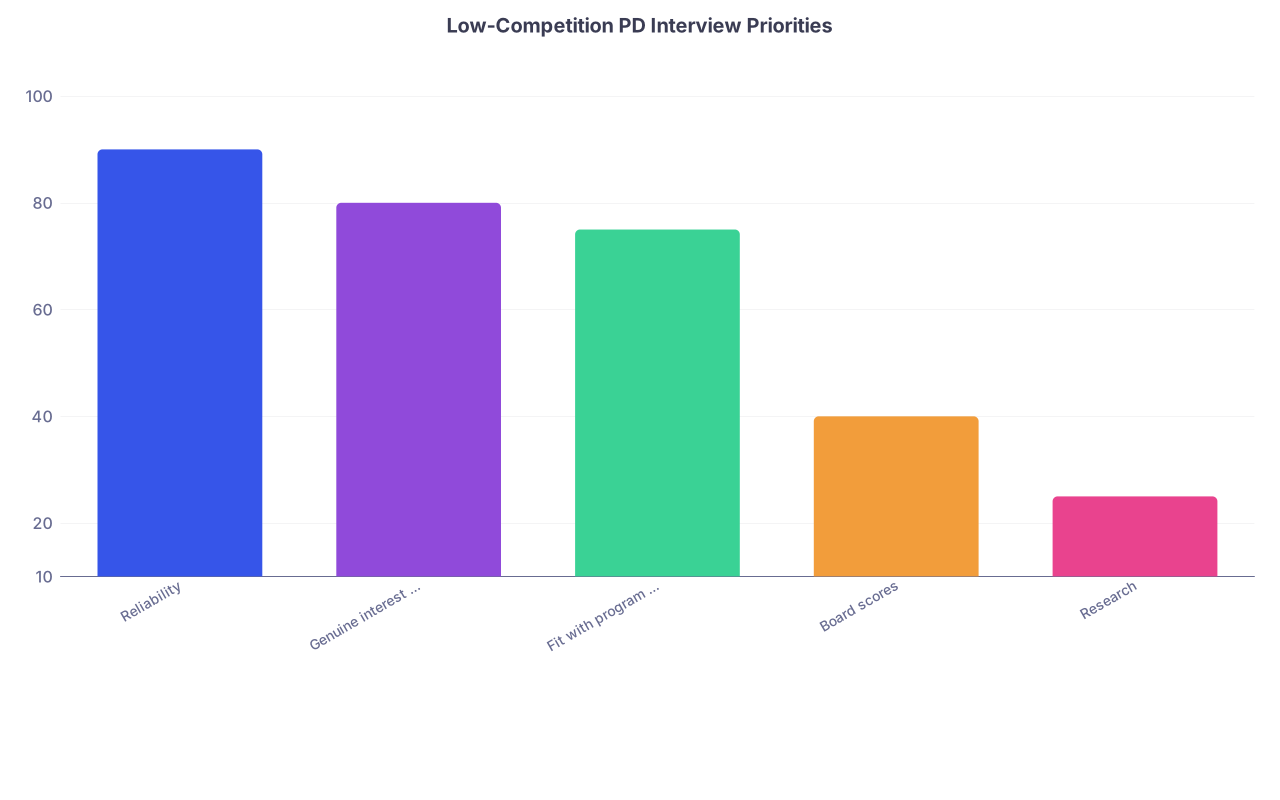
Visual Snapshot: What Program Directors Actually Prioritize
| Category | Value |
|---|---|
| Reliability | 90 |
| Genuine interest in specialty | 80 |
| Fit with program culture | 75 |
| Board scores | 40 |
| Research | 25 |
Notice: the things people obsess about online (research, prestige) drop down the list. What gets you killed in interviews at these places is not your CV—it’s your attitude.
FAQ (Exactly 5 Questions)
1. Is it always wrong to mention work–life balance in lifestyle specialties?
No, but it’s dangerous as a headline. If the first thing out of your mouth is “lifestyle,” you sound like you care more about your schedule than your patients. Frame it as one of several reasons, and pair it with specific, clinical motivations for the specialty. “I want to be there for my family” is human; “I picked this field to get out early” is a red flag.
2. How honest should I be if this program really is my backup?
You should be honest about your interests and goals, not your rank list math. Don’t say, “You’re my backup.” Do say, “I’m looking for a program with X and Y features, and I see those here.” The ranking algorithm exists so you can rank freely; broadcasting to a PD that they’re Plan B only hurts you and helps no one.
3. What if I truly switched specialties late and have a weak narrative?
Then own it instead of faking some childhood calling. “I came to this later” is much more believable than “I always knew,” when your CV doesn’t show that. Show a clear pivot point (a rotation, a patient, a mentor) and how your behavior changed afterward (electives, reading, projects). PDs care more about your current clarity than your perfect origin story.
4. Is it bad to talk openly about wanting a competitive fellowship?
Not inherently. The mistake is framing the residency as a “stepping stone” or something you’re just using. You can say, “I’m interested in cardiology and looking for strong general IM training that will prepare me well, with exposure and mentorship.” That respects the core field and the program, instead of treating them like a formality.
5. How many specific things should I know about each program before the interview?
At least two, ideally three: one about structure (rotations, clinic, curriculum), one about patient population or setting, and one about culture or outcomes (where grads go, what they’re proud of). If your “Why this program?” answer could be used word‑for‑word anywhere, it’s a problem. You don’t need a dissertation. You do need proof you gave a damn.
Remember:
- Low-competition specialty or program does not mean low expectations on attitude.
- The quickest way to get silently blacklisted is to imply they are your consolation prize or “stepping stone.”
- Specific, respectful, and honest beats vague, flattering, and obviously fake—every single time.