
The belief that “least competitive” specialties will overlook your CV gaps is dangerous—and often flat‑out wrong.
Yes, family medicine, psych, peds, IM at community sites, PM&R, path, and some prelim programs are more forgiving. But there are certain gaps and patterns that still jump off the page and get you screened out before anyone even thinks about your personal statement.
I’ve sat in rooms where faculty say, “We’re community, we give people chances,” and then thirty seconds later: “Skip this one—too many unexplained gaps.” Do not rely on competitiveness level to rescue a sloppy or mysterious CV.
Let’s go through the mistakes that stand out even in the least competitive Match fields—and how to avoid looking like a risk instead of a redemption story.
The Myth: “It’s Just Family Med, They’ll Take Anyone”
Let me kill this first.
Programs in “less competitive” specialties are not desperate. They’re cautious in a different way. They’re not terrified about Step 260s; they’re terrified about:
- Residents who won’t show up
- Residents who burn out by December
- Residents who fail boards, prolong graduation, or trigger ACGME problems
- Residents who bring drama, complaints, or professionalism headaches
So when they scan your CV, they’re not asking, “Is this the smartest person?” They’re asking, “Is this person going to be reliable for three years?”
That’s why certain gaps are lethal. Not because you had a rough patch, but because it looks like you either can’t stick with commitments, can’t communicate, or can’t be trusted when life goes sideways.
Gap Type #1: The “Disappearing Act” in Training Years
The worst CV gaps are the ones that sit inside medical school or during early postgraduate time and are just… blank.
Example patterns that make programs nervous:
- MS2 → MS3: 9–12‑month “nothing listed” period
- Completed med school in 8+ years with no explanation
- A “Leave of Absence” mentioned with no dates and no context
- Started a residency, then nothing for a year, then “applying again”
Here’s what hurts you: vagueness. Not the fact that you took time off.
Programs in less competitive specialties have seen:
- Students needing a year for health or family
- Pregnancy or childcare pauses
- Visa/immigration delays
- Mental health leaves
- Degree intercalation gone sideways
Those are survivable. But they need clarity.
What gets you quietly tossed aside is the CV that looks like this:
- 2016–2020: Medical School, XYZ University
- 2020–2022: Nothing
- 2022: Applying to Family Medicine
That’s where people say, “What happened here?” and then move on to the next application because there are 1500 others.
How to not make this mistake
Do not leave internal training years blank. If there was a leave:
- Put the dates.
- Label it honestly. “Personal health leave,” “Family care leave,” “Research year,” “Administrative delay.”
- Make sure the explanation in ERAS and the MSPE align—no mismatched stories.
Have your school (or prior program) address it briefly in their letter:
- “Student took an approved leave of absence from Jan–Oct 2021 for personal and family reasons and returned in good standing.”
Be prepared with a concise, non‑defensive explanation for interviews. Two sentences, not a life story.
When you try to hide a leave, you look unstable. When you own it briefly and clearly, many family med / psych / peds / IM programs will shrug and move on to your strengths.
Gap Type #2: The “Drift” Years After Graduation
This one destroys otherwise salvageable applications to less competitive specialties:
- Graduated med school 3–6 years ago
- No residency or a short attempt then nothing
- CV filled with part‑time, non‑clinical, or completely random work
- No clear path back to clinical medicine
Programs in community FM or psych absolutely look at this. I’ve heard versions of:
“They’re 5 years out of med school and have done Uber, retail, and one observership. How current are they, realistically?”
Here’s what raises red flags:
- Multiple “gap years” with no clinical contact at all
- Year(s) listed as “studying for boards” with zero other activity
- A sprinkling of unrelated jobs (sales, tutoring, office admin) with no narrative of staying clinically engaged or improving as an applicant
You’re not penalized for struggling to match. You’re penalized if your CV makes it look like you walked away from medicine and just wandered.
What makes you safer in their eyes
If you’re 2+ years out from graduation, you need a story that says:
“I’ve stayed in the game.”
That means some combination of:
- Consistent clinical involvement: scribe, clinical research coordinator, outpatient assistant, telehealth work (where legal), or structured observerships
- Evidence of board progress: passing scores, or at least serious structured prep, not just “I was studying”
- Letters from recent US clinicians who’ve actually seen you show up on time, take feedback, and behave like a resident
| Scenario | Programs Think | Safer Alternative |
|---|---|---|
| 3 years “studying for boards” and nothing else | “Avoidant, not resilient” | Part‑time work + structured clinical observership + exam progress |
| Gig work only (Uber, retail, no clinical) | “Out of touch clinically” | Gig work + hospital volunteer/assistant role |
| One random observership 2 years ago | “Token effort” | Longitudinal (3–6 months) clinical role with letter |
Do not try to pretend those years did not happen. Fill them with something that points back to medicine and reliability.
Gap Type #3: The Serial Re‑Applicant With No Growth
Least competitive specialties see a lot of re‑applicants. That alone is not the problem.
The problem is the CV that says:
- Applied to IM 3 times
- Same Step scores
- Same lack of US letters
- Same generic personal statement
- Same red flags unaddressed
You’re basically asking them to take the same risk that dozens of other programs already said no to.
Programs think: “If nobody has taken them in four years, what are we missing?” That’s not paranoia; that’s pattern recognition.
How to avoid looking stuck
If you’re reapplying—especially to things like family medicine, psych, peds, community IM—you must show:
- Fresh clinical experience (last 12–18 months ideally)
- New letters from that period
- Board progress (if you hadn’t passed one before, you have now; if you had marginal scores, you’ve at least matched performance on later exams like Step 2/3)
- A slightly reframed personal statement that acknowledges growth, not just “my lifelong dream”
If your application from 2022 and 2025 are almost identical, you’re telling them you either did nothing to improve or don’t understand why you failed before. Both look bad.
Gap Type #4: Fragmented Training With No Explanation
This one is nuclear if you present it badly.
You’ll see versions like:
- 2019–2020: Categorical Internal Medicine, Program A
- 2020–2021: Transitional Year, Program B
- 2021–2022: No training
- 2023: Applying to Psych
Or:
- Started surgery prelim, left mid‑year
- Started IM, did 6 months, then vanished
- Now pivoting to family medicine “for lifestyle”
Programs in “less competitive” specialties are exactly the ones that meet the fallout from failed prior matches. They’ve all had bad experiences with residents who:
- Couldn’t function clinically
- Had major professionalism problems
- Disappeared mid‑year
- Needed remediation for everything
So when they see fragments of training, they wonder if you’re bringing someone else’s problem into their program.
The mistake: trying to hide or minimize it
I’ve seen applicants bury the prior residency under “preliminary training” or “externship” as if no one will notice. Program directors do notice. They talk. They verify.
Trying to downplay or obscure previous residency time is one of the fastest ways to get instantly filtered out, even at small community FM programs.
The better (not perfect, but survivable) approach
You cannot erase fragmented training. You can:
- Be brutally clear on the CV: exact dates, exact roles
- Have a direct, aligned explanation on ERAS, your personal statement, and in interviews
- Secure at least one honest but supportive letter from someone at that prior program if at all possible
And you need a story that doesn’t sound like: “I left because it was hard.”
It needs to sound like:
- “Mismatch in specialty fit; I was supported clinically but realized I was better suited to outpatient / longitudinal care; we mutually agreed I would not continue.”
- “Family crisis required relocation; I left to be closer to X while remaining committed to residency training. Since then, I’ve been involved in Y clinical work and confirmed my interest in Z specialty.”
You don’t need to confess every painful detail, but the absence of any explanation makes everyone fill in the worst‑case scenario.
Gap Type #5: The Dysfunction Pattern (Too Many Short Things)
Some of you don’t have one big gap. You have 10 small ones. That’s just as bad.
What it looks like:
- 3 research assistant jobs, all under 3 months
- Two clinical observer roles, each a few weeks
- A “committee member” here, a “volunteer” there, all short stints
- No role held longer than 6 months in the last 4–5 years
Individually, nothing is awful. But as a pattern? It screams: “This person never sticks with anything.”
Even community psych and peds programs, which are often generous about non‑traditional paths, care about this. Because residency is one long exercise in sticking with something when it’s deeply unfun.
What to fix now
You can’t rewrite the past, but you can build a counter‑pattern:
- Commit to one clinical role for 6–12 months. Scribe, MA, clinical research coordinator, hospital assistant—whatever is realistic.
- Stop hopping between short observerships. Do one or two longer ones with people who can actually know you and vouch for consistency.
- If you have to juggle multiple part‑time roles (you need the money, fair enough), at least have one core anchor experience that lasts.
You’re trying to show: “I can show up to the same place, work with the same people, and earn trust over time.” Right now your CV might be saying the opposite.
Gap Type #6: The Subtle Professionalism Red Flags
These aren’t always labeled as “gaps” in time, but they show up as gaps in reliability.
Things like:
- Failed Step attempts scattered across several years, with no clear study or remediation plan
- Remediation rotations in clerkships, especially if there are multiple across specialties
- “Leaves” or “extensions” that line up suspiciously with exam periods
- Repeated failed or delayed OSCE/CS-style assessments
Even in least competitive specialties, program directors look at this and think:
“Do I want to spend three years chasing this person about deadlines, charting, and duty hour documentation?”
What applicants do wrong
They:
- Pretend the failures didn’t happen
- Assume “pass is pass” and don’t address multiple attempts
- Avoid mentioning remediation for anything
- Provide no sign of insight or change
That’s what gets you filtered out. Not the failure itself, but the complete absence of evidence that you learned and adapted.
Better approach
Own it in a controlled, strategic way. For example:
“After failing Step 1 on the first attempt, I worked with a learning specialist, completed a structured study program, and passed comfortably on the second try. I’ve used those strategies to stay organized for clinical work and for Step 2.”
Have someone else (dean’s letter, LOR) back up that story: “Student had early difficulty with exam performance but showed maturity and improvement with structured support.”
Programs in family medicine, psych, peds, PM&R are often willing to take a chance on people who struggled—but only if you convince them you’re not going to repeat the same mistakes under greater pressure.
Gap Type #7: The “Mystery Life Event” You Try to Hide
This one’s subtle.
You had something big happen: serious mental health crisis, addiction treatment, legal trouble, academic misconduct, family catastrophe. You took time out. You survived it.
Then, when you build your CV, you:
- Compress dates to hide the break
- Lie by omission under “continuous enrollment”
- Avoid explaining anything anywhere
You think you’re minimizing damage. What you’re actually doing is building inconsistencies.
Program coordinators and faculty are not stupid. They see when:
- The med school graduation date doesn’t match the “expected date” listed previously
- Your MSPE hints at a leave but your ERAS is silent
- Your previous application (yes, they can see it) said one timeline, and this one says another
They do not need to know all your private details. But they do need the timeline to be real. If they catch you fudging it, you move from “maybe a risk, but honest” to “untrustworthy.” That’s fatal.
Safer way to handle a serious private issue
- Keep dates accurate.
- Use neutral phrasing for the gap: “Personal medical leave,” “Family care responsibilities,” “Personal circumstances requiring time away from training.”
- Prepare a 1–2 sentence, calm explanation if asked. You are allowed to say, “I’m not comfortable going into details, but I took time to address X and I’m now fully able to meet the demands of residency.”
The mistake is not having a crisis. The mistake is lying or distorting the record.
What “Least Competitive” Programs Actually Want to See
Let me flip this so you understand the standard you’re trying to meet.
Community family medicine, psych, peds, IM, PM&R, path—they’re looking for:
- A clean, honest timeline (even if bumpy)
- Some evidence of recent, real clinical work
- Board exams at least mostly under control (or trending the right way)
- Letters from people who’ve seen you work in the last 1–2 years
- A story that says: “I know myself better now, and I can show up.”
You can have:
- A leave of absence
- Two extra years of med school
- Borderline scores
- A failed first residency attempt
And still get interviews—if your CV presents that as a coherent journey rather than a chaotic string of disappearances.
Don’t Make These Sloppy CV Mistakes
A few quick, brutal ones that get you silently binned even in the “easy” fields:
- Leaving months ambiguous (“2020–2021” for everything), which hides the length of gaps and makes programs suspicious.
- Using inconsistent titles that look inflated: calling a two‑week shadowing stint a “clinical fellowship” or a short volunteer role “staff physician assistant” (when you’re not).
- Listing “research positions” with no supervisor names or institutions, making them look made‑up.
- Having big time blocks with just “USMLE prep” and nothing else—no employer, no structured activity.
These aren’t just aesthetic errors. They say: “This person either doesn’t understand how serious this is, or they’re hoping we don’t look too carefully.”
Programs in less competitive specialties don’t have as many staff or time as the top‑tier academic places. They compensate with blunt filters. If your CV looks messy or evasive, they don’t argue about it—they just move on.
A Visual of How Programs See Time Gaps
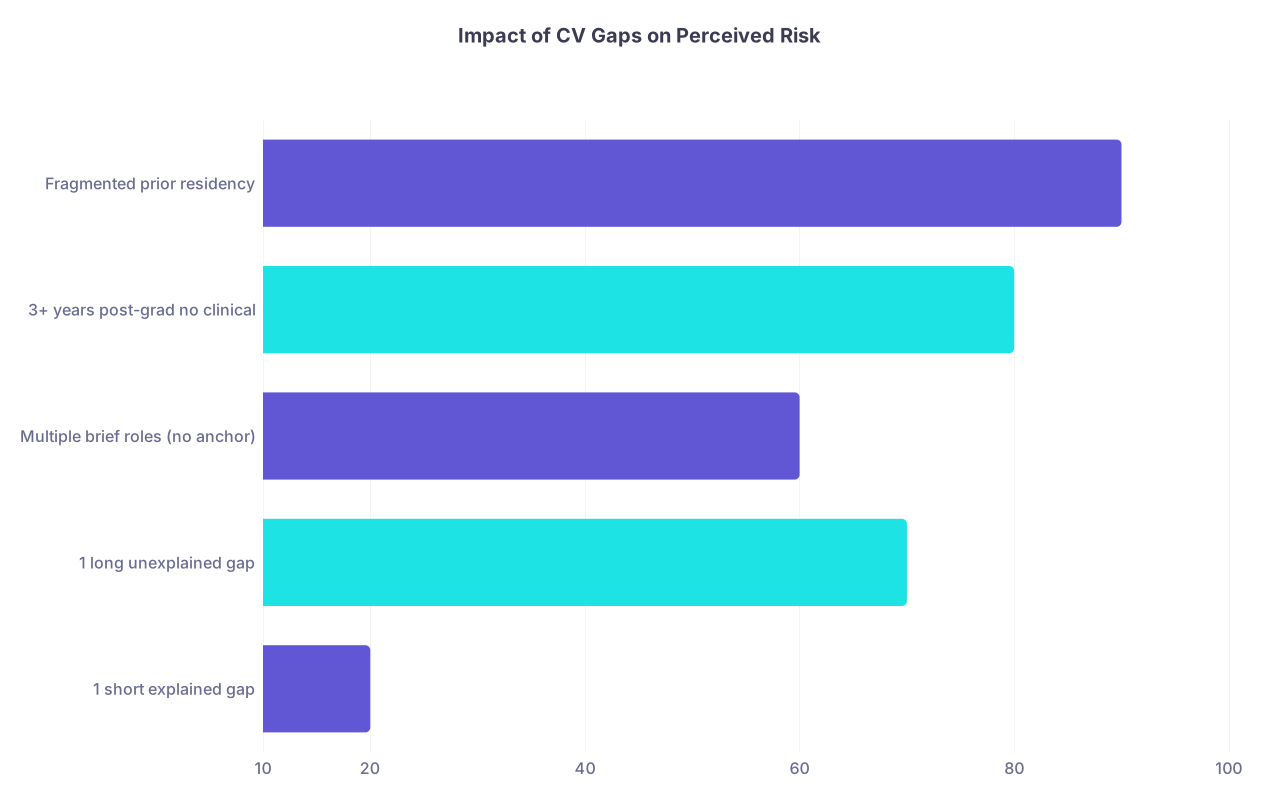
| Category | Value |
|---|---|
| 1 short explained gap | 20 |
| 1 long unexplained gap | 70 |
| Multiple brief roles (no anchor) | 60 |
| 3+ years post-grad no clinical | 80 |
| Fragmented prior residency | 90 |
(Values are “perceived risk” out of 100 based on how PDs talk, not official stats—just to give you a sense of magnitude.)
What You Should Do This Week
Stop telling yourself, “It’s just family med / psych / peds, they’ll understand.” Some will. Many will not—unless you give them a clean, honest, structured story to work with.
Here’s your next step:
Open your CV and timeline today and do this brutally honest exercise:
- Highlight every period of 3+ months where you have nothing concrete listed.
- For each one, write a one‑line explanation that is truthful, neutral, and specific enough to make sense.
- Then ask yourself: “What have I done in the last 12–18 months that proves I can now show up consistently in a clinical environment?”
If you can’t answer #3 convincingly, your priority is not more personal statement edits. It’s finding one sustained, real clinical or medically adjacent role and committing to it.
Do that now—before you upload another application that looks like a collection of gaps and guesses.