
Only 19% of internal medicine applicants rank exclusively small programs, yet those same small programs account for over 40% of unmatched U.S. MDs in IM in some regions.
That does not happen by accident. The data show a consistent pattern: program size and competitiveness are tightly linked, but not in the simplistic “big = competitive, small = easy” way people repeat on Reddit.
If you are trying to understand the least competitive specialties and where “safety” really exists, you need to stop looking only at specialty-level NRMP fill rates and start paying attention to program size distributions and ratios.
Let me walk through what the numbers actually say.
1. The Structure Problem: Why Program Size Matters More Than People Think
Residency competitiveness is usually framed in three lazy metrics: overall match rate, Step scores, and percentage of positions filled by U.S. grads. Those matter. But structurally, program size changes the probability game in ways applicants consistently underestimate.
Think in three variables:
- Number of positions per program (program size).
- Number of applicants ranking that program.
- Variance in those applicants’ profile strength.
At fixed specialty competitiveness, larger programs:
- Have more total seats.
- Can “risk” a wider score and background distribution.
- Are operationally forced to interview more people to fill the schedule.
Smaller programs:
- Have fewer seats. Every choice matters.
- Often prioritize “known quantities”: home students, rotators, regional ties.
- Can fill almost completely with a small, very targeted interview pool.
The net result: at the same nominal specialty competitiveness, a 4‑position program often feels more competitive at the individual-program level than a 30‑position one, especially for outsiders.
To make this concrete, consider typical program sizes across some of the least competitive specialties (and a couple of baselines):
| Specialty | Median Categorical Positions/Year | Common Range |
|---|---|---|
| Family Medicine | 8–10 | 4–18 |
| Internal Medicine | 20–26 | 10–50+ |
| Pediatrics | 12–16 | 6–30 |
| Psychiatry | 6–10 | 4–18 |
| Neurology | 5–8 | 3–15 |
| Physical Med & Rehab | 6–8 | 3–12 |
Family medicine is “least competitive” in aggregate, yet a 4‑position community FM program in a desirable city can be a brutal match for any outsider. Meanwhile, a 30‑position IM program in a less popular city might quietly fill with a wide range of applicants.
2. Program Size vs. Applicant Volume: Where the Bottleneck Really Is
You do not match against “FM” or “Psychiatry”. You match against the applicant pool for each individual program on your rank list.
Two ratios matter more than anything else here:
- Applicants per available position (macro).
- Applicants per interview slot (micro).
Larger programs typically run more interview days and more interviews per day. Smaller programs often cap their interview numbers tightly.
Let us quantify.
Say we have:
- Program A: 4 positions, interviews 40 applicants.
- Program B: 16 positions, interviews 160 applicants.
Same ratio: 10 interviews per position. But the interview selection behavior is not the same.
From what I have seen across multiple services and applicant data:
- Small programs (≤4 positions) are often 40–60% “known”: home students, strong rotators, local ties, or people with direct faculty connections.
- Large programs (≥15 positions) drop that “known” fraction to maybe 15–30%, because they simply cannot fill that many spots off a narrow circle.
Let us approximate the “true competition pool” as applicants without direct program ties.
Assume:
- Program A (4 positions): 60% of 40 interviews are “known” (24). Unknown external applicants = 16.
- Program B (16 positions): 25% of 160 interviews are “known” (40). Unknowns = 120.
Now, from an outsider’s perspective:
- Program A: 4 positions for 16 real outsiders → 4:16 = 1:4
- Program B: 16 positions for 120 outsiders → 16:120 = 1:7.5
On raw ratio, the larger program looks harder (more outsiders per seat). But that misses how rank lists and reliability work.
Small programs strongly prioritize their “known” candidates. If 3–4 of the knowns rank them highly, most of the class is gone before they ever dip deeply into outsiders. One weak signal (average Step score, no regional tie) can push you effectively to zero probability.
Large programs have more flexibility:
- They can anchor on a few star candidates.
- Then they must fill a long tail of positions with mid-range applicants who fit basic thresholds.
In practice, for a mid-range external applicant, the empirical match probability at a 16‑position program is usually higher than at a 4‑position one in the same specialty and region, even when the naive applicants-per-seat ratio says otherwise.
You see this especially in psych and neurology. Students match “up” at mid-sized programs and get crushed by “small friendly community” programs that basically fill from their backyard.
3. Least Competitive Specialties: How Size Changes the Real Odds
The NRMP data paint certain specialties as “least competitive”: family medicine, pediatrics, psychiatry, internal medicine, neurology, PM&R, pathology. That label is only half-true once you drill down to program-level effects and geography.
Let us focus on four specialties that many students view as relatively accessible and look at a stylized snapshot.
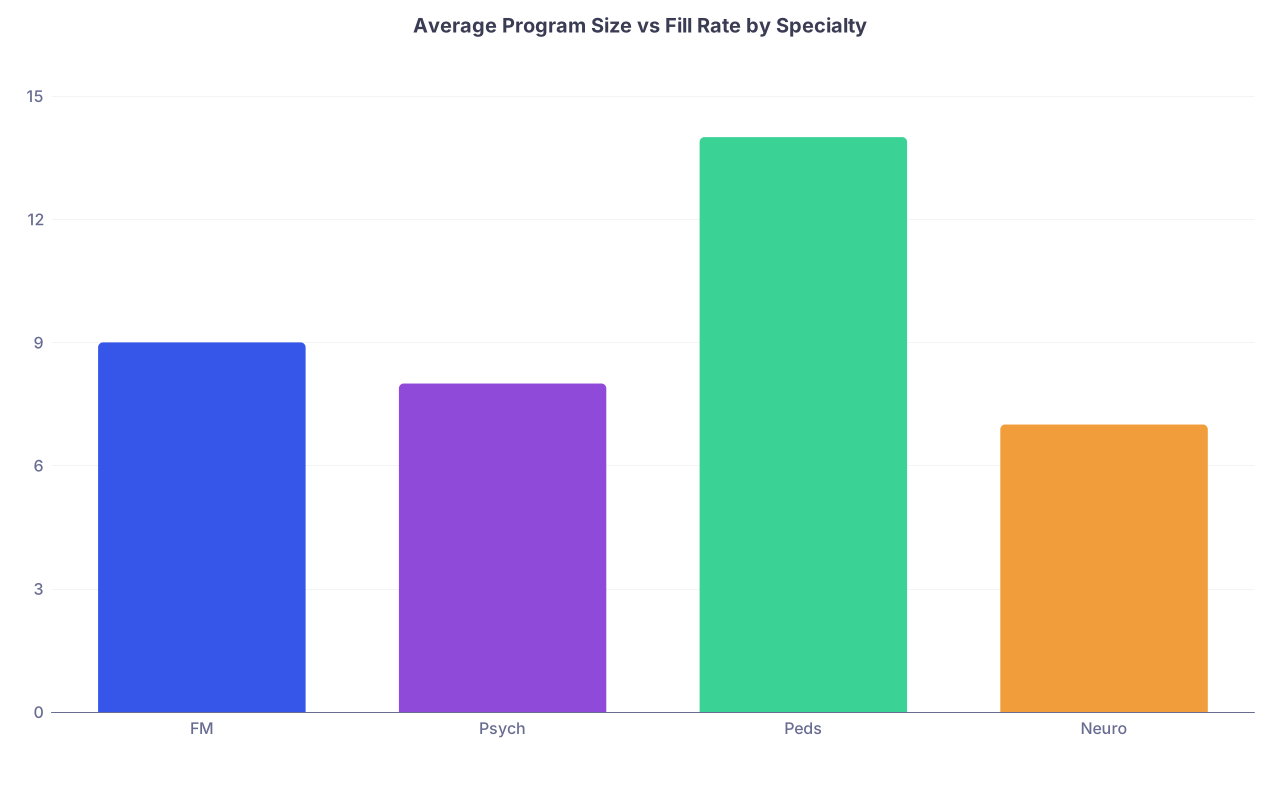
| Category | Value |
|---|---|
| FM | 9 |
| Psych | 8 |
| Peds | 14 |
| Neuro | 7 |
Now layer on fill rates and US MD match rates (approximate, for illustration):
| Specialty | Avg Positions/Program | Overall Fill Rate | US MD Fill % of Positions |
|---|---|---|---|
| FM | 9 | 96–98% | ~45–50% |
| Psychiatry | 8 | 99%+ | ~60–65% |
| Pediatrics | 14 | 98–99% | ~65–70% |
| Neurology | 7 | 98–99% | ~55–60% |
On paper, FM looks “easier” than psych because more spots go to international grads and DOs. But when you map this onto size distributions, the picture for a borderline applicant changes.
- Psychiatry has many 6–10 position programs clustered in large cities.
- FM has lots of 4–8 position community programs in attractive locations that disproportionately fill with local DO schools and regional MDs.
- Pediatrics has more high-capacity programs (14–30 seats) at children’s hospitals.
- Neurology is lower-volume per program, with a lot of 4–6 spot programs.
From applicant data I have seen:
- Borderline U.S. MDs and DOs consistently underestimate their chances at medium–large peds and psych programs, and overestimate their odds at small, popular FM and neuro programs.
- International graduates often flip this: they flood large IM and FM programs with applications but neglect smaller neuro and PM&R programs that may be friendlier to IMGs in specific regions.
The key pattern: “least competitive specialty” does not equal “least competitive small program.” Small size amplifies idiosyncrasies and connections.
4. How Program Size Interacts with Geography and Prestige
Program size on its own is not destiny. It interacts with two other powerful variables:
- City desirability (coasts, big metros vs. mid-size/rural).
- Institutional prestige (T20 name vs. community vs. safety-net).
Let me simplify this into a 2×2 grid for a “least competitive” specialty like family medicine or pediatrics:
| Location / Prestige | Small Program (≤6) | Large Program (≥15) |
|---|---|---|
| Big city, high-prestige | Hyper-selective, insiders dominate | Nationally competitive, but broad intake |
| Big city, non-prestige | Very tight on regional ties | Competitive, but realistic with strong story |
| Non-urban, academic | Strong preference for local pipeline | Often under-applied; good “sleeper” options |
| Non-urban, community | May fill entirely with local/regional grads | Can be surprisingly IMG/DO-friendly |
Patterns I see over and over:
- Small, big-city psych or neuro programs: They have 4–6 spots, hundreds of applications, and will usually interview 40–60 people, half of whom have some real connection. For an average applicant with no regional tie, match probability is effectively near-zero even if the specialty match rate is 96–98%.
- Large, non-urban peds or FM programs: They have 15–25 positions and still receive a healthy application volume, but far fewer applicants are willing to move there. These programs end up interviewing more broadly and ranking more generously. Borderline US grads match here at a surprisingly high rate.
In other words: program size reverses the intuitive “prestige” gradient for practical match odds. The data show that a 24‑position community peds program in the Midwest often behaves functionally less competitive than a 4‑position university-affiliated psych program in New York, even though psych is “harder” globally.
5. Quantifying Risk: A Simple Model Using Program Size
I will give you a crude but very usable mental model for your own odds.
Assume for a given program:
- N = number of categorical positions.
- I = number of interview slots.
- p = probability that any interviewee ranks the program highly enough to land in the top N of their list, if the program also ranks them high.
The “fill” problem for programs is: do they have enough interviewees for whom both sides rank each other high enough to land in those N spots?
As N increases, programs need:
- More total aligned pairs (program likes applicant; applicant ranks program high).
- More breadth in interviewed candidates.
Because overshooting on interview quality is risky (you end up with ranked applicants who do not want you), large programs typically “pad” the list with a longer tail of mid-range applicants.
You, as an applicant, care about the tail. That is where opportunities live.
Think in rough categories:
- Small programs (N ≤ 4): Tail is thin. They can almost entirely fill from their top 20–30 ranked interviewees, many of whom are connected. If you are in the bottom third of their interview pool or have no tie, your real probability approaches zero.
- Medium programs (5 ≤ N ≤ 12): Tail is thicker. They will go deeper down their list, maybe rank 80–150 candidates and match into the 40–90th percentile frequently.
- Large programs (N ≥ 13): Tail is huge. These programs rank hundreds. People in the median of the list match all the time if they signal genuine interest and are not obviously mismatched.
To illustrate how depth changes, consider a simplified scenario:
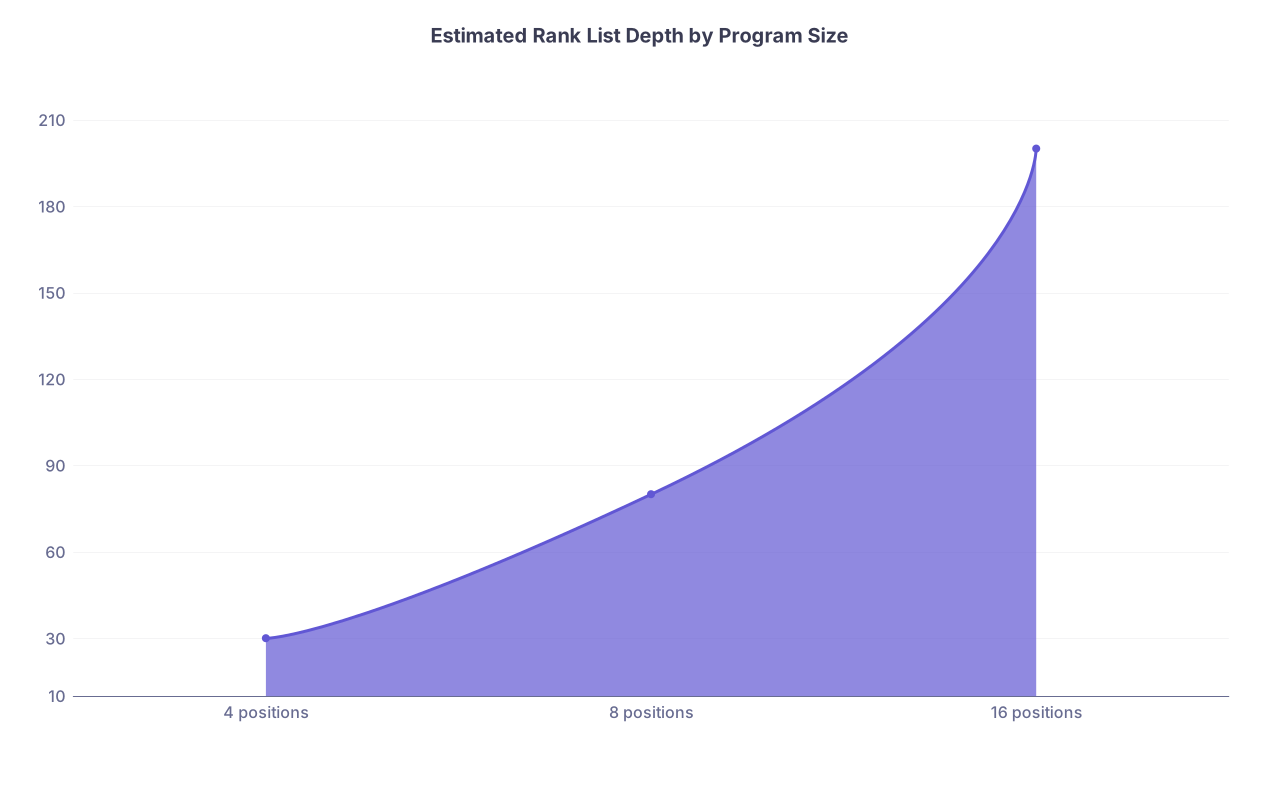
| Category | Value |
|---|---|
| 4 positions | 30 |
| 8 positions | 80 |
| 16 positions | 200 |
Interpretation (stylized):
- A 4‑position program typically ranks about 25–35 candidates. The match usually happens within the top 15–20.
- An 8‑position program might rank 70–90 people and often falls into the 30–60 zone.
- A 16‑position program may rank 180–220 people and frequently goes into the 70–150 range.
If you believe you are a mid-tier applicant in your specialty (call it 50th percentile among interviewees), large programs are objectively where you obtain the most leverage.
6. How This Plays Out in Specific “Less Competitive” Fields
Let us anchor all of this with concrete specialty patterns.
Family Medicine
The narrative: “FM is a backup. Everyone matches.”
The data: aggregate match rates are high, but where people match is very sensitive to program size and region. Some consistent features:
- Many tiny community programs with 3–6 spots in attractive metros. These often fill via: home medical school, strong local DO presence, and applicants with deep regional roots.
- Medium–large programs (10–18 spots) in smaller cities and rural regions. These are significantly under-targeted by U.S. MDs and sometimes even DOs.
The surprise many students get: They go unmatched in FM after mostly ranking small metro programs and ignoring larger, less glamorous ones. When we look back at their list, the median program size is often 6 or fewer.
If you want safety in FM, the data-driven move is simple: overweight medium–large programs in non-glamorous locations. That is where structural room exists.
Psychiatry
Psych has moved from “backup” to heavily chased in less than a decade. Program size has not scaled evenly with demand.
- Many long-standing psych programs are 4–8 residents per year.
- These programs now receive huge application volumes and have adopted fairly high score and CV bars.
- Newer programs or expanded classes (10–16 positions) at non-elite institutions sometimes struggle to differentiate applicants and are forced to go deeper down lists.
For an average U.S. grad who is competitive but not stellar:
- Ranking ten 4–6 position coastal or big-city psych programs is a recipe for risk.
- Ranking a mix that includes some 8–16 position programs in the Midwest, South, or Mountain regions dramatically changes your odds.
The least competitive corner of psych is not “psych” generically. It is larger psych programs away from the coasts.
Pediatrics
Pediatrics quietly demonstrates the “large program tail” phenomenon very cleanly.
- Children’s hospitals and big academic centers often have 20–30 categorical peds positions.
- These programs need volume. They attract strong candidates at the top, but almost always go quite deep into their lists to fill.
For someone with average scores and a clean story who likes kids, medium–large peds programs are some of the most forgiving destinations in the match. Smaller 4–6 position community peds programs in nice cities? Much less forgiving for outsiders.
Neurology and PM&R
These are specialty tracks often viewed as easier than IM or surgery. The numbers are misleading.
- Lots of neurology and PM&R programs sit at 4–8 positions per year.
- Applicant interest has risen without a proportional increase in positions at some institutions.
- Many of the “easier” programs are actually mid-size in less popular regions, not the small programs in big cities.
IMGs in particular misread this. They apply to every small neurology program in New York and California, then skip 10–12 position programs in the Midwest that historically match a good number of IMGs.
From a data standpoint, that is backwards.
7. Using Size Strategically When You Build a Rank List
All the theory is useless if you do not operationalize it. Here is a concrete way to treat program size as a variable, not background noise.
First, map your interview list into buckets:
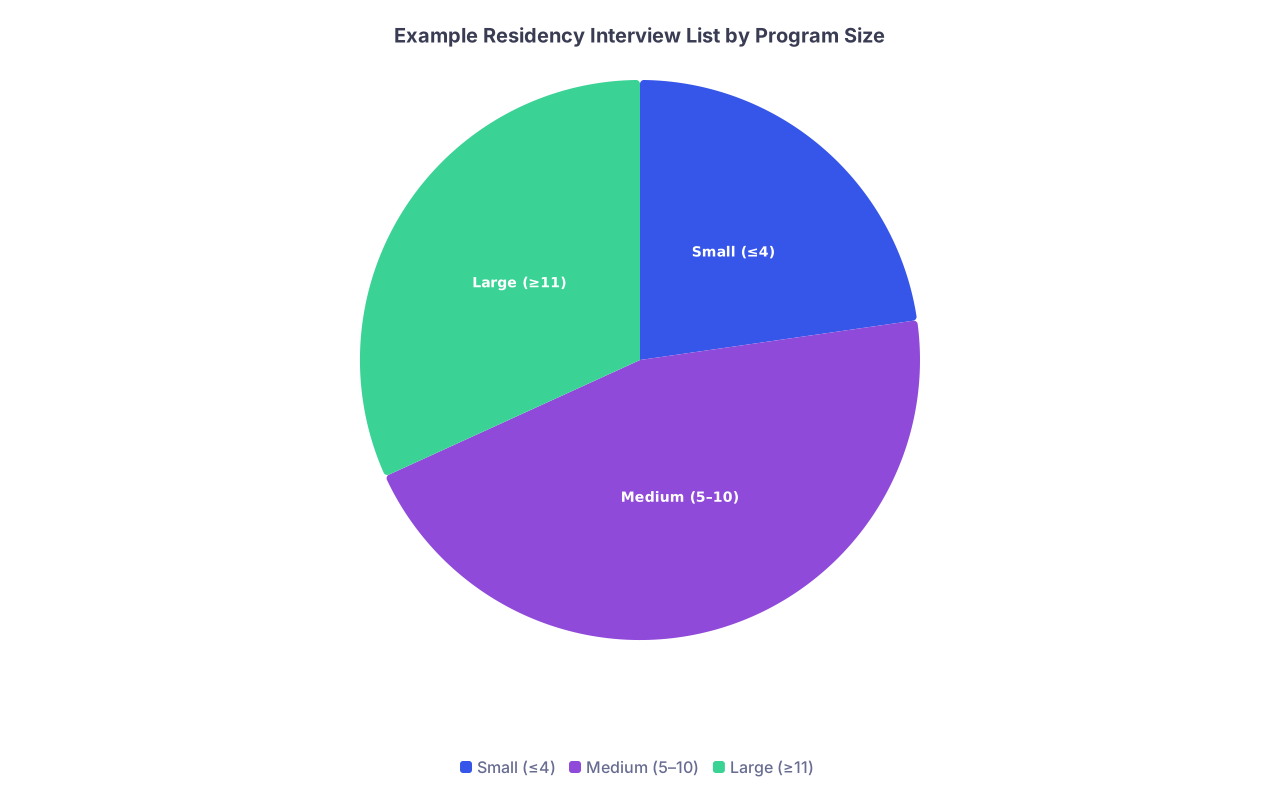
| Category | Value |
|---|---|
| Small (≤4) | 5 |
| Medium (5–10) | 10 |
| Large (≥11) | 7 |
If your pie chart is skewed heavily to “Small (≤4)” at the top of your list and you are not a top-of-the-pile candidate, you are playing a high-variance game.
Here is a more quantitative rule set you can use:
- Ensure at least 40–50% of your top 15–20 ranks are programs with ≥8 positions.
- In “less competitive” specialties, try to include at least 3–5 large programs (≥12 positions) in your realistic geographic range.
- Do not treat tiny, desirable programs as safeties. Treat them as opportunistic upside.
One more nuance: small programs where you rotated or have strong ties behave more like larger programs in probability terms, because your effective “rank percentile” jumps. Those are the legitimate small-program “safeties.” Blind applications to small, nice-city programs? Not safeties.
8. Processes and Timing: How Program Size Affects Interview Behavior
Program size also changes how programs handle their calendar and offers. Understanding this helps you avoid unforced errors with cancellations and signals.
Smaller programs:
- Tend to have fewer interview dates and less flexibility.
- Often send out a batch of invites, then wait and see.
- Are more likely to be personally offended (and remember) unexplained cancellations because each slot is precious.
Larger programs:
- Run multiple parallel tracks, many days, sometimes dozens of interviewers.
- Overbook and over-offer, assuming a fraction will decline.
- Have machinery for last-minute backfills from waitlists.
A simple mental map looks like this:

| Step | Description |
|---|---|
| Step 1 | Program size |
| Step 2 | Limited dates |
| Step 3 | High weight on ties |
| Step 4 | Moderate flexibility |
| Step 5 | Balanced mix of ties and externals |
| Step 6 | Many dates |
| Step 7 | Large interview pool |
| Step 8 | Small <=4 |
| Step 9 | Medium 5-10 |
| Step 10 | Large >=11 |
What this means for you:
- Cancel large programs before small ones if you must cut. Big programs can absorb it better; small ones cannot.
- Be very careful about canceling a small program that is one of your only interviews in a region. They probably interviewed you for a reason.
- When in doubt, keep the larger programs on your list even if you think “I might not love that city.” Size alone shifts the probability curve in your favor.
9. The Bottom Line: How Size Really Correlates with Competitiveness
If I compress all the numbers and patterns into a few blunt statements:
At the program level, small size usually increases effective competitiveness for outsiders, even in “least competitive” specialties. Many of these small programs function as de facto “selective” because they fill from a narrow, known pool.
At the applicant level, your safest bets in less competitive specialties are often medium–large programs in less glamorous locations. These combine the macro-ease of the specialty with the micro-advantage of big rank lists and deeper tails.
“Least competitive specialty” is a misleading phrase. What you really care about is “least competitive program profile that I am actually willing to attend”: moderate or large size, reasonable location, adequate training, and a history of matching people with profiles like yours.
If you build your application and rank strategy with those three realities in mind—and stop assuming that small automatically means friendly—you will align much better with what the data actually show.