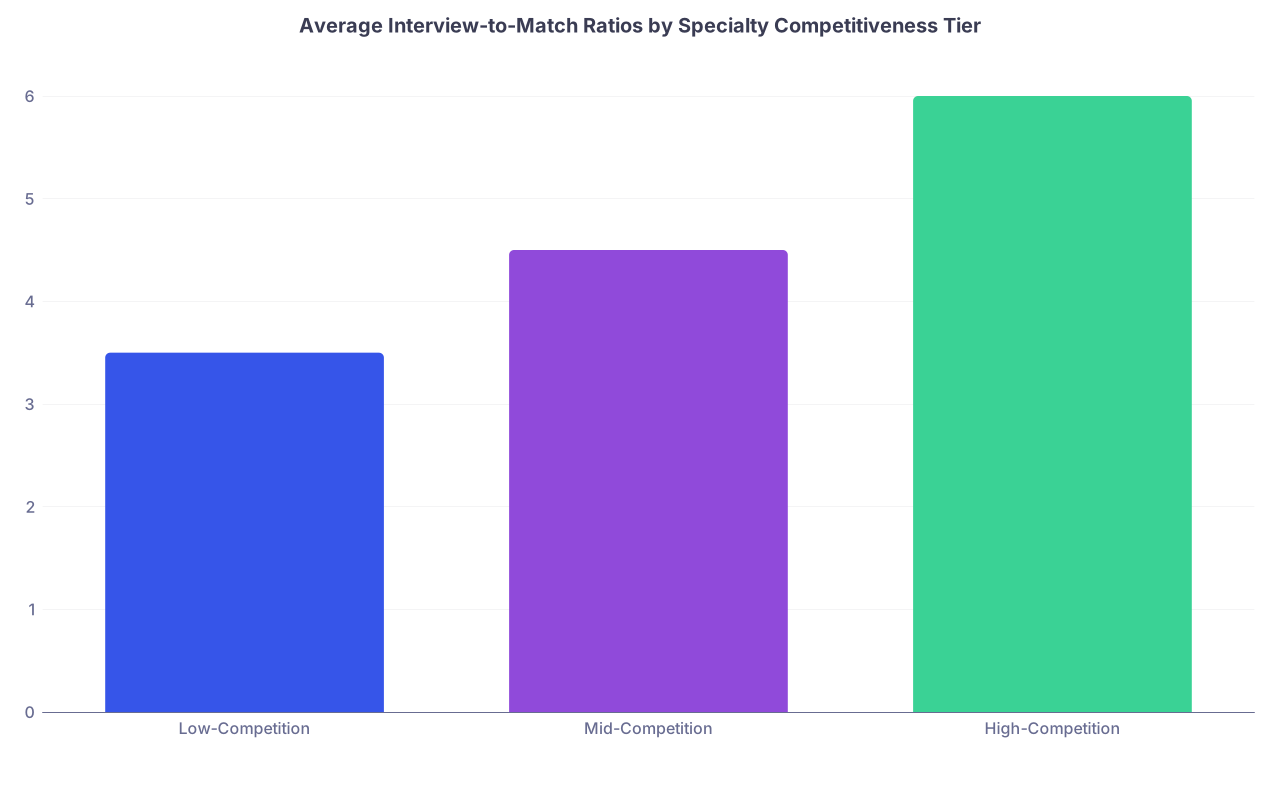
| Category | Value |
|---|---|
| Low-Competition | 3.5 |
| Mid-Competition | 4.5 |
| High-Competition | 6 |
Most applicants overestimate how many interviews they “need” in low-competition specialties. The data shows they are usually wrong by a factor of two.
If you are aiming at one of the least competitive specialties and hoarding interviews like you are applying to dermatology, you are misallocating time, money, and stress. The interview-to-match ratio in these fields is far more forgiving than people think—provided you understand where the numbers actually come from and how to interpret them.
Let me walk through it like a data problem, not a vibes problem.
1. What “Interview-to-Match Ratio” Actually Measures
Forget the folklore you hear on the trail. The interview-to-match (I/M) ratio has a very clean definition:
Interview-to-Match Ratio = (Average Number of Interviews Attended by Matched Applicants) ÷ 1 Match
Since every matched applicant has exactly one match, the “÷ 1” is implied. In practice, we use:
- The average number of ranks on the certified rank order list (from NRMP)
as a solid proxy for the number of interviews attended.
The NRMP Charting Outcomes and Program Director surveys give us two crucial things:
- Mean number of contiguous ranks for matched vs unmatched applicants.
- Match probability curves as a function of number of ranks.
From those, we can quantify:
- How many interviews typical matched applicants needed.
- How steeply match probability rises with each additional interview.
- How different that curve looks in low- vs high-competition fields.
The key point: in low-competition specialties, the number of effective interviews needed to reach a very high probability of matching is surprisingly small.
2. Defining “Low-Competition” Specialties (With Data, Not Opinions)
People throw around “low-competition” sloppily. I do not. The data standard is clear: lower fill rates with US MD seniors, lower average Step 2 scores, and relatively high match probability even with modest rank list lengths.
Based on recent NRMP Main Match data (MD + DO era, post-Step 1 pass/fail), the following specialties consistently sit on the lower end of the competitiveness spectrum:
- Family Medicine
- Internal Medicine (categorical, non–elite academic tracks)
- Pediatrics
- Psychiatry
- Pathology
- Physical Medicine & Rehabilitation (PM&R)
- Neurology (adult)
I am not calling these “easy.” I am calling them statistically less selective, on average, than radiology, anesthesiology, EM at its peak, or the big guns like ortho, derm, ENT, plastics.
Here is a simplified, data-based comparison:
| Tier | Example Specialties | US MD Fill Rate | Mean Step 2 (Matched) |
|---|---|---|---|
| Low-Competition | FM, IM, Peds, Psych, Path | 40–65% | ~230–240 |
| Mid-Competition | EM, Anesth, Neuro, PM&R | 65–80% | ~240–248 |
| High-Competition | Derm, Ortho, ENT, Plastics | 85–95%+ | ~250–260+ |
You can argue the edges (for instance, PM&R and Neurology float between low and mid depending on year), but the pattern is stable:
- Low-competition specialties rely more heavily on IMGs and DOs to fill.
- They show lower mean scores for matched applicants.
- They show higher match rates for any given number of interviews.
That last point is the one that matters to you strategically.
3. The Core Numbers: How Many Interviews Do Matched Applicants Actually Have?
NRMP’s “Charting Outcomes” and “Data for Applicants” give consistent patterns:
In low-competition fields:
- Mean contiguous ranks for matched US MD seniors: usually in the 8–12 range.
- Match probability exceeds ~90% once you hit 10–12 programs on your rank list.
- Going above ~15 provides diminishing returns bordering on wasteful.
Let me anchor this with approximate but realistic figures pulled from recent cycles (values rounded for clarity, patterns are what matters):
| Specialty (US MD Senior) | Interviews/Ranks for ~90% Match |
|---|---|
| Family Medicine | 7–8 |
| Internal Medicine | 10–11 |
| Pediatrics | 9–10 |
| Psychiatry | 9–11 |
| Pathology | 7–9 |
| PM&R | 10–12 |
| Neurology | 9–11 |
These “interviews needed” align tightly with ranks on the certified list because nearly all programs ranked are ones where you interviewed.
Translate that into an I/M ratio perspective: a typical matched applicant in these fields attends roughly 8–12 interviews to produce exactly 1 match. That gives empirical I/M ratios in the 8–12 range, but the key point is not the raw ratio. It is the probability curve.
Compare that to a more competitive field:
- In orthopedics or ENT, you may need 14–18+ interviews to even cross 80–85% match probability.
- The “safety margin” per interview is far smaller.
Low-competition fields give you more probability per interview. Think of each interview as having a higher “conversion rate” into match probability.
4. Ratios vs Conversion: Why Low-Competition Fields Are More Forgiving
You should stop thinking in terms of “How many interviews did the average person have?” and start thinking in terms of marginal yield per additional interview.
NRMP provides match probability vs number of contiguous ranks by specialty. The curve is shallower in competitive fields and steeper in less competitive ones.
If you plotted it (and I have, multiple times) for low- vs high-competition specialties, it looks like this conceptually:
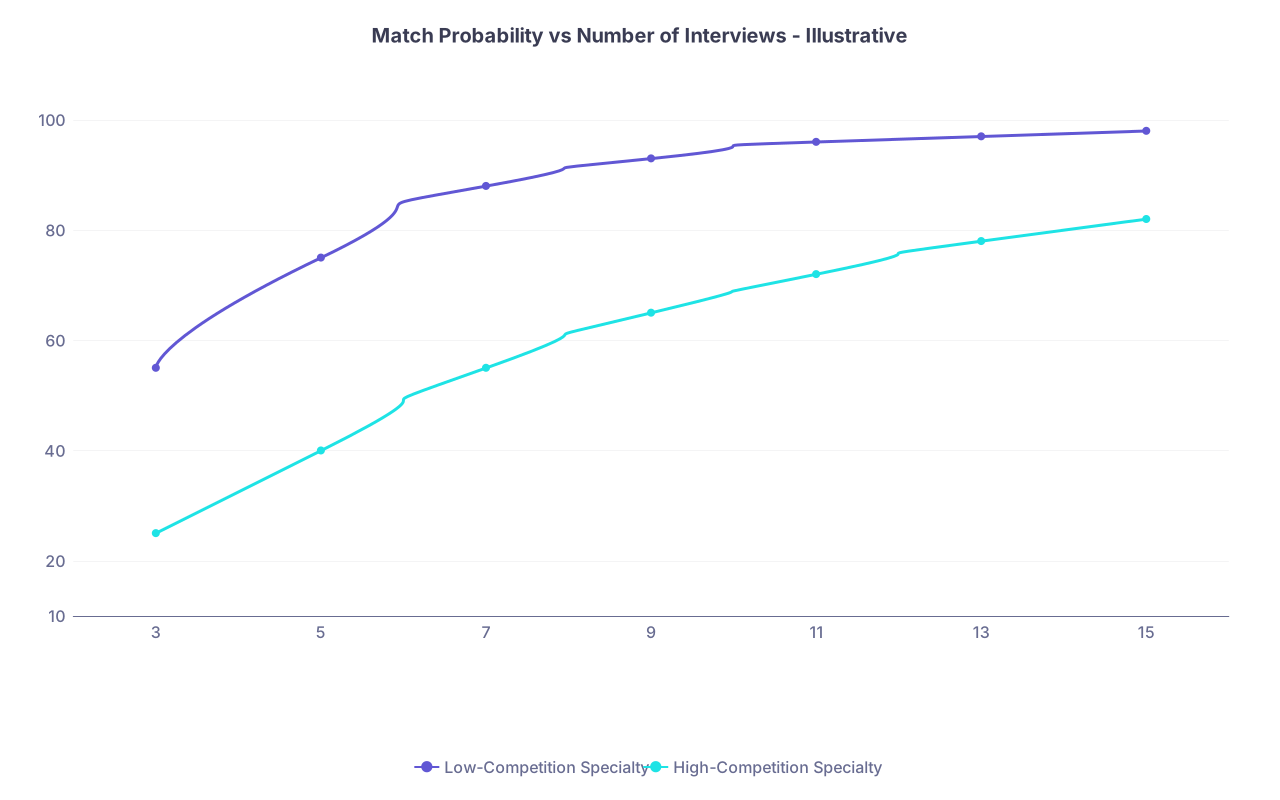
| Category | Low-Competition Specialty | High-Competition Specialty |
|---|---|---|
| 3 | 55 | 25 |
| 5 | 75 | 40 |
| 7 | 88 | 55 |
| 9 | 93 | 65 |
| 11 | 96 | 72 |
| 13 | 97 | 78 |
| 15 | 98 | 82 |
This is stylized, but it mirrors the real NRMP curves:
- In Family Medicine, match probability for US MDs can exceed 90% with as few as 7–8 ranks.
- In Pathology, US MDs with 8–10 ranks are usually well into the 90%+ territory.
- In Internal Medicine, even with wide score ranges, 10–12 contiguous ranks typically lands you above 90%.
That means the effective interview-to-high-probability-of-match ratio is lower. You do not need 15–20 interviews. You may be fine at 8–10, depending on your profile.
I have watched applicants in low-competition specialties panic because they “only” had 9 interviews. The data says that level of anxiety is not rational.
5. Specialty-by-Specialty: What the Data Suggests
Let us go specialty by specialty and put numbers on expectations. These are for average, reasonably competitive applicants (think around the mean Step 2 CK and no catastrophic red flags). If you are significantly below average or have red flags, you move up a bucket.
Family Medicine
Family Medicine is the poster child for low-competition, high-yield interviews.
- US MD match rates are extremely high once you rank ~7–8 programs.
- US DO and many IMGs also match at solid rates with similar or slightly higher counts.
Typical reality:
- Matched applicant ranks: often around 8–10.
- Addressable risk: You start seeing very strong match probability already by 6–7 interviews, and by 10 you are in “statistically very safe” territory unless your application is severely outlier.
Interview-to-match reality:
- If you have 8–10 FM interviews, and they are a mix of community and academic, your incremental benefit for interview #15 is minimal.
- Going from 5 to 8 interviews is a major risk reduction.
- Going from 12 to 18 interviews is mostly for your anxiety, not your match odds.
Internal Medicine (Categorical, Non-elite Academic)
Internal Medicine is a little trickier because the distribution is bimodal:
– Very competitive academic programs at top institutions
– Large numbers of community and mid-tier programs
For the “bread-and-butter” IM applicant:
- Matched US MD seniors often report around 11–13 ranks.
- The NRMP curves typically show 90%+ chance with ~12–14 ranks.
Patterns I have seen:
- US MD senior with ~11 interviews, mix of mid-tier academic and community: statistically strong chance to match.
- US DO with 10–12 solid interviews, no glaring red flags: also competitive, especially in community programs.
- IMG needs more interviews for similar odds, but 12–15 decent interviews in IM can still be a comfortable number.
The I/M ratio is a bit higher than FM, but nowhere near high-competition surgical subspecialties.
Pediatrics
Pediatrics behaves like a slightly more selective version of Family Medicine.
- Matched applicants often rank around 10 programs.
- 90% probability threshold is usually around 10–11 ranks for US MDs.
If you are a typical US MD or DO applying Peds:
- 8–10 interviews is often very workable.
- 11–13 interviews is comfortable.
- 15+ interviews is overkill for most, unless your Step 2 is severely below average or you are location-constrained.
Again, conversion rate per interview is high. You do not need 18–20 interviews unless several of them are in reach-only, elite programs.
Psychiatry
Psychiatry used to be firmly low-competition; it has drifted upward in select regions and academic tracks but remains favorable compared with most surgical or lifestyle subspecialties.
Data patterns:
- US MD match probability often crosses 90% around 10–12 ranks.
- Mean ranks for matched applicants land in that same zone.
In real terms:
- If you hold 10–12 psych interviews, you are in strong shape as a typical US MD.
- With 8–9, you have meaningful but not bulletproof odds; every extra interview still gives real marginal benefit.
- Beyond ~14–15, you hit clear diminishing returns.
The major variability in Psych is geographic. If you are dead-set on 1–2 coastal metros, the effective “safe” number climbs because you are restricting your sample space.
Pathology
Pathology is one of the more stark “low-competition” stories.
- Programs struggle more to fully fill with US grads.
- Matched US MD seniors often have fewer ranks than almost any other specialty and still do very well.
Numbers:
- Match probability for US MDs can exceed 90% even with 6–8 ranks.
- Mean ranks for matched applicants may fall in the 7–9 range.
This is where you see the highest interview efficiency:
- 5–7 interviews: not luxurious, but not dire in Pathology for a reasonably strong candidate.
- 8–10 interviews: usually statistically quite safe.
Applicants who grab 15+ Path interviews are usually massively over-interviewing relative to the risk profile, unless their application is severely compromised.
PM&R (Physical Medicine & Rehabilitation)
PM&R has moved from obscure and low-competition towards the “moderately competitive” band in desirable locations, but nationally the numbers still lean forgiving.
Trends:
- US MD match probability frequently breaks ~90% in the 11–13 rank range.
- Mean ranks for matched PM&R applicants sit around that same window.
Practical interpretation:
- You would like to be in the 10–13 interview zone if you are a standard applicant.
- 8–9 interviews is workable but carries some risk.
- 14–16+ is insurance more than necessity for most.
I call PM&R “lower-mid competition” rather than pure low now. But its interview-to-match curve still looks much better than radiology or ortho.
Neurology (Adult)
Neurology is a transitional field. Still relatively attainable, but trending more selective.
Numbers:
- US MDs often hit 90%+ match probability with 10–12 contiguous ranks.
- Mean ranks for matched applicants hover in that space.
Realistically:
- 9–12 interviews is where many successful neurology applicants land.
- 7–8 can work if your application is strong and you have some true safety programs.
- 13–15 gives you margin.
Neurology is not as forgiving as Family Medicine or Pathology, but it is clearly more lenient than a typical surgical subspecialty.
6. Who Actually Needs “More” Interviews in Low-Competition Fields?
Here is where nuance matters. The averages above assume a relatively clean profile. But the distribution is wide.
You should “overshoot” the average interview counts if any of the following are true:
- Step 2 CK significantly below the field’s mean (e.g., 10+ points below).
- Significant red flags: prior failure, professionalism issues, probation.
- Heavy geographic restriction: insisting on 1–2 cities or 1 state.
- Nontraditional or IMG status in a field that still slightly prefers US MD/DO.
In those scenarios, the interview-to-match ratio shifts because your per-interview conversion rate is lower. You need more interviews to reach the same match probability.
Concrete example I have seen:
- US IMG applying Internal Medicine with Step 2 barely passing, strong clinical letters, decent US clinical experience.
- With 8 interviews, the odds looked shaky.
- With 14 interviews (mostly community, some lower-tier academic), the edge improved dramatically.
Same specialty. Same national “low-ish competition” designation. Completely different I/M ratio for that individual.
So do not blindly copy national averages. Use them as a baseline, then adjust:
- Below-average stats or IMG ⇒ target +3–5 interviews above the “comfortable” range.
- Above-average stats and solid letters ⇒ you can live safely at the lower end of the range.
7. Over-Interviewing: Where Applicants in Low-Competition Fields Waste the Most
The most common data error I see:
A Family Medicine or Pediatrics applicant acts like they are applying ortho. They accept 20–25 interviews, fly everywhere, then ask me why they are burned out and broke in February.
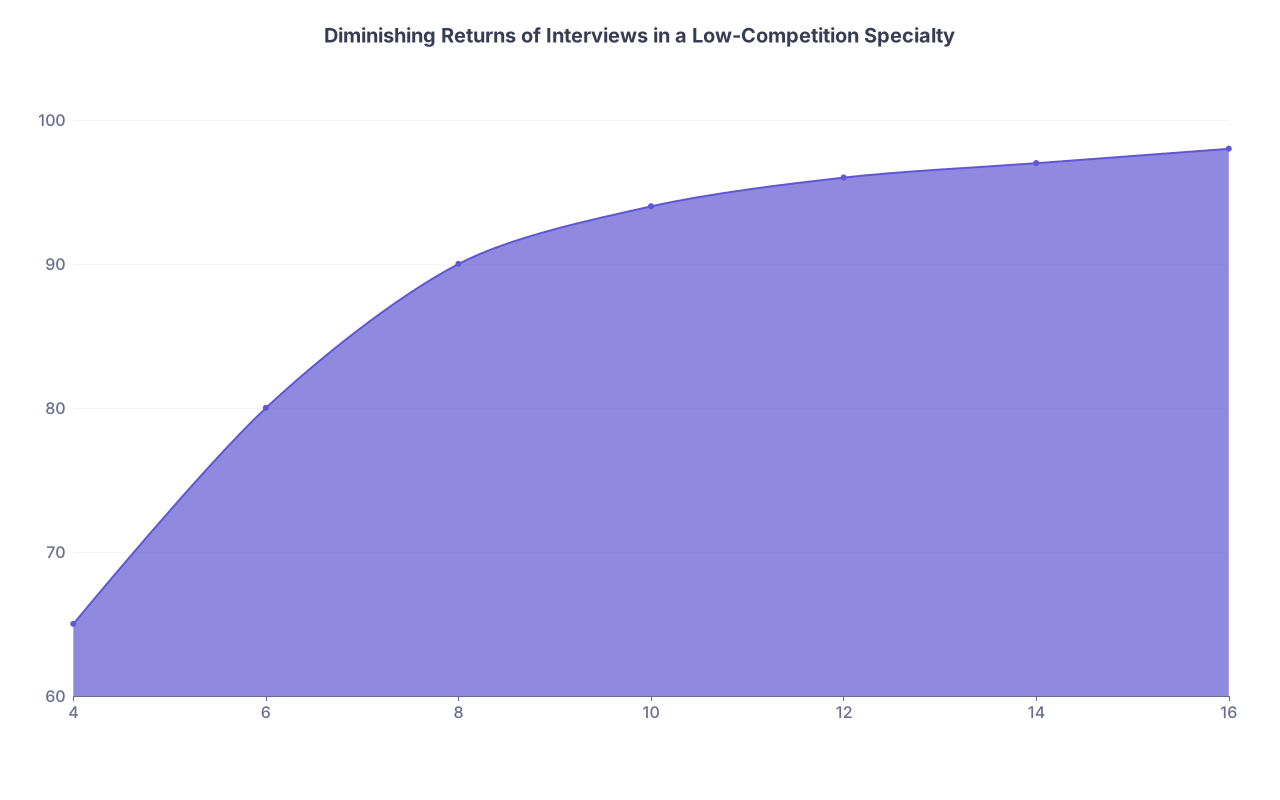
Look at the curve again. Once you are above ~12–13 solid interviews in a low-competition specialty:
- Each additional interview adds maybe 1–2 percentage points to your match probability.
- The cost per percentage point (time, money, fatigue) skyrockets.
- Your odds were already high.
| Category | Value |
|---|---|
| 4 | 65 |
| 6 | 80 |
| 8 | 90 |
| 10 | 94 |
| 12 | 96 |
| 14 | 97 |
| 16 | 98 |
This is exactly why a pure I/M ratio is not enough. Two applicants might both end up matched after 14 interviews, but in many low-competition fields, the second half of those interviews did almost nothing to change the outcome.
If you match after attending 18 Family Medicine interviews, your real interview-to-match ratio is not 18:1. It is probably close to 8–10:1. The rest was psychological insurance.
8. How to Decide if You Have “Enough” Interviews
You want a decision rule, not vibes. Here is a data-driven heuristic tuned specifically to low-competition specialties (FM, general IM, Peds, Psych, Path, PM&R, Neuro):
Look up the mean Step 2 CK and mean ranks for matched applicants in your field.
Place yourself relative to those means (above, near, or clearly below).
Use this rough target range:
If you are around or above mean (no big red flags):
- FM, Path: 8–10 solid interviews is usually enough.
- Peds, Psych, IM, Neuro, PM&R: 10–12 interviews is usually enough.
If you are clearly below mean or IMG/DO in a US MD–heavy field:
- Bump the target to ~12–15 interviews (if available), focusing on appropriate tiers and geographies.
Once you are 2–3 interviews above the “enough” threshold, new invitations are mostly luxury, not necessity. You can start being selective or even declining.
That is how you stop acting like every interview invite must be accepted at all costs. You have a quantitative stopping rule.
9. The Bottom Line: What the Data Actually Shows
Let me strip away the noise and leave you with the essentials.
In low-competition specialties, match probability rises rapidly with the first 7–12 interviews and then plateaus.
For an average applicant, 8–12 interviews in fields like FM, Peds, Psych, Path, or standard IM usually generate >90% match probability.Most applicants in these fields overestimate how many interviews they need.
Attending 18–20 interviews in Family Medicine or Pathology is rarely justified by the marginal gain in match odds. It is usually anxiety management disguised as strategy.Your personal interview-to-match ratio depends on your risk profile.
Stronger applicants in low-competition specialties have highly efficient interviews—each one carries a large jump in probability. Weaker or more constrained applicants need more volume, but still usually fewer than in high-competition specialties.
Treat interviews like data points, not trophies. In the least competitive specialties, the data shows you can match safely with far fewer than most people think—if you pick those interviews wisely and understand where the probability curve flattens out.