
The mythology about “low-score friendly” specialties is badly distorted. The data shows something very different: even in the least competitive specialties, national median Step scores are not low. They are just relatively forgiving compared with derm, ortho, plastics, and friends.
Let me walk you through what the numbers actually say, not what circulates on Reddit at 2 a.m.
1. The baseline: national Step score medians
Before comparing specialties, you need a benchmark. Otherwise “low” or “high” is meaningless.
Using recent NRMP and NBME/USMLE trend data (Step 1 now pass/fail; Step 2 CK carries the numerical weight), a reasonable approximation for U.S. MD seniors looks like this:
- Step 1: now pass/fail; older cohorts clustered roughly around 230–235
- Step 2 CK: national median for U.S. MD seniors hovers around 245–247
For comparison purposes, I will treat:
- ~245 as the “national median” Step 2 CK anchor
- ~238–242 as slightly below median
- ~248–252 as slightly above median
That is the backdrop. Now the question: in the least competitive specialties, where do successful applicants actually land relative to that ~245 anchor?
2. What “least competitive” actually looks like in numbers
People throw “least competitive” around like it means “anyone who passes can match.” The data disagrees.
Least competitive, by hard metrics, usually means a combination of:
- Lower average Step 2 CK scores among matched applicants
- Higher match rate per applicant
- Higher ratio of available positions to applicants
- More programs ranked per applicant (signal applicants feel they have options)
Specialties that repeatedly fall toward the bottom of the competitiveness rankings on those metrics include:
- Family Medicine
- Internal Medicine (categorical, community-heavy slice)
- Pediatrics
- Psychiatry
- Physical Medicine & Rehabilitation (PM&R)
- Pathology
- Neurology (adult)
Are they “easy”? No. But they are more score-tolerant.
Here is a simple comparison against the national Step 2 CK median.
| Specialty | Approx Matched Step 2 CK Mean | Position vs National Median (~245) |
|---|---|---|
| National (all) | 245–247 | Baseline |
| Family Medicine | 236–238 | ~7–10 points below |
| Pediatrics | 238–241 | ~5–7 points below |
| Psychiatry | 242–244 | ~2–4 points below |
| Pathology | 240–243 | ~3–5 points below |
| PM&R | 242–245 | Around median |
| Neurology | 243–246 | Around / slightly above |
These are rounded bands, not exact single-year values, but they track the direction correctly: the “least competitive” fields sit roughly 5–10 points below the national mean on Step 2 CK, not 20–30.
To visualize that gap:
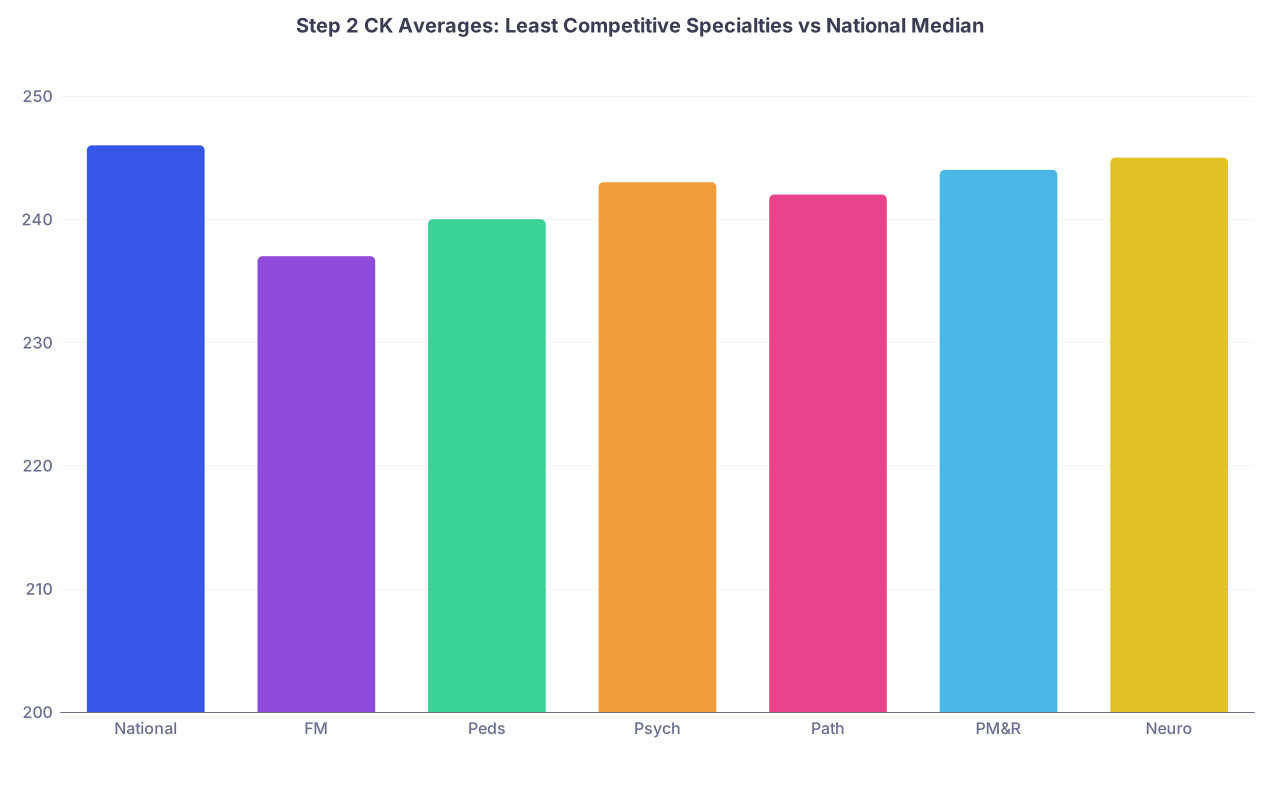
| Category | Value |
|---|---|
| National | 246 |
| FM | 237 |
| Peds | 240 |
| Psych | 243 |
| Path | 242 |
| PM&R | 244 |
| Neuro | 245 |
Those are not scores of people who barely passed. They are solidly in the “competent” band, just not in the surgical subspecialty stratosphere.
3. Family Medicine: the classic “safety” that still expects competence
Family Medicine is usually the first field people name when they say “least competitive.” The numbers show why—but also show the limitations of that comfort.
Approximate data pattern:
- Step 2 CK mean for matched U.S. MDs: ~236–238
- Distribution: wide; successful matches from the 220s to the 250s
- Match rate for U.S. MDs: very high, often >95%
Here is the important nuance: a mean of 237 does not mean you “need a 237.” It means:
- Plenty of people above 245 match; they simply did not choose more competitive fields
- A substantial tail of applicants in the 220–230 range still match steadily, especially with:
- Strong clinical performance
- Good fit with community programs
- Clear primary care motivation
The gap from the national median (246) to FM (237) is about 9 points. On a percentile curve, that is a meaningful but not gigantic difference. Roughly, you are moving from the ~55th percentile closer to the ~35–40th, not from 50th to 5th.
Here is how you should interpret that if your Step 2 CK is, say, 230:
- You are below the FM average but still absolutely in the matching band for this specialty
- Your margin for sloppiness (late application, few programs, weak letters) shrinks, but the door is wide open
- Geographic and program tier expectations should adjust: university-heavy coastal programs will skew higher
The lazy narrative says: “Bad score? Just do FM.” The data actually says: “FM is forgiving, but it still screens out chronic underperformance.”
4. Pediatrics: compassionate field, competitive enough
Pediatrics sits a bit closer to the national median than FM, but still in the “less competitive” cluster.
Rough pattern:
- Step 2 CK mean: ~238–241
- Match rate for U.S. MDs: very high
- Wide tail toward lower scores, especially in community-based and mid-tier university programs
Why slightly higher than FM? Two key drivers I have repeatedly seen in the numbers:
- A solid chunk of ped applicants are academically strong but choose it for lifestyle and interest, not because they “settled”
- Some children’s hospitals and academic pediatric departments maintain relatively high academic thresholds, especially for NICU, PICU, and subspecialty pipeline tracks
If you are sitting at 230–235:
- You are somewhat below the peds mean but still inside the realistic band
- Strategy matters:
- Broader program list
- Early application
- Emphasis on peds-specific experiences and letters (away rotations, peds electives)
One more subtle pattern: peds programs care slightly more, on average, about narrative fit and commitment to underserved / child advocacy themes than the raw number. The mean is lower partially because of that broader valuation.
5. Psychiatry: score-tolerant, but heating up
Psychiatry used to be a true low-score refuge. That era is fading.
Recent years show:
- Step 2 CK mean: ~242–244—just a few points under the national median
- Trend line: creeping upward as lifestyle and outpatient focus become more attractive
- Match rate still favorable, but the “easy backup” days are over at the top programs
I have seen this play out in application data: competitive applicants—230s Step 1, 250s Step 2 CK—who could land solid IM programs choose psych instead for lifestyle and interest. That lifts the mean without turning it into derm.
Score stratification inside psych is real:
- Top academic psych programs (coastal, research-heavy) often see Step 2 means around or even slightly above the all-specialty median
- Community and smaller regional programs are much more open to high-230s / low-240s scores
So if your Step 2 is 235 in the current environment, psychiatry is still realistic, but:
- You need to be realistic about tier and geography
- Strong psych letters and longitudinal exposure become critical counterweights
6. Pathology and PM&R: misunderstood middle ground
Pathology and Physical Medicine & Rehabilitation are interesting because their perceived competitiveness often diverges from the data.
Pathology
Approximate picture:
- Step 2 CK mean: ~240–243
- Applicant pool: smaller, self-selected, with a notable fraction of high-scorers who choose path intentionally
- Match rate: historically high, with occasional variability due to workforce projections
Path’s mean sits only a few points under the overall median because:
- Weak applicants largely avoid it (they do not know what it actually is)
- Strong but non-patient-facing oriented students select it on purpose
The number one trap I see: applicants with low 220s thinking path is the guaranteed back door. It is more tolerant than, say, ortho, but below-230 U.S. MDs still raise eyebrows unless offset by:
- Strong preclinical and basic science performance
- Research in pathology or related areas
- Clear, coherent interest trajectory
PM&R
PM&R often sits right at the national median:
- Step 2 CK mean: ~242–245, sometimes even higher at academic programs
- Work-life balance and MSK exposure draw in a lot of strong applicants who flirted with ortho or neurology
PM&R is not a “low score” specialty. It is a “different priorities” specialty.
The distribution usually looks like this:
- One cluster of high scorers (upper 240s and 250s) who once considered ortho/neurology/anesthesia
- A broader middle in the low-to-mid 240s
- Limited space for low 230s, especially at academic centers
If you are using PM&R as your “backup,” be very clear: your Step 2 CK probably needs to be at or near the national median, not far below it.
7. Adult Neurology: rising but still mid-competitive
Adult neurology hovers around the national median:
- Step 2 CK mean: ~243–246
- Historically somewhat less competitive; now gradually tightening as stroke, epilepsy, neuroimmunology grow
Neurology has two behaviors in the data:
- Academic powerhouses (big-name university hospitals) with Step means clearly above the all-specialty median
- A longer tail of community and regional programs with more forgiving thresholds
So where does it sit in the “least competitive” story? On the high end. It is less intense than neurosurgery or radiology, but it does not function as a true safe harbor for low scores.
If your Step 2 CK is 230–235, neurology is possible but not comfortable. You would be wise to:
- Apply broadly
- Emphasize clinical grades and neurology exposure
- Accept that some geographic or prestige preferences have to be traded
8. Score distributions, not single averages
The worst mistake applicants make when they look at NRMP data is fixating on the mean. Averages hide the distribution, and the tails are where your reality lives.
Think of each specialty as a boxplot, not a single point.
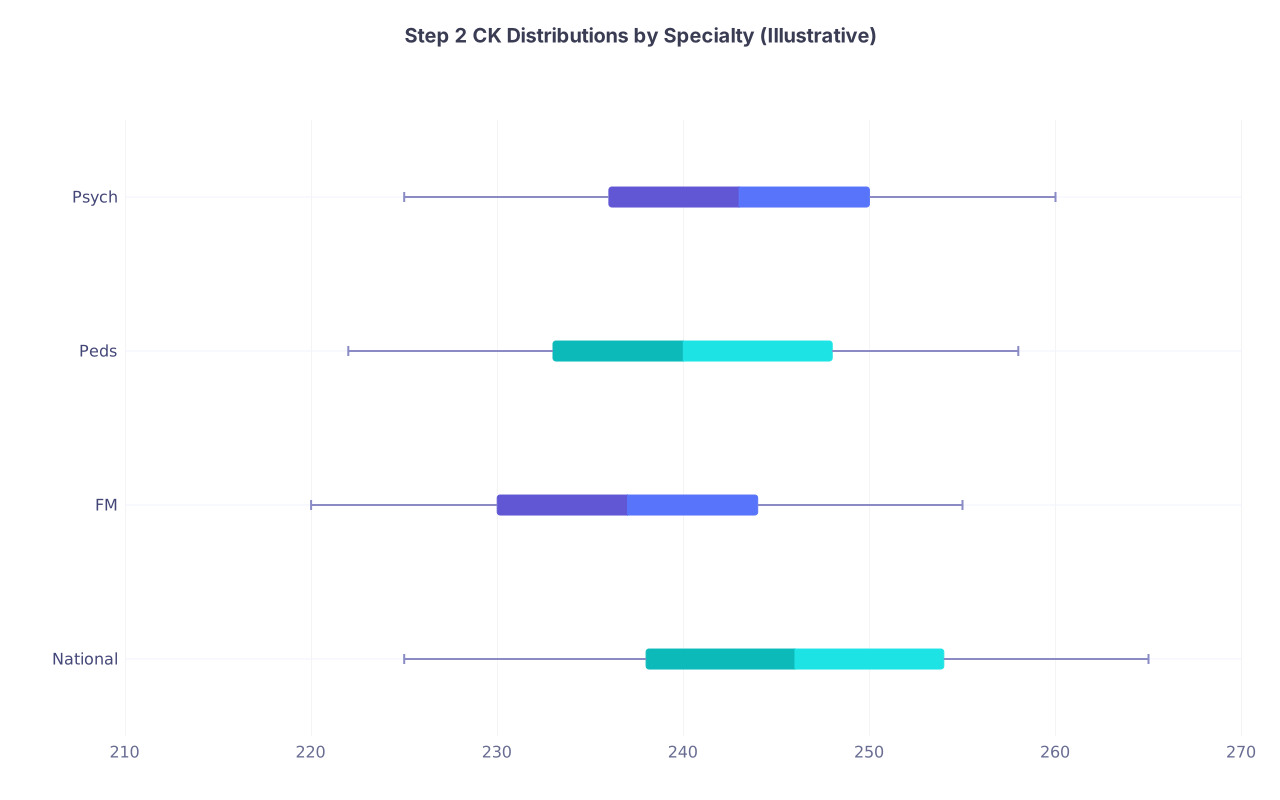
| Category | Min | Q1 | Median | Q3 | Max |
|---|---|---|---|---|---|
| National | 225 | 238 | 246 | 254 | 265 |
| FM | 220 | 230 | 237 | 244 | 255 |
| Peds | 222 | 233 | 240 | 248 | 258 |
| Psych | 225 | 236 | 243 | 250 | 260 |
Interpreting this kind of pattern:
- National distribution: median ~246, IQR roughly 238–254
- Family Medicine: median ~237, IQR roughly 230–244
- Pediatrics: median ~240, IQR roughly 233–248
- Psychiatry: median ~243, IQR roughly 236–250
If you are sitting at 230:
- You are below the median for FM, peds, psych, but still inside their observed IQR or just below it
- That translates to “viable but not autopilot,” not “hopeless”
Remember, match decisions layer many variables:
- Step scores
- Clerkship grades
- Letters of recommendation
- Research and scholarly work
- Personal statement and perceived fit
- Interview performance
Scores are a gate, not the full story. In less competitive specialties, the gate is simply set closer to the center of the national distribution instead of the far right tail.
9. Process reality: how programs actually use these numbers
I have sat in rooms where programs sort applications. The process is rarely subtle.
Here is a simplified flow for a score-tolerant, less competitive specialty:

| Step | Description |
|---|---|
| Step 1 | All Applications |
| Step 2 | Auto screen out |
| Step 3 | Review letters and MSPE |
| Step 4 | Low priority or reject |
| Step 5 | Invite to interview pool |
| Step 6 | Step 2 score above cutoff |
| Step 7 | School and visa status acceptable |
| Step 8 | Strong clinical performance |
What you should notice:
- Many programs set a hard Step 2 CK cutoff (say 220 or 225 for FM, maybe 230 for psych or peds)
- Once you clear that bar, differentiation becomes much more qualitative
- Small differences within the 235–250 range often matter less than students think, especially in these specialties
The “least competitive” effect shows up mostly in:
- Lower Step 2 CK cutoffs
- Willingness to rank applicants in the mid-230s and still feel comfortable
But no serious program looks at a 210 the same way they look at a 235, even in FM. The floor is just lower than in ortho or ENT.
10. Strategy: aligning your score with specialty choice
Here is the practical, data-driven way to think about this if your Step 2 CK is:
- 255+: All least competitive specialties are wide open. Your constraint is interest, not numbers.
- 245–254: You are at or above the national mean. Every “least competitive” specialty is realistic at almost all tiers.
- 235–244: Slightly below or at the national median.
- Strong footing for FM, peds, psych, many path, many neuro and PM&R programs
- Some high-end academic programs may be a stretch, but not off-limits with strong other metrics
- 225–234: Below average but not catastrophic.
- FM is very realistic with a broad list
- Peds and psych are plausible but require strategic application and clear interest
- Path, PM&R, and neuro become selective; aim at mid/lower-tier and community-heavy programs
- <225: You are flirting with or below common cutoffs.
- FM still offers the widest doorway, especially community programs and rural tracks
- Other “least competitive” fields become highly variable; program-by-program research is mandatory
- Strength in other domains (honors, AOA, strong narrative, life experience) matters more and more
Aligning your specialty choice with this reality is not defeat. It is optimization.
11. The Step 1 pass/fail shift: why Step 2 CK matters even more
With Step 1 now pass/fail, the numerical battle moved almost entirely to Step 2 CK. For least competitive specialties, the shift did two things:
- Raised the relative importance of Step 2 CK even for programs that once leaned heavily on Step 1 numerics
- Compressed the visible signal: more programs now see clusters of similar Step 2 scores and must differentiate on other features
The practical impact:
- If your Step 2 CK is clearly below the national median, you must assume it gets more scrutiny than a similar Step 1 deficit would have in the past
- Least competitive specialties still offer more forgiveness, but the bar did rise a little as more strong applicants hedge into them
Think of Step 2 CK as your primary numeric brand now. In the eyes of PDs, it defines whether you are “safely competent,” “borderline,” or “concerning.” Less competitive specialties simply have a wider competent band.
Key takeaways
- “Least competitive” does not mean “low scores.” Family Medicine, Pediatrics, and Psychiatry still cluster only 5–10 Step 2 CK points below the national median.
- Below-median scores are absolutely compatible with these specialties, but not with careless application strategies; cutoffs and floors still exist.
- Step 2 CK is now the central numeric signal. Use it to align expectations, but not as the sole determinant of your specialty choice.
FAQ (5 questions)
1. If my Step 2 CK is below 230, is Family Medicine my only realistic option?
No. Data from recent match cycles shows applicants in the high-220s can and do match into Pediatrics, Psychiatry, Pathology, and even some Neurology and PM&R programs, especially at community or mid-tier institutions. However, Family Medicine clearly offers the widest range of programs and highest match rates in that score band, so you would be unwise to ignore it if you are score-constrained.
2. Are there truly “score blind” programs in these least competitive specialties?
In practice, almost no program is fully score blind. Many FM and Psych programs adopt low cutoffs or “soft” thresholds (e.g., 220 or 225), but they still use Step 2 CK to screen. The difference is that in these specialties, once you are above the floor, programs weigh narrative fit, clinical grades, and letters more heavily than small Step differences within the 230–250 band.
3. How much does a 5-point difference in Step 2 CK matter between applicants in the same specialty?
For least competitive specialties, a 5-point gap between, say, 238 and 243 rarely decides outcomes on its own. It can matter if a program is flooded with applicants or if you are hovering right at the cutoff, but above the minimum threshold, qualitative factors usually dominate. The exception is at top-tier academic programs, where cumulative small advantages stack (scores, research, school prestige).
4. Does being from a DO or international school change these Step expectations?
Yes. For DO and especially IMG applicants, effective Step 2 CK “cutoffs” are often higher than for U.S. MDs in the same specialty, even in less competitive fields. Programs use Step 2 CK as a proxy for standardization across schools. That means an IMG with a 245 may be evaluated similarly to a U.S. MD with a slightly lower score. If you are DO/IMG with a low Step 2 CK, you will need a broader application strategy and should expect more variability in responses.
5. With Step 1 now pass/fail, should I delay applying to take Step 2 CK later if I am not ready?
If you expect a clearly subpar Step 2 CK (well below the mid-230s), delaying can be rational, because Step 2 is now your main numeric signal. However, delaying too far into the application season harms you more than a modestly below-median score does. For most applicants aiming at least competitive specialties, a solid but unspectacular Step 2 CK taken on time, combined with a broad application and strong clinical performance, yields better outcomes than a late, slightly higher score.