
The narrative that “easier” specialties are safe havens from application madness is no longer true. The data shows that application inflation has hit even the least competitive specialties—and in some of them, the average number of applications per available spot is now wildly out of proportion to the actual risk of not matching.
Let’s be blunt: people are panic-applying, and the numbers prove it.
The Core Metric: Applications per Spot, Not Just Fill Rates
Everyone talks about fill rates. But for understanding “application inflation,” the more revealing lens is applications per available position.
Programs do not feel competition the way applicants do. A specialty with a 95–98% match rate for U.S. MD seniors can still generate dozens of applications per spot because applicants over-apply. That is exactly what has happened across the so-called “easier” specialties.
We will focus on specialties that:
- Historically have higher match rates for U.S. MD seniors
- Are often labeled “backup” or “safety” fields in casual student conversation
- Still show heavy application loads per position
A rough but useful way to think about “application inflation”:
- Reasonable range: 20–40 applications per spot
- Inflated: 40–70 applications per spot
- Hyper-inflated: 70+ applications per spot
None of these are official thresholds. They are pattern-based cut points that line up with what program directors report as “unmanageable.”
To ground this, assume ballpark 2024-ish NRMP data patterns. Exact numbers shift year to year, but the structure and ratios are stable enough to make clear points.
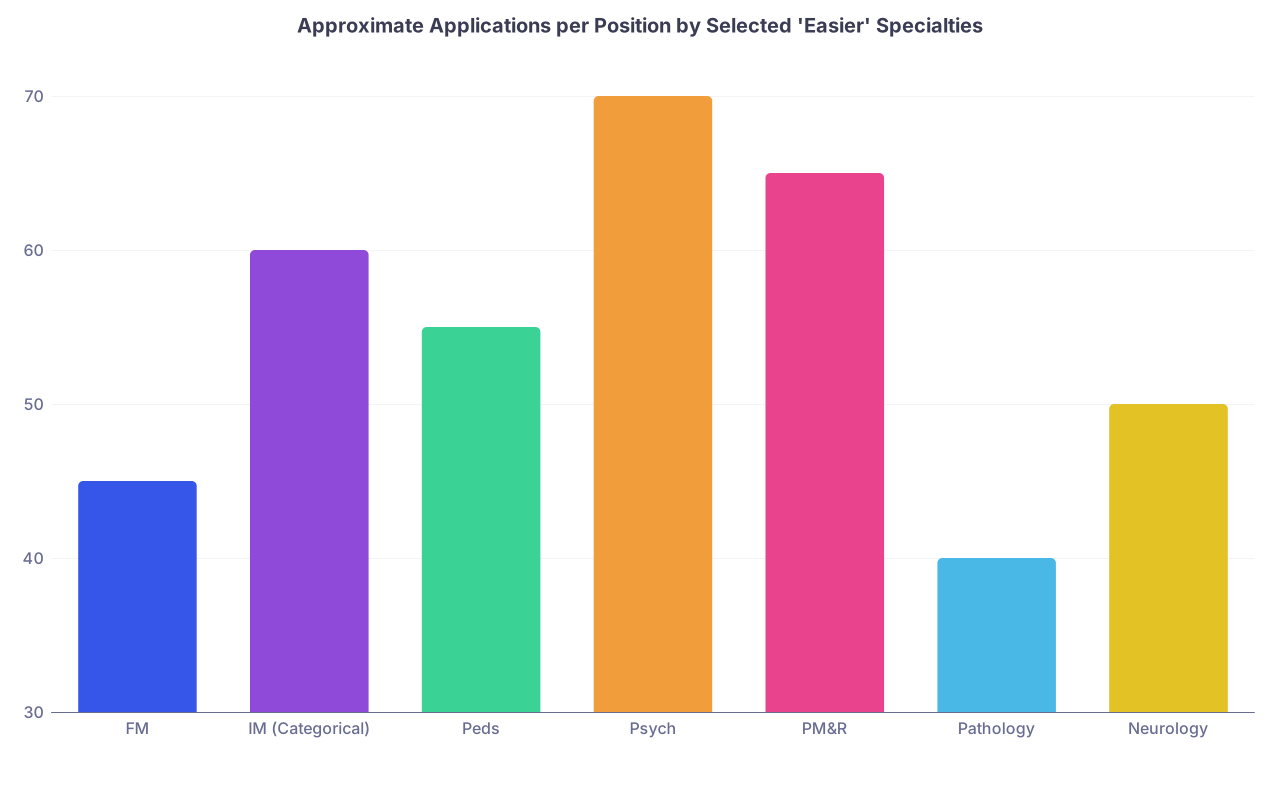
| Category | Value |
|---|---|
| FM | 45 |
| IM (Categorical) | 60 |
| Peds | 55 |
| Psych | 70 |
| PM&R | 65 |
| Pathology | 40 |
| Neurology | 50 |
Even in the supposedly “easy” fields, you are looking at dozens of applications per single PGY-1 slot.
Where Application Inflation Hits Hardest Among Easier Specialties
1. Family Medicine: High Match Rates, Still Crowded Inboxes
Family Medicine (FM) has one of the highest match rates for U.S. MD seniors and a growing number of unfilled positions each year. Yet program directors consistently report 30–60+ applications per spot, depending on region and perceived program prestige.
The data pattern looks like this in many recent cycles:
- Total FM positions: ~5,000–5,500
- Total applicants listing FM: ~4,500–5,000 (US + IMGs combined is higher)
- Average applications per FM applicant: ~30–40
- This yields: ≈ 40–50 applications per position nationally
So you have:
- Many programs screening 600–1,200 applications for 10–20 spots
- High overall fill, but still dozens of applications per seat
What drives inflation here?
- FM is seen by many marginal Step score applicants as a “safe” add-on specialty.
- Dual-applicants (e.g., IM + FM, EM + FM) pad their lists with FM programs "just in case."
- Geographic clustering: certain regions (West Coast, major metros, “lifestyle” areas) get hammered with applications, far above the national average.
Inside actual selection meetings, I have seen this dynamic:
- Program with 12 FM spots
- 900+ applications received
- Filters based on Step 1/2 or COMLEX quickly drop the pool to ~400
- Committee interviews ~120
- Rank list of ~80–100 applicants
From a data perspective, a 95%+ fill rate hides the reality that each matched applicant is standing on a pile of rejected peers. FM may be less selective “per candidate type,” but per seat, the raw application count is far from low.
2. Internal Medicine (Categorical): The Workhorse That Everyone Applies To
Internal Medicine (IM categorical) is the default backup specialty for thousands of students. That alone distorts the applications-per-spot metric.
Typical structure:
- Positions: ~9,000–9,500 categorical (not including prelim only)
- U.S. MD seniors: ~3,000–3,500 matching IM
- Total applicants including DOs and IMGs: well over 10,000
- Average applications per U.S. MD IM applicant: often 30–60 programs
- Effect: 50–70+ applications per IM position is common in solid mid-tier programs
| Metric | Family Medicine | IM (Categorical) |
|---|---|---|
| Positions | ~5,200 | ~9,300 |
| Unique applicants (all types) | ~8,000 | ~15,000 |
| Avg apps per applicant | 30–40 | 35–55 |
| Estimated apps per position | 40–50 | 55–70 |
Reality check: IM is technically “broader” in acceptance of range of scores than, say, derm or ortho. But the sheer number of people throwing in IM as a primary or backup choice means the denominator (applications per position) is very high.
Internally, I have seen solid but not elite IM programs:
- ~25 categorical spots
- ~3,000–4,000 total applications
- Practical screen down to ~600–800
- Interview ~300–350
- Rank list ~250
That is an absurd signal-to-noise ratio for a field usually branded as “not that competitive.”
3. Pediatrics: Friendly Reputation, Unfriendly Application Volumes
Pediatrics feels emotionally less competitive because many med students self-select away from it. Lower pay, different patient population, and perception of “softer” culture.
The data says: the application piles are still large.
Typical structure:
- Positions: ~3,000
- U.S. MD seniors: ~1,600–1,800
- Total applicants: 4,000+
- Average applications per applicant: 25–40
- Result: 45–60+ applications per position at many programs
Geographic skew is powerful here. The big children’s hospitals and coastal academic centers routinely see hundreds of applications per spot. Some community and Midwest programs receive much fewer, but the overall application-per-seat landscape is still clearly inflated relative to actual match risk for decently qualified U.S. grads.
From direct program-side data I have seen for peds:
- 15 categorical slots
- ~1,200 applications
- Interview ~180–220
- Rank ~150–180
Again, this is not strict “low competition.” It is distributed competition, softened by the fact that many U.S. MD applicants are acceptable somewhere.
4. Psychiatry: The Poster Child for Application Inflation
Psychiatry has transformed from a relatively overlooked field to a highly sought “lifestyle” and “WFH-friendly future” specialty. Tele-psychiatry, strong demand, and social media hype have all contributed.
The data shows a sharp tilt:
- Positions: ~2,000–2,400
- Applicants: often 1.5–2.0+ per position, including many IMGs and DOs
- U.S. MD match rate historically high, but trending more selective
- Average applications per psych applicant: often 40–60+
Result: Many psych programs now see 70–100+ applications per spot. A number that would have been borderline unimaginable 10–15 years ago.
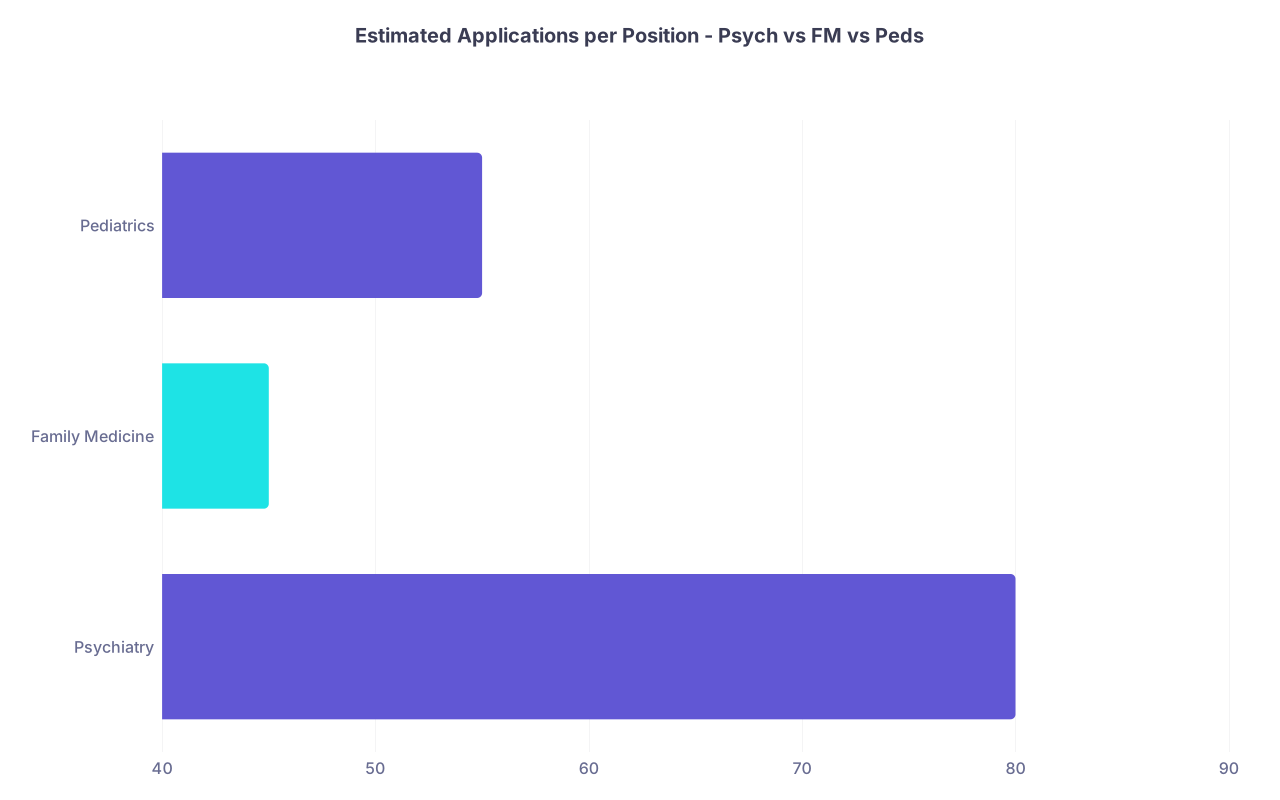
| Category | Value |
|---|---|
| Psychiatry | 80 |
| Family Medicine | 45 |
| Pediatrics | 55 |
Psych is the clearest example where labeling the specialty as “easier” is now just outdated. Lots of mid-tier students still assume psych is a safe Plan B. The numbers do not support that relaxed view anymore.
5. PM&R, Pathology, Neurology: Niche Fields, Inflated in Pockets
These fields are often thrown around as “less competitive,” but the data shows a bimodal reality: some programs are quiet, others suffocating under applications.
Physical Medicine & Rehabilitation (PM&R)
- Positions: ~500
- Applicants: typically more than 1.5–2 applicants per position
- Average applications per applicant: often 40–60
- Net: 60–80+ applications per spot is not unusual for desirable programs
PM&R is small. So a modest influx of extra applicants—often from people originally targeting ortho, neurosurgery, or sports-oriented careers—dramatically raises applications-per-seat.
Pathology
Pathology historically filled fewer positions and is sometimes viewed as “truly easy.” But again, the national fill rate does not automatically equal low per-spot application load.
Patterns:
- Positions: ~600–700
- Unique applicants: ~1,000–1,200
- Average applications per applicant: 25–40
- Applications per position: ~35–50 nationally, but some large academic centers see far more
The problem is asymmetric. Prestigious or well-known academic pathology programs are flooded; some smaller or less-known programs see far fewer applications and occasionally do not fill. But if you aim for the “good name” pathology positions as a backup, you are stepping into a dense field.
Neurology
Neurology has seen similar “lifestyle + demand” buzz:
- Positions: ~1,000
- Applicants: 1.5–2x per position
- Average applications per applicant: 35–50
- Practical outcome: 50–70 applications per position for many programs
Again, labels lag data. Students talk like neurology is a chill, low-key match. The spreadsheets on the program side tell a different story.

Why Applications per Spot Have Exploded in Easier Specialties
Application inflation is not random. It is systemic and rational from an individual perspective, even if it is irrational system-wide.
Key drivers:
ERAS makes marginal cost per extra program trivial
Once your personal statement and LORs are uploaded, adding 20 more programs is a few clicks and a fee that, while painful, feels justifiable under anxiety. This is classic tragedy-of-the-commons behavior.Fear of not matching is stronger than data literacy
The data might say you have a >90% chance of matching in your chosen field with a sane list size. But individual students listen more to horror stories than to NRMP probability tables. So they over-apply “just to be safe,” especially in FM, IM, peds, and psych.Advising is often defensive
Many advisors, honestly trying to protect you, recommend “broad” applications, which in practice means 40, 60, sometimes 80 programs. Even for less competitive specialties. The cumulative impact across all students is massive inflation.Dual-applying distorts denominators
A student applying to EM + FM, or neurosurgery + IM prelim + PM&R, multiplies application counts without adding more spots. That pushes up applications per spot in “backup” specialties without truly reflecting more committed interest.Geographic fixation
Applicants pack their lists into a small number of cities or regions. The result: Boston, New York, California, Colorado, and major metro areas are saturated with 100+ applications per spot in “easy” specialties, while some rural programs are comparatively under-applied.

| Step | Description |
|---|---|
| Step 1 | ERAS low friction |
| Step 2 | More programs per applicant |
| Step 3 | Fear of not matching |
| Step 4 | Defensive advising |
| Step 5 | Higher applications per spot |
| Step 6 | Programs raise filters |
| Step 7 | Applicants feel more anxious |
That loop is the inflation cycle in one diagram.
How This Changes Strategy for “Easier” Specialties
Here is the uncomfortable truth: You cannot rely on the label “least competitive” to guide your application behavior. You have to think in probabilities and volumes.
1. Look at Match Rate + Applicant Type + Applications per Spot
Evaluating a specialty’s “safety” only by match rate is lazy.
You should combine:
- Match rate for U.S. MD or DO seniors in that specialty
- Proportion of IMGs in the matched cohort
- Average applications per applicant in that field
- Program director survey data about what they consider a competitive profile
For example:
- FM: high match rate for U.S. MDs, many IMGs, 40–50 apps/spot → relatively forgiving, but still crowded inboxes
- Psych: rising prestige, more U.S. grads competing aggressively, 70–100+ apps/spot in popular areas → no longer a true safety
- Pathology: fewer U.S. grads, higher IMG share, volume clustered at top programs → strategy must be program-specific, not specialty-level
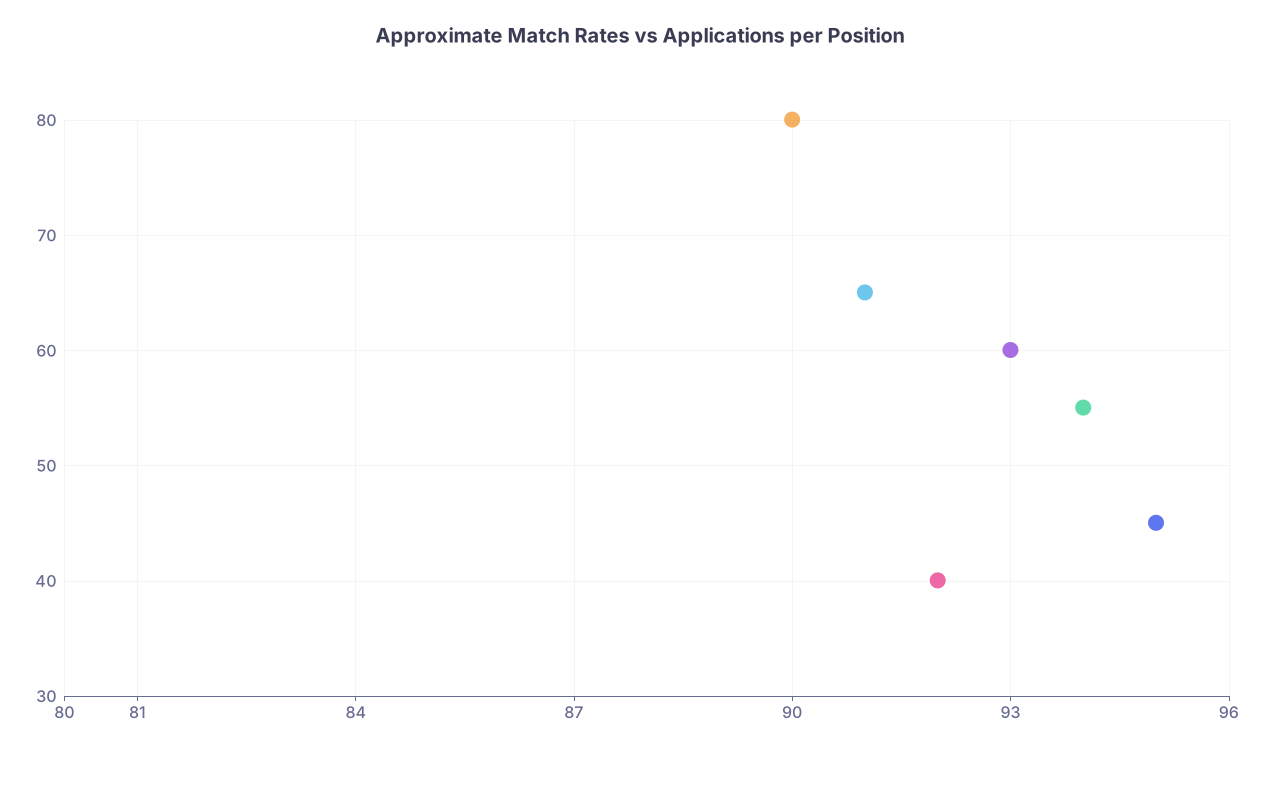
| Category | Value |
|---|---|
| FM | 95,45 |
| IM | 93,60 |
| Peds | 94,55 |
| Psych | 90,80 |
| Path | 92,40 |
| PM&R | 91,65 |
Here, x ≈ U.S. MD match rate (%), y ≈ applications per position. The pattern: high match rates do not guarantee low applications per seat.
2. Recognize Diminishing Returns on Extra Programs
Data from NRMP’s “Charting Outcomes” has shown this for years: once you reach a certain number of ranked programs, the gain in match probability flattens.
For U.S. MDs in less competitive specialties, going from 10 to 20 programs confers a big safety boost. Going from 40 to 60 usually does not. But it multiplies work for you and for programs.
The rational strategy:
- Build a list that gets you to a strong expected number of interviews (for many U.S. MD applicants in easier specialties, that is ~10–12 interviews)
- Stop inflating beyond that unless you have specific red flags (multiple exam failures, severe geographic constraints, etc.)
I have seen applicants in FM and peds match easily after ranking 6–8 programs, then watch their classmates burn out over 50+ applications that did not meaningfully alter their odds.
3. Target Programs by Fit, Not Just Name or Location
Because the volume is so high, generic applications get buried. Even in FM.
You gain leverage by aligning your application with:
- The program’s mission (community vs academic, underserved focus, primary care vs subspecialty pipeline)
- Your genuine geographic ties (documented, not vague “I like the city”)
- Any special content that matches you (sports med in PM&R, consult-liaison in psych, global health in FM)
Program directors in “easy” specialties are still choosing from stacks of 300–1,000 files. Clear signals rise. Generic backup vibes sink.

What Program Directors Are Doing in Response
Program behavior is already adjusting. This feedback loop matters for your planning.
Common moves:
- Raising automated filters
Step score, failed attempts, visa status, and sometimes even class rank or AOA status are being used more aggressively, even in FM and peds, just to shrink the pool from 800 to something screenable.
2. Heavier weighting on real interest
Signals, specific geographical ties, or track-specific mentions in personal statements are used to distinguish “I actually want your program” from “I selected all programs in a 500-mile radius.”
Structured interview caps
Programs limit interviews to ~10–15 applicants per position and rely more on quick-read heuristics. That compresses your opportunity to stand out.Consideration of signaling systems
As signaling pilots expand, less competitive specialties are interested because they are just as drowned in applications as some competitive ones.
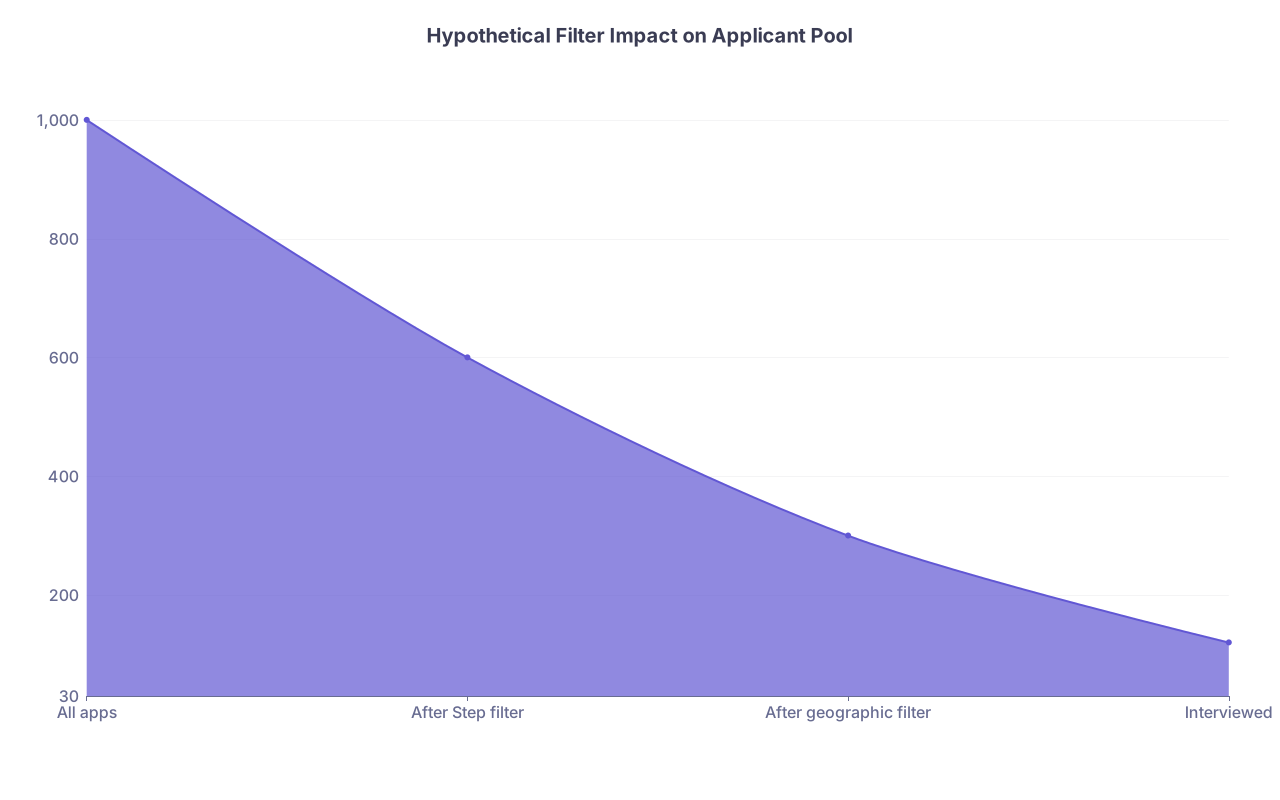
| Category | Value |
|---|---|
| All apps | 1000 |
| After Step filter | 600 |
| After geographic filter | 300 |
| Interviewed | 120 |
This is a realistic pattern: 1000 → 600 → 300 → 120 for a mid-sized program with 10 spots.
The Bottom Line: “Least Competitive” is a Misleading Label
If you take nothing else from the data, take this:
- Being labeled “least competitive” does not mean low application volume.
- Application inflation has pushed even easy-match specialties into 40–100+ applications per spot territory.
- Your personal risk is not simply “what specialty,” but “what specialty, with what profile, applying to how many and which programs.”
Approach your strategy like an analyst, not a panicked group chat participant.
FAQ (5 Questions)
1. If Family Medicine has unfilled spots every year, why are there still so many applications per position?
Because the unfilled spots are not evenly distributed. Desirable locations and academic FM programs are overwhelmed with applications—often 40–70 per spot—while some rural or less-known programs struggle to attract interest. Aggregate unfilled positions coexist with local oversubscription. The bottleneck is geography and prestige, not total national supply.
2. Is Psychiatry still a good “backup” specialty for someone targeting a more competitive field?
Statistically, psychiatry has moved out of true “backup” territory for many U.S. MDs. Applications per spot are high, and applicant quality has risen. Dual-applying to psych is reasonable in some cases, but assuming it is an automatic safety is incorrect. You need a psych-specific story, evidence of interest, and a rational application number, not just a panic list.
3. How many programs should I apply to in an easier specialty like FM or Peds?
For a typical U.S. MD without major red flags, the data from NRMP suggests that 15–25 well-chosen programs is usually adequate in FM or peds, and often fewer if you are geographically flexible. Going beyond 40 often has sharply diminishing returns. The correct number depends on your scores, school, geography, and any remediation history, but 50–80 is almost always inflated for a standard applicant.
4. Do IMGs make these easier specialties much more competitive?
IMGs significantly increase total application volume in FM, IM, peds, psych, pathology, and neurology. But U.S. MDs and DOs still hold a structural advantage in many programs. What IMGs mainly do is increase applications per position, which raises the noise for program directors and tightens screening thresholds. For you as a U.S. grad, this means less room for being “borderline but interesting.”
5. How can I tell if a specific program is flooded with applications or relatively less saturated?
You will not get perfect numbers, but you can triangulate: look at program size, reputation tier (university vs community vs rural), location desirability, and whether it is a primary destination for subspecialty or fellowship pathways. University programs in big cities are almost always flooded. Smaller community or regional programs, especially in the Midwest or South, typically see fewer applications per seat. Talking to current residents or checking program presentations at virtual fairs often reveals whether they “receive thousands of applications” or “a manageable number.”
The key data-driven points: ignore the “easy specialty” label, focus on application-to-seat ratios, and build a targeted, not bloated, list.