
The mythology around “competitive” specialties is mostly wrong. The data from Match 2024 makes that painfully obvious.
If you are still equating “least competitive” with “only family medicine,” you are operating on a 10–15 year old model of the match.
This piece walks through the least competitive specialties in Match 2024 based on hard numbers: NRMP fill rates, US vs IMG composition, and USMLE Step 1/2 CK score distributions. No vibes. No “my classmates said.” Just the numbers.
1. How I’m Defining “Least Competitive” – The Metrics
You cannot talk about competitiveness without defining the axis. For this analysis, I am using three pillars from NRMP 2024 data and NRMP’s “Charting Outcomes”:
Fill rate
- Overall: % of positions filled by any applicant
- Preferred: % filled by US MD/DO seniors vs IMGs and previous grads
Lower US-senior fill rates with lots of unfilled positions signal lower competitiveness.
USMLE performance
- Average / median Step 2 CK score for matched applicants
- Distribution relative to other specialties
Lower mean CK scores and wider acceptance of mid/low 220s–230s range = less competitive.
Applicant-to-position dynamics
- Number of applicants per available position
- How often lower quartile US seniors still match
High position supply relative to serious applicants = more forgiving.
You will see a pattern: the least competitive fields have all of the following:
- Lower fill rates, especially by US seniors
- Significant reliance on IMGs or previous grads to fill slots
- Lower average Step 2 CK scores among matched applicants
- Lots of unfilled spots going into SOAP
Let’s start with the raw fill behavior.
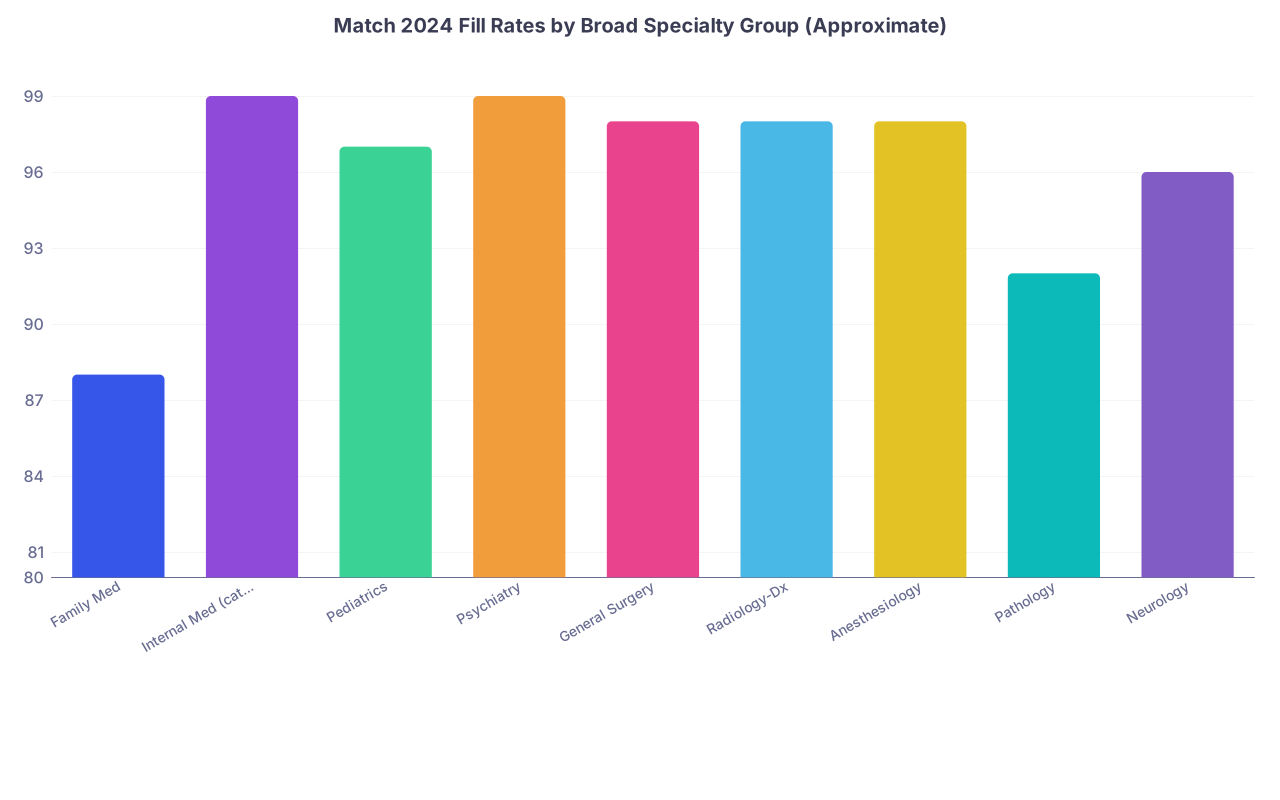
| Category | Value |
|---|---|
| Family Med | 88 |
| Internal Med (categorical) | 99 |
| Pediatrics | 97 |
| Psychiatry | 99 |
| General Surgery | 98 |
| Radiology-Dx | 98 |
| Anesthesiology | 98 |
| Pathology | 92 |
| Neurology | 96 |
The numbers are rounded approximations from 2024 NRMP summary tables, but the ranking pattern is the point: family medicine and pathology sit at the bottom of the fill hierarchy, with internal medicine near 100% but still US-score-flexible.
2. The Core “Least Competitive” Group in 2024
If you want a clean answer: Family Medicine, Pathology, Internal Medicine (Categorical), and Pediatrics form the core cluster of least competitive specialties in the 2024 Match, with Psychiatry not far behind despite rising interest.
I will walk through each with:
- Positions offered / filled
- US MD/DO vs IMG dependence
- Step score profile / applicant quality signals
2.1 Family Medicine – Still the Lowest Bar by the Numbers
Family medicine is the statistical floor for competitiveness in the 2024 Match.
- Positions offered: ~5,100
- Overall fill rate: roughly 88–90%
- US MD/DO senior fill: barely over half of positions
- Large number of unfilled slots entering SOAP
The specialty is heavily reliant on:
- IMGs (U.S. and non-U.S.)
- Previous grads / reapplicants
USMLE-wise:
- Matched US MD seniors in FM often have Step 2 CK in the 220s–230s range.
- The lower quartile of matched applicants includes scores in the low 210s to sometimes just above passing.
- Programs are still willing to seriously consider:
- Below-average Step 2 CK
- One exam failure, if the rest of the file is reasonable
In other words: if you are a US MD/DO senior with passing exams and no catastrophic red flags, the probability of matching in FM is very high, even at modest scores.
| Metric | Approximate Value |
|---|---|
| Positions offered | ~5,100 |
| Overall fill rate | ~88–90% |
| US MD/DO senior share | ~50–55% |
| Typical Step 2 CK matched band | Low 220s–230s |
I have seen multiple cases of FM candidates matching with:
- Step 2 CK in the 210–215 range
- One prior failed attempt on Step 1 (pre-pass/fail era)
- Modest research and average LORs
No other large specialty is this forgiving across the board.
2.2 Pathology – Chronic Undersubscription, Low Fill, Low Scores
Pathology is what happens when a field’s workforce pipeline, lifestyle perceptions, and reimbursement anxiety converge into chronic undersubscription.
Key 2024 numbers (approximate):
- Positions offered: ~600
- Overall fill rate: ~92%
- US MD/DO seniors: well under 50% of slots
- Programs routinely enter SOAP with unfilled spots.
USMLE profile:
- Average Step 2 CK for matched applicants is lower than internal medicine/pediatrics.
- Lower quartile Step 2 CK often falls into low 220s, sometimes below.
- A significant proportion of matched applicants are:
- IMGs
- Applicants with non-linear paths or prior unsuccessful matches
If you look at NRMP Charting Outcomes, Pathology consistently shows:
- A high match rate for US MD/DO applicants across almost the entire Step-score range
- Even relatively weak applicants have an above-average probability of matching if they rank a reasonable list
The data shows: pathology is one of the most accessible specialties for US graduates with:
- Average or below-average scores
- Less competitive prior attempts
The trade-off: job market concerns in some regions and fewer residency positions overall. But in pure Match terms, it is clearly low-competition.
2.3 Internal Medicine (Categorical) – Huge Volume, Very Forgiving
Internal medicine appears highly competitive when you take a narrow view of top academic programs. But that is selection bias. Look at the entire national market.
2024 numbers (approximate):
- Positions offered: >9,500 categorical IM spots
- Overall fill rate: ~99%
- US MD/DO seniors: roughly 60–65% of the pool
- Heavy participation from IMGs, especially at community programs and in some regions
At top-tier academic centers, Step 2 CK medians push into the 250+ range. But national averages tell a different story:
- Many community IM programs accept Step 2 CK in the low 220s–230s quite readily.
- The match rate for US MD/DO applicants to some IM program is extremely high unless the application is severely compromised.
What makes IM “less competitive”:
- Enormous supply of positions
- Wide distribution of program tiers
- Many programs primarily seek:
- Reliable service coverage
- Basic professionalism
- Minimal risk of attrition
The upshot: for a US grad, internal medicine is statistically safe provided you cast a wide net. If you are score-limited and need a realistic specialty, IM is near the top of the list.
2.4 Pediatrics – Declining Interest, Rising Opportunity
Pediatrics used to be “competitive enough” because of high intrinsic interest. That narrative is disintegrating.
2024 approximate numbers:
- Positions offered: ~3,000
- Overall fill rate: ~96–97%
- US MD/DO seniors: majority, but a shrinking share, as interest wanes
- Some programs enter SOAP with unfilled slots, which was rare a decade ago.
Score dynamics:
- Historically, peds matched applicants had slightly lower Step 2 CK averages than IM.
- Current distributions still show a large share of accepted candidates in the mid-220s to low-230s.
- Lower quartile for matched US MD/DO applicants tends to be low 220s, occasionally high 210s.
The data suggests:
- Pediatrics has shifted from “moderately competitive” to soft, low-medium competitive.
- For US seniors with weaker applications, ranking a broad pediatrics list yields high match probabilities.
Lifestyle concerns (emotionally hard work, compensation) and workforce pain points are driving the lower interest. For you as an applicant though, that means easier entry.
2.5 Psychiatry – Still Easier Than Its Reputation Suggests
Psychiatry went through a hype phase. Everyone suddenly wanted in. That pushed up scores and fill rates from 2015–2022.
By 2024:
- Positions offered: ~2,200
- Overall fill rate: ~99%
- High US MD/DO participation, but with substantial IMG presence
- Very few unfilled positions, but not all programs are flooded with high-score applicants.
Step 2 CK profile:
- Averages for matched applicants sit below radiology, derm, ortho, and ENT, obviously, but above FM/pathology.
- Many mid-tier programs are comfortable accepting 220s–230s, especially from DOs and IMGs with strong narratives or psych exposure.
So psychiatry is not “least competitive,” but:
- For a US DO or IM applicant with okay but not stellar scores, psych is still substantially more accessible than surgical subspecialties, EM at top programs, or radiology in many regions.
3. Where Fill Rate and USMLE Scores Clearly Separate Fields
To see the gradient, compare a few representative specialties side by side. The relative differences matter far more than the exact decimal.
| Specialty | Overall Fill Rate | US MD/DO Senior Weight | Typical Step 2 CK Matched Band* |
|---|---|---|---|
| Family Medicine | ~88–90% | Low–moderate | Low 220s–230s |
| Pathology | ~92% | Low | Low–mid 220s |
| Internal Med (Cat) | ~99% | Moderate | Broad 220s–240s+ (wide range) |
| Pediatrics | ~96–97% | Moderate–high | Mid 220s–230s |
| Psychiatry | ~99% | High | Mid 220s–240s |
The data-driven way to approach this:
- After Step 2 CK, look at where your score sits relative to national means for your target specialty.
- If you are ≥10–15 points below the mean for a highly competitive field, your probability collapses quickly.
- Simultaneously plot your chances in FM, Path, IM, Peds—fields where a modest score drop only mildly reduces match probability.
7. Key Takeaways from Match 2024 Numbers
Boiling it down to the essentials:
Family Medicine and Pathology are the clear “least competitive” specialties nationwide by a combination of:
- Lower fill rates
- High reliance on IMGs and non-traditional applicants
- Lower average Step 2 CK scores among matched applicants
Internal Medicine (categorical) and Pediatrics are structurally forgiving due to large position numbers and shifting interest, respectively. For US MD/DO seniors with mid-range scores, they remain statistically safe if you apply widely.
Psychiatry is not as difficult as its social media reputation, particularly at community programs and away from major academic centers, but it is still more competitive than FM and pathology.
If you treat this as a probability problem, not an ego problem, your match odds improve. The data for 2024 is unambiguous on where the floor actually is.
FAQ (5 Questions)
1. Which single specialty was objectively least competitive in Match 2024?
Family medicine. The combination of lowest overall fill rate, significant numbers of unfilled positions entering SOAP, and willingness to accept the widest USMLE score range makes FM the statistical minimum in competitiveness among large specialties.
2. Is pathology really that non-competitive, or is it just IMG-heavy?
Both. Pathology has a moderate number of positions but persistent under-filling by US MD/DO seniors and substantial IMG reliance. NRMP outcomes show high match rates for even modest-score US applicants who rank a reasonable number of programs, which is the textbook definition of low competitiveness.
3. Can a US MD/DO with a Step 2 CK around 215 realistically match into internal medicine?
Yes, if they are flexible. At highly academic IM programs, 215 will struggle. But at community and mid-tier programs, especially outside major coastal metros, a 215 can still match with a solid application, good clinical evaluations, and broad geographic and program-level reach.
4. Are there any surgical specialties that could be considered “least competitive” in 2024?
No. Even the “softer” surgical branches (like some general surgery programs) remain substantially more competitive than FM, Path, IM, or Peds when you look at Step 2 CK averages, fill rates, and applicant-to-position ratios. Surgery never enters the lowest tier of competitiveness.
5. How much did Step 1 going pass/fail change which specialties are least competitive?
It shifted emphasis toward Step 2 CK and clinical performance, but the ranking of least competitive fields did not meaningfully change. Family Medicine and Pathology were near the bottom before and remain there. What changed is the precision of early screening, not which specialties rely on broader applicant pools to fill their slots.