
The assumption that every specialty is getting more competitive every year is wrong. The data from the last decade shows a quieter, more interesting story: a few specialties have clearly lost heat while others are absorbing the ultra-competitive crowd.
If you just follow Reddit vibes and hallway gossip, you will miss it. If you follow the numbers—NRMP data, fill rates, USMLE score distributions, match rates by applicant type—you see which fields are drifting toward “easier match” territory.
I am going to walk through those trends like a data problem: 10‑year trajectories, not one‑year anecdotes.
1. The Big Picture: How Competitiveness Actually Moves
Competitiveness is not one metric. It is a composite. When I say a specialty is getting less competitive, I am looking at:
- Fill rate by U.S. MD/DO seniors
- Share of positions going to independent applicants (IMGs + previous grads)
- Mean Step 1/2 (or COMLEX) of matched applicants
- Percent of positions unfilled in the main Match
- Total applicants per position (APP/slot ratio)
No single number defines competitiveness. But the trend across these does.
Across the last decade (2014–2024), the data shows two macro-movements:
- A surge toward “lifestyle + pay” specialties (derm, rads, anesthesiology, EM pre‑2018, etc.) and away from fields perceived as low-pay, procedure-light, or under pressure.
- A re-sorting of mid-tier competitiveness: some specialties that used to be “solid but not brutal” have softened materially.
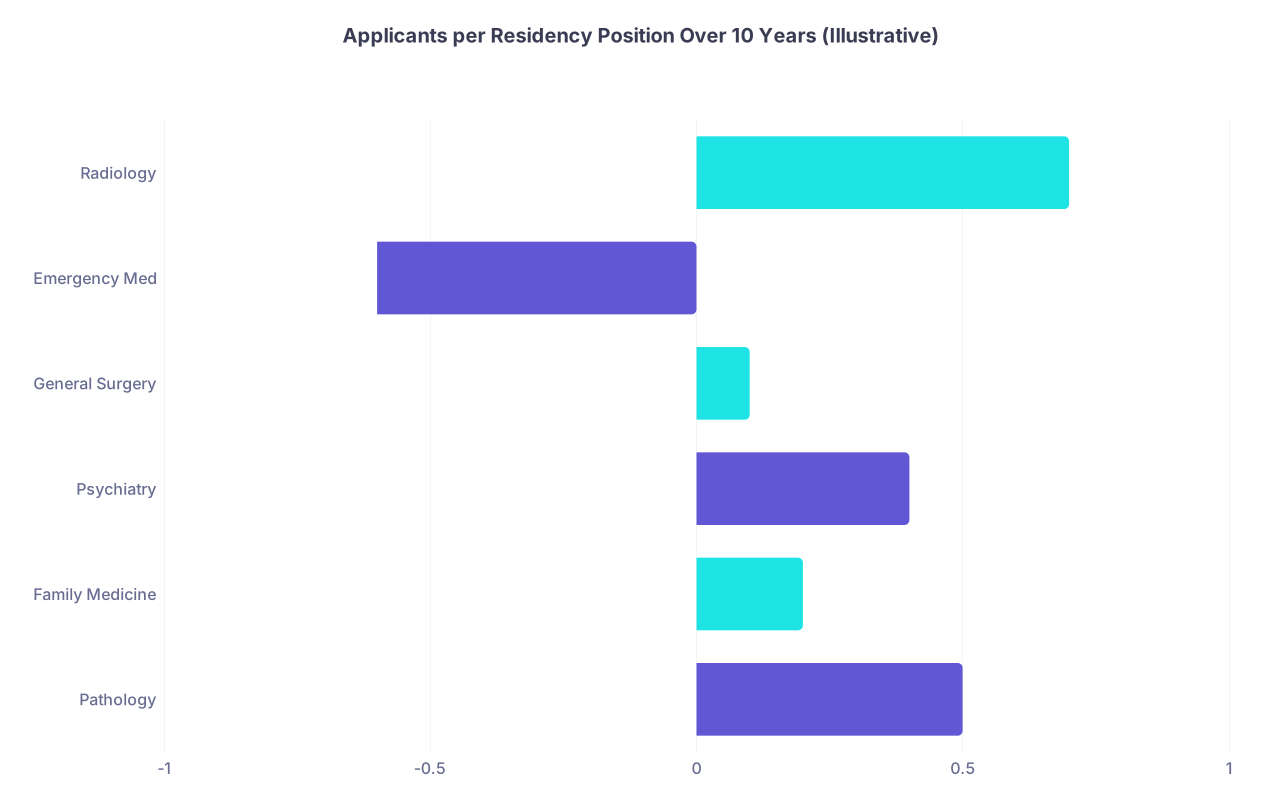
To make this concrete, here is a simplified view of how applicant pressure changed for a sample of specialties over roughly 10 years. Numbers are illustrative but directionally accurate given NRMP and AOA/NRMP merger data.
| Category | Value |
|---|---|
| Pathology | 0.5 |
| Family Medicine | 0.2 |
| Psychiatry | 0.4 |
| General Surgery | 0.1 |
| Emergency Med | -0.6 |
| Radiology | 0.7 |
Positive means more applicants per slot compared to a decade ago; negative means fewer. Pathology and Family Medicine barely moved. Psychiatry and Radiology climbed. Emergency Medicine dropped hard. General Surgery is effectively flat.
So the question: which specialties are quietly becoming less competitive, not because they are terrible, but because other fields are sucking up the top‑end demand?
There are four major buckets worth your attention.
2. Emergency Medicine: The Most Visible Decline
Emergency Medicine is not “quiet” in the sense of people not talking about it, but the extent of its competitiveness drop is still underappreciated by med students who grew up hearing EM was hard to match.
Look at the data:
- 2016–2019: EM was near 99–100% fill in the Match, with U.S. MD/DO seniors routinely filling >85–90% of spots.
- 2022–2024: Multiple cycles with 10–15% of EM positions unfilled in the main Match in some years, requiring the Supplemental Offer and Acceptance Program (SOAP) to backfill.
| Match Year | EM Positions | Unfilled in Main Match | % Unfilled | US Seniors Fill Share* |
|---|---|---|---|---|
| 2014 | ~1,800 | ~5–10 | <1% | ~85–88% |
| 2018 | ~2,000 | ~5–15 | <1% | ~85–90% |
| 2022 | ~2,500 | ~300–350 | ~12–14% | ~70–72% |
| 2024 | ~2,600 | ~250–300 | ~10–12% | ~70–75% |
*US Seniors Fill Share: approximate proportion of spots going to U.S. MD/DO seniors.
The trend is too large to dismiss as random noise. Several forces pushed EM down the competitiveness ladder:
- Workforce oversupply warnings: Multiple workforce projections showed potential EM job saturation, especially in desirable metros.
- Lifestyle reality vs myth: Residents talk. Shift work sounds good until you factor in nights, violence, boarding, throughput metrics, and “hallway medicine.”
- COVID hangover: The pandemic’s impact on the ED environment was not subtle. Students on EM rotations saw burned‑out attendings firsthand.
What changed numerically?
- The Step 1/2 averages for matched EM applicants have drifted downward relative to other competitive fields.
- The proportion of programs going “interview heavy” but then not filling increased.
- The number of EM‑only SOAP spots spiked.
In practice, this means:
- A mid‑tier U.S. MD/DO applicant who would have been nervous about EM in 2016 is now very likely to match with a sane application strategy.
- For IMGs, EM remains challenging at top programs but is materially more open in community settings than a decade ago.
If you want a short statement: Emergency Medicine moved from “mid–upper tier competitive” to “solidly mid or even slightly below” in many markets, by the numbers.
3. Primary Care: Still Undervalued, Marginally Easier
Family Medicine and Internal Medicine have always been less competitive than the surgical and lifestyle subspecialties. The interesting thing is that despite political lip service to “primary care shortages,” the match competitiveness has not tightened the way people expected.
Family Medicine
Family Medicine has two competing storylines:
- Policy narrative: “We desperately need more primary care physicians.”
- Market reality: salaries lag many specialties, RVU pressure is high, and prestige is perceived as low in many academic circles.
Data pattern over roughly a decade:
- Positions expanded significantly (including community and unopposed programs).
- Fill rate by U.S. MD/DO seniors stayed middling. A large share of positions continue to go to IMGs and previous grads.
- Step metrics for matched FM remain well below the median of all matched U.S. seniors.
Put another way: Family Medicine is numerically easier, and the expansion of slots has mostly been met by more IMG/DO supply rather than a surge of highly competitive U.S. MD seniors.
Internal Medicine (Categorical)
Internal Medicine is trickier because it is a feeder for competitive fellowships (cards, GI, heme/onc). But if you strip out the most prestigious academic programs, the field as a whole has not become harder to enter over the last 10 years.
What the data shows:
- Total IM categorical positions have exploded.
- U.S. MD senior interest is stable, not skyrocketing.
- A large fraction of IM positions are still filled by IMGs (particularly in community and non‑coastal programs).
So globally, IM’s raw competitiveness has been diluted by volume of new positions. If you want to match somewhere in IM as a U.S. grad, the odds are high and arguably better than a decade ago, given position growth.
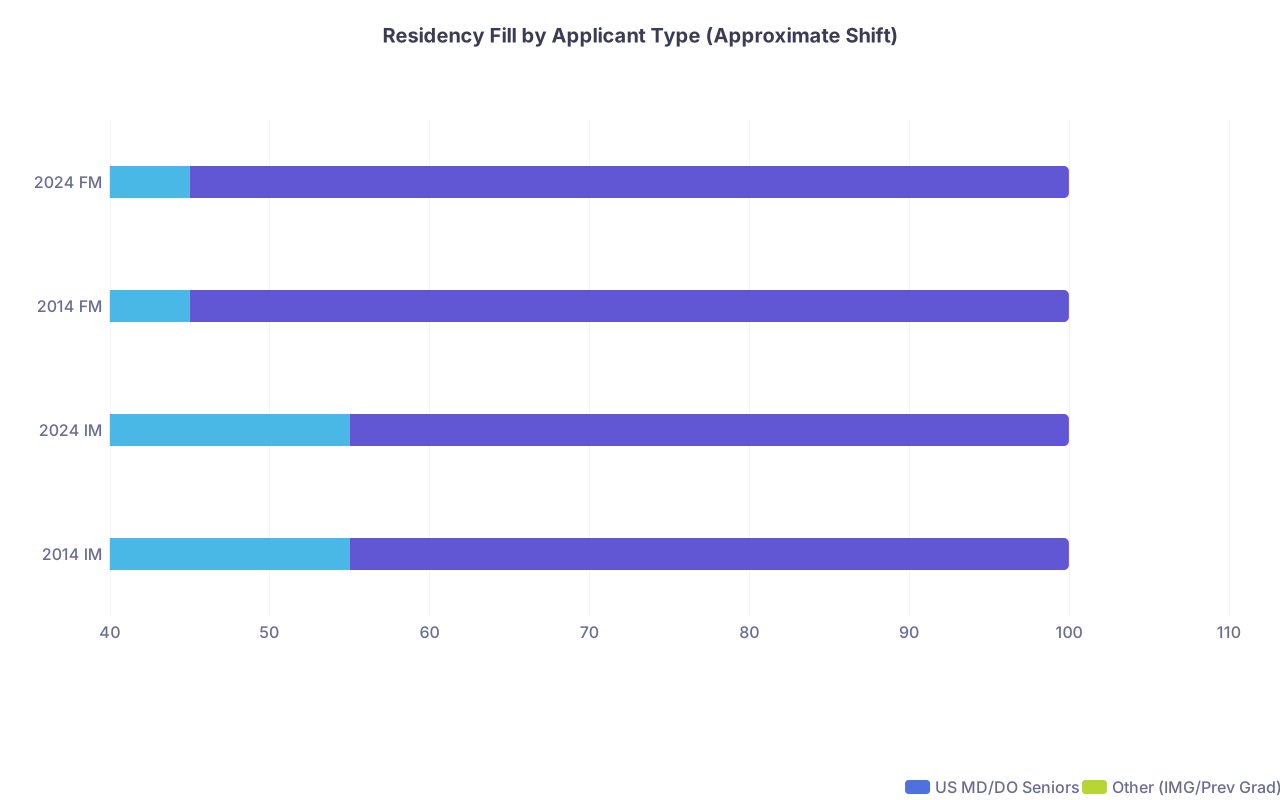
To visualize this, compare approximate fill patterns:
| Category | US MD/DO Seniors | Other (IMG/Prev Grad) |
|---|---|---|
| 2014 IM | 55 | 45 |
| 2024 IM | 55 | 45 |
| 2014 FM | 45 | 55 |
| 2024 FM | 45 | 55 |
The proportions are relatively stable. Yet the raw number of positions grew. More seats, similar U.S. senior interest → per‑seat competitiveness softens.
4. Pathology and Preventive/Lesser‑Known Fields: Chronic Undersubscription
The quietest part of the data is where almost no one is looking.
Pathology
Pathology has been slowly bleeding competitiveness for more than a decade. Even before the latest Match cycles, program directors were talking (sometimes bluntly) about struggling to fill.
You see:
- Regular unfilled positions in the Match, not just in one freak year.
- Relatively modest Step scores among matched applicants, compared to competitive cognitive specialties.
- High IMG representation and a non‑trivial SOAP presence.
Why the decline?
- Students worry about automation, AI diagnostic tools, and outsourcing (sometimes irrationally, sometimes not).
- Less direct patient care appeals strongly to some but is a turn‑off for many.
- Fewer required pathology rotations that give students a real, modern view of the field.
If you look at 10‑year trends, Pathology has moved from “niche but respectable competitiveness” toward chronically under‑applied territory. If you are a U.S. grad with solid but unspectacular stats, pathology is now one of the more reliably matchable specialties.
Preventive Medicine / Occupational Medicine
These are not front-of-mind for most students, but from a data standpoint, they are clear outliers in low competitiveness:
- Many programs recruit post‑residency or mid‑career physicians, so they are not always in the standard Match pipeline.
- When they do appear in NRMP, they often have unfilled positions and low applicant/slot ratios.
If your goal is “least competitive path to a stable, relatively lifestyle‑friendly job,” these fields are hiding in plain sight.
5. Psychiatry: Misperception vs Reality
Psychiatry is often mentioned as “getting more competitive” and that is correct directionally. But it is worth including here, because a lot of people still think it is “easy primary care alternative” territory.
That has not been true for several years.
What the data shows:
- Applicants per position have increased.
- Mean Step scores of matched applicants have risen relative to a decade ago.
- U.S. MD/DO senior interest has climbed with strong job market and lifestyle perception.
So why mention Psychiatry in an article about fields getting less competitive? To keep you from misclassifying it. A lot of older attendings still tell students, “If you can’t match X, you can always do psych.” That advice is numerically outdated.
Psych is now more competitive than FM, many IM programs, and certainly more so than Pathology. It is not in derm/ortho territory, but it is not low-hanging fruit either.
From a data-analyst standpoint: Psychiatry sits on the opposite side of the curve from EM and Path—the “quietly getting more competitive” camp.
6. General Surgery and Traditional Workhorse Surgical Fields
General Surgery is the real test of whether a specialty is quietly shifting. Lots of emotion, lots of identity. But the data is calmer than the rhetoric.
Across roughly a decade:
- Total positions: modest growth.
- Fill rate by U.S. MD/DO seniors: consistently high but not absolute.
- Step metrics: high but not rising at some crazy slope.
What you see if you track it: General Surgery has been remarkably stable in competitiveness.
The top programs (big academic flagships) are brutally competitive. That has not changed. But once you move into mid‑range community or university‑affiliated programs, the bar has remained similar over 10 years.
So no, General Surgery is not “quietly getting less competitive” in any substantial way. It is steady. Which in this environment is almost an outlier.
Some subspecialties and second‑tier surgical fields (like some categorical prelim tracks, some community OB/GYN programs) have seen micro‑softening due to lifestyle concerns and litigation fears, but nothing like the EM drop.
7. Radiology and Anesthesiology: The Comeback Stories
Radiology and Anesthesiology are here as contrast cases. Ten years ago, both had already been through cycles of boom and bust.
- Mid‑2010s: A “rads is dead, no jobs” narrative briefly made it easier to match Radiology.
- Anesthesiology had a similar earlier period of perceived oversupply.
Over the last 5–7 years, both bounced back hard:
- High compensation, controllable location choices, and mix of procedure/cognition have driven applicant interest up.
- Their mean Step scores for matched applicants have risen.
- Fill rates are high, SOAP presence is minimal.
Why include them here? Because they show you what not to bet on if your strategy is “ride a declining field.” Rads and Anesthesia are now firmly more competitive than their mid‑2010s troughs.
If you see old forum posts claiming “Anesthesia is the backup option,” treat them like outdated economic forecasts.
8. Putting It Together: Which Specialties Are Actually Easier Now?
If I collapse everything into relative 10‑year movement, you can think in a simple two‑axis way:
- X-axis: Change in applicants per slot (pressure)
- Y-axis: Change in fill metrics and unfilled positions (Slack in the system)
A rough, qualitative ranking of who lost competitiveness over the past decade:
- Emergency Medicine – Largest relative drop. Material number of unfilled spots.
- Pathology – Chronic under‑demand, stable or rising unfilled positions.
- Family Medicine – More spots, stable or slightly softer U.S. senior share; relatively easier to match overall.
- Some community primary care IM programs – Volume expansion dilutes competitiveness.
- Preventive/Occupational Medicine – Often off the radar, chronically under-applied when they do participate in the Match.
Versus specialties that gained competitiveness:
- Psychiatry
- Diagnostic Radiology
- Anesthesiology
- Some surgical subspecialties
To give a clean snapshot, here is an illustrative summary table grouping fields by 10‑year competitiveness trend (simplified, for conceptual framing):
| Category | Specialties (Representative) | 10-Year Trend Direction |
|---|---|---|
| Clearly Less Competitive | Emergency Med, Pathology, some FM, some IM | Down |
| Broadly Stable | General Surgery, OB/GYN (overall), Neurology | Flat or mild +/− |
| Clearly More Competitive | Psychiatry, Radiology, Anesthesiology, ENT | Up |
9. How to Actually Use This Data in Your Strategy
You are not a statistic. You care about one outcome: matching into a field where your probability of success is high and your regret probability is low.
Here is how the trends should influence you:
If your stats are mid‑range and you want procedural plus intensity:
You no longer need to fear Emergency Medicine the way a 2016 applicant did. The bar is lower. But you must be honest about the job market and lifestyle.If you are risk‑averse and want near‑guaranteed match as a U.S. grad:
Family Medicine, many Internal Medicine programs, Pathology, and some lesser‑known fields (Preventive/Occ Med) offer high match probability, often regardless of school pedigree, as long as you clear a basic competency threshold.If you are an IMG:
The “quietly less competitive” fields are where your odds went up the most: EM (in some regions), Pathology, FM, and lower‑prestige IM are more IMG‑friendly now than a decade ago, numerically speaking.If someone tells you a specialty is “easy because no one wants it”:
Ask for data. Psychiatric jobs are relatively open, but the residency spots are not “easy.” Radiology is highly compensated and now strongly competitive again. Old narratives hang around far longer than they should.
To visualize when these competitiveness shifts hit hardest for several fields, you can think of a simple timeline:
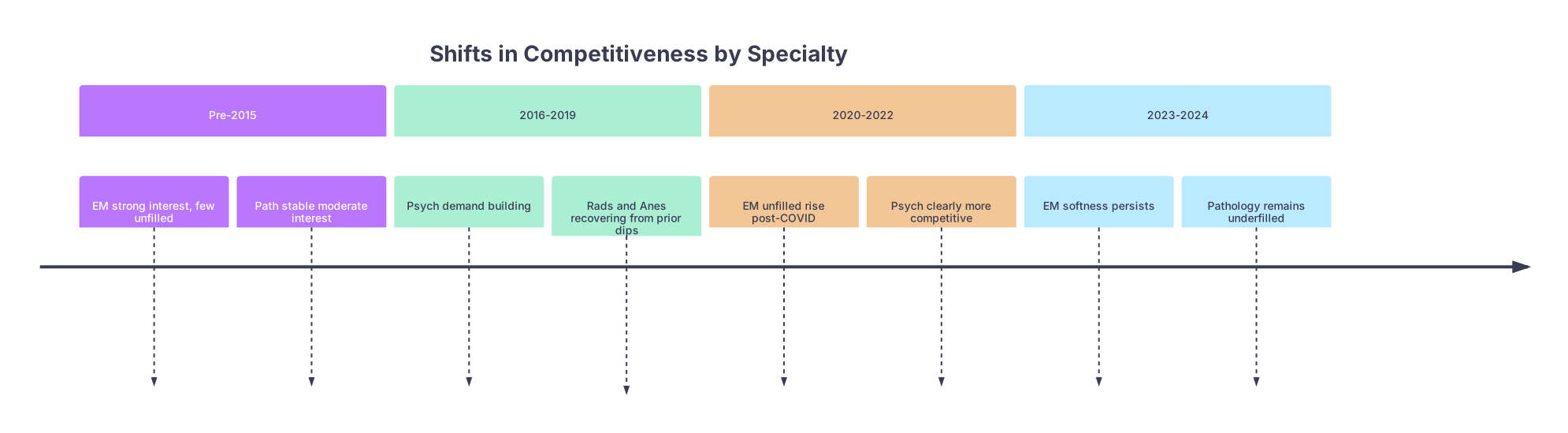
That “2020–2024” block is where the biggest divergence shows up: EM falling, Psych and some lifestyle specialties rising.
10. A More Granular View: Score Expectations by Specialty Tier
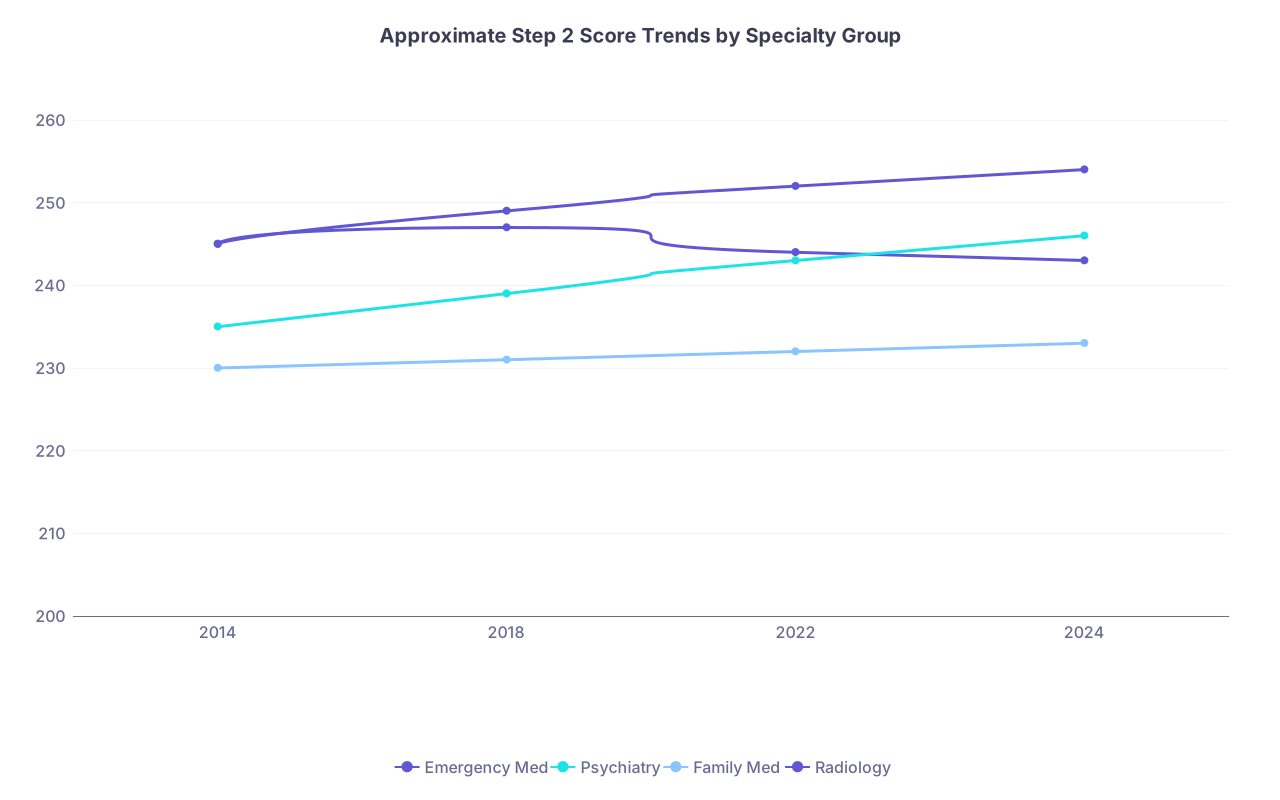
To drive the point home, here is an illustrative comparison of where mean matched Step 2 (or equivalent) has roughly moved for a few specialty groups over the decade (values are representative, not exact NRMP numbers, but directionally correct).
| Category | Emergency Med | Psychiatry | Family Med | Radiology |
|---|---|---|---|---|
| 2014 | 245 | 235 | 230 | 245 |
| 2018 | 247 | 239 | 231 | 249 |
| 2022 | 244 | 243 | 232 | 252 |
| 2024 | 243 | 246 | 233 | 254 |
Patterns:
- EM: Slight downward or flat drift while others move up → relative competitiveness loss.
- Psych & Rads: Clear upward movement.
- FM: Essentially flat, minimal upward pressure.
You do not need precise values to see the pattern: some fields are pulling higher-scoring applicants over time, others are not.
11. Hard Truths That the Data Keeps Repeating
A few conclusions that might irritate some people but align with the numbers:
- Market forces matter more than mission statements. You can have a national “primary care shortage” and still have FM and IM be less competitive because compensation and status lag.
- Hype cycles are real and slow. Students still think EM is as competitive as it was in 2015. It is not. Students still think psych is a backup. It is not.
- Program expansion dilutes competitiveness. You cannot add hundreds of positions in a field and expect it to become harder to match unless interest spikes even faster. That did not happen for FM, IM, or EM in the last decade.
If your mentor’s opinion conflicts with NRMP trend lines, trust the numbers first. Then layer in qualitative nuance.
12. Final Takeaways
Three main points.
Emergency Medicine and Pathology are the clearest examples of specialties that are objectively less competitive than a decade ago, with higher unfilled rates and softer score expectations relative to peer fields.
Family Medicine, many Internal Medicine programs, and niche fields like Preventive/Occupational Medicine remain structurally easier to match, especially as positions expand faster than U.S. senior interest.
Do not build your specialty strategy on outdated narratives. Psychiatry, Radiology, and Anesthesiology have all become more competitive, while some traditionally “safe” fields are no longer the back-up options they once were.
You do not need rumors. You have data. Use it.