
The mythology around “easy-match” specialties is collapsing under its own data.
For years, medical students traded folklore about backup fields: “If anesthesia does not work out, just go FM.” “Path always has spots.” “Psych is wide open.” The numbers now show that many of those statements are outdated, if not outright wrong.
What has actually happened is more interesting: historically less competitive specialties have followed the same boom–bust pattern as the big-name competitive fields, just with a delay and different drivers. If you are treating family medicine, psychiatry, pathology, or PM&R as your safety net, you are playing with data that expired about a decade ago.
Let us walk through the trend lines, not the anecdotes.
1. The Data Behind “Easy Match” – What That Actually Means
Students usually mean one of three things when they say a specialty is “easy to match”:
- Lower average Step/COMLEX scores among matched applicants.
- Higher overall match rate for U.S. MD/DO seniors.
- A non-trivial number of unfilled positions each year.
Those are quantifiable. We can track them.
To ground this, think of historically “less competitive” specialties in the U.S. match:
- Family Medicine (FM)
- Internal Medicine (categorical) – but with nuance
- Pediatrics
- Psychiatry
- Pathology
- Physical Medicine & Rehabilitation (PM&R)
- Neurology
- Transitional Year / Preliminary year spots (as entry paths)
Now look at the structural reality: the U.S. graduate medical education (GME) system has expanded positions faster than U.S. MD graduates have increased. That gap is filled by DOs and international medical graduates (IMGs). Any specialty with chronic unfilled spots historically became a magnet for “backup” strategies.
But the data since about 2015 shows three simultaneous shifts:
- Rising baseline Step 1/2 scores across applicants in general.
- Lifestyle preference migration: controllable hours → increased demand.
- Institutional pushes (e.g., ACGME, hospitals) to expand certain fields like psychiatry and FM.
Net result: the “easy match” concept is increasingly relative, not absolute.
2. Quantifying the Rise: Score Inflation and Match Rates
Let us start with the core quantitative trends: USMLE scores and match rates. I will generalize across several recent NRMP cycles (because you do not need the exact tenth percentile; you need the directional story).
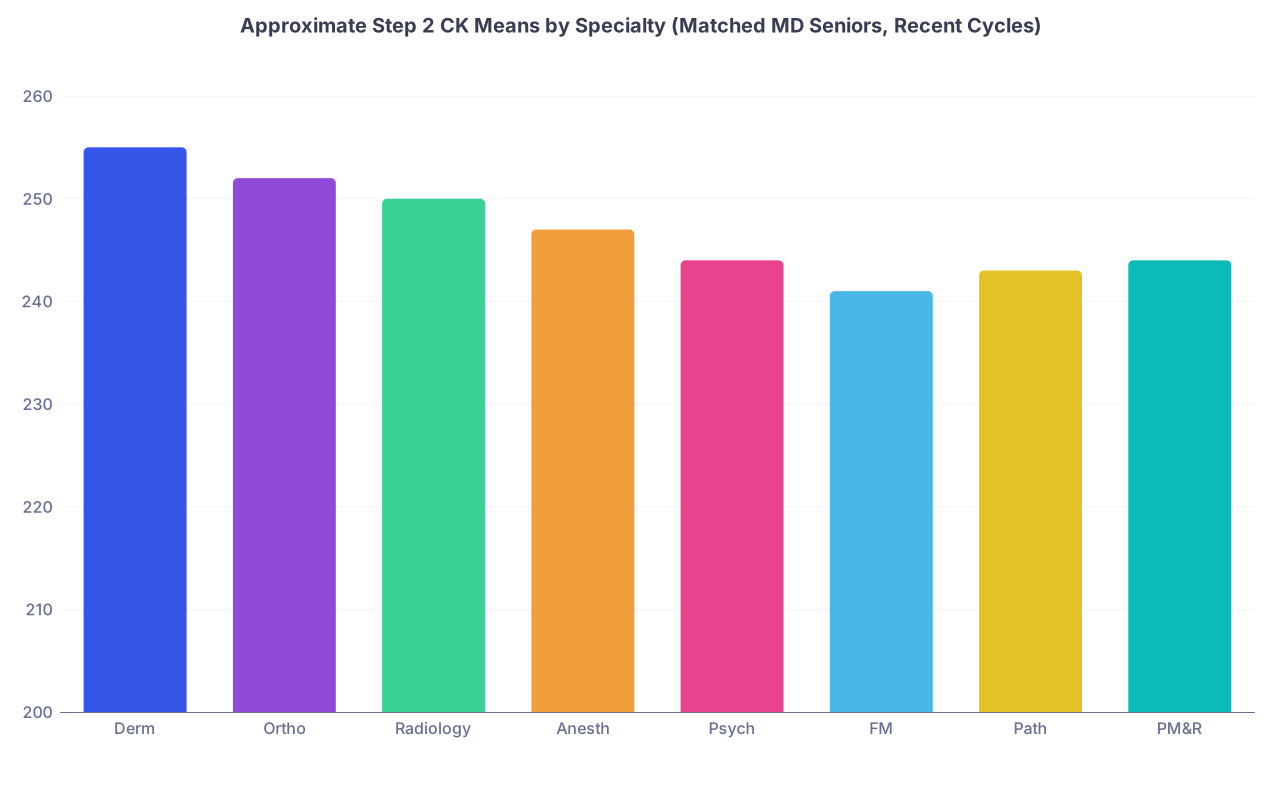
For U.S. MD seniors, approximate Step 2 CK means of matched applicants by specialty:
| Category | Value |
|---|---|
| Derm | 255 |
| Ortho | 252 |
| Radiology | 250 |
| Anesth | 247 |
| Psych | 244 |
| FM | 241 |
| Path | 243 |
| PM&R | 244 |
The “easy” specialties are not sitting at 230 anymore. Psychiatry, PM&R, and even family medicine now cluster in the low–mid 240s for matched MD seniors at many programs. Do top derm programs still demand higher numbers? Absolutely. But the spread is shrinking.
Now, look at match rates for U.S. MD seniors (rounded, recent cycles):
- Dermatology / Ortho / ENT: often in the 60–80% range (self-selected very strong applicants)
- Psychiatry: ~92–96%
- PM&R: ~90–95%
- Pathology: ~95–98%
- Family Medicine: ~92–96%
- Pediatrics: ~95–98%
On paper, that still looks “easy.” But the key detail: the applicant pool to these formerly less competitive fields is stronger than it used to be. A 240 on Step 2 CK that once made you a star in family medicine is now just “solid.” I have seen applicants with 250+ going into psych and FM by choice, not by default.
So what changed?
- Lifestyle-aware students moved earlier toward psych, FM, PM&R.
- Shift away from pure procedural prestige toward “longitudinal care” and work–life balance.
- Step 1 pass/fail has nudged risk-averse students toward historically safer choices.
The net effect: rising floor, slightly rising ceiling, and fewer truly “forgiving” specialties.
3. Specialty Deep Dives: Who Rose, Who Fell, Who Stayed Flat
Time to get specific. “Easy match” is not monolithic. Every specialty has its own trajectory.
Psychiatry: From Afterthought to Hot Ticket
Ten years ago, psychiatry was the quintessential backup. Programs had unfilled spots almost every year. IMGs and lower-scoring applicants could reliably find a position.
That is not the current world.
Key pattern: nationwide focus on mental health + lifestyle + expanded positions.
What the data shows:
- Number of psych positions has increased every cycle.
- Fill rate by U.S. MD/DO seniors has steadily climbed.
- Average Step 2 CK for matched psych applicants has crept into the mid 240s at many competitive academic centers.
You still see some community programs with lower thresholds, but the days of “end-of-cycle scramble into psych” as a standard strategy are fading.
I have watched mid-tier med schools where, in 2014, psych was where people “landed.” In recent cycles, their psych applicants include AOA students with research, dual degrees, and serious CVs. That is a very different applicant composition.
Family Medicine: The Workhorse with Quiet Score Inflation
Family medicine remains one of the most open-door specialties by raw position count. It also remains mission-critical for the U.S. health system. Yet the profile of who is matching is shifting upward, slowly but clearly.
Trend lines:
- FM positions have grown substantially; it is still one of the largest specialties by slots.
- Historically low fill rates have improved, especially for U.S. seniors, but some unfilled spots persist in less desirable geographies.
- Stronger students are choosing FM for lifestyle, rural medicine interests, and broad scope.
The score distribution in FM is wide. You will find:
- Academic FM programs where the mean Step 2 CK is in the mid 240s and research is common.
- Community programs and rural sites where applicants with mid 220s and red flags can still match.
So FM has a bifurcated market. As a “backup,” it is safer than, say, radiology. But the top FM programs and popular locations (Seattle, Denver, Austin, coastal cities) are not soft landings. They are quietly selective.
Pathology: From “Guaranteed Match” to Moderate Risk
Pathology is one of the more dramatic “fall from easy” examples.
Historically, pathology:
- Had a large proportion of IMG and late-switch applicants.
- Frequently had dozens of unfilled categorical spots.
- Was a refuge for applicants with low scores or career changes.
Then came:
- Workforce concerns and job market anxiety.
- US grads getting cautious about long-term prospects.
- A gradual reduction or stabilization of positions in some regions.
Recent patterns:
- The field is smaller than IM/FM by orders of magnitude, so small swings in interest or positions matter.
- Stronger applicants with specific interests (molecular, heme-path, academic careers) still target path intentionally.
- There are fewer blatantly “desperate” programs, and many are choosier than their reputation implies.
Is pathology still less competitive than ortho? Of course. But I have seen applicants assume “anyone can match path” and then get burned when they only applied to a narrow set of university programs in desirable cities. Data reality: small specialty + geographic preference = amplified risk.
PM&R: The Quiet Riser
Physical Medicine & Rehabilitation has had one of the steepest reputational climbs.
A decade ago, PM&R was barely on many students' radar. Now:
- Lifestyle is attractive: outpatient-heavy, procedural options, limited overnight work at many practices.
- Growing demand: aging population, sports medicine crossover, pain, neuro rehab.
- Research and academic interest: brain injury, stroke rehab, spasticity, MSK.
On the numbers side:
- PM&R fill rates for U.S. MD/DO seniors have risen.
- Unfilled spots are fewer and more concentrated.
- Step 2 CK averages at competitive programs are now similar to psych and sometimes anesthesia-lite.
In many mid-tier applicant strategies I have seen, PM&R has replaced pathology as the “thoughtful backup” to anesthesia or radiology. That is a huge perception shift.
Pediatrics and Internal Medicine: Broad, but Not Automatically Easy
Pediatrics and internal medicine (categorical) look safe at the macro level: high match rates for U.S. seniors, giant number of positions.
The nuance lives underneath:
- High-prestige IM programs (UCSF, BWH, MGH, Hopkins) are brutally selective. They are not part of the “easy” conversation.
- Same with big-name pediatrics programs (CHOP, Boston Children’s, Seattle Children’s). These may value Step 2 less than procedural specialties but look very hard at research, letters, and school pedigree.
- Lower-tier and geographically less popular IM/peds programs still function as backups, especially for applicants with red flags.
So yes, you can still salvage a rough cycle with categorical IM or peds if you apply broadly and flex on geography. But if your mental model is “IM is easy,” and your application list consists only of Boston, NYC, San Francisco, and Chicago, the data does not support your optimism.
4. The “Fall” Phase: Why Some Historically Easy Fields Tightened
The rise is clear. Where is the “fall” in “rise and fall”?
The “fall” is relative: these specialties have fallen from guaranteed-safety to conditionally-safe, depending on three levers:
- Applicant quality inflation
- Geographic clustering
- Program differentiation (academic vs community)
Let me put some structure on that with a comparative snapshot. Think of this as a stylized before/after of general competitiveness for U.S. MD seniors over roughly the last decade.
| Specialty | ~2012 Competitiveness* | ~2024 Competitiveness* |
|---|---|---|
| Psychiatry | 2 / 5 | 3–4 / 5 |
| Family Med | 1 / 5 | 2–3 / 5 |
| Pathology | 1 / 5 | 2–3 / 5 |
| PM&R | 2 / 5 | 3–4 / 5 |
| Pediatrics | 2 / 5 | 3 / 5 |
*1 = very easy relative to other specialties; 5 = very competitive.
The story is not that these are “hard” now. The story is that the gap between them and mid-tier competitive specialties (anesthesiology, radiology, EM pre-crisis) has narrowed.
Three main drivers:
- Score compression: As Step 2 CK has shifted upward overall, weaker applicants in easy specialties are now competing against objectively strong candidates who like the lifestyle and content.
- Location obsession: Applicants still cling to major coastal cities. Programs in those cities, even in “easy” specialties, function competitively.
- Brand stratification: A university psych program with strong research funding behaves more like a mid-to-high tier specialty on competitiveness; a small rural FM program behaves like the historical easy-match standard.
5. Visualizing the Trend: From Safety Net to Stratified Market
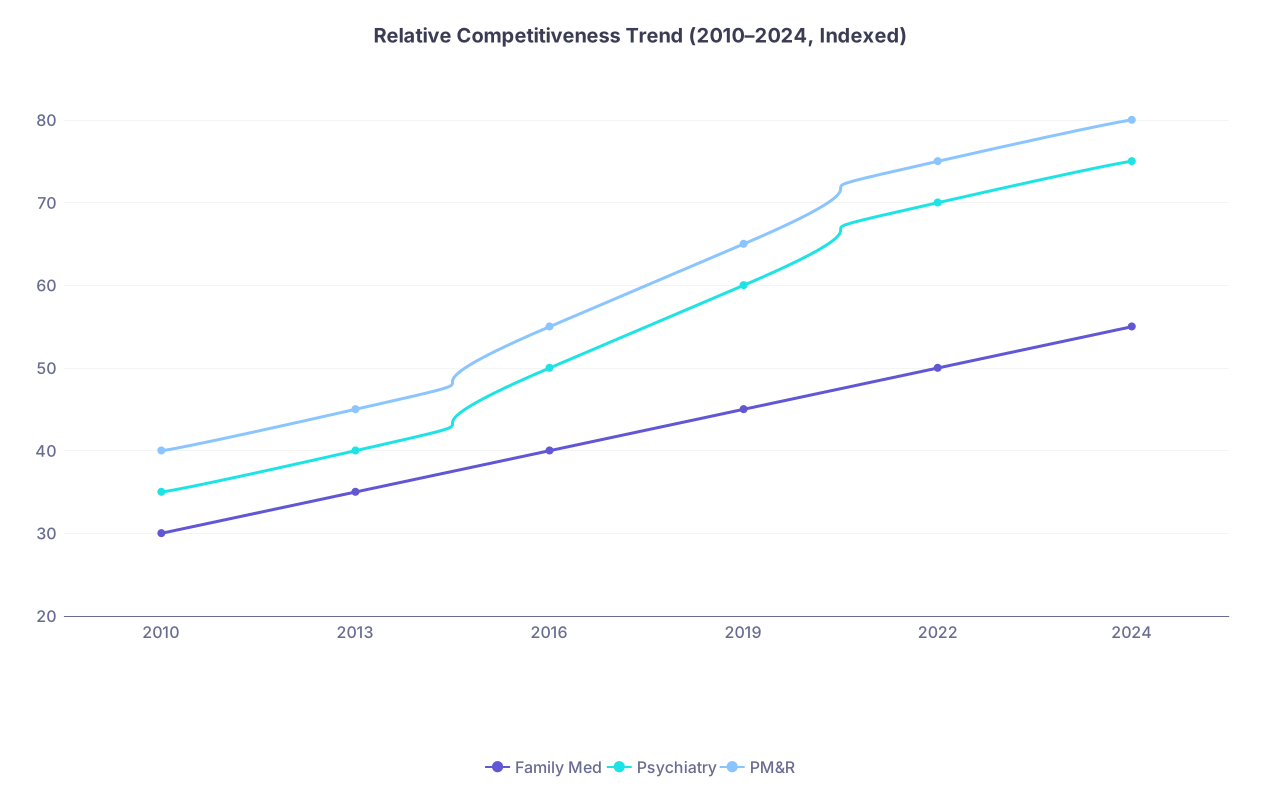
To make this more tangible, imagine a rough trend line of competitiveness (scores, research, applicant volume) over time for three specialties: family medicine, psychiatry, and PM&R.
| Category | Family Med | Psychiatry | PM&R |
|---|---|---|---|
| 2010 | 30 | 35 | 40 |
| 2013 | 35 | 40 | 45 |
| 2016 | 40 | 50 | 55 |
| 2019 | 45 | 60 | 65 |
| 2022 | 50 | 70 | 75 |
| 2024 | 55 | 75 | 80 |
Indexed scale: 20 = very easy, 80 = approaching mid–high competitiveness.
Psych and PM&R have a sharper climb; FM has a modest but real slope. The takeaway: your senior who matched psych in 2014 with a 220 CK and a lukewarm application is not an appropriate comparator for your situation in 2026.
6. The New Reality of “Backup” Planning
Here is where it gets practical. The data forces a new way of thinking about contingency planning.
First, a process map of how students actually (and often badly) approach this:

| Step | Description |
|---|---|
| Step 1 | Choose dream competitive specialty |
| Step 2 | Apply broadly to dream field |
| Step 3 | Rank dream programs only |
| Step 4 | Panic in late fall |
| Step 5 | Add backup specialty last minute |
| Step 6 | Limited interviews in backup |
| Step 7 | Higher risk of not matching |
| Step 8 | Get enough interviews |
This works worse every year. Because the “backup” specialties are not sitting empty waiting for your late pivot.
A more data-aligned strategy looks like this:
- Decide early whether your dream field is truly reach, mid, or safe based on objective metrics (scores, school, research, red flags).
- If dream is mid or high risk, pick a backup specialty by September, not December.
- Structure your rotations, letters, and personal statement so that both fields make sense narratively and academically.
- Apply to a realistic number of programs in both fields up front.
And you must update your mental tiering. The backup hierarchy many students implicitly use is outdated:
Old model (totally wrong now):
Derm → if fail, go psych.
Anesthesia → if fail, go path.
Ortho → if fail, go PM&R.
Radiology → if fail, go IM or neurology.
New, reality-based framing:
- Psych and PM&R are now mid-tier in many locations. Treat them as such.
- Pathology is small enough that geographic pickiness can burn you.
- FM and peds are the most forgiving, but top locations act semi-competitive.
7. Geography and Program Type: The Underrated Variables
The single biggest blind spot I see in student planning is underestimating how much geography amplifies competition in historically easy specialties.
Take family medicine:
- FM in rural Midwest: still close to “classic easy match.” Wide range of scores, open to red flags, willing to train IMGs.
- FM in Seattle, Portland, Boston, Bay Area: absolutely not easy. Strong U.S. grads, significant interest in academic primary care, often heavy on research or leadership.
Same pattern for psych and PM&R:
- Psych in NYC/LA/Boston: mid-tier competitive at minimum; some programs quite selective.
- Psych in smaller cities or less dense states: better safety value.
- PM&R: the total number of programs is much smaller. Being picky about one or two cities is a luxury, not a default plan.
Program type also matters:
- University / academic: higher bar (scores are only part of it – research and letters heavily weighted).
- Community / hybrid: more variable, sometimes more holistic, but can still be surprisingly selective in major metros.
- Newer programs: occasionally more open, but also riskier for training quality and accreditation stability.
When you overlay geography and program type, you realize there is no single “easy” specialty. There are easier pockets within each specialty.
8. Putting It Together: How To Use This Data as a Student
Let me be direct: if you are banking on a “historically easy” specialty to save a weak or unfocused application without changing your behavior, you are misreading the market.
A data-driven approach looks like this:
Benchmark yourself honestly.
Look at recent NRMP Charting Outcomes and specialty-specific data. Compare your Step 2 CK, class rank, research, and red flags to the median matched applicant in your desired and backup specialties.Segment programs by tier within each specialty.
For psych, PM&R, FM, peds, path, list programs as roughly “reach,” “target,” “safety” based on their historical fill patterns, location, and applicant profiles you hear about from recent grads.Build a two-specialty application plan early.
If your dream is risky, you probably need 2 coherent stories: one for the dream field, one for the backup. And you need at least one letter in each that is strong and specific.Exploit the pockets of remaining “easy match.”
There are still programs that carry most of the safety value:- Rural FM and peds programs in less popular states.
- Some community psych and IM programs in the Midwest, South, Mountain West.
- Smaller, less brand-name path programs away from coastal magnets.
But you must be realistic about living there for 3–4 years. If your true constraint is “must be in New York or California,” your effective competitiveness for almost any specialty, even FM, is lower than you think.
Update your mental model every cycle.
One cohort’s experience does not define yours. Changes in Step scoring, visa rules, IMG flows, or specialty scandals (EM recently) can move the market in just a few years.
9. Visual Snapshot: Where Safety Still Exists
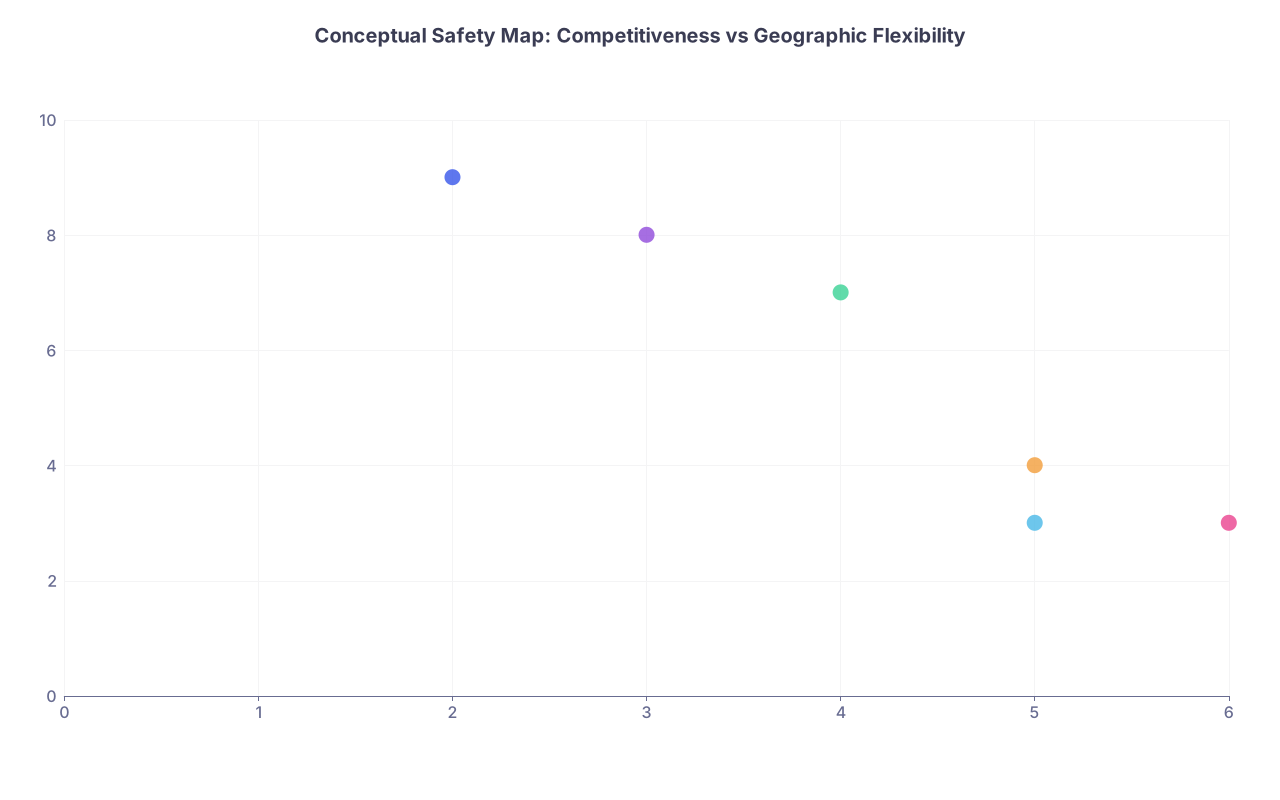
To close the data section, here is a simple scatter-style mental model: competitiveness vs geographic flexibility. Fields that are lower on competitiveness and higher on safety appear in the lower-right quadrant.
| Category | Value |
|---|---|
| Rural FM | 2,9 |
| Rural Peds | 3,8 |
| Community Psych (Midwest) | 4,7 |
| PM&R (Limited Cities) | 5,4 |
| Academic Psych (Coastal) | 6,3 |
| Academic FM (Coastal) | 5,3 |
X-axis (first value): higher = more competitive
Y-axis (second value): higher = more geographically flexible / more open spots
You do not need the exact numerics. The point is relative positioning:
- Rural FM and peds still anchor the “true safety” corner.
- Community psych in less saturated regions is next.
- PM&R and coastal academic programs drift toward the higher-competition, lower-flexibility zone.
FAQ (4 Questions)
1. Is there any specialty that is still truly an “easy match” for almost everyone?
Not in the blanket way students imagine. The closest you get is certain family medicine and pediatrics programs in less popular regions that continue to accept a wide range of applicants, including those with lower scores, gaps, or non-traditional paths. Even there, you cannot ignore Step failures, lack of U.S. clinical experience for IMGs, or catastrophic professionalism issues. The floor has risen compared with 10–15 years ago.
2. Has Step 1 going pass/fail made historically easy specialties more competitive?
Indirectly, yes. When Step 1 lost its discriminating power, more students hedged toward lifestyle and less procedurally intense specialties earlier, rather than gambling on ultra-competitive fields with marginal numerical advantages. That shift pushed more 240–250 Step 2 CK applicants into psychiatry, PM&R, and family medicine. Programs then adjusted expectations upward simply because the median applicant was stronger.
3. If I have low scores, which specialty gives me the best odds now?
Statistically, your best odds are still in high-volume, primary-care oriented fields—family medicine and, to a lesser extent, pediatrics and categorical internal medicine—especially if you are open to a broad geographic spread and community or rural programs. For IMGs, pathology and some psych programs remain accessible, but not as universally as in the past. The critical factor is breadth and realism in your application list, plus a clean narrative around any red flags.
4. How many programs should I apply to in a historically less competitive specialty?
For an average-risk U.S. MD or DO applicant targeting something like FM, psych, or peds as their primary specialty, 25–40 well-chosen programs can be adequate. If you have significant risk factors (exam failures, weak letters, limited clinical exposure), or if the specialty is a backup paired with a more competitive field, that number should move closer to 50–70, with heavy emphasis on community and geographically flexible programs. The data from recent NRMP surveys is clear: applicants who under-apply in “easy” specialties because of outdated myths are disproportionately represented among those who do not match.
With these realities and numbers in hand, you can stop treating “easy-match” specialties as a safety net and start treating them as what they actually are now: stratified markets with pockets of safety, real competition at the top, and room for smart, data-driven strategy. Your next step is to zoom into one or two target fields, pull their most recent match statistics, and design an application plan that respects the trend lines, not the folklore. The details of that field-specific playbook—psych vs FM vs PM&R—that is another analysis entirely.