
The belief that “least competitive” specialties are equally easy everywhere is false. The data shows that geography quietly reshuffles the entire difficulty curve.
You can be “average” on paper and still match comfortably in one city, while that same profile would be laughed out of consideration in another. Same specialty. Same applicant. Different ZIP code. Different odds.
This is not guesswork. NRMP reports, state match data, program fill statistics, and Step score distributions all converge on a blunt conclusion: regional effects can turn a supposedly “least competitive” specialty into a brutal climb—or into a surprisingly low-friction path.
Let me walk through where the numbers bend the curve in your favor, and where they absolutely do not.
1. The Baseline: What “Least Competitive” Actually Looks Like in the Data
First, anchor the discussion. “Least competitive specialties” (by data, not rumor) usually mean:
- Lower average Step 2 scores for matched U.S. MD/DO seniors
- Higher match rates
- Higher proportion of positions filled by IMGs and DOs
- Larger number of total positions relative to applicant pool
Based on recent NRMP Program Director Survey and Main Residency Match data, the core “less competitive” specialties (for U.S. grads) typically include:
- Family Medicine
- Internal Medicine (categorical, non‑elite programs)
- Pediatrics
- Psychiatry (historically less competitive, now tightening but still below the surgical arms race)
- Pathology (variable by year, but often accessible in many regions)
- PM&R (Physical Medicine & Rehab – mid‑tier, but regionally quite variable)
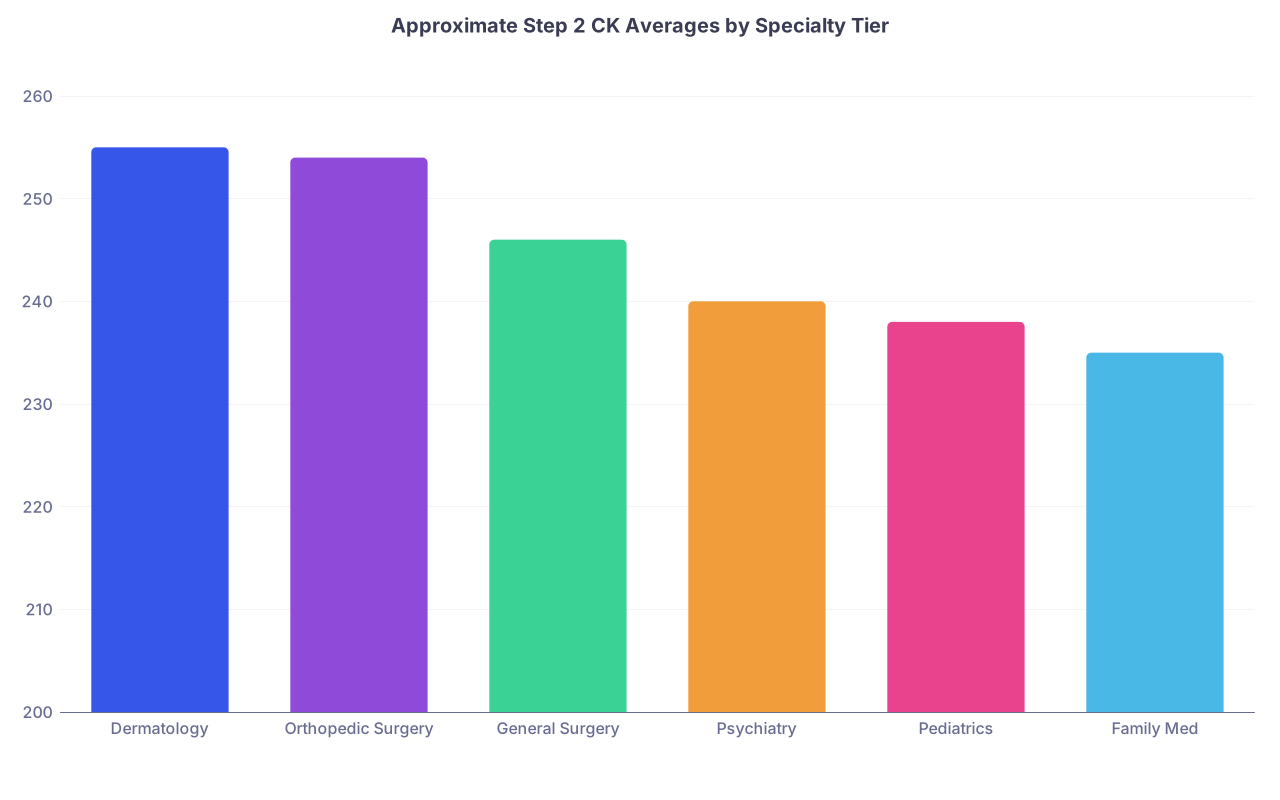
To ground this, look at rough Step 2 CK averages for matched U.S. MD seniors (values are representative, not exact, since NRMP trends slightly year to year):
| Category | Value |
|---|---|
| Dermatology | 255 |
| Orthopedic Surgery | 254 |
| General Surgery | 246 |
| Psychiatry | 240 |
| Pediatrics | 238 |
| Family Med | 235 |
On a national level, Family Medicine and Pediatrics sit at the lower end of the score spectrum. Yet that snapshot hides the real story: a 235 in one region can be “you’ll have 10+ interviews.” The same 235 in another region can be “we do not interview below 245 plus research plus a home rotation.”
So we need to layer geography onto specialty.
2. The Regional Gradient: Coasts vs Midwest vs South vs Rural
If you compare where U.S. seniors actually match against where positions are left unfilled or filled by IMGs, a consistent pattern emerges:
- Coastal, urban, “name‑brand” regions (Northeast corridor, California, Pacific Northwest, big cities like Chicago/Boston/NYC) are more competitive across almost every specialty.
- Interior and Southern regions (Midwest, parts of the South, non‑coastal states) are systematically more accessible, particularly in primary care and non‑procedural fields.
- Rural and community‑based programs inside any region are easier to access than large academic centers in the same state.
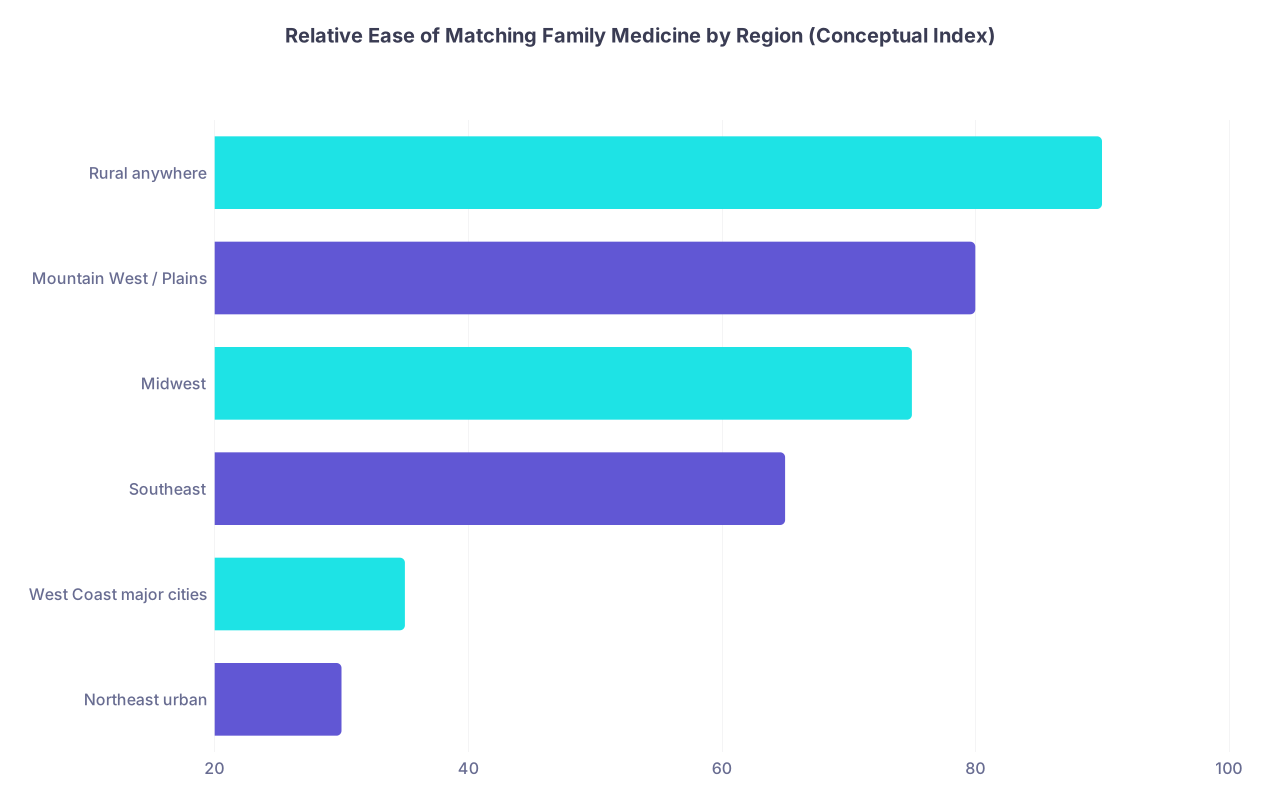
Here is a simplified, conceptual picture for something like Family Medicine accessibility for an “average” applicant (say Step 2 = 235, middle‑of‑class, modest research):
| Category | Value |
|---|---|
| Northeast urban | 30 |
| West Coast major cities | 35 |
| Southeast | 65 |
| Midwest | 75 |
| Mountain West / Plains | 80 |
| Rural anywhere | 90 |
Interpreting that as an “ease index” (not official NRMP data, but aligned with patterns from fill rates and IMG proportions):
- 30–40 = You will need a stronger application and/or regional ties.
- 60–70 = Average applicants do well with a reasonable list size.
- 80–90 = Even below‑average applicants (or non‑traditional/IMG) can often match if they apply broadly.
So the question is not “Is Family Medicine competitive?” but “Where is Family Medicine a true backup vs another arms race?”
3. Least Competitive Specialties by Region: Where They Are Actually Easier
Now let’s get concrete. I will focus on U.S. residency positions and typical patterns seen across multiple recent match cycles.
3.1 Family Medicine: From Brutal in Boston to Open Doors in the Midwest
Family Medicine is the archetype of a region‑dependent specialty.
In major coastal metros:
- Many FM programs are academically oriented, heavily sought after by lifestyle‑focused U.S. grads who want to live in Manhattan, Boston, San Diego, Seattle, etc.
- Program fill rates for U.S. MD/DO can be very high.
- Step 2 expectations climb, and holistic factors (research, leadership, language skills, underserved experience) gain weight.
In contrast, look at many Midwestern, Plains, and certain Southern states:
- A sizable portion of FM positions go to IMGs or DOs.
- Some programs do not fill in the main match and recruit in SOAP.
- Step thresholds are lower; many will interview applicants with scores in the 220s or even below, especially with strong communication skills or regional ties.
This pattern shows up clearly when you look at the proportion of FM positions filled by non‑U.S. MDs across regions (proxy for program demand vs supply):
| Region | FM Fill by U.S. MDs | IMG/DO Presence | True Difficulty Level* |
|---|---|---|---|
| Northeast urban centers | High | Low–Moderate | Medium–High |
| West Coast metros | High | Low | High |
| Midwest (non‑Chicago) | Moderate | High | Low–Medium |
| Plains / Mountain West | Moderate | High | Low |
| Deep South / Rural South | Variable | Moderate–High | Low–Medium |
*“Difficulty” relative to other FM programs, not to surgery/derm.
Translation for you:
- If you are a marginal FM candidate (low Step, red flags, late career change), your match odds spike if you prioritize Midwest, Plains, and rural‑focused programs.
- If you insist on SF, LA, NYC, Boston, Seattle, then FM is no longer truly “least competitive.” You are competing with top‑quartile U.S. grads who simply want that lifestyle.
3.2 Internal Medicine (Categorical): Community Midwest vs Academic Northeast
Internal Medicine is bifurcated. There is “academic IM” and there is “service‑heavy community IM.” Very different animals.
- Academic IM in big coastal cities behaves like a moderately competitive specialty. Think Step 2 CK in the mid‑240s to 250s for realistic interviews, strong letters, possible research.
- Community IM in the Midwest, the South, and many non‑destination states can be much more forgiving. Step 2 in the high 220s–230s with solid clinical performance often suffices.
The regional gap is especially obvious when you look at:
- Proportion of IM positions filled by U.S. MDs vs DOs vs IMGs
- Whether programs participate in the Supplemental Offer and Acceptance Program (SOAP) regularly
Regions with higher IMG percentages and recurring SOAP presence are, by definition, more accessible.
For an “average” IM applicant (Step 2 ~235–240, 0–1 pubs, no red flags):
- Northeast academic hospitals (Boston, NYC, Philly): you are on the margin unless you have strong home institution ties or outstanding clerkship performance.
- Community programs in Ohio, Indiana, Iowa, Kansas, Kentucky, Arkansas, etc.: you are squarely within the usual interview pool.
3.3 Pediatrics: Best Played Outside Major Coastal Academic Hubs
Pediatrics looks easy on paper. Lower Step averages. Strong primary‑care emphasis. Friendly culture.
The trap is assuming that all peds programs are equally welcoming.
Reality by region:
- Big‑name children’s hospitals (Boston Children’s, CHOP, Seattle Children’s, etc.) are competitive even within pediatrics. High caliber applicants, significant research, top‑of‑class students.
- Many community and regional peds programs outside the coasts do not face the same demand. Those remain genuinely accessible to mid‑tier applicants.
Again, look at IMG and DO presence as your compass:
- High IMG share + stable fill rate over years → less competitive, more forgiving.
- Low IMG share + long line of home students and “name” applicants → much harder than the national pediatrics average.
4. Where “Least Competitive” Stops Being Easy: Urban Magnets and Prestige Traps
Here is where many students miscalculate. They pick a “less competitive” specialty, then constrain themselves to:
- High‑cost, high‑prestige coastal metros
- Only university‑affiliated or “big name” institutions
- One or two states due to personal preference
On a probability level, that is reckless.
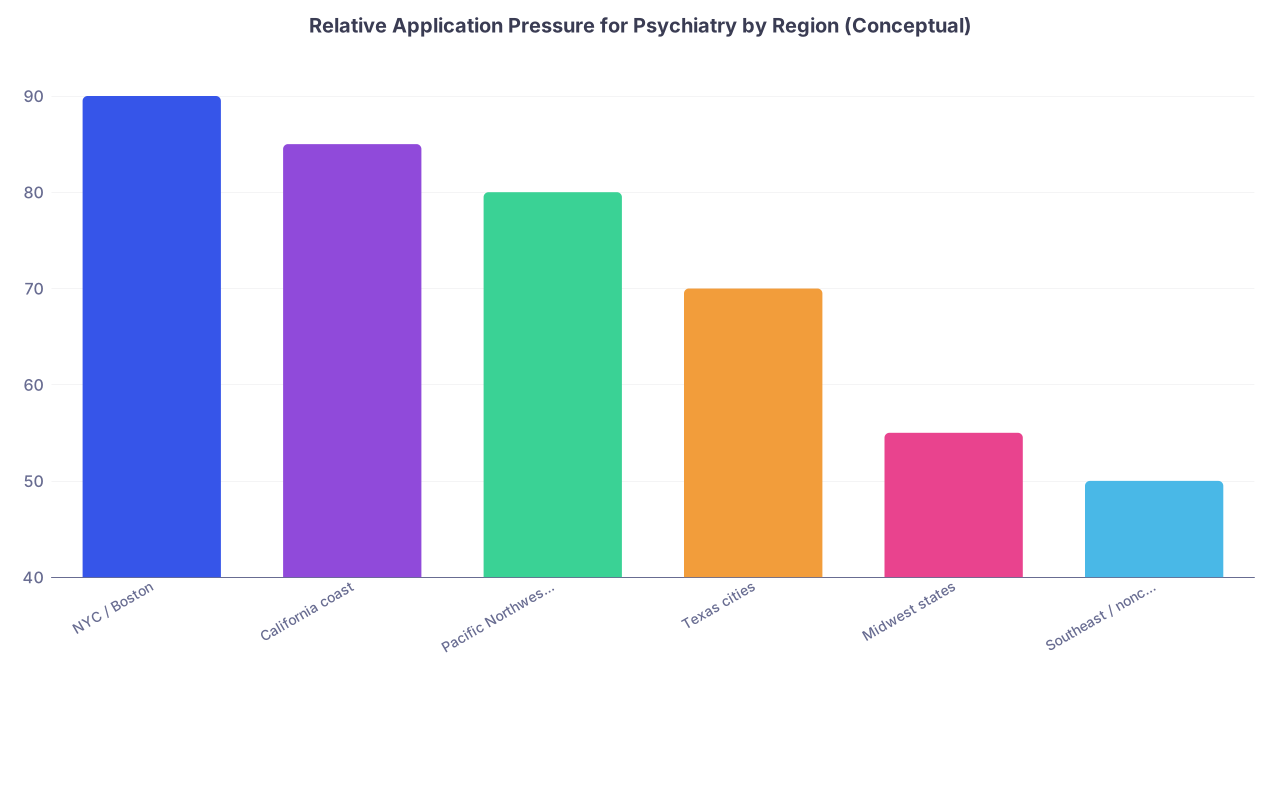
Look at conceptual acceptance pressure if we fix specialty (e.g., Psychiatry) and change only region:
| Category | Value |
|---|---|
| NYC / Boston | 90 |
| California coast | 85 |
| Pacific Northwest cities | 80 |
| Texas cities | 70 |
| Midwest states | 55 |
| Southeast / noncoastal | 50 |
Higher bar = more applicants per spot (relative).
Take Psychiatry as an example:
- On paper, one of the easier non‑primary‑care specialties.
- On the West Coast and in major East Coast cities, it can feel closer to neurology/EM in competitiveness due to lifestyle appeal, work‑life balance, and location desirability.
- In interior states with fewer applicants chasing each position, it still behaves like a relatively accessible specialty.
The mistake is confusing “specialty competitiveness” with “program desirability.” A “least competitive” specialty in Manhattan is not the same as that specialty in Nebraska.
5. Regional Patterns for DOs and IMGs: Where the Door Is Actually Open
For DOs and IMGs, regional effects matter even more. The data consistently shows:
- Higher IMG match rates into primary care (FM, IM, Pediatrics) in the Midwest, South, and some Northeast community programs.
- Lower IMG presence and fewer DOs at large coastal academic centers, regardless of specialty.
If you are DO or IMG aiming for a “less competitive” specialty, the data‑driven strategy is brutally clear:
- East/West Coast academic powerhouses: treat as aspirational, not safety.
- Interior, non‑coastal, and rural‑heavy regions: this is where the probabilities are genuinely on your side.
6. Hidden Variables: State Policy, Local Medical School Density, and Lifestyle
Regions are not just coordinates. They combine multiple structural variables that affect your odds:
Density of medical schools nearby
Where there are many medical schools (Northeast corridor, California), there is a pipeline of local U.S. MD/DO seniors who want to stay. Programs fill earlier, and “average” outsiders are squeezed.State retention incentives and shortage status
States with primary care shortages and fewer in‑state graduates are more eager to recruit and retain. That usually means more openings and a higher willingness to consider a wider applicant profile.Lifestyle desirability and cost of living
High‑cost, high‑“cool factor” cities attract more applicants per spot, even in FM and psych. Under‑the‑radar mid‑sized cities or rural regions draw fewer, which lowers the bar.
You see this in application behavior patterns that people talk about casually on interview trails:
- Everyone applying FM in California knows: “San Diego FM is stacked. You need a lot more than ‘I like primary care.’”
- In contrast, an FM program in, say, rural Kansas may actually email you asking for interest if you look remotely plausible on paper.
7. How to Exploit Regional Differences Intelligently
Let me translate the data patterns into concrete tactics. Assume you are targeting FM, IM, Peds, Psych, or similar “less competitive” fields.
7.1 Segment Your Application List by Region and Difficulty
You want a portfolio, not a monolith.
Rough framework (example for Psychiatry):
- Tier A (High competition): Major metros on coasts (NYC, Boston, SF, LA, Seattle). Treat these as “reach,” even with good stats.
- Tier B (Moderate): Mid‑sized cities with academic centers (Pittsburgh, Minneapolis, Denver, St. Louis, Raleigh, etc.). Competitive but realistic for solid applicants.
- Tier C (Lower competition): Smaller cities, Midwest/Southern states, programs with historically higher IMG/DO intake.
Allocating applications:
- Strong applicant: ~30–40% Tier A, 40–50% Tier B, 20–30% Tier C.
- Average applicant: 10–20% Tier A, 40–50% Tier B, 30–40% Tier C.
- Below‑average or red‑flag: 0–10% Tier A, 30–40% Tier B, 50–70% Tier C.
If you skew everything to Tier A in a “least competitive” specialty, you are basically undoing the advantage of picking that field.
7.2 Use IMG/DO Proportions as a Proxy for True Accessibility
You do not need an internal PD spreadsheet. Public data plus some pattern recognition will do.
Signals of easier entry:
- Program with substantial IMG percentage in recent years.
- Long‑standing presence in SOAP.
- Location in lower‑demand states (think: middle of the country, away from coasts, or economically struggling regions).
Signals of hidden competitiveness:
- Almost all U.S. MD fills.
- Prestigious university affiliation and well‑known subspecialty fellowships.
- Located in high‑demand cities or states with multiple med schools.
7.3 Align Away Rotations and Networking with Target Regions
Regional matching is heavily path‑dependent. A few high‑yield moves:
- Rotate in regions where you are willing to practice. Programs heavily weight “this person has actually been here and functioned well on our service.”
- Build letters from faculty who have regional connections. A letter from a Midwest program director carries more signal at another Midwest program than a random letter from a distant institution that has never sent them graduates.
This is not fuzzy networking talk. It is simple probability: known entities are less risky to rank highly, especially in smaller, lower‑visibility programs.
8. Which Regions Are Truly Easier by Specialty?
Summarizing the multi‑variable mess into a usable mental model. This is directional, but aligned with what match data and program fill patterns show.
| Specialty | Easiest Regions (on average) | Hardest Regions (on average) |
|---|---|---|
| Family Medicine | Midwest, Plains, Rural South, Mountain West | Coastal metros (CA, NY, MA, WA) |
| Internal Med | Midwest, some South, non‑coastal interior states | Northeast academic hubs, CA major cities |
| Pediatrics | Midwest, Southeast, smaller regional children’s | Top coastal children’s hospitals, big metros |
| Psychiatry | Midwest, some Southern and interior programs | West Coast cities, NYC/Boston |
| Pathology | Midwestern and Southern academic–community hybrids | Elite research‑heavy coastal institutions |
| PM&R | Some Midwest and interior academic–community programs | Highly ranked urban PM&R centers on coasts |
Do not overcomplicate it. For most “least competitive” specialties, the Midwest, Plains, and non‑coastal South consistently offer an easier statistical path than the Pacific or Atlantic coasts.
9. Strategic Takeaways: Matching the Data to Your Reality
Here is what the numbers and patterns really say if you strip away ego and anecdotes.
- Choosing a “least competitive” specialty does not rescue you if you confine yourself to the most competitive regions.
- For FM, IM, Peds, Psych, and similar fields, regional targeting can turn a 50–60% match probability into something closer to 80–90% with the same application.
- DOs and IMGs gain disproportionate benefit from prioritizing Midwest, Plains, and non‑coastal Southern states, where programs structurally depend on them.
If you care more about securing a position than about a particular city’s skyline, the rational move is clear: follow the data, not the hype.
FAQ (Exactly 5 Questions)
1. If I am a strong applicant, does regional strategy still matter in a least competitive specialty?
Yes. Strong applicants can match almost anywhere, but regional strategy still changes your outcome profile. A top applicant who applies broadly, including easier regions, will get more interviews, more program choice, and better leverage when ranking. Limiting to hyper‑competitive metros reduces optionality and makes you vulnerable to bad luck (a poor interview day, a lukewarm letter).
2. I want to do Family Medicine but only in California. Is FM still “easy” for me?
No. In that scenario, you have transformed FM from a least competitive specialty into a regionally competitive one. California FM, especially in coastal and urban areas, attracts many strong U.S. grads who want the lifestyle. You will need higher scores, stronger experiences, and a wider application list than you would need for FM in the Midwest or Plains. Treat it more like a mid‑tier specialty.
3. How can I quickly estimate if a program is regionally less competitive without deep data analysis?
Use three simple heuristics: check the proportion of IMGs and DOs in recent resident classes, the location desirability (coastal big city versus smaller interior city), and whether the program has historically participated in SOAP. High IMG/DO presence, non‑destination city, and SOAP use are strong indicators of lower competitiveness. You do not need perfect numbers; consistent patterns are enough.
4. Does applying to easier regions hurt my chances later for fellowship or jobs in more competitive cities?
Usually not, especially for least competitive specialties. Fellowship and job placement depend more on your performance, letters, and networking than on being in a flashy ZIP code. Many graduates from Midwestern or Southern programs end up practicing or doing fellowships in coastal cities. For highly academic research careers, region can matter more, but for core primary care and psychiatry, performance trumps geography.
5. If I have a geographic restriction for personal reasons, how should I compensate in a least competitive specialty?
You have to move everything else up a notch. That means: higher Step 2 CK score target, stronger clinical evaluations, more relevant electives, and earlier networking with local programs. In a high‑demand region, you should treat even a traditionally “easy” specialty like a moderate or hard one and apply to more programs. You are trading geographic flexibility for higher performance and broader program lists within that region.