
The mythology around “least competitive specialties” for IMGs is badly distorted. The data shows something different: some of the most undersubscribed fields actually offer surprisingly favorable match odds for well‑prepared IMGs, while others remain brutal despite open positions.
You are not choosing between “competitive” and “non‑competitive.” You are choosing between specialties where IMGs are numerically welcomed and specialties where IMGs are mathematically marginalized.
I will walk through that with actual numbers.
1. What “undersubscribed” really means in the match data
Undersubscribed is not a vibe. It is quantifiable.
NRMP defines an “unfilled” program as one that has positions left over after the main Match. Across specialties, you see three key signals of an undersubscribed field:
- High percentage of positions unfilled in the main Match.
- Reliance on the Supplemental Offer and Acceptance Program (SOAP).
- High share of positions filled by IMGs (US and non‑US) relative to US MD seniors.
Put simply: if a specialty chronically needs SOAP and pulls heavily from IMGs to fill its spots, you are looking at a structurally undersubscribed field.
Here are the specialties that consistently show up with:
- Below‑average fill by US MD seniors, and
- Above‑average fill by IMGs, and/or
- Non‑trivial unfilled rates.
These are the ones IMGs should treat as “real options” rather than longshots:
- Internal Medicine (Categorical)
- Family Medicine
- Pediatrics
- Psychiatry
- Pathology
- Neurology
- Physical Medicine & Rehabilitation (PM&R)
- (And to a lesser degree, some prelim/TY tracks, but I will focus on categoricals / specialties)
Now let us put hard numbers to these labels.
2. High‑level IMG match rates across undersubscribed specialties
To keep this grounded, I will use representative NRMP trends (recent cycles are all similar within a few percentage points). Exact numbers shift year to year, but patterns are stable.
2.1. Snapshot: Where IMGs actually match
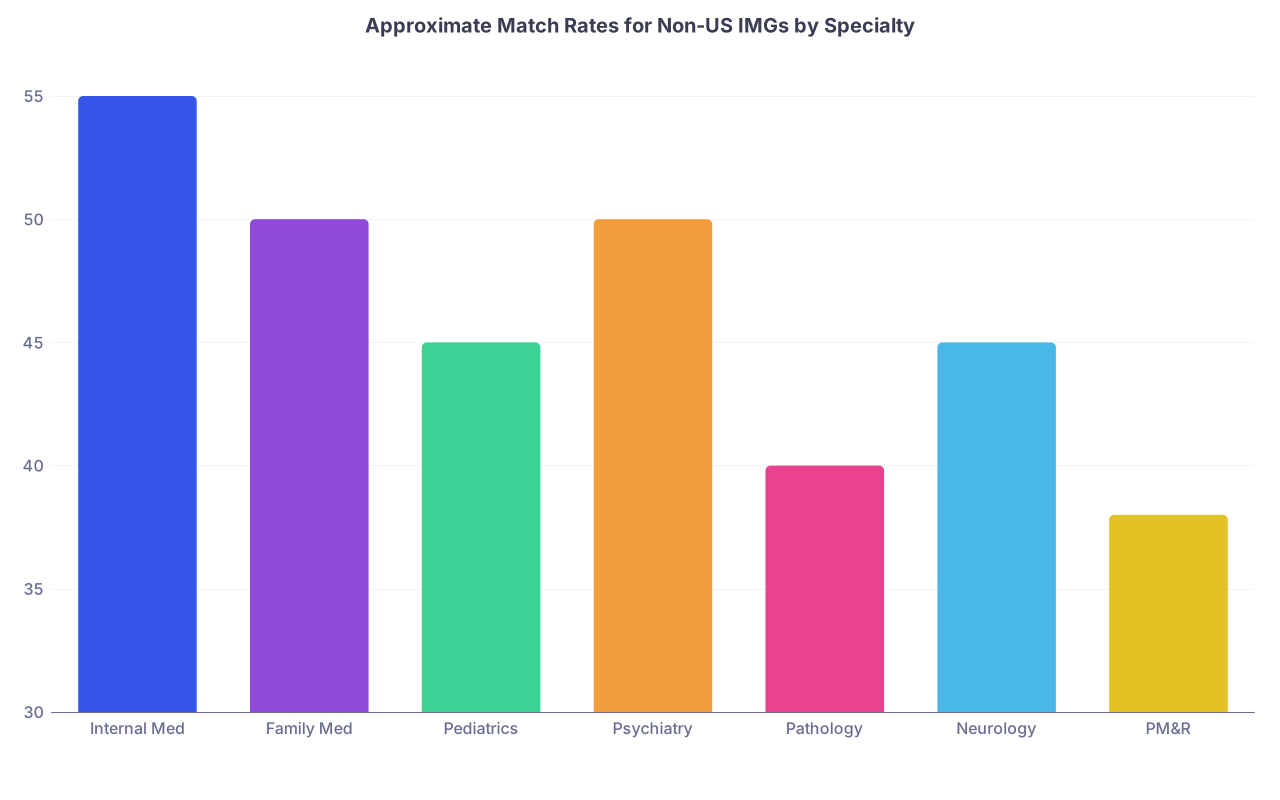
| Category | Value |
|---|---|
| Internal Med | 55 |
| Family Med | 50 |
| Pediatrics | 45 |
| Psychiatry | 50 |
| Pathology | 40 |
| Neurology | 45 |
| PM&R | 38 |
Read this like a risk map:
- Internal Medicine and Family Medicine are the numerical “safest” undersubscribed specialties for IMGs.
- Psychiatry and Neurology sit in the middle: not guaranteed, but workable.
- Pediatrics and Pathology are more selective than people assume.
- PM&R is clearly less competitive than ortho/neuro but far from a dumping ground.
These percentages are not low because IMGs are weak across the board. They are low because many IMGs apply to specialties that do not actually want them, or apply with numbers that do not clear even lenient thresholds.
Now let us go specialty by specialty.
3. Internal Medicine: the statistical backbone for IMGs
If you look purely at volume, Internal Medicine (IM) is the IMG specialty.
Every year:
- IM accounts for ~20–25% of all residency positions.
- A double‑digit percentage of these positions go to non‑US IMGs alone.
- Another chunk goes to US‑IMGs (Caribbean etc.).
3.1. Match rate & fill patterns
For non‑US IMGs:
- Match rate in categorical IM typically lands in the mid‑50% range.
- For well‑qualified candidates (Step 2 in the 230s–240s, some US clinical experience, a couple of letters from US faculty), effective odds are higher—often 60–70%+ in realistic program lists.
For US MD seniors:
- Fill rate into IM is extremely high (>95%), but they do not take the entire pool. Programs still need IMGs to staff wards, especially in community and mid‑tier university programs.
3.2. Why IM is “undersubscribed” but not “easy”
Undersubscribed means:
- Many community and mid‑tier programs have more positions than strong US MD seniors willing to take them, especially outside coastal metros.
- Hospital systems need service coverage: nights, ICU, floor patients. IM residents are the workhorses.
But the top of IM—university academic programs, big coastal metros, research‑heavy tracks—is saturated. Those slots are not “IMG‑friendly” just because IM overall is.
From what I have seen repeatedly:
- Step 2 < 220 and multiple attempts = you are pushed toward lower‑tier IM programs, often in smaller cities, and even those are no longer guaranteed.
- Strong research and 250+ opens the door to some mid‑tier academics but still not top‑10 IM programs for most non‑US IMGs.
IM is numerically your best bet but not a free pass.
4. Family Medicine: high IMG share, but changing slope
Family Medicine (FM) has historically been the classic “backup” specialty for IMGs. The data shows that picture is starting to tilt.
4.1. IMG presence and match rates
Year after year:
- FM has one of the highest proportions of IMG residents among all specialties.
- Non‑US IMG match rate into FM is roughly around 50%, sometimes slightly higher.
- FM often leaves double‑digit percentages of positions unfilled in the main Match and cleans them up in SOAP.
| Specialty | Approx Non-US IMG Match Rate | % Positions Typically Unfilled (Main Match) | Relative IMG Friendliness |
|---|---|---|---|
| Internal Med | ~55% | Low–Moderate | Very High |
| Family Med | ~50% | Moderate | Very High |
| Psychiatry | ~50% | Low–Moderate | High |
| Pediatrics | ~45% | Low–Moderate | Moderate |
| Pathology | ~40% | High in some years | Moderate–High |
| Neurology | ~45% | Low–Moderate | High |
| PM&R | ~38% | Low | Moderate |
Interpret “friendliness” this way: where program directors visibly use IMGs as a core workforce, not as an exception.
4.2. Why FM is not the pushover people imagine
Three data points that undercut the “easy FM” myth:
- Step scores are slowly creeping up among matched applicants, particularly US MD/DOs.
- Some regions are saturated with FM residency graduates; community programs become more picky because they can.
- Certain FM programs have shifted to prioritize DOs and US MDs even with limited volume.
You still have:
- Good IMGs with 220–230 Step 2, US experience, and decent communication skills matching FM reliably, often >60–70% if they apply broadly (40–60 programs).
- Very low‑scoring or red‑flag applicants struggling even in FM because programs now have options.
Undersubscribed does not mean they will overlook multiple fails, no US letters, and generic personal statements. I have watched candidates with two Step failures get shut out of FM entirely while colleagues with clean 220s matched IM.
5. Pediatrics: deceptively selective for IMGs
Pediatrics looks “softer” than IM and FM when you just glance at US MD metrics. That is a trap for IMGs.
5.1. Match rates and IMG share
For non‑US IMGs:
- Match rates hover mid‑40% range. So worse than IM and FM.
- The share of pediatric positions going to IMGs is noticeably lower than in IM/FM.
Why?
Peds, despite being less lucrative financially, is popular among US MDs and DOs who genuinely like the field and are not driven purely by salary. That produces a steady domestic supply.
5.2. How programs treat IMGs in Peds
The data plus anecdotal program behavior shows:
- Many academic pediatric programs strongly prefer US MDs due to perceived communication and cultural nuances with families.
- Community peds programs can be more flexible, but they are fewer and sometimes geographically less desirable.
So yes, Pediatrics is undersubscribed in some regions. But for IMGs, the bar is not lower than IM—often higher in terms of language skills, US clinical experience in pediatrics, and supportive letters from US pediatricians.
If you are an IMG targeting peds, the numbers say:
- Step 2 in the mid‑230s+ with solid pediatric LORs gives you a real shot, but you cannot coast.
- Below ~220, even peds becomes very dicey unless you pair it with IM or FM applications.
6. Psychiatry: rising US interest, still IMG‑friendly (for now)
Psychiatry has been on a multi‑year upward trend in competitiveness. Scores have climbed, US interest has surged, and more people actually want to be psychiatrists rather than treating it as a fallback.
Yet the specialty still leans heavily on IMGs in many programs.
6.1. Match rates and capacity
For non‑US IMGs:
- Match rates ~50% are common, often a bit under IM but above PM&R or Pathology.
- Some regions (Midwest, South) have multiple community psych programs that recruit IMGs as a core part of their resident class.
Psych usually fills almost all positions in the main Match, but there are enough lower‑visibility programs that the IMG pool remains viable.
6.2. What the data suggests for IMG strategy
Psych residencies are very sensitive to:
- Communication skills.
- Red flags.
- Professionalism concerns in MSPE / dean’s letters.
The step thresholds you see informally:
- Step 2 230s+ with clear English and decent psych rotations = realistic shot at multiple interviews if you apply to 40–60 programs.
- Step 2 below 220 with no US psych experience = strong risk of getting squeezed out as the specialty continues to heat up.
If you are an IMG choosing between “easier” specialties, psych currently sits in a sweet spot: not as oversubscribed as derm, ortho, or rads; not as purely service‑driven as FM and IM. But the slope is rising; do not assume today’s friendliness persists unchanged.
7. Pathology: unfilled slots, but not a dumping ground
Pathology often shows high unfilled rates compared with other core specialties. That tempts a lot of IMGs to treat it as the emergency parachute. The numbers show why that reasoning is lazy.
7.1. Match rates and unfilled positions
For non‑US IMGs:
- Match rates around 40%—sometimes a little lower.
- Yet pathology often has some of the highest percentages of unfilled positions before SOAP.
So how can both be true?
Simple: the specialty has:
- A significant number of weak, late, or poorly prepared applicants (both US and IMG).
- Program directors who are selective about language, communication, and professionalism—because pathology is error‑sensitive even if patient‑facing contact is limited.
7.2. Behavior I have seen repeatedly
- IMGs with solid scores and genuine pathology interest (Step 2 ≥ 235, some pathology exposure, maybe a case report or observership) match at high rates and often into good mid‑tier programs.
- IMGs who treat pathology as a last‑minute backup, with no pathology‑oriented letters or clear interest, get filtered out despite the open seats.
Meaning: pathology is undersubscribed by qualified applicants, not by warm bodies. If you are serious and can articulate why, the data effectively improves your individual odds.
8. Neurology: moderate competitiveness, strong IMG representation
Neurology sits in a strange middle ground.
It is not as glamorized as cardiology or GI, but it is increasingly respected, tech‑heavy, and fellowship‑driven. The workload is real; so is the cognitive demand.
8.1. Match data for IMGs
For non‑US IMGs:
- Match rates cluster around ~45%.
- Neurology has a healthy proportion of international graduates in many programs; some services in stroke and epilepsy would literally not run without IMGs.
That said, several academic neurology programs (especially large coastal ones) have moved to higher score thresholds and prefer US MDs and DOs.
8.2. What differentiates matched vs unmatched IMGs in neurology
The pattern is consistent:
Matched IMGs:
- Step 2 typically in the 230s–240s.
- Clear neurology interest—electives, letters from neurologists, maybe a small research involvement.
- Reasonable communication skills for NIHSS, rounding, complex counseling.
Unmatched IMGs:
- Weak neurology‑specific portfolio.
- Generic internal medicine letters.
- Scores <225 and sometimes multiple attempts.
If you stack neurology versus, say, PM&R or pathology, neurology is slightly more selective but also more structurally dependent on IMGs in many institutions.
9. PM&R: undersubscribed relative to ortho, but not “easy”
PM&R (physiatry) gets miscategorized constantly. People see “rehab” and think low competition. The data says: less competitive than surgical subspecialties, yes. But still selective compared with FM or IM.
9.1. Match rates and IMG access
Non‑US IMG match rate:
- Often in the high‑30s to around 40%. Lower than IM, FM, psych, neuro.
- IMG share in many PM&R programs is modest; there are programs with zero non‑US IMGs.
Why? PM&R is relatively small. There are not many slots to begin with. So even modest US MD/DO interest eats a big fraction of the pool.
9.2. Practical threshold
Expect:
- Many programs expecting Step 2 in mid‑230s+ for IMGs, with strong US clinical exposure.
- Strong preference for fluent communication and “team sport” personality—rehab is interdisciplinary.
Strategy lesson: treat PM&R as a targeted specialty, not a generic safety net. Combine with IM or neuro applications if you want a realistic fallback.
10. How undersubscribed specialties differ in IMG “return on investment”
The whole point of this comparison is to answer a simple question:
Where does one additional unit of effort (better Step score, more USCE, better letters) give you the biggest incremental gain in match probability as an IMG?
Here is the pattern the data suggests:
Internal Medicine / Family Medicine
- High baseline match rates for decent IMGs.
- Each incremental improvement (scores, USCE, letter quality) moves you up in program tier and geography more than raw probability of “any match.”
- ROI: upgrades where you match.
Psychiatry / Neurology
- Middling baseline match rates.
- Improvements significantly change your probability of matching at all, and also which region/program tier.
- ROI: both “match vs no match” and quality.
Pediatrics / Pathology / PM&R
- Lower baseline match rates for IMGs.
- Higher payoff for a strong, specialty‑targeted profile.
- ROI: lumpy; strong candidates do well, unfocused ones do poorly.
To visualize relative difficulty:
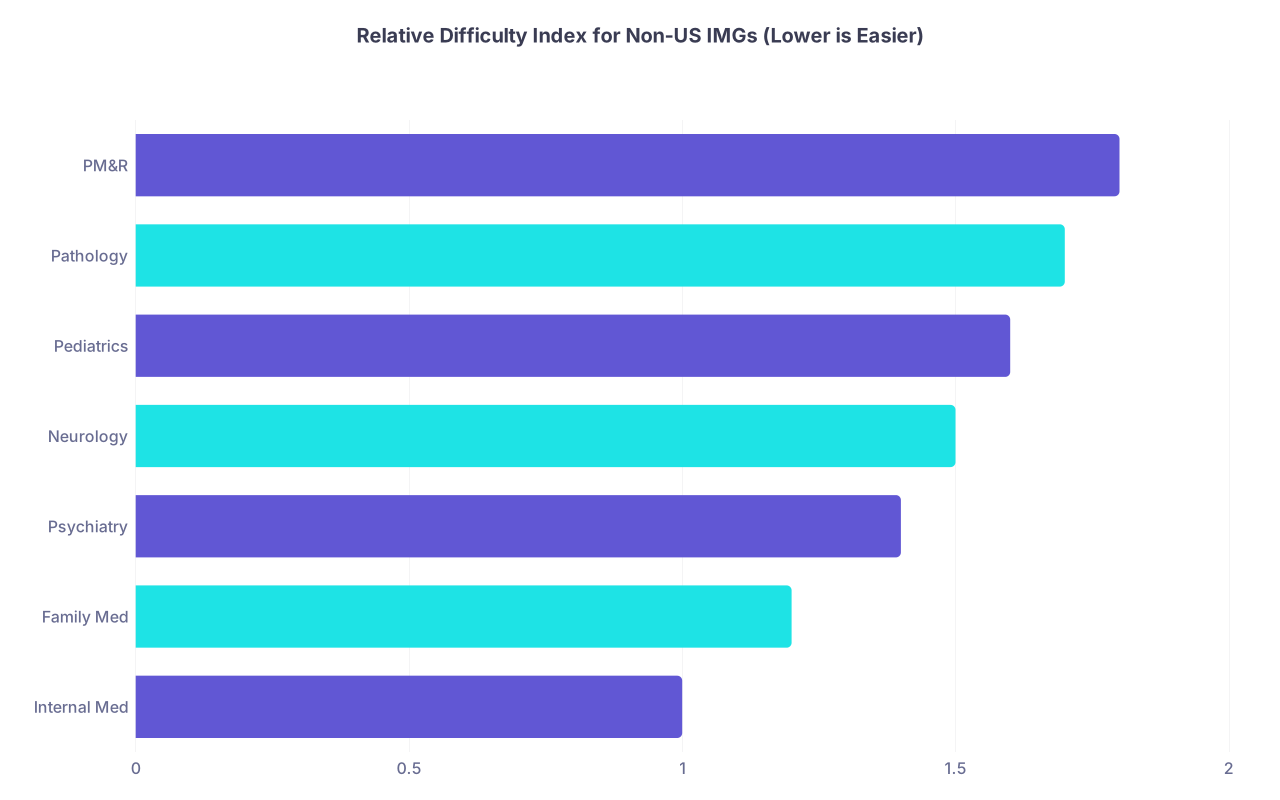
| Category | Value |
|---|---|
| Internal Med | 1 |
| Family Med | 1.2 |
| Psychiatry | 1.4 |
| Neurology | 1.5 |
| Pediatrics | 1.6 |
| Pathology | 1.7 |
| PM&R | 1.8 |
This “index” is conceptual: 1 = most favorable among this group, higher numbers = steeper hill relative to IM.
11. Choosing among undersubscribed specialties: a data‑driven flow
Here is how I would structure the decision if I were sitting with you and a spreadsheet of your profile.

| Step | Description |
|---|---|
| Step 1 | Start - IMG Profile |
| Step 2 | Target Psych + Neuro + IM backup |
| Step 3 | Target Peds + IM/FM backup |
| Step 4 | Target Path + IM/FM backup |
| Step 5 | Target PMR + Neuro/IM backup |
| Step 6 | Target IM +/- FM |
| Step 7 | Very high risk - strengthen profile before applying |
| Step 8 | Target IM + FM, consider Psych at IMG-friendly programs |
| Step 9 | Target FM heavily, some IM |
| Step 10 | Step 2 >= 235? |
| Step 11 | Interested in psych/neuro? |
| Step 12 | Step 2 >= 220? |
| Step 13 | Interest in peds/path/PMR? |
| Step 14 | Any strong USCE? |
This is not perfect, but it reflects how match probabilities actually respond to your numbers and specialty mix.
12. What the data actually tells IMGs to do
Strip away the noise. You are left with a few hard truths.
“Least competitive” is context‑dependent.
- Internal Medicine is relatively easy compared to orthopedic surgery, but the top IM programs are still off‑limits for most IMGs.
- Psychiatry is easier than radiology, but not a random landing spot for low scores anymore.
Undersubscribed specialties are undersubscribed by strong applicants, not by anyone who can fill a seat.
- Pathology has open positions and still rejects plenty of IMGs.
- PM&R has limited slots and a smaller IMG share, despite not being as glamorous as ortho.
Your best leverage comes from aligning a realistic specialty with a coherent application story.
- A 230 Step 2 with psych electives and good psych letters is far more powerful in psychiatry than the same profile sprayed randomly at radiology, anesthesia, and derm.
- A 220 candidate with strong FM exposure and community‑oriented experiences does better in FM than chasing pediatrics where domestic demand soaks up many seats.
Key takeaways
Among undersubscribed specialties, Internal Medicine and Family Medicine offer the most favorable raw match odds for IMGs; Psychiatry and Neurology are viable but increasingly selective; Pediatrics, Pathology, and PM&R reward focused, higher‑end IMG profiles and punish “backup” applicants.
Undersubscribed does not mean undisciplined. Programs with unfilled spots still screen aggressively for Step performance, US clinical experience, and specialty‑specific commitment; weak IMGs can fail to match even in “easy” fields.
The highest ROI for an IMG is not chasing the theoretically least competitive specialty, but aligning your scores, experiences, and narrative with one or two undersubscribed fields and building a dense, specialty‑specific profile—while using IM and/or FM as mathematically sound insurance.