
The phrase “low-competition specialty” is dangerously misleading. Program directors in these fields are not desperate. They’re selective in a very different way—and if you do not understand that, you’ll get quietly filtered into the trash.
Let me walk you through what actually happens in the rooms you never see.
We’re talking about the specialties students love to dismiss as “safeties”: family medicine, psychiatry (at many programs), pediatrics, PM&R outside a few hotspots, community internal medicine, sometimes neurology. Not derm, not ortho. The ones your classmates assume they can “fall back on” if Step does not go their way.
That attitude leaks into your application. And program directors in these fields are extremely good at smelling it.
The First Reality: “Least Competitive” ≠ “We Take Anyone”
Behind closed doors, the language is blunt.
In a family medicine rank meeting I sat in, one PD said:
“I would rather leave a spot unfilled than rank another warm body who clearly doesn’t want to be here.”
And they meant it. They had done it before.
Here’s the fundamental truth: in lower-competition fields, program directors are not struggling to fill spots. They’re struggling to fill spots with people who will:
- Show up.
- Do the work that no one glamorizes.
- Not quit or be a constant problem.
The bottleneck is not volume of applicants. It’s signal in a pile of generic, poorly targeted applications.
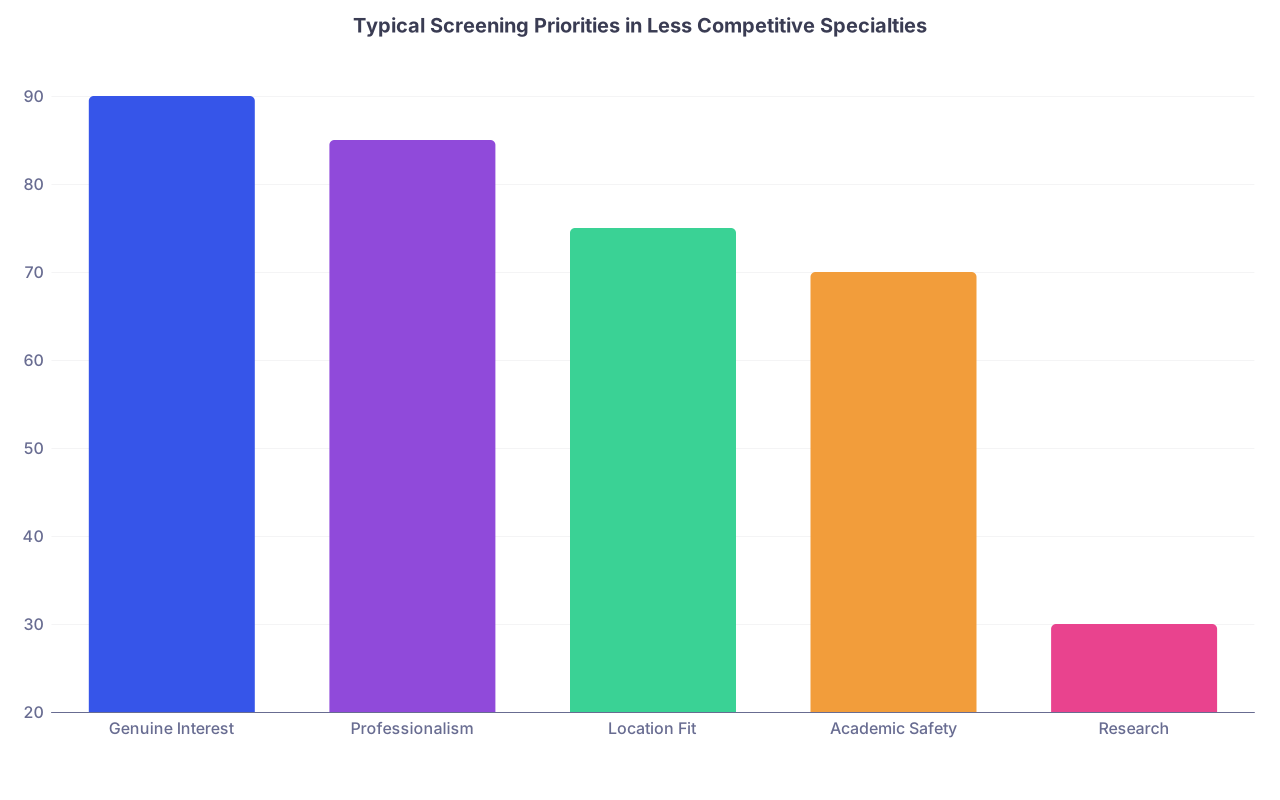
You need to understand what they actually screen for.
| Category | Value |
|---|---|
| Genuine Interest | 90 |
| Professionalism | 85 |
| Location Fit | 75 |
| Academic Safety | 70 |
| Research | 30 |
That chart is about right for what I’ve heard in actual PD meetings. Research is dead last. Faking interest is an auto-kill.
Let’s get specific.
What They Privately Look for in “Easy-to-Match” Fields
1. Real, Traceable Interest – Not a Last-Minute Pivot
This is the single biggest hidden filter.
A psych PD once said during a closed faculty meeting:
“If I see a ‘decided-on-psychiatry-late’ story with zero psych before December of MS4, I assume they are running from something—scores, reputation, reality.”
They’re not offended you switched late. They’re suspicious if your file does not show any prior orbit around the specialty.
Here’s what quietly counts as real interest in low-competition fields:
- Longitudinal involvement. Psych student interest group, free clinic mental health nights, primary care outreach, peds camps, rehab volunteering, etc. Not all of it. But something that predates your Step score meltdown.
- Earlier rotation choices. Did you front-load derm, rad onc, ortho and suddenly “fall in love with family medicine” in January of M4? They notice those schedules. They know what that usually means.
- A story that matches your file. If your personal statement claims you’ve “always been drawn to longitudinal relationships and community health,” but your electives are ICU, cards, interventional radiology, and two away rotations in ortho, the cognitive dissonance is obvious.
The private scoring conversation sounds like this:
“Applicant 243 – says they’re passionate about psych but no psych research, no psych electives before January, no letter from a psychiatrist. This is trauma surgery burnout plus low scores. Pass.”
If you’re genuinely pivoting late, you can still make it work—but you have to show concrete, recent, intense engagement: targeted electives, strong specialty-specific letters, actual patients you can discuss in detail on interview day.
2. Stability and Low Drama
This one is huge and rarely discussed openly with applicants.
Lower-competition fields tend to be more people-heavy and continuity-heavy. That means your personality, reliability, and emotional steadiness matter more than your Step 1 percentile.
What PDs do not want:
- Residents who chronically call out
- People who blow up at nurses or staff
- Those who melt down under moderate stress
- Constant complainers who poison a small team
In closed-door rank meetings, I’ve heard:
- “She’s bright but she pinged three services for professionalism. Absolutely not.”
- “I do not care that his Step 2 is 260. The surgery eval calling him ‘confrontational’ is all I need to see.”
Here’s what actually signals stability:
- Consistently solid professionalism language in your MSPE, especially from core rotations
- No whispers of “required remediation”, “patterns of tardiness”, “difficulty integrating feedback”
- A personal statement that isn’t chaotic. If your narrative is packed with interpersonal conflict, constant victimhood, or drama without reflection, that sets off alarms.
In low-competition fields, strong but quiet is gold. They’d rather have a 220 Step 2 with flawless professionalism than a 250 with even one honest, concerning red flag.
3. Fit with Their Patient Population and Mission
This is the part applicants consistently underestimate.
A community family medicine program in rural Iowa and an academic psych program in NYC are not looking for the same “type” of resident. But both are actively filtering for people who will not hate their day-to-day reality.
Here’s what they look for that they will not put on the website:
- Geographic plausibility. If you’re from New York and every rotation is urban, and suddenly you’re applying to five rural Midwest FM programs with zero rural health exposure, they are suspicious. You may rank them low then leave or be miserable.
- Language skills. For programs serving large Spanish-speaking, Vietnamese, Haitian Creole, etc. populations, seeing real language ability—clinic work, certificates, lived experience—is an enormous plus. They might not say it in the brochure, but behind the scenes they light up when they see it.
- Mission congruence. Safety-net hospitals, VA-heavy programs, or FQHC-based residencies pay close attention to whether you’ve actually worked with underserved patients, veterans, or similar populations. “Committed to serving the underserved” is a dead phrase unless you can back it up with concrete experiences.
I once watched a PD bump a “borderline” applicant into the interview pile based almost entirely on one line: Spanish fluency + 3 years as a medical interpreter in a county clinic. Every faculty member nodded. That’s the real back-room scoring.

How They Really Use Your Scores and Transcript
Low-competition does not mean “score-blind.” It means they use scores differently.
The Academic “Safety Check,” Not a Beauty Contest
For many IM, FM, peds, psych, PM&R programs, Step 1 (if numerical in your year) and Step 2 are binary screens:
- “Can this person safely pass our in-training exam and board exam with reasonable support?”
If yes, they move on. They don’t spend time ranking 235 vs 248. They care about whether you’re going to fail out, require remediation, or become a board failure statistic.
Where do they get nervous?
- Step 2 score substantially below their current residents’ average
- Multiple failed courses or repeated clerkships
- Pattern of barely passing shelf exams with narrative comments about “knowledge gaps”
The private conversation is simple:
“This Step 2 is 210, we can work with that if the rest is solid.”
“This applicant failed Step 1 and barely passed Step 2 on second attempt. We do not have the bandwidth to rescue another board failure. Decline.”
If you’re in that gray zone, the only way through is to overwhelm them with evidence that you’re reliable, hardworking, and trainable—and that faculty are willing to vouch for your growth.
Red Flags on the MSPE and Clerkship Comments
This is where many applicants to “easier” specialties shoot themselves in the foot.
Program directors read:
- “Tends to disappear during downtime”
- “Needed frequent reminders to complete tasks”
- “At times defensive when given feedback”
And they translate it as:
- “Will be missing when the waiting room is full.”
- “Will leave notes undone at 5 pm.”
- “Will argue with faculty, nurses, and co-residents.”
Those comments matter more than one mediocre shelf percentile.
In less-competitive fields, your behavioral track record matters as much as your academic one because they know they can teach you medicine. Fixing laziness or entitlement? Much harder.
The Hidden Power of Letters in These Specialties
Letters are currency. But not in the way pre-meds think.
In lower-competition fields, what PDs crave is not a letter from a famous name. It’s a letter that proves you are:
- Dependable
- Good with patients
- Humble enough to learn
The best letters in FM, psych, peds, community IM, PM&R all share a few traits behind the scenes:
- Specific stories. “She spent 45 minutes with a homeless patient working through his med list in a way I almost never see from students.”
- Longitudinal contact. Attending who saw you over multiple weeks and watched your growth is far more convincing than a two-day elective letter.
- Explicit hireability language. “I would be delighted to have this student as a resident in our program” is a phrase PDs search for mentally. They can sniff out hedged, lukewarm letters instantly.
What quietly kills you:
- Generic letters full of adjectives, devoid of examples
- Letters from big names who barely know you
- Letters that hint at “room for growth” but never clearly endorse you for residency
If you’re aiming for a “lower-competition” field, your priority should be deep, meaningful performance on core rotations and electives that generate powerful, specific letters, not stacking your CV with ten meaningless research posters.
The Rural and Community PD’s Unspoken Checklist
Community and rural programs are a different beast. Their PDs have a mental list they rarely say out loud at info sessions.
Roughly, it looks like this:
| Priority | How They Quietly Check It |
|---|---|
| Will stay in the area | Ties to region, family, realistic reasons |
| Will actually show up | Professionalism comments, work history |
| Can handle workload | Transcript, Step 2, clerkship narratives |
| Will not be toxic | MSPE language, interview demeanor |
| Basic cultural fit | How you talk about patients and staff |
A midwestern FM PD once told me over coffee:
“If you’re from either coast, have zero midwest exposure, and tell me ‘I just want to experience something different,’ I assume you’ll leave after PGY-1.”
They’re not close-minded. They’ve just been burned. Residents who move for the wrong reasons, hate the town, become chronically negative, or leave early. That devastates small programs.
So they look for:
- Real life reasons to be there: partner’s residency, family, previous years living there, or strong, credible interest in rural/community medicine.
- A work history that suggests you’re not allergic to effort: jobs before med school, especially in non-glamorous roles. CNAs, scribes, EMTs, bartenders who worked 40+ hours while in college—that stuff actually impresses them more than your preclinical honor society.
If you want those programs to take you seriously, you cannot sound like you’re slumming it for three years before your “real life” starts.
What Happens in the Actual Rank Meeting
You need to visualize this, because if you understood how your name is discussed, you’d change how you apply.
Picture a conference room. Whiteboard. Spreadsheet projected.
They go applicant by applicant. The conversation is quick and surprisingly human. It sounds like:
- “She’s fine academically. Great evals. Loves primary care. Local roots. Top third.”
- “Letters all call out her compassion. Interview was normal, maybe a bit shy, but solid.”
- “He kept talking about cardiology fellowship. Every other sentence. I did not believe a word about wanting community IM.”
- “I worry this one will be miserable here. They bad-mouthed their home program during the interview. Hard pass.”
Notice what’s missing? No one is debating 3 publications vs 5. They’re talking about:
- Believability
- Reliability
- Whether you’ll fit their daily reality
In a so-called “less competitive” specialty, this is the real game. You win or lose not on prestige metrics, but on whether you feel like someone they’d trust with their patients and their team at 2 a.m.

| Step | Description |
|---|---|
| Step 1 | Application Received |
| Step 2 | Reject |
| Step 3 | Scan MSPE and Comments |
| Step 4 | Check Specialty Interest Evidence |
| Step 5 | Assess Location and Mission Fit |
| Step 6 | Review Letters and Personal Statement |
| Step 7 | Invite to Interview |
| Step 8 | Meets Basic Score/Cutoffs |
| Step 9 | Any Professionalism Concerns |
| Step 10 | Genuine and Consistent |
| Step 11 | Plausible Fit |
| Step 12 | Would I Work With This Person |
That “Would I work with this person” step is where most borderline applicants live or die.
How To Actually Align Yourself With What They Want
If you’re early, you have room to build this in deliberately. If you’re late, you can still salvage a lot by being honest and surgical.
Here’s what PDs in these fields quietly reward:
Clear, believable narrative.
Your specialty choice should make sense when someone looks at your entire application, not just your personal statement. They should see breadcrumbs: volunteer work, electives, letters, even hobbies that plausibly point in the same direction.Evidence of real-world work ethic.
Jobs, long-term commitments, leadership that actually required effort, not just a title. They love seeing someone who’s clocked in somewhere at 6 am before med school.Respectful, grounded attitude.
If you talk down about primary care, community hospitals, or “just” doing psych or peds, you’re done. PDs hear the subtle condescension. They hate it.Strong core rotation performance.
Not perfect grades, but consistent comments about working well with staff, being proactive, connecting with patients. They will take that over a shiny research CV any day.Interview behavior that matches your file.
If your letters describe you as calm and thoughtful and you show up hyper-aggressive or dismissive, they notice the mismatch. Same if you claim to love underserved care but clearly know nothing about it beyond buzzwords.
There’s no gimmick here. The “secret” is that low-competition specialties are selecting primarily for attitude, stability, and fit. But they won’t say that on the website because it isn’t easily quantifiable.