
The idea that “any residency is better than none” is dangerous advice that keeps getting repeated by people who do not have to live your career for the next 30 years.
The Myth: “Just Match Somewhere. In Anything.”
You have probably heard some version of this:
“Don’t be picky, just match.”
“Apply to easier specialties as backup – dermatology dreams are nice, but family medicine will always take you.”
“An unmatched MD or DO is useless. Any residency is better than nothing.”
This line gets pushed hard on anxious MS4s in January and February. It plays perfectly into fear: the NRMP Match is brutal, the SOAP stories are scary, and nobody wants to be the one person in their class who doesn’t post a happy Match Day photo.
So students panic-apply to “least competitive specialties” they never really wanted. They rationalize it as “I’ll just switch later” or “I can always subspecialize out of it.”
Here is the problem. A lot of this is fantasy.
Not all residencies are equal. Not all “easier” fields are really that easy. And no, you cannot always “just switch later.”
Let’s pull actual data and real-world outcomes instead of wishful thinking.
What The Match Data Actually Shows
First, some numbers. Every year, the NRMP publishes specialty competitiveness, US senior match rates, and fill rates. People love to quote these at a surface level: “Look, Family Med is easy, 90+% fill by US grads now, just go there!”
The reality is more nuanced.
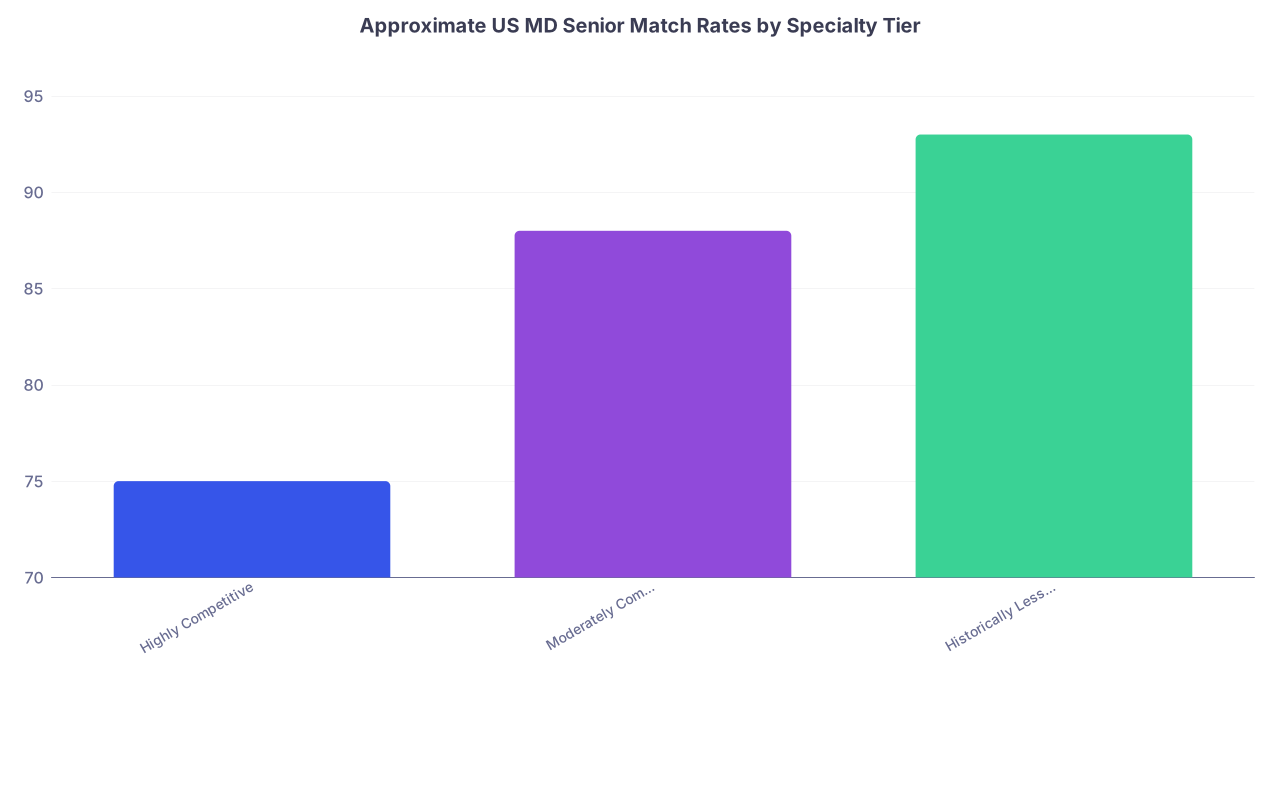
| Category | Value |
|---|---|
| Highly Competitive | 75 |
| Moderately Competitive | 88 |
| Historically Less Competitive | 93 |
That last group – historically “less competitive” – is where everyone tells you to hide: family medicine, internal medicine prelims, peds, psych, pathology in past years, etc.
What the match data actually shows:
- The “easy backup” pool has been shrinking. Many of those specialties have become more competitive as lifestyle and salary perceptions shift (psych and EM are textbook examples).
- The least competitive programs within those fields are often the ones with the worst training, lowest support, poorest fellowship placement, and highest burnout.
- Unmatched risk is real, but so is the risk of burning out in a field you never wanted.
The key question is not: “Is this specialty easier to get into?”
It’s: “What happens to me if I actually have to live this specialty for decades?”
That’s where “any residency is better than none” starts to fall apart.
The Trap of “Backup” Specialties
Let me be blunt: many people who “back up” into less competitive specialties never get out again. Not because they are lazy. Because structurally, switching is hard.
Myth: “I’ll Match Something Now, Then Transfer Later”
Sometimes, yes. Usually, no.
Transfers between specialties require:
- An available funded position (not common).
- A program director willing to take a chance on a partially trained resident.
- Recommendation letters from your current PD who is willing to lose a resident and tell another specialty you weren’t a mistake.
You start to see the problem.
In practice, specialty switching tends to favor a few groups:
- People moving from broad-core fields (IM, peds) into closely related subspecialties or fields (cards, pulm, allergy, etc.) through fellowship, not residency jump.
- Early PGY-1 switches, where you bail fast and the spot is easy to repurpose.
- Residents at big academic centers with strong connections and PDs who make calls.
If you SOAP into a small, struggling community program in a field you never wanted, your leverage in future negotiations is low. This is not theoretical; I have seen multiple residents stuck in programs they hate, with no real path out.
Myth: “Least Competitive = Less Stress”
Completely backwards.
The least competitive programs (not just specialties) often mean:
- Thinner staffing → more scut, more cross-coverage, more call.
- Weak ancillary support → you’re doing blood draws, transport, clerical nonsense at 3 a.m.
- Poor didactics → you graduate less prepared, with fewer options.
- Weak fellowship match → the “you can always subspecialize later” line collapses.
An “easy to enter” program can be brutally hard to survive.
Myth: “Backup Fields Don’t Close Doors”
They absolutely do.
Take a simple example:
You wanted orthopedics. You panic-applied and SOAPed into a categorical family medicine program.
Your realistic options later:
- Sports medicine fellowship (non-surgical).
- Maybe pain management, maybe urgent care, maybe outpatient MSK-heavy primary care.
What is not realistic:
- Doing a full re-residency in orthopedics after you finish FM. That’s almost nonexistent.
Your backup choice did not keep the door open. It closed it permanently and opened a different corridor.
That’s not automatically bad. It is bad if you lied to yourself about what it meant.
“Any Residency” vs No Residency: The Real Tradeoff
Here is the uncomfortable truth nobody likes to say out loud:
Sometimes, not matching and using a year strategically is better than scrambling into a career you know you will hate.
I am not talking about endless limbo. I am talking about a structured, intentional plan.
To make this concrete, compare three paths.
| Path | Short-Term Risk | Long-Term Career Control |
|---|---|---|
| Match into disliked, low-quality backup | Low | Low |
| Do a deliberate research/prelim/extra-year plan | Medium | High |
| Go unmatched with no plan | High | Very Low |
The scare-tactic phrase “unmatched MD is useless” conflates the second and third rows. They are not the same.
When “Any Residency” Is Probably Better
There are scenarios where a backup residency is rational:
- You genuinely like several broad specialties and could see yourself happy in more than one (say, IM, FM, psych).
- The program is solid, with real training, support, and fellowship prospects, even if the field wasn’t your first love.
- Your application is weak, and the probability of ever matching your dream ultra-competitive specialty is near zero even with another year (e.g., chronically low Step scores, repeated failures, major professionalism issues).
In those cases, “any decent residency within your realistic range” might indeed be better than gambling on a long-shot specialty that will never say yes.
When “Any Residency” Is Probably Worse
Where this advice is flat-out harmful:
- You have a strong, focused interest and your application is borderline but salvageable with a serious plan (research year, away rotations, Step 2 improvement).
- The only programs willing to take you are clearly malignant or chronically failing ACGME reviews.
- You are about to enter a specialty whose day-to-day life you know you actively dislike, based solely on fear of not matching.
That last one is how you end up with bitter family physicians who hate outpatient medicine, burned-out prelims repeating the Match, and residents counting days to finish instead of building skills.
The Ugly Side of “Least Competitive” Fields
Let’s talk about the “least competitive specialties” phrase directly. Because it’s sloppy.
There are three separate concepts people mash together:
- Historically less competitive specialties (FM, peds, psych, path, etc.).
- Least competitive programs within any specialty.
- Temporary distortions (like EM becoming toxic-competitive, then swinging down).
And then there’s the fourth layer: lifestyle myths.
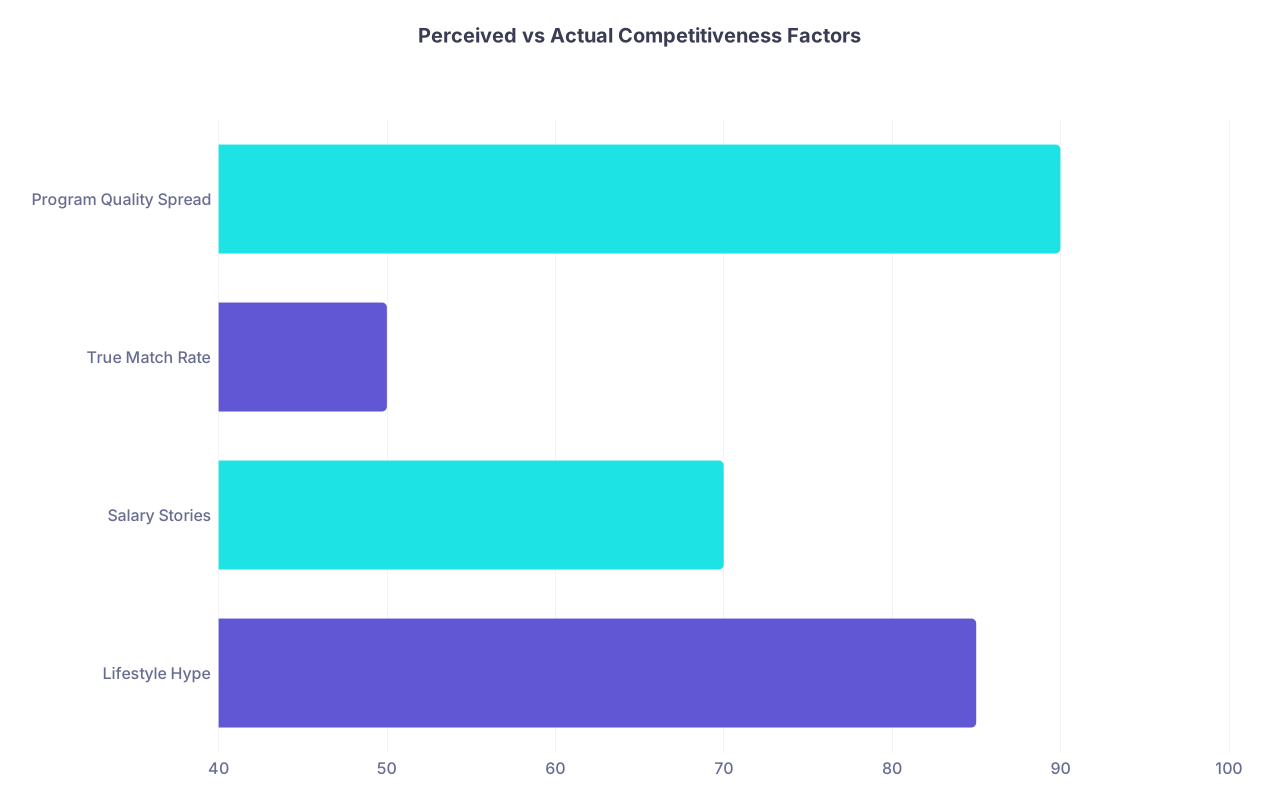
| Category | Value |
|---|---|
| Lifestyle Hype | 85 |
| Salary Stories | 70 |
| True Match Rate | 50 |
| Program Quality Spread | 90 |
Translation:
- Lifestyle hype (e.g., derm, radiology, anesthesia, psych) distorts student interest wildly.
- Salary stories (“you can make 400k in outpatient psych easy”) attract people for the wrong reasons.
- True match rate only tells you how hard it is to get in, not how good it will be once you are there.
- Program quality spread is huge; the bottom quartile of almost any specialty is rough.
Fields that used to be classic backups – psych, PM&R, pathology – have seen significant shifts in interest. The bottom-of-the-barrel programs in those specialties can be brutal.
And family medicine? Yes, there are some phenomenal FM programs. There are also rural, understaffed, overworked, underpaid setups that will grind you down.
So when someone waves a hand and says “just choose an easier field,” ask:
“Easier to get into, or easier to live with?”
Those are not the same.
What You Should Actually Do If You’re Worried About Matching
I am not going to sugarcoat this. The risk of not matching is real. That fear is not imaginary. But fear-based specialty choice is the wrong solution.
Here is a more rational approach.
1. Get brutally clear on your non-negotiables
Not vague “I want to help people.” I mean:
- Can you tolerate nights and procedures?
- Do you hate outpatient continuity, or does it energize you?
- Can you live with long training (6–7 years) if needed?
- Are you okay with lots of exam-based cognitive work vs hands-on stuff?
If you fundamentally cannot stand outpatient medicine, choosing FM or general peds solely because they are “less competitive” is self-sabotage.
2. Know the real competitiveness of your target field… for you
Derm and ortho are not the same universe as pathology or FM. But even within a field, your personal competitiveness matters more than the average.
If your Step/COMLEX, clerkship grades, and research are already significantly below the median for a hyper-competitive field, then yes, you are paying lottery odds. In that case, a “backup” may be rational – but pick one you can tolerate, not one you dread.
3. Treat backup specialties as real options, not disposable trash bins
If you would rather work as a non-residency MD (research, admin, industry, MPH, etc.) than be a lifetime internist, then internal medicine is not a backup for you. It is the wrong path.
A real backup is something you could see yourself doing without hating your life. Maybe less ideal. Not intolerable.
4. If you do not match, have a structured plan – not panic
What actually helps unmatched graduates:
- A research year in the field you truly want, with publications and real mentorship.
- A transitional year or prelim IM year in a decent program where you prove you can work hard, get letters, and reapply more competitive.
- Strategic geographic flexibility the second time around.
What does not help:
- Jumping blindly into any categorical spot you can grab, knowing you hate the field, with no thought beyond “at least I’m not unmatched.”
The first path is scary, yes. But it preserves agency. The second trades long-term agency for short-term relief.
So, Is Any Residency Better Than None?
No. Flatly no.
A solid residency in a field you can at least tolerate is usually better than rolling the dice on unemployment. That part is true.
But “any residency” – malignant programs, specialties you actively dislike, backup choices that lock you out of what you truly want – is not inherently better than a carefully planned, one-year detour to rebuild your application or redirect your life.
Residency is not a 3-year inconvenience. It is the launchpad for everything that comes after. Once you are boarded in something, inertia takes over.
Treat it like a one-time decision, not a disposable safety net.