
What if that “safe backup specialty” you’re eyeing because of its high match rate is actually one of the easiest ways to burn out, stall your career, or end up in a job market you did not sign up for?
Let’s dismantle the fantasy that a big match percentage automatically equals “easy, safe, and low risk.”
The Myth: “High Match Rate = Least Competitive = Good Backup”
Here’s the script you’ve heard a hundred times on Reddit and from panicked classmates:
- “Family med is always there as a backup.”
- “Psych is getting more competitive, but it’s still easier than derm or ortho.”
- “If I just apply to a non-competitive specialty, I’ll be fine.”
They look at NRMP match data, see that Family Medicine, Pediatrics, Psychiatry, Pathology, and some primary-care–oriented Internal Medicine tracks have high match rates, and they conclude these are “least competitive specialties” that will catch them if their dream specialty fails.
This is shallow reading of the data.
Match rates tell you who got in, not:
- How good those programs are
- How good the fit is
- What the job market looks like after
- What the day-to-day life actually feels like
- How many people quietly regret the “backup” they matched into
You can absolutely match into a “least competitive” specialty and still lose.
What Match Rates Actually Measure (And What They Hide)
Let me be blunt: match rates are a crude, blunt instrument. They measure one thing—did an applicant match somewhere in that specialty.
Nothing about:
- Program quality
- Geography
- Lifestyle
- Training intensity
- Fellowship prospects
- Long-term income and autonomy
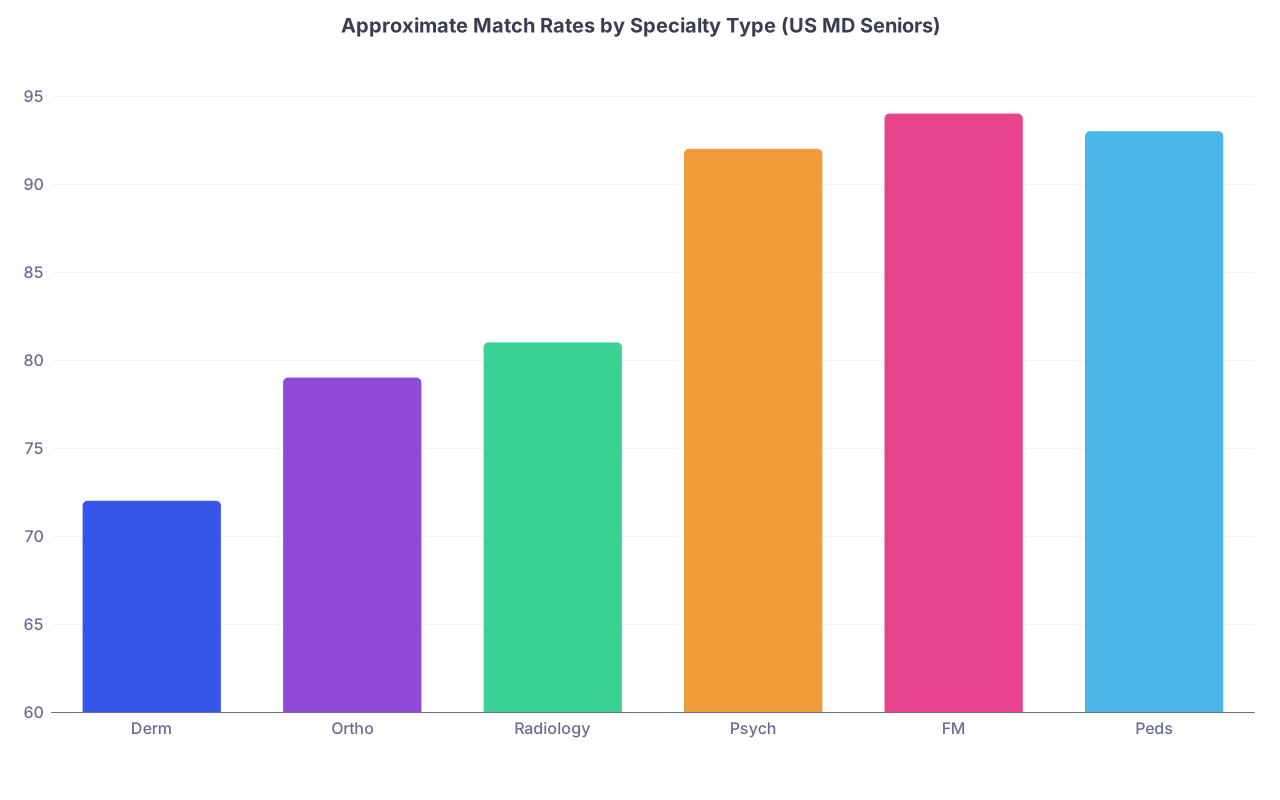
| Category | Value |
|---|---|
| Derm | 72 |
| Ortho | 79 |
| Radiology | 81 |
| Psych | 92 |
| FM | 94 |
| Peds | 93 |
You see derm at ~70–75%, family med in the mid-90s. On paper, your brain goes, “Okay, family med is safe. Derm is scary.” That’s the level most people stop thinking at.
But look at what those numbers don’t tell you:
- Derm unmatched: Usually had strong applications but faced a small, selective market. Many end up in a solid backup they actually chose carefully.
- Family med matched: Includes everyone from stellar candidates at academic powerhouses to completely unfiltered applicants matching to a single community program in a town they’ve never heard of.
The denominator is different. The applicant pool is different. The incentives are different.
Least competitive specialties often:
- Have more positions than applicants
- Are used by schools and health systems to “solve” workforce gaps
- Take a wider range of academic profiles
- Get flooded by last-minute “backup” applicants
So yes, the match rate is high. But that doesn’t tell you if you will like:
- The work
- The schedule
- The pay relative to workload
- The patient population
- The practice environment (e.g., RVU mills vs academic clinics)
Match data is a rearview mirror. You’re driving forward.
The “Least Competitive” Specialties Everyone Misunderstands
Let’s walk through a few of the usual suspects and what’s hidden underneath the shiny match percentages.
Family Medicine: High Match Rate, High Variability
Family medicine is the poster child for “backup specialty.” It also might be the most misrepresented.
What the data shows:
- High match rates for US MD/DO seniors
- Many unfilled spots each year (especially in community and rural programs)
- A huge range in program quality and scope
What people conveniently ignore:
- FM can mean anything from:
- Urban academic program with strong fellowships, procedures, sports, OB tracks
- To a three-resident-per-year program doing everything, with minimal support, 1:4 call, and 50+ patient clinic days
- The gap between “top” FM programs and the bottom tier is massive in:
- Teaching quality
- Faculty support
- Future job options
- Burnout in primary care is not a Reddit myth. It’s in the literature. Reimbursement, admin burden, and RVU pressure hit FM hard.
So is FM “least competitive”? On paper, maybe.
Is it “low risk”? Not if you match into the wrong program in the wrong system and wake up as a volume robot by PGY3.
Psychiatry: Everyone Wants the Lifestyle, Few Understand the Reality
Psych has ridden a wave: mental health crisis awareness, lifestyle reputation, and better compensation in recent years. Match rates are still relatively high, but the specialty is tightening.
What the data shows:
- Match rate for US seniors still >90% in many cycles
- Increasing proportion of international grads and DOs matching, but also increasing competition for “desirable” programs/cities
- Big regional variation in fill rates
What’s missing:
- Psych’s overall match rate hides that top coastal academic programs are much more selective now.
- There’s a real supply-demand mismatch:
- Urban, affluent areas: competitive jobs, saturated practices
- Rural/underserved: desperate for psychiatrists but often under-resourced, with complex, high-need populations and fewer supports
- The work can be emotionally heavy. Some people discover during PGY2 they cannot do high-acuity inpatient psych or constant suicidal risk assessment for life.
High match rate doesn’t mean low emotional load. Or low attrition. It just means you can probably get a seat. Somewhere.
Pediatrics: “Wholesome” But Underpaid and Overidealized
Peds screams “nice,” “supportive,” “family-friendly specialty.” That branding works. The match rate is high. Many use it as a softer backup.
What the data shows:
- High match rates, including for applicants with mid-tier scores
- Fair number of community spots that fill late
- Most graduates go into general pediatrics or outpatient work, not subspecialties
What you rarely hear:
- Pediatrics is one of the lowest-paying physician specialties relative to training length. That matters when you’re sitting on $250–400k of loans.
- Many peds residents discover the emotional toll of chronically ill kids, complex families, child protective situations is not “cute kid medicine.”
- The job market is very location-sensitive. Some metro areas are flooded with general peds, while others are starving for them.
Least competitive on match day does not mean least difficult 10 years later when you’re fighting with insurers over a prior auth for a kid’s inhaler.
Pathology: High Match Rate, Quiet Job Market Complexity
Path often gets tossed around as a backup for people who like diagnostics but didn’t match radiology or who “don’t like patients.” That logic is lazy.
What the data shows:
- Historically high match rates and unfilled spots
- US seniors sometimes underapply to path, leaving room for IMGs and late deciders
- Solid training, but heavily fellowship-driven job market
What match data hides:
- There’s a non-trivial concern about path job markets in certain regions. You’ll hear real pathologists say things like, “You need a good fellowship and you need to be flexible about relocation.”
- The field is being reshaped by:
- Consolidation of labs
- Automation
- Digital pathology and AI tools
- Many positions want subspecialty training (heme, GI, dermpath, etc.), which means extra years on top of a specialty you thought was “easy to get into.”
You match easily. Then you compete hard for the right fellowship and later for the right job. Match statistics do not forecast that second phase at all.
The Trap: Conflating “Easier to Match” With “Better for You”
The number-one mistake medical students make with “least competitive” specialties is treating them as generic, interchangeable backup buckets.
“I’ll just rank a few FM, psych, peds programs at the end. One of them will catch me.”
That’s how people end up:
- In a city they hate
- In a program with poor teaching and high service load
- In a specialty whose core problems they didn’t understand (e.g., primary care reimbursement, safety concerns in psych, emotional weight of peds)
Match rates are a system-level statistic. They don’t tell you:
- How many graduates of that specialty are happy with their careers
- How many changed paths, went into non-clinical work, or burned out
- How many feel trapped in low-autonomy jobs

Better Questions to Ask Than “What’s the Match Rate?”
If you’re trying to be strategic (and you should be), stop asking “Is this least competitive?” and start asking:
What is the spread in program quality within this specialty?
FM and psych have enormous variability. Some programs are phenomenal; some are downright predatory in work expectations.What’s the post-residency job market actually like?
Not just “Are there jobs?” but:- Where are the jobs?
- What do they pay?
- How many RVUs?
- What’s turnover like?
What’s the burnout and satisfaction data?
Multiple studies show primary care docs and some frontline specialties carry some of the highest burnout. Least competitive does not mean least burned out.How much is this field changing?
Pathology, radiology-adjacent things, outpatient primary care—technology and policy are moving fast. Being easy to get into now does not guarantee stability.What happens if I want to sub-specialize?
Some fields are increasingly fellowship-driven: peds, path, even FM with sports, OB, or hospitalist tracks. You might match easily into residency and then struggle at the fellowship stage.
A More Honest Way to Use Match Data
I’m not telling you to throw away the NRMP data book. I’m telling you to use it like an adult, not like a superstition.
Here’s how to read “least competitive specialties” more intelligently:
| Question | What Match Data Shows | What You Must Investigate Yourself |
|---|---|---|
| Can I likely match? | Overall match rate | My own stats vs recent matched profiles |
| Where will I match? | Program fill rates | Geographic and program selectivity |
| How will I live/work? | Nothing | Lifestyle, workload, burnout |
| Future job prospects? | Nothing | Regional job market, pay, autonomy |
Use match rates to:
- Decide if you need parallel planning or backup applications
- Gauge how much geographic flexibility you might require
- Estimate roughly how “tight” the specialty is at your competitiveness level
But then you do the harder work:
- Talk to actual residents and attendings in those fields
- Ask about call schedules, clinic volume, and admin load
- Look up salary and job postings in multiple regions
- Read beyond the glossy program websites
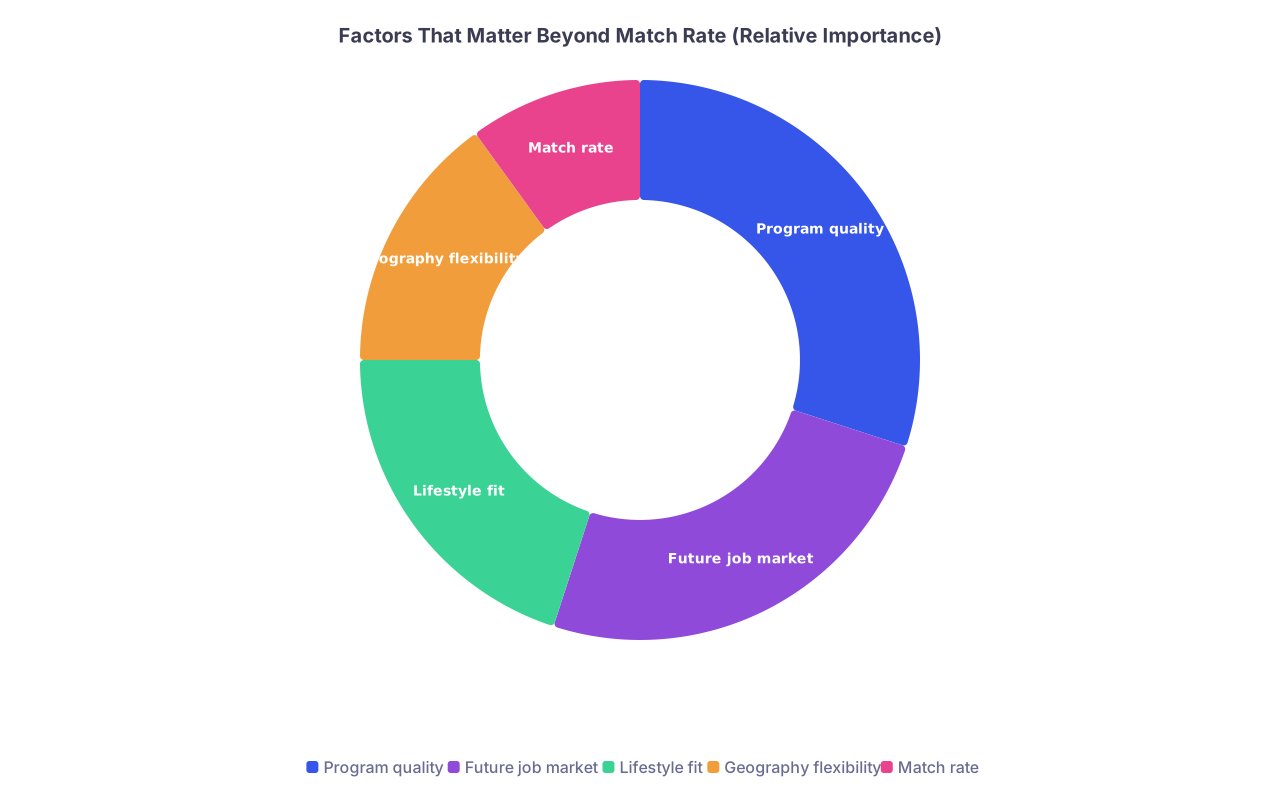
| Category | Value |
|---|---|
| Program quality | 30 |
| Future job market | 25 |
| Lifestyle fit | 20 |
| Geography flexibility | 15 |
| Match rate | 10 |
The point: match rate should not be the dominant variable in your decision. It’s one piece, and not the most important one.
The Backup Plan That Isn’t a Trap
You should have a backup plan if you’re shooting for something truly competitive like derm, ortho, plastics, or ENT. But a smart backup is not “whatever has the highest match rate.”
A smart backup looks like this:
- You’d genuinely be okay doing that specialty long term. Not thrilled? Fine. But not miserable.
- You’ve actually rotated in it. At least once.
- You’ve talked with at least 3+ attendings and residents who are honest about their careers in it.
- You understand how people in that field:
- Get jobs
- Avoid burnout
- Change directions if needed (fellowships, admin, non-clinical paths)
And your rank list reflects real thought, not panic.

| Step | Description |
|---|---|
| Step 1 | Choose Target Specialty |
| Step 2 | Focus on Fit and Programs |
| Step 3 | Identify Backup Specialty |
| Step 4 | Do More Exploration |
| Step 5 | Apply Strategically to Both |
| Step 6 | Create Honest Rank List |
| Step 7 | Highly Competitive? |
| Step 8 | Would I Accept Backup as Career? |
If you cannot, in good faith, say you’d tolerate your backup specialty as a real career, then it is not a backup. It’s a future regret.
The Real Takeaway
Least competitive specialties are not charity options. They’re fields with their own complexity, politics, job markets, and pain points. They look safer because they have high match rates and lots of positions.
But you’re not just trying to win Match Day. You’re trying to build a 30–40 year career that you:
- Don’t hate
- Can sustain
- Can live on financially
Match statistics tell you who sat in the chairs last year. They do not tell you who wishes they’d chosen differently.
Years from now, you’ll barely remember your exact match percentile. You’ll remember whether you can stand the work you do each day—and that has almost nothing to do with how “competitive” the specialty looked on paper.