
What if your “backup” specialty — the one everyone calls a safety net — actually gives you a better career 15 years out than the flashy field you feel pressured to chase?
Let’s ruin a popular myth: that choosing a less competitive specialty (family medicine, psychiatry, pediatrics, PM&R, path, etc.) is some kind of permanent downgrade. “Career suicide.” I hear that exact phrase from MS2s and MS3s every single year.
Here’s what the data actually shows.
The Prestige Trap: Why People Think Less Competitive = Worse Career
The story you hear in med school corridors is simple and wrong:
- Competitive = smart, respected, rich, happy
- Less competitive = could not match something better, lower pay, fewer options
You see it in how students talk:
“Yeah, he’s doing FM… but he could’ve gotten into anesthesia if he’d tried harder.”
“She settled for psych.”
“He only went into peds because his Step score tanked.”
Notice the word: settled. Nobody ever says, “She settled for orthopedics.”
But look past the hallway gossip and a different picture emerges. Competitiveness is a measure of supply and demand among applicants, not quality of life, long-term income, impact, or satisfaction.
Plastic surgery is competitive because there are few spots and lots of people chasing them, not because every plastic surgeon is happier than every internist.
To make this concrete, let’s look at a basic economic reality that students conveniently ignore: less competitive does not mean low demand. It often means high demand and chronically undersupplied.
Where the real need is
Primary care, psychiatry, geriatrics, rural generalists — these are the fields with:
- Chronic job vacancies
- Heavy recruiting incentives
- Employer competition for you, not the other way around
That is power. But most students are staring so hard at Step score percentiles they never notice.
Money: Are You Really Dooming Your Lifetime Earnings?
This is the part everyone pretends they don’t care about and secretly obsesses over.
Let’s compare some broad strokes. These aren’t perfect, but they’re directionally right and backed by salary surveys (MGMA, Medscape, etc.). Think “order of magnitude,” not “down to the last dollar.”
| Specialty | Typical Range (USD) |
|---|---|
| Family Medicine | $240k–$300k |
| Psychiatry | $270k–$350k |
| Pediatrics | $220k–$280k |
| Internal Medicine | $250k–$320k |
| General Surgery | $350k–$500k |
| Orthopedic Surgery | $600k–$800k+ |
| Dermatology | $450k–$650k+ |
Yes, ortho and derm pay much more than family medicine or pediatrics. That part is real.
But the “career suicide” narrative ignores three massive counterweights:
- Time to attending income. If you jump into a long, hyper-competitive training pathway (say 7+ years with fellowship), you’re delaying full attending income while interest on your loans compounds.
- Where you practice. A family med doc in a rural or underserved area can out-earn a pediatrician at an elite children’s hospital in a major city. Psych in a high-need market can quietly cross $350–400k with relatively sane hours.
- Control over schedule and burnout. You do not keep that top 1% subspecialty income if you burn out and drop to part-time at 42.
I’ve seen an FM doc in the Midwest making ~$380k with a 4-day week and no call. I’ve also seen an interventional cardiologist in a desirable city making less than $450k while being perpetually one bad month from a stress-induced meltdown.
Now look at the bigger picture:
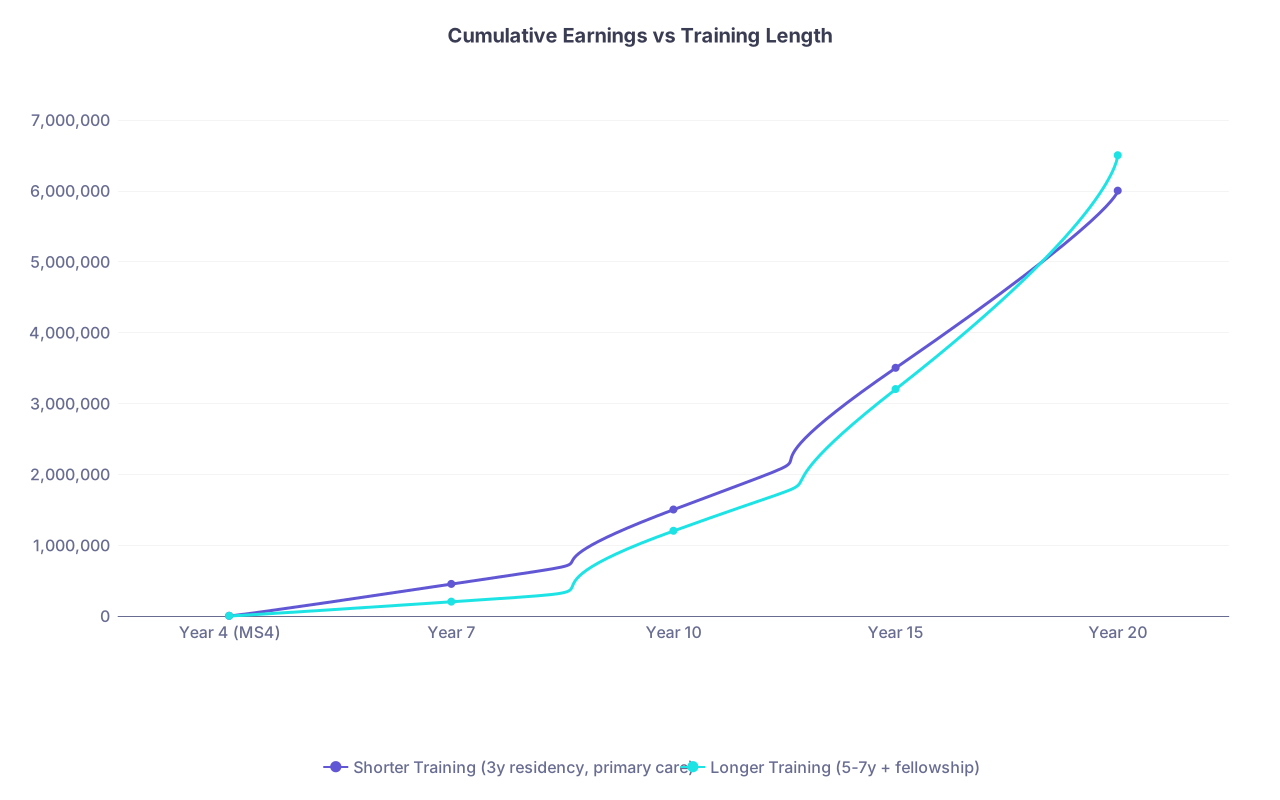
| Category | Shorter Training (3y residency, primary care) | Longer Training (5-7y + fellowship) |
|---|---|---|
| Year 4 (MS4) | 0 | 0 |
| Year 7 | 450000 | 200000 |
| Year 10 | 1500000 | 1200000 |
| Year 15 | 3500000 | 3200000 |
| Year 20 | 6000000 | 6500000 |
For many “less competitive” fields with shorter training, you’re earning attending money earlier. Over a 20–25 year career, the gap with a more competitive but longer-training specialty is smaller than med students think, sometimes negligible, sometimes in your favor depending on location and workload.
Is ortho still likely to win the raw dollar race? Yes. But most of the “middle of the pack” specialties end up much closer together than the med school rumor mill suggests.
The real question is: do you need “top 5% of all physicians” income, or do you need “highly comfortable upper-middle/upper-class for life” income? Because a lot of so-called “backup” fields give you the latter, reliably.
Job Security, Autonomy, and Mobility: Underrated Weapons
Ask ten M4s what they fear about picking FM or psych and you’ll hear this: “I don’t want to limit my options.”
Reality check: some of the “less competitive” fields give you more options, not fewer.
Geographic freedom
High-need, lower-supply specialties like family medicine, psychiatry, and general internal medicine are in demand almost everywhere. Want to move states? Switch health systems? Go 0.8 FTE? Much easier.
I’ve watched a hospital system offer a psychiatrist:
- A six-figure sign-on
- A flexible schedule
- Loan repayment
- And remote work options for part of the week
Try asking for that kind of leverage when your subspecialty is saturated in major metro areas.
Non-clinical doors
Certain “less competitive” fields integrate naturally with non-clinical roles:
- Psych → leadership in mental health systems, telehealth leadership, clinical trials for CNS drugs
- FM/IM → medical directorships, quality roles, population health, insurance, ACO leadership
- Path → lab directorships, diagnostics companies, industry
You do not need a hyper-competitive match for a C-suite job 20 years from now. You need reputation, experience, and a network. Those grow just fine in “unsexy” specialties.
Burnout and exit risk
Here’s the piece almost nobody talks about as an MS3: your biggest career risk isn’t “I picked the wrong prestige level.” It’s: “I picked something that chews me up and spits me out.”
Survey after survey shows high burnout in:
- Emergency medicine
- Some surgical specialties
- Certain shift-based, high-acuity fields
Not exclusively, but disproportionately.
Contrast that with many outpatient-heavy fields — FM, psych, allergy, geriatrics, peds subspecialties — where you have more room to adjust panel size, alter schedule, or move to a lower-acuity setting without abandoning your specialty.
Career suicide is not “I matched family med.”
Career suicide is “I chose a lifestyle I can’t survive for 25 years.”
Prestige, Identity, and the Ego Problem
Let’s talk about what’s really driving some of the fear: identity.
Med students are trained, implicitly, to equate specialty competitiveness with personal worth. Your Step score becomes your value. Your specialty choice becomes your brand. That’s why someone with a 250 feels like they “can’t” do psych — it feels like “wasting” the score.
That logic is backwards.
Your Step score is a door-opener, not a destiny. Using it to chase a specialty you do not like, just to “maximize” it, is like choosing a spouse based on how impressed others will be at the wedding.
I’ve heard residents in super-competitive fields openly say things like:
“If I had matched psych instead of this, my life would be better, but I just couldn’t swallow it back then.”
They’re not imagining it. They’re living the mismatch.
Less competitive fields are often broad, flexible, and humane. You can:
- Craft your niche
- Shift over time (e.g., FM → sports, addiction, urgent care; psych → forensics, interventional, TMS, etc.)
- Adjust pace with age, kids, health changes
A 50-year-old psychiatrist can reduce clinic days and still have meaningful work. A 50-year-old trauma surgeon… different calculus.
The painful truth: chasing prestige often maximizes external validation while ignoring internal sustainability.
Misconceptions About “Being Stuck”
Another myth: “If I choose a less competitive specialty, I’m stuck forever.”
Not exactly.
Fellowship pathways
Plenty of less-competitive cores have competitive fellowships that significantly change your day-to-day work and income:
- IM → cards, GI, pulm/crit, heme/onc
- FM → sports med, palliative, addiction, OB-heavy practices
- Psych → child & adolescent, addiction, forensics, interventional
And some jobs do not require formal fellowship to niche down. I know FM docs doing:
- Full-time urgent care
- Mostly procedures
- Nursing home and hospice care with high autonomy
Same story in psych: some docs build practices around specific modalities, populations, or tech (ketamine, TMS, digital platforms) without extra alphabet soup.
Actual career pivots
Switching fully from one specialty to another is not simple and not common. But it’s not zero.
I’ve seen EM → FM, surgery → anesthesia, peds → psych, FM → radiology. Painful, costly, but doable. Those transitions had one thing in common: the physician realized they picked based on prestige, not fit.
If you think choosing family medicine at 27 is permanent “career suicide,” but somehow doing a radical specialty switch at 38 is not… you have the risk calculus backward.

| Step | Description |
|---|---|
| Step 1 | Choose Specialty |
| Step 2 | Higher Satisfaction |
| Step 3 | Higher Mismatch Risk |
| Step 4 | Adjust Within Specialty |
| Step 5 | Burnout or Pivot |
| Step 6 | Late Career Change |
| Step 7 | Chose by Fit or Prestige |
What Long-Term Outcomes Actually Look Like
If you zoom out 15–20 years after residency, here’s what usually matters:
- How exhausted you are
- Whether you still like your patient population
- How much control you have over your time
- Whether your income supports the life you want, in the place you want to live
Less competitive fields do very well on these.
Family medicine, IM, psych, peds, PM&R, path — these are the workhorses of the system. They rarely command the conference-room awe of “I’m a neurosurgeon,” but they quietly:
- Build stable practices
- Become local leaders
- Take leadership roles in health systems, medical groups, community health, and industry
- Maintain flexibility as medicine changes
If you’re thinking about 30-year outcomes, here’s the harsh but accurate truth: good, boring, sustainable beats shiny, brittle, and miserable.
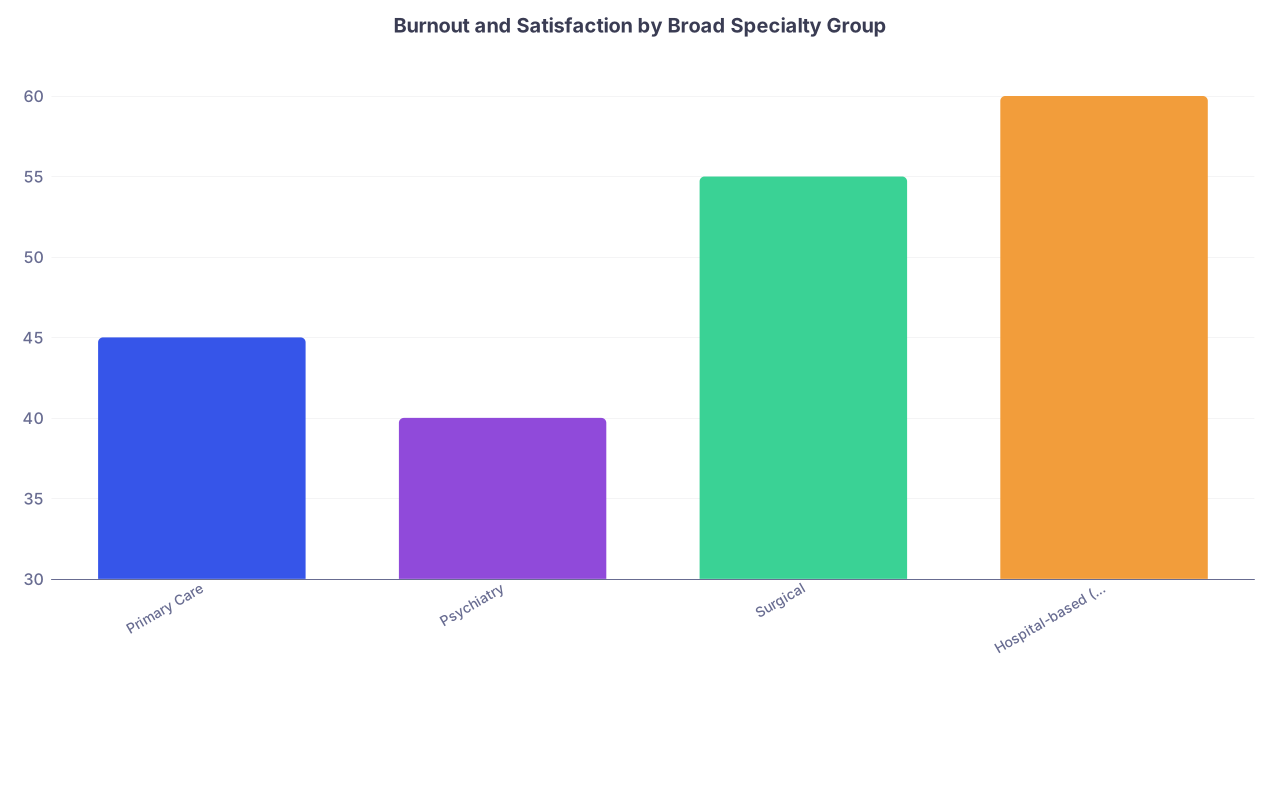
| Category | Value |
|---|---|
| Primary Care | 45 |
| Psychiatry | 40 |
| Surgical | 55 |
| Hospital-based (EM, Anes, Rad) | 60 |
(Approximate % reporting burnout in surveys — the exact numbers vary by year, but the pattern is stable: no group is immune, but some are consistently worse.)
You’re not choosing a trophy. You’re choosing a long-term job with a human cost.
So, Is It Career Suicide?
No. And I’ll say it bluntly: calling FM, psych, peds, path, PM&R, or other less-competitive specialties “career suicide” is ignorant.
What is career suicide — or at least career self-harm — looks more like this:
- Choosing a specialty you do not like to impress classmates
- Ignoring your own temperament and energy in favor of perceived prestige
- Underestimating how much burnout will wreck your income, relationships, and health
- Overestimating the long-term payoff of an extra $100–200k/year when you’re already in the top 5–10% of household income
Picking a less competitive specialty that matches your brain, your values, and your stamina is not suicide. It’s risk management.
Choose something that lets you stay in the game.
FAQ
1. If I have a high Step score, is it “wasted” on a less competitive specialty?
No. A high score gives you options, not obligations. Using it to secure a strong program in a so-called “less competitive” field can mean better training, mentorship, and future leverage. That’s not waste. That’s optimization.
2. Will I regret not chasing a more competitive specialty later?
You might regret ignoring your genuine interests to chase prestige; I see that all the time. I rarely see someone who truly likes FM, psych, or peds and matched there later say, “I wish I’d forced myself into neurosurgery.” Regret usually tracks mismatch, not competitiveness level.
3. Can I still do leadership, admin, or industry work from a less competitive specialty?
Absolutely. Medical directors, CMOs, quality leads, pharma/biotech consultants, informatics people — they come from everywhere. Once you’re 10–15 years out, your track record matters more than how competitive your residency was.
4. Are there any less competitive fields I should avoid because of poor prospects?
No specialty is universally “bad,” but some are more market-sensitive (e.g., certain narrow hospital-based roles in saturated markets). Your risk isn’t that a field is less competitive now; it’s that you choose something shrinking, oversupplied in your desired location, or misaligned with your future flexibility. Look at job trends and geography, not just the match rate.