
The idea that “only weak applicants choose low-competition specialties” is lazy, wrong, and honestly a little toxic.
You hear it on every campus: the surgery-bound MS3 muttering that “people who can’t match something real just go into family” or the Step-2-hero who sneers at psych because “it’s for people who can’t handle real medicine.” I’ve heard versions of this from students, residents, and yes, even from a few attendings who should know better.
Let’s dismantle it with actual data and real-world context.
What “Low-Competition” Actually Means (And What It Does Not)
People throw around “non-competitive” and “backup specialty” like they’re objective categories. They’re not. NRMP doesn’t label specialties as “for strong people” and “for everyone else.”
What we do have are numbers: fill rates, Step scores, applicant-to-position ratios, percentage of unmatched applicants, and the proportion of positions filled by US MD seniors.
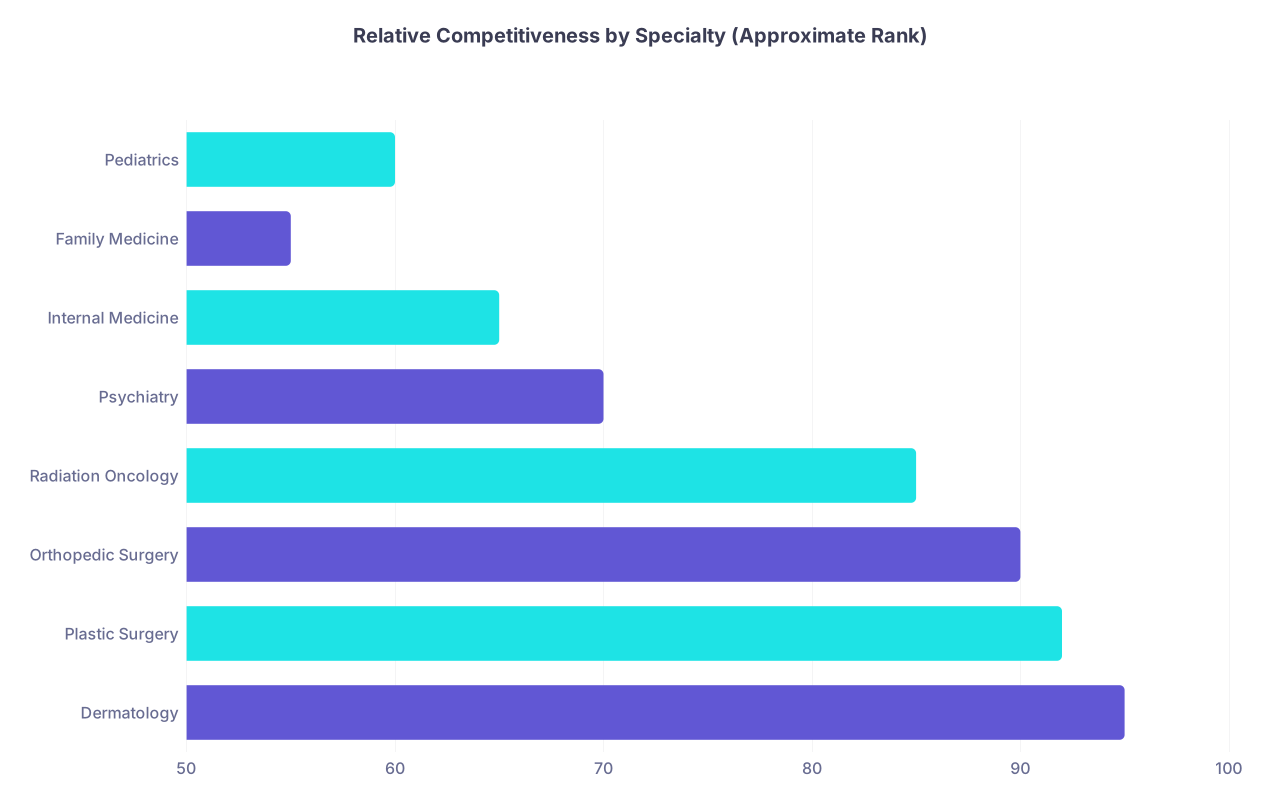
| Category | Value |
|---|---|
| Dermatology | 95 |
| Plastic Surgery | 92 |
| Orthopedic Surgery | 90 |
| Radiation Oncology | 85 |
| Psychiatry | 70 |
| Internal Medicine | 65 |
| Family Medicine | 55 |
| Pediatrics | 60 |
That chart is conceptual, but directionally right: some specialties are consistently more competitive by metrics (derm, plastics, ortho), some are moderate (IM, EM, anesthesia), and some are relatively less competitive (family, peds, psych, pathology). But “less competitive” does not mean:
- “Anyone can match here”
- “Only low-score applicants end up here”
- “The field is easy or low-value”
The data shows something more nuanced: different specialties select for different strengths, priorities, and risk tolerances.
Data Check: Are “Low-Competition” Specialties Full of Weak Applicants?
Short answer: no. Longer answer: not even close.
Look at typical patterns:
- Family Medicine
- Psychiatry
- Pediatrics
- Pathology
- PM&R (depending on the year)
These are often labeled “less competitive.” But if you actually look at NRMP data and program-level numbers, you see something else: a huge spread of applicant strength.
You’ll find people with:
- Step scores in the 260s who voluntarily chose family medicine because they want longitudinal care and a sane life.
- Applicants who could have realistically matched IM subspecialty tracks at big-name places, but went into pediatrics or psych because they like the population.
- MD/PhDs going into pathology or PM&R because the research questions there actually interest them.
And yes, you’ll also find people whose board scores are marginal, or who had red flags, who gravitate toward these specialties because the match odds are less brutal. Both things are true at once.
That’s the part no one on your surgery rotation will admit: low-competition specialties have both very strong and more marginal applicants. High-competition fields, by definition, mostly filter out the marginal ones. That’s a selection effect, not a judgment on worth or capability.
The Applicant Pool Is Not Random: Self-Selection Is Doing a Ton of Work
This is the piece most students miss.
You can’t compare “average Step scores” across specialties and say, “See? Low number. Weak people.” That assumes everyone wanted the same specialty and then got sorted purely by ability. That’s fantasy.
Here’s what actually happens:
People who want a high-paying, procedure-heavy, prestige-boosted specialty are more likely to grind test scores, prioritize research, and treat med school like an arms race. They self-select into derm, ortho, ENT, plastics, etc.
People who want lifestyle, longitudinal relationships, mental health, kids, systems work, or academics without 2 am laparotomies self-select into psych, family, peds, PM&R, pathology, etc.
People who aren’t sure… follow the noise. And the noise in medical school tilts hard toward prestige and competition. So the “default” high-achiever path gets framed as specialty X or Y, and everything else is painted as “backup.”
So the fact that mean Step scores are lower in some fields is not a pure ability readout. It’s mainly:
- Different incentives
- Different values
- Different thresholds of “I need a 260 to even be considered” vs “I can match with a 225 if the rest of my application makes sense”
There’s also the very simple fact that some specialties are structurally more open to a wide range of applicants. Family medicine has tons of community programs across the country. Derm has a tiny number of spots clustered at highly resourced centers. Of course the latter will look “stronger on paper” on average. That says more about supply and selection filters than human worth.
The Quiet Reality: Many Strong Applicants Choose “Low-Competition” On Purpose
Let me be direct: a lot of you are stronger on paper than the field you’re secretly drawn to. And you’re afraid to admit that because your classmates will say you “wasted” your scores.
I’ve watched several versions of this play out:
- The MD at a top-10 school with a 255+ Step 2, multiple first-author pubs, who matched community family medicine in the Midwest so they could be near aging parents and be done with the training rat race.
- The PhD-level neuroscientist who matched psychiatry at a strong academic center because they care about severe mental illness more than ICU numbers.
- The ultra-high-performing MS4 who realized halfway through sub-I that they loathed the OR and switched to pediatrics. Their ortho-bound friends literally told them they were “throwing away their career.”
You see the pattern. People with “top-tier” stats choosing “lower-tier” specialties because they care about:
- Patient population
- Lifestyle and burnout risk
- Geographic control
- Longitudinal relationships
- Type of work (procedural vs cognitive vs diagnostic)
The “only weak applicants choose low-competition” myth survives because those high-performing people often stop broadcasting how strong they could have been “elsewhere.” They just quietly match, do their jobs, and stop arguing on Reddit.
Specialty Difficulty ≠ Specialty Competitiveness
Another lazy conflation: “If it’s not competitive, it must be easy.”
Really? Let’s walk through a few supposedly “easy” fields.
Family Medicine
You’re the first call for literally anything. Your clinic day whiplashes from uncontrolled diabetes to undiagnosed psychosis to chronic pain to prenatal care. You’re managing complexity with limited time, limited resources, and often limited specialty backup. The cognitive load is huge. So is the emotional load.
Psychiatry
This field sees some of the most complex, high-risk patients in medicine. Not “weak applicants who can’t handle medicine.” Residents manage patients who are suicidal, psychotic, violent, or profoundly traumatized. The liability is real, the stakes are high, and the evidence base—while growing—is still full of ambiguity. You think that’s easier than closing a straightforward hernia?
Pediatrics
You’re constantly dosing meds by weight, interpreting subtle signs in nonverbal patients, and fighting the system for your patients’ social needs. And if you go NICU, PICU, or heme/onc, the medicine is every bit as complex as adult critical care—just in smaller, less forgiving packages.
Pathology
The entire hospital relies on their reads. One mislabel, one misread margin, one missed atypical cell cluster, and a patient gets the wrong chemo or wrong surgery. The stakes are quiet but enormous.
“Easy” usually means “less visibly glamorous” or “less physically brutal in residency.” It doesn’t mean clinically trivial.
Why The Myth Won’t Die: Status, Insecurity, and Projection
Let’s be honest about the social physics in med school:
- Prestige in medicine is still tied to procedures, pay, and scarcity.
- Students are constantly ranking each other—scores, publications, letters, school name.
- Anxiety about your own competitiveness easily morphs into contempt for others’ choices.
So people cope by building hierarchies:
“I’m going into ortho, which is hard to match, so I’m better than the people going into peds.”
It’s not always said aloud. But it’s implied in jokes, eye rolls, and “Oh, you’ll be fine, that field takes everyone.”
The myth that “only weak applicants choose less competitive specialties” is a status defense mechanism. It keeps the prestige narrative intact: if you choose high-competition, you’re strong and ambitious. If you choose low-competition, you’re either weak or wasting your potential.
Reality is more uncomfortable:
Some of the most resilient, self-aware, and clear-sighted people in medicine look at high-competition fields, understand they could chase them, and say: “No thanks.”
That threatens the whole hierarchy. So the system calls them weak to stay comfortable.
The Real Question: Are You Choosing From Strength or Fear?
You’re not actually trying to answer, “Do only weak applicants choose low-competition specialties?” You’re asking: “If I choose one, what will people think of me? And will I regret it?”
Here’s the more honest framework.
Choosing from fear looks like:
- “I’d love to do ENT, but I’ll never match, so I’m going to say I ‘always wanted psych’ even though I haven’t actually explored it.”
- “My scores are average, so I guess I have no choice but family medicine,” even though you’ve done zero sub-Is in other fields at programs where you’d realistically be competitive.
- “Everyone says anesthesia is too competitive this year, so I’ll just default to IM without really considering whether I want hospitalist life.”
Choosing from strength looks like:
- “My stats are strong enough for a more competitive field, but I’ve actually done the rotations and spoken to attendings, and the day-to-day life in that specialty is not how I want to spend the next 30 years.”
- “I’m not willing to apply to 80 programs across the country, move anywhere, and be geographically miserable just to say I matched X.”
- “I’m okay with people quietly judging my choice because my tolerance for status games is low and my tolerance for daily misery is lower.”
I’ve seen applicants with 230s grind like hell and match radiology because they truly loved it. Strong choice. I’ve seen people with 260s walk away from competitive fields because they wanted time for family and outpatient continuity. Also a strong choice.
The “weak” move isn’t choosing a less competitive specialty. It’s lying to yourself about why you’re making that choice.
The Numbers That Actually Matter Long-Term
Everyone obsesses over Step scores and match stats. Then five years after residency, the scoreboard changes completely.
What matters then?
- Burnout vs. sustainability
- Control over your practice (location, schedule, patient volume)
- Alignment between the daily grind and your actual temperament
- Your ability to stay curious and not resent your life
I’ve watched:
- High-powered surgical residents quit mid-training because they realized too late they hated the lifestyle.
- “Non-competitive” family docs build niche practices (sports med, addiction, geriatrics) with full panels and real autonomy.
- Psychiatrists with “backup” reputations doing cutting-edge research and consulting, miles ahead of many “prestige” classmates in academic impact.
Long-term, specialty prestige is noise. Fit, autonomy, and sustainability are the signal.
Quick Reality Check With a Comparison Table
Let’s put some of this in a structured snapshot. These are directional, not exact, and vary by year and program, but the pattern holds.
| Specialty | Perceived Competitiveness | Typical Applicant Range | Lifestyle Predictability | Scope of Practice Breadth |
|---|---|---|---|---|
| Dermatology | Very high | Narrow, high stats | High | Narrow/procedural |
| Orthopedic Surg | Very high | Narrow, high stats | Low | Narrow/procedural |
| Psychiatry | Moderate | Wide range | Moderate-High | Moderate |
| Family Medicine | Lower-moderate | Wide range | Moderate | Very broad |
| Pediatrics | Moderate | Wide range | Moderate | Broad (with subspecialties) |
| Pathology | Moderate | Wide range | High | Broad diagnostic |
See the pattern? The so-called “low-competition” fields systematically accept a wider range of applicants, not a uniformly weaker one.
Final Reality Check
Let’s end this cleanly.
“Low-competition” specialties are not dumping grounds for weak applicants. They are fields with broader doors, attracting both top-tier and marginal candidates, heavily shaped by self-selection and values—not just ability.
Choosing a less competitive specialty can be an extremely strong move if it reflects clear priorities, honest self-knowledge, and a willingness to walk away from prestige theater.
The myth itself mostly reveals other people’s insecurity, not your worth. Your real job is not to win the med school status game. It is to pick a specialty you can practice for decades without hating your life—or your patients.