
Challenging the Belief That Research Doesn’t Matter in Easier Specialties
The belief that “research doesn’t matter if you’re going into an easy specialty” is one of the laziest myths in medical training. It is also a very efficient way to quietly limit your own options without realizing it.
You hear the same lines over and over in workrooms and group chats:
“I’m just doing family, I don’t need research.”
“Psych is chill, they don’t care about pubs.”
“FM/IM is backup — nobody’s looking at my CV that closely.”
That’s not how this actually works.
If you look past the anecdotes and people’s selective memories, the data tell a very different story: research matters more than you think, earlier than you think, and in more “non-competitive” fields than most students realize. It doesn’t matter equally everywhere. But it’s never irrelevant.
Let’s walk through what the numbers and real match outcomes actually show.
The “Easy Specialty” Myth Is Already Crumbling
First problem: the whole idea that there are “easy” specialties is outdated.
Yes, there are specialties with higher overall match rates and more spots: family medicine, internal medicine (categorical), pediatrics, psychiatry, PM&R, pathology, neurology, etc. But calling them “easy” obscures a critical point: the floor may be lower, but the ceiling is very high.
In almost every one of these fields, there are:
- Elite academic programs
- Highly selective tracks (research tracks, primary care leadership tracks, global health tracks)
- Strong geographic choke points (Boston, NYC, Bay Area, Seattle, etc.)
At that top end, research suddenly stops being “optional.”
Let’s be concrete. Look at NRMP Charting Outcomes and Program Director Surveys over recent cycles (yes, they’re a few years behind, but the direction is consistent). If you separate “matched anywhere” from “matched at a top, research-heavy or urban program,” a pattern shows up:
- Average publications for all applicants in internal medicine: modest.
- Average publications for matched applicants at top academic IM programs: noticeably higher.
- Same pattern in psychiatry, pediatrics, neurology, PM&R, even family medicine.
Research is not the sole difference — board scores, clerkship grades, letters matter — but it’s one of the clearest levers that distinguishes “I matched” from “I had actual choice.”
To make this less abstract:
| Specialty | All Matched (avg pubs) | Top Academic Programs (avg pubs) |
|---|---|---|
| Internal Med | 3–4 | 6–8 |
| Psychiatry | 2–3 | 5–6 |
| Pediatrics | 2–3 | 4–6 |
| Family Med | 1–2 | 3–4 |
| Neurology | 3–4 | 6–7 |
Those numbers are approximate and vary by year and dataset, but the pattern is consistent enough that program directors openly admit it when surveyed: academic programs and university hospitals weigh research more heavily. “Less competitive” specialty or not.
What the PDs Actually Say (Not What Your Classmate Thinks They Say)
Stop listening to the M2 who “heard from a friend” that research is irrelevant in primary care. Listen to the people voting on rank lists.
In repeated NRMP Program Director Surveys, PDs are asked:
- Do you consider research in deciding who to interview?
- How important is it in your overall ranking?
The answers are not subtle.
- In internal medicine, pediatrics, psychiatry, neurology, and PM&R, a majority of PDs in university-based programs rate “demonstrated scholarly activity” as at least moderately important.
- Community-heavy fields like family medicine rate it lower on average, but even there, around a third of PDs report that research or scholarly activity is part of what they review, especially at university-affiliated or competitive urban programs.
Here’s roughly what that looks like:
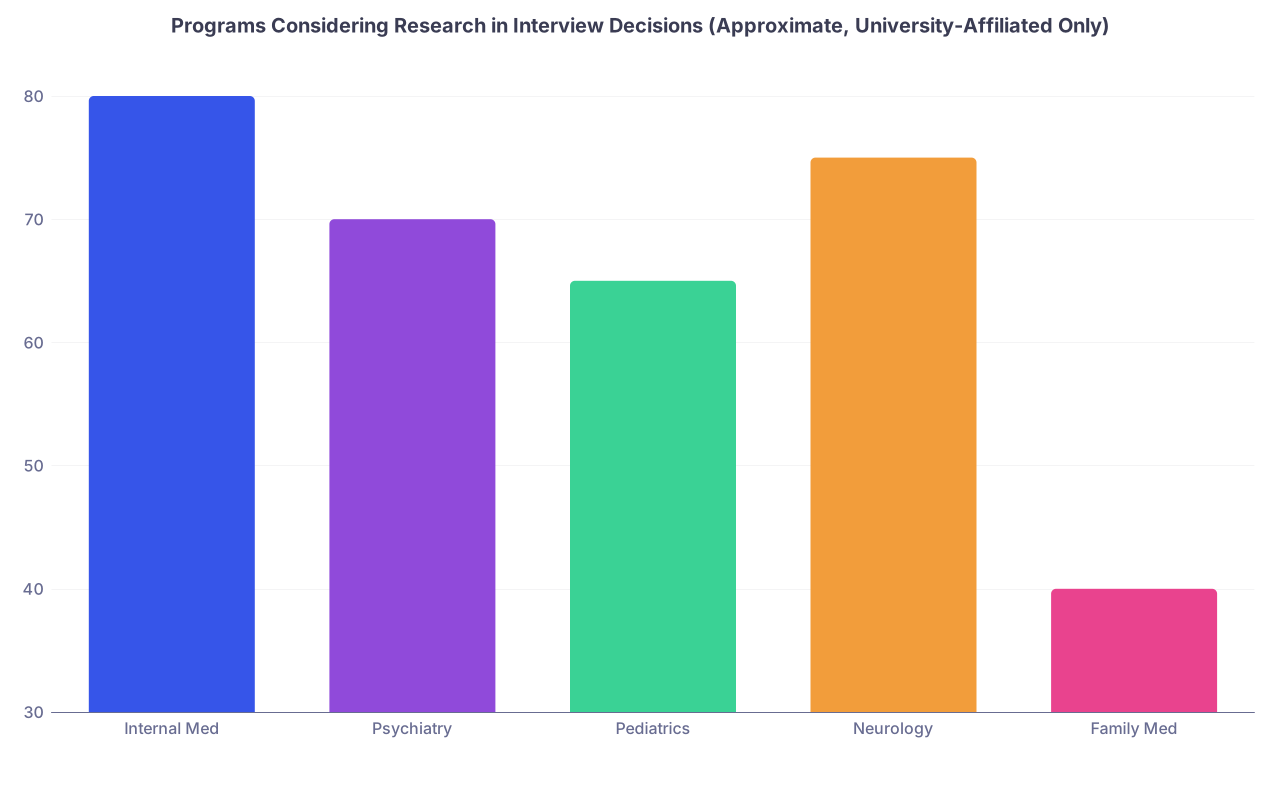
| Category | Value |
|---|---|
| Internal Med | 80 |
| Psychiatry | 70 |
| Pediatrics | 65 |
| Neurology | 75 |
| Family Med | 40 |
Is research the top factor? No. Clinical performance and letters dominate almost everywhere. But that’s not the question you should be asking.
The real question is: once your scores and grades are “good enough,” what moves your application from the giant middle of the pack into the “this one looks interesting” pile?
For many academic and urban programs in so‑called “easier” specialties, the answer is: some type of scholarly work. Even better if it’s relevant to the field.
I’ve watched rank meetings where two otherwise similar applicants are compared: same Step scores, same clerkship comments, both from mid‑tier schools. One has a psych-related poster at APA and a co‑authored paper. The other lists “none.” Guess which one got bumped up the rank list. Nobody even pretended it was a coin toss.
Specialties Where People Underestimate Research the Most
There are a few fields where this myth causes real, repeated damage.
Psychiatry: “They Don’t Care About Numbers”
Psych has exploded in popularity. Everyone knows this now, but the culture around it hasn’t caught up. People still talk like it’s 2008 — “Psych doesn’t care about research; they just want to see that you’re nice and interested.”
Yes, they care about fit, communication, and professionalism. But look at the academic psych programs at places like Columbia, UCSF, UW, Penn, MGH/Harvard. Their residents’ bios are full of:
- MD/PhDs or research tracks
- Students with multiple psych-related abstracts, posters, or QI projects
- People who did a dedicated research year or consistent longitudinal work
Are there residents with zero pubs? Sure. But they’re not the norm in the upper tier. PDs in those programs are building future faculty, subspecialists, and grant‑funded clinicians. They want some evidence you can ask questions and follow them through.
If you’re aiming for a competitive coastal city, a top university psych program, or a future fellowship in child/adolescent, forensics, or addiction at a big center, pretending research is irrelevant is self-sabotage.
Family Medicine: “They Just Need Warm Bodies”
This one’s nasty because it’s often said with a little sneer, usually by people who have never looked at a University of Washington, UNC, or UCSF-Santa Rosa FM resident CV.
Family medicine is broad. The small rural community program in the Midwest and the high‑profile, academic FM program in Seattle do not select the same way. The national match rate for FM is high, but the competitive nodes inside FM are very real.
Those academic FM programs disproportionately pick people who can:
- Do QI projects
- Work with population health data
- Engage in research on health equity, primary care redesign, addiction, etc.
That is research. Even if you call it “scholarly activity” to make it sound less scary.
The students who say, “I’m just doing FM, I don’t need research,” are usually also the ones who later complain that they couldn’t match into the one or two coastal academic programs they decided they wanted in October of M4.
Internal Medicine: “Research Only Matters if You Want Cards or GI”
This one is half-true, which makes it dangerous.
If you want a competitive IM fellowship — cardiology, GI, heme/onc, some critical care or academic hospitalist paths — you’ll need research during residency. But residency selection itself is already stratified by research intensity.
Look at the IM residents at Mass General, Brigham, Hopkins, UCSF, Duke, Michigan. Then compare them with a random community IM program that mostly feeds local hospitalist jobs. Different worlds.
The claim that “research only matters later” collapses the second you realize that to end up in a research-heavy fellowship, you often need to:
- Match into a residency that has those fellowships and
- Beat out your co-residents for those spots
Both of which are easier if you already know how to be productive academically.
What Research Really Signals to “Easier” Specialties
Programs aren’t looking at your CV saying, “Ah yes, three first-author RCTs in NEJM, we must take this one.” That’s not the bar.
In less cutthroat fields, research signals a few practical things:
- You can finish what you start. Getting from “idea” to poster or publication proves you don’t vanish halfway through.
- You understand basic evidence. Especially in primary care and psych, being able to read and apply literature is not optional.
- You’ve shown real interest in the specialty. A psych case report, FM QI project, or peds outcomes study says “I didn’t just pick this in October of M4.”
- You’ll probably be a good bet if they want chiefs, future faculty, or QI leads.
For a PD with 600 applications and 80 interview slots, these signals matter. A lot.
Programs in these “less competitive” specialties are also under pressure to demonstrate outcomes, quality metrics, and scholarly productivity to keep their institutional status and ACGME reviews looking good. Residents who arrive already somewhat literate in research lighten that load.
The New Reality: Everyone Is Looking for Edges
The Step 1 pass/fail shift did not make things more holistic in a magical, feel‑good way. It made PD jobs harder. When the clean numerical triage tool disappeared, everything else gained weight:
- Letters
- Clerkship grades
- School reputation
- And yes, research output
Look at the trend lines in recent cycles. The average number of “abstracts, posters, presentations” and “publications” per matched applicant has been creeping up almost across the board — including in internal medicine, psychiatry, pediatrics, neurology, and PM&R.
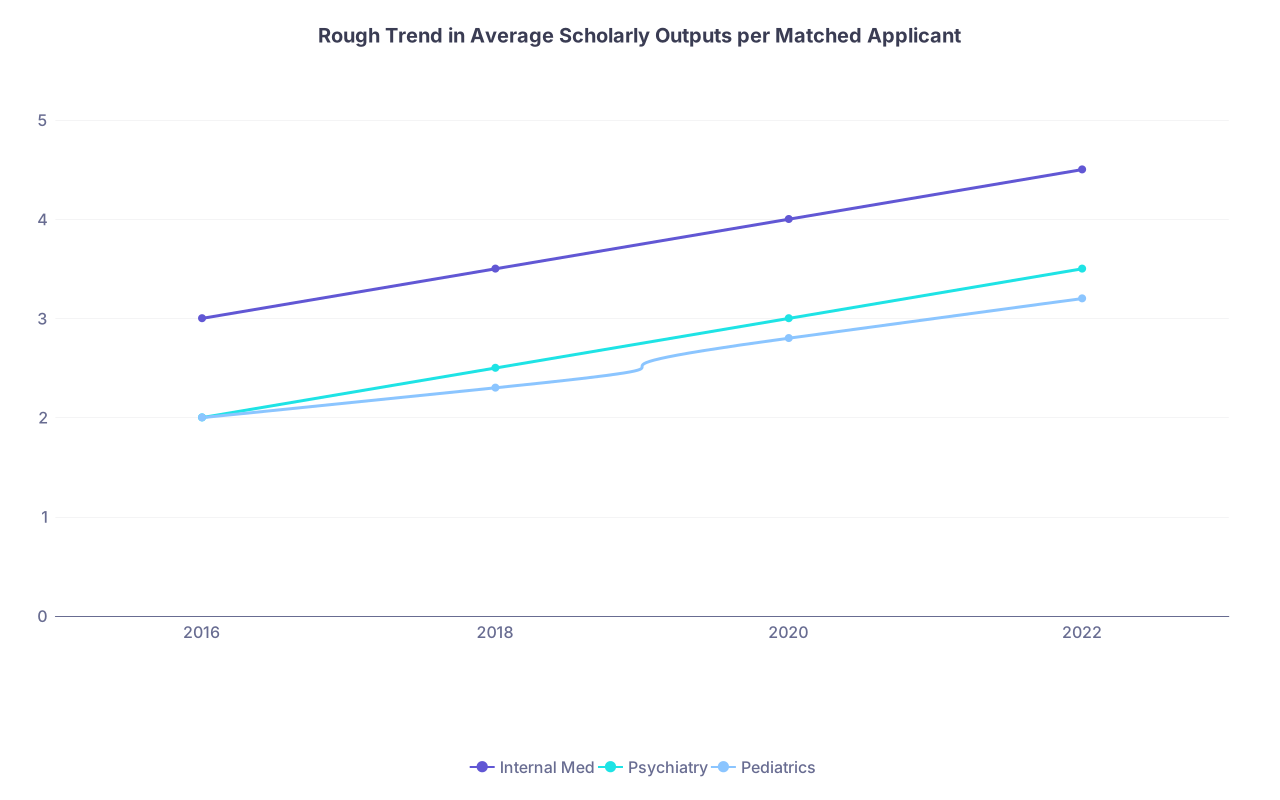
| Category | Internal Med | Psychiatry | Pediatrics |
|---|---|---|---|
| 2016 | 3 | 2 | 2 |
| 2018 | 3.5 | 2.5 | 2.3 |
| 2020 | 4 | 3 | 2.8 |
| 2022 | 4.5 | 3.5 | 3.2 |
Will a single extra poster magically change your life? No. But you’re competing against distributions, not individuals. When the median creeps up, “no research at all” looks worse every year.
The Hidden Risk: Locking Yourself Out of Options
The most dangerous part of the “research doesn’t matter” myth isn’t that you’ll fail to match. Most of you going into less competitive specialties will match somewhere.
The danger is that you’ll quietly erase your own options without realizing it until M4.
Here’s how I’ve seen it play out — repeatedly:
- M2 decides: “I’ll do family or psych, so I don’t need research.”
- M3 discovers they actually love academic medicine, teaching, maybe even subspecialty work.
- M4 realizes the programs they now care about — big urban academic centers, heavy psych research sites, academic FM tracks — have residents with research on their CVs.
- Same student suddenly panics, asking if they can throw together a couple of rushed case reports in six months and “count that as research.”
Sometimes they squeeze something in. Often, it’s too little, too late to really move the needle for the top tier.
Doing some research early, even if you later decide you do not care about academics, operates like an insurance policy. You may never cash it in. But you’ll be glad it’s there if your goals or geography change.
What “Enough Research” Actually Looks Like in These Fields
Here’s where people massively overestimate the bar. They imagine hardcore wet‑lab postdocs or multi-year R01 projects.
In reality, for many “easier” specialties, the difference between “weak” and “solid” research on an application is:
- A couple of posters or oral presentations
- Maybe one or two co‑authored papers (not necessarily first-author)
- A structured QI project with data and a presentation at a local or regional meeting
- Specialty-relevant work: e.g., depression screening QI in an FM clinic, psych consult-liaison case series, peds asthma readmissions project
Not glamorous. Very doable if you start early and attach yourself to someone who’s already producing work.
You absolutely do not need a PhD-level portfolio to stand out in family medicine or psychiatry. You just need more than zero and ideally something connected to the field you’re claiming to be passionate about.
Where Research Actually Doesn’t Matter Much
Let’s be honest. There are programs and situations where research truly is a non-factor:
- Small community programs desperate to fill
- Some rural FM and IM programs where clinical service and local ties dominate
- Programs where the PD explicitly tells you, “We don’t do much research; we care about work ethic and fit”
If your goal is simply “match somewhere in this specialty, anywhere,” and you’re fine with a broad range of programs and locations, then no, you don’t need research to succeed.
But that’s a very specific, very narrow goal. And it’s not the picture most M1–M2s have in mind when they say, “Research doesn’t matter for my specialty.” They usually think it means “I’ll be fine at strong academic programs without it.” Different claim. Very different reality.
The Bottom Line
“Less competitive specialty” does not mean “research-proof specialty.”
Research is:
- A tiebreaker
- A signal of seriousness and follow-through
- A tool to open doors to academic or urban programs
- An insurance policy against your own evolving interests
You can absolutely match into internal medicine, family medicine, pediatrics, psychiatry, neurology, or PM&R without research — especially at smaller or more service-oriented programs. But if you care about where you match, not just whether you match, pretending research does not matter is a convenient fantasy.
Years from now, you won’t remember how annoyed you were writing that abstract or revising that manuscript. You will remember whether you had real choices on Match Day — or whether you realized too late that you’d quietly taken yourself out of the running.