
The idea that “backup means guaranteed” is one of the most dangerous lies in residency planning. Especially when it comes to so‑called “least competitive” specialties.
You’ve heard it in the hallway:
“Don’t worry, just rank a few FM or IM programs at the end, you’ll be fine.”
“I’ll gun for derm but throw in psych as backup. Psych always takes people.”
No. They do not “always take people.” And the data absolutely does not support the fantasy that least competitive = automatic match.
Let’s dismantle this properly.
The Myth of the “Safe” Specialty
People talk about “backup specialties” like they’re an insurance policy you just buy in March. Family medicine, internal medicine, pediatrics, psychiatry, neurology, pathology. The classic second‑choice bucket.
The unspoken assumption:
“These fields are so desperate for bodies that if you just show up with a pulse and an ERAS ID, you’re in.”
Reality is messier:
- There are huge differences between “overall” competitiveness and your competitiveness.
- “Shortage” does not mean “shortage for you, at any program, with any record.”
- Many “backup” specialties have two parallel markets: a relatively accessible one, and a brutally selective one. Same name, different world.
You don’t apply “to psychiatry.” You apply to 10–80 individual psych programs with wildly different standards, cultures, and tolerance for risk.
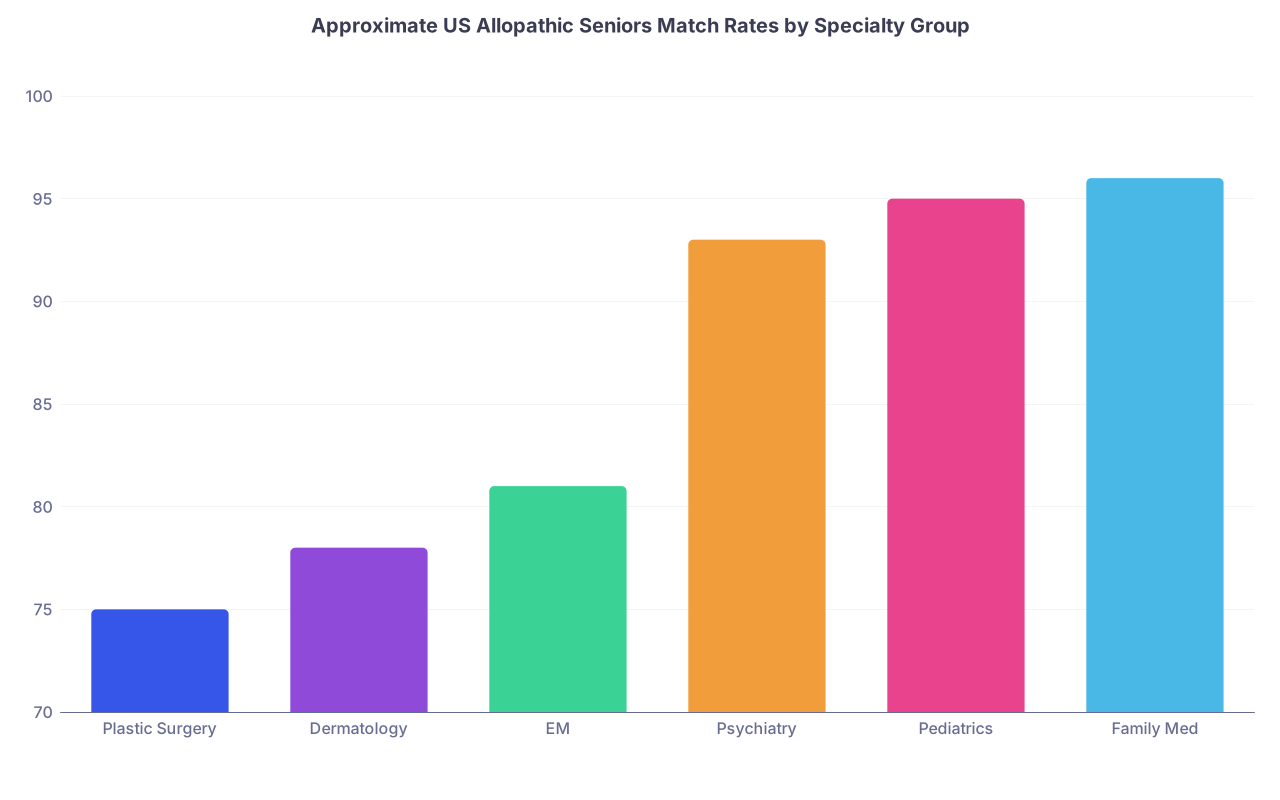
Let me show you what that actually looks like in numbers.
| Category | Value |
|---|---|
| Plastic Surgery | 75 |
| Dermatology | 78 |
| EM | 81 |
| Psychiatry | 93 |
| Pediatrics | 95 |
| Family Med | 96 |
People look at that 93–96% for psych, peds, FM and go, “See? That’s my safety net.”
They forget the fine print: that’s US MD seniors, often with at least a half‑coherent application aimed at that field.
If you’re a late, half‑baked tourist? Those numbers don’t belong to you.
Least Competitive ≠ Guaranteed: How the Market Really Works
Let’s separate two things that get lazily conflated:
- Macro-level competitiveness – how hard is it, statistically, for a typical well‑prepared US MD senior aiming for that specialty to match?
- Micro-level fit and risk – how much tolerance do individual programs have for red flags, late interest, weak letters, or nontraditional backgrounds?
Residents and students repeatedly confuse #1 with #2.
The two-tier reality inside “backup” specialties
Take family medicine or psychiatry. On paper, “least competitive.” In real life, both have:
A top tier of academic, urban, or lifestyle programs that:
- Filter hard on Step 2 (yes, even post‑Step 1 pass/fail)
- Expect clear commitment to the field
- Prefer US MD over DO, and DO over IMGs, when flooded with apps
A bottom tier (often community, rural, or historically underfilled) that:
- Is more open to IMGs and red flags
- Still screens out chaos applications with no coherence
So what happens when someone “backups” psych last minute?
They apply to 15 big‑name urban programs that are actually competitive and ignore the small or rural programs more likely to consider them. Then they act shocked when they don’t match.
I’ve watched this happen in real time:
- US MD, mid‑220s Step 2, reorients to psych in October.
- Applies to only 18 psych programs, 80% in large coastal cities.
- Has zero psych letters. Everything is IM or research.
- Gets two interviews. Ranks both. Doesn’t match.
Then they complain that “psych is getting so competitive.” No. Their strategy was bad, and they treated psych like a participation trophy.
What the Data Actually Shows: Unfilled Spots vs. Unmatched Humans
Another popular myth:
“There are tons of unfilled FM and peds spots every year, so I’ll be able to scramble somewhere.”
Here’s how that logic falls apart.
| Metric | Family Med | Pediatrics | Psychiatry |
|---|---|---|---|
| Total Positions | 5200 | 3000 | 2400 |
| Unfilled in Main Match | 3–5% | 2–4% | 2–3% |
| Unmatched US MD seniors (specialty) | 2–4% | 3–5% | 5–7% |
Those unfilled positions aren’t just sitting there waiting for your late‑November “backup” click. Many are:
- In rural or underserved areas that most applicants refuse to consider
- At programs with concerning reputations (work hours, support, board pass rates)
- Already being targeted by savvy IMGs and DOs who’ve done their homework and signaled interest early
Then there’s the Supplemental Offer and Acceptance Program (SOAP). People romanticize it like “I’ll just SOAP into FM if my top choice doesn’t work out.”
Reality: SOAP is brutal musical chairs.

| Step | Description |
|---|---|
| Step 1 | Do not match |
| Step 2 | See unfilled positions list |
| Step 3 | Apply to limited programs |
| Step 4 | Programs re-screen hundreds of apps |
| Step 5 | Short interviews or none |
| Step 6 | Offer rounds |
| Step 7 | Filled |
| Step 8 | Remain unmatched |
Programs have no incentive to rescue you personally. They’ll often prioritize:
- Applicants who already expressed interest
- People without major red flags
- Those who actually look like they want that specialty and location
SOAP is not “backup means guaranteed.” It’s a last‑ditch marketplace where your lack of planning is competing against people who intentionally aimed for these exact “backup” fields as their first choice.
Specialty by Specialty: Where the Myths Are Worst
Let’s run through a few of the usual “backup” suspects and what’s actually true.
Family Medicine: “They take everyone”
The myth: FM is so desperate that if you don’t match, you can always just go there.
Reality:
- Top FM programs (think University of Washington, UNC, UCSF-affiliated sites) get more serious applicants than they have spots. They’re selective.
- Even many mid‑tier community FM programs now filter by:
- Step 2 cutoffs
- US clinical experience
- Evidence you even care about primary care
If your entire ERAS screams “ortho bro who pivoted on December 1,” they notice. And yes, some will pass on you in favor of a DO or IMG who’s been dedicated to FM for two years.
Psychiatry: “Everyone is matching psych now, it’s easy”
Psych is the current dumping ground fantasy for unmatched or scared applicants. That alone makes it more competitive.
What’s actually happening:
- Interest in psych is up. Significantly. US MDs, DOs, and IMGs are all piling in.
- Lifestyle, telehealth options, and relatively lighter procedural demands make it appealing.
- Program directors are openly saying in NRMP surveys:
They now have the luxury to be picky—about letters, red flags, and evidence of genuine commitment.
If you pivot late with no psych rotations, no psych letters, and no narrative tying your story to the field, you’re not walking into a guaranteed match. You’re walking into a crowded room full of people who actually prepared for this.
Pediatrics: “If all else fails, I’ll just do peds”
Pediatrics has this weird PR problem where students assume no one wants it. That’s not accurate.
Yes, some rural and smaller peds programs struggle to fill. But:
- Competitive academic children’s hospitals absolutely do not.
- Peds PDs care a lot about:
- Communication skills
- Reliability
- Teamwork
- If they see you as “failed surgeon, now reluctantly here,” they’ll rank you accordingly—if they even interview you.
Least competitive doesn’t mean “indifferent to who we train.”
Pathology, Neurology, PM&R: “Quirky backups”
These three get thrown into backup conversations by people who don’t understand them at all.
Here’s the pattern I’ve seen repeatedly:
- Student fails to get interviews in a surgical or road specialty.
- They panic in November and decide, “Fine, I’ll swing at path/PM&R/neuro.”
- They have zero exposure, zero letters, and no idea what the day‑to‑day looks like.
- Commit to a field based purely on perceived competitiveness.
Half of those who actually slip into a spot then regret it because they never chose it on purpose.
These aren’t dumping grounds. They’re careers. Competitive enough at solid programs that a half‑baked pivot is not a safe plan.
The Real Reasons People Don’t Match Their “Backup”
It’s not mostly about scores. Scores matter, but they’re not the killer in backup failures. The killers are:
Too few applications in the backup field
People still apply to 10–15 backup programs like this is 2005. Meanwhile everyone else is applying to 40–80.No specialty‑specific letters
PDs see 3 ortho letters attached to a psych application and assume you’re hedging or bailing.Late signal of interest
You decide in October. You email one program in November. You expect them to believe you’re serious while someone else has 2 rotations and 2 years of interest.Geographic arrogance
“I’ll only go to major coastal cities.”
The “backup means guaranteed” crowd somehow always wants their backup in San Diego or Boston.Red flags + magical thinking
Failures, professionalism issues, or long gaps that were never addressed properly. Students assume a “less competitive” specialty won’t care. Many do.
What Actually Makes a Backup Strategy Real, Not Fantasy
If you want a backup that functions like actual insurance and not a lottery ticket, you need to treat it seriously months before ERAS opens.
Here’s what that looks like in practice:
Decide your backup specialty early
By late MS3 at the latest. Not November 15.Get at least one rotation in it
Home or away. Show up, do good work, and be clear with the team that you’re genuinely considering the field.Obtain at least one strong letter in that field
Not lukewarm. Not “nice person, showed up.” A real endorsement that you’d be a solid resident in that specialty.Craft a second personal statement that isn’t obviously copy‑pasted
PDs can smell when you just swapped “orthopedic surgery” for “psychiatry” in the same essay. Write a clean, specific narrative.Build a realistic program list
A true backup strategy includes:- Lower‑tier academic and community programs
- Less desirable locations
- Programs known to be IMG‑friendly and “forgiving”
If your “backup” list is just “top 20 programs in a new specialty,” that’s not a backup. That’s wishful thinking with extra steps.
| Category | Primary Specialty Apps | Backup Specialty Apps |
|---|---|---|
| Primary Focus | 70 | 0 |
| Heavy Backup | 40 | 30 |
| True Split | 45 | 35 |
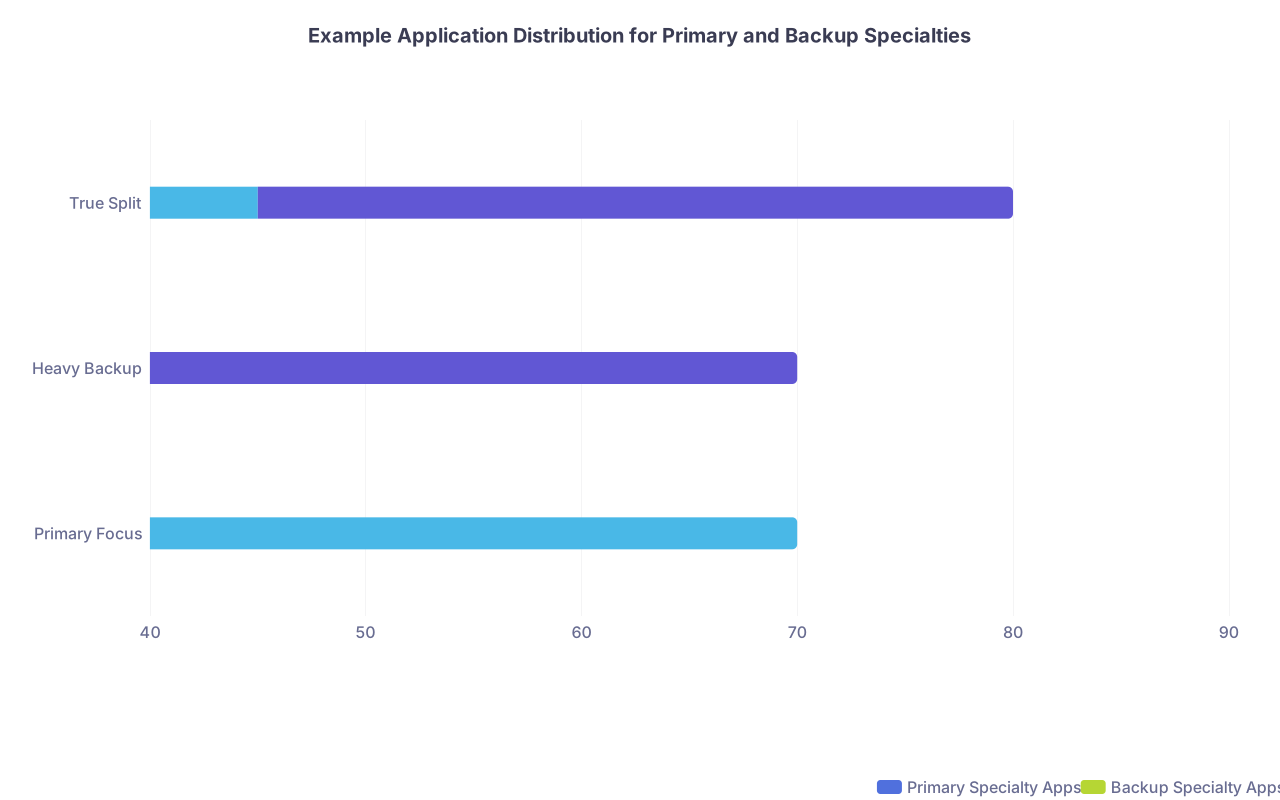
Most people who get burned by the backup myth fall into that “Primary Focus” bar. 70 applications to one dream specialty. Zero early work put into the backup. Then they pray SOAP will save them.
Why This Myth Keeps Surviving (And Why You Need To Ignore It)
A few reasons this “backup means guaranteed” nonsense persists:
- Selection bias – You only hear the success stories. The person who pivoted to psych in October and matched tells that story loudly. The person who tried the same thing and didn’t match quietly disappears into prelim limbo or a research year.
- Ego protection – It’s emotionally easier to believe “least competitive” means “will always want me” than to face the fact you might need to:
- Apply broadly
- Leave your favorite city
- Truly consider a different specialty as Plan A, not B
- Garbage hallway advice – Residents and attendings often quote match rates from memory and don’t distinguish US MDs vs DOs vs IMGs, or strong vs weak applicants. They also rarely see the whole distribution of their school’s unmatched.
So you get lines like:
“Don’t worry, nobody from here has gone unmatched in psych in years.”
Usually spoken by someone who never saw the student with 1 interview in psych who quietly didn’t match and left.
Bottom Line: Backups Aren’t Magic; They’re Work
You can absolutely use a less competitive specialty as a rational, effective backup. Many people do. Successfully. But the ones who succeed share some traits:
- They treated their backup field with respect, not as a trash can for their failed first choice.
- They started early enough to build actual credibility in that specialty.
- They ran realistic, data‑driven program lists that reflected their profile, not their pride.
So no, “backup” does not mean “guaranteed.”
It means “second plan that still requires planning, effort, and humility.”
If you remember nothing else, remember this:
- Least competitive specialties still reject people—often the ones who assumed they were automatic admits.
- A backup only works if you prepare for it months in advance with rotations, letters, and a realistic program list.
- SOAP is not a strategy. It’s what you use when your strategy failed. Don’t build your career plan around a panic market.