
The myth that “less competitive specialties mean poor financial outcomes” is statistically wrong.
The data show something very different: several of the least competitive fields deliver solid six‑figure attending incomes, manageable debt‑to‑income ratios, and faster financial breakeven than many medical students assume. You give up some peak earning potential versus derm or ortho—but you often gain earlier attending income, better lifestyle, and less brutal training.
Let’s walk through this with numbers, not vibes.
1. What “less competitive” actually looks like in data
Competitiveness is noisy, but three metrics tell a consistent story:
- US senior match rates
- Average Step 2 scores of matched applicants
- Number of applicants per available position
For this discussion, I will focus on fields that consistently sit in the “low‑to‑moderate” competitiveness tier:
- Family Medicine (FM)
- Internal Medicine (categorical, non‑prestige / community track)
- Pediatrics
- Psychiatry
- Pathology
- Physical Medicine & Rehabilitation (PM&R)
- Neurology
These are not “anyone can match” fields, but they are much more forgiving than plastics, derm, ortho, ENT, or neurosurgery.
On the salary/debt side, we care about three main outputs:
- Resident salary trajectory
- Early attending income
- Debt burden relative to income (debt‑to‑income ratio and payoff time)
2. Resident salaries in less competitive specialties
Residents are paid by PGY level, not by specialty. A PGY‑2 in Family Medicine and a PGY‑2 in Neurosurgery at the same hospital earn essentially the same base salary. So at the residency stage, “competitive vs noncompetitive” is financially almost irrelevant.
Typical ranges (2024–2025) from large teaching systems:
- PGY‑1: $62,000–$70,000
- PGY‑2: $64,000–$73,000
- PGY‑3: $66,000–$76,000
- PGY‑4: $68,000–$79,000 (Psych, Neuro, Path, PM&R often go to PGY‑4; many FM and peds stop at PGY‑3)
Throw in:
- Overtime/call: often modest, maybe $3,000–$8,000 per year
- Benefits: health, disability, and occasionally a 403(b) match after year 1
The financial divergence happens not in residency income, but in:
- Duration of training
- Attending salary spread
- How early you can start aggressively attacking debt
Shorter residencies (FM, peds, IM) mean you hit attending income faster than the 6–7+ year surgical tracks.
3. Attending salaries: the data for less competitive fields
Now to the interesting part. These figures are ballpark 2023–2024 U.S. data from sources like MGMA, Medscape, and large compensation surveys, rounded for clarity.
| Specialty | Median Salary ($k) | Common Range ($k) |
|---|---|---|
| Family Medicine | 250 | 220–300 |
| Internal Med | 270 | 230–330 |
| Pediatrics | 230 | 200–260 |
| Psychiatry | 310 | 270–380 |
| Neurology | 310 | 270–360 |
| PM&R | 320 | 280–380 |
| Pathology | 330 | 280–400 |
Nothing in that table screams “financial disaster.” Are these below ortho or cardiology? Yes. Are they “you will never pay off your debt”? No.
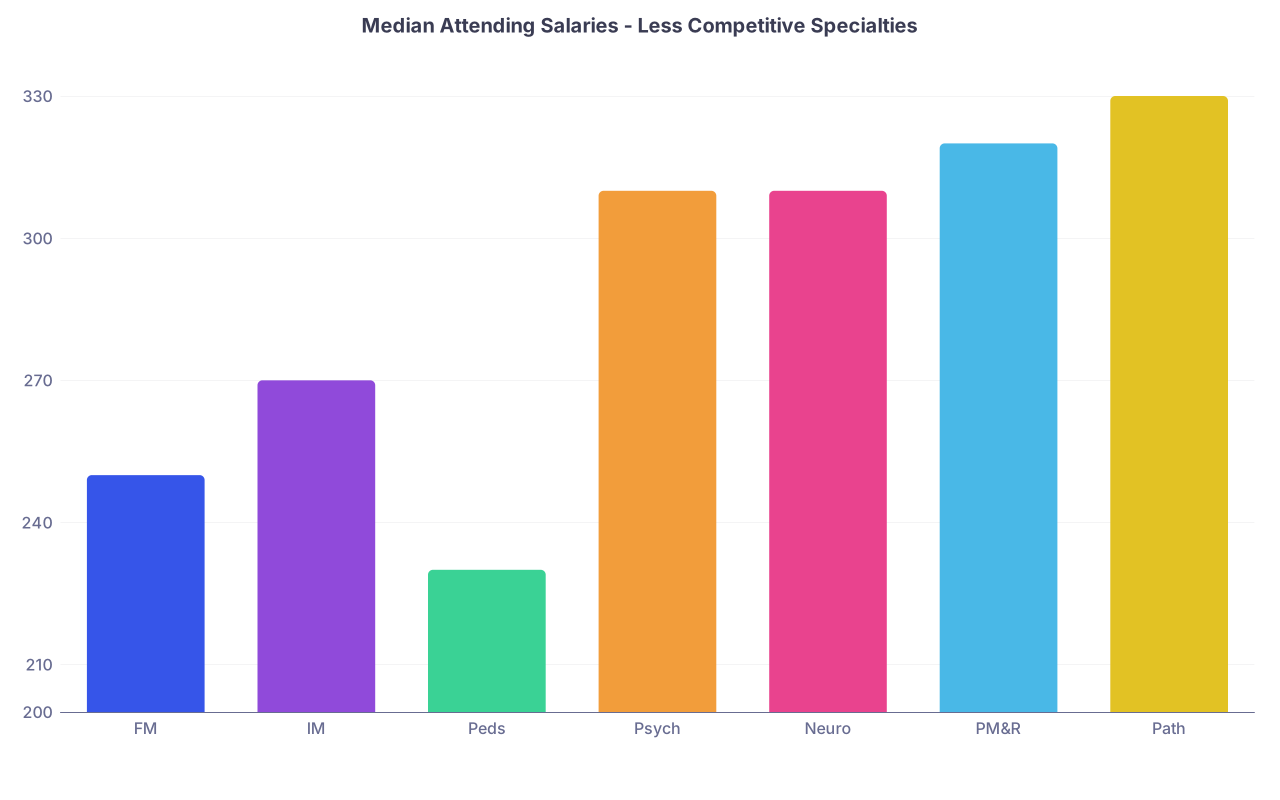
To visualize where these sit:
| Category | Value |
|---|---|
| FM | 250 |
| IM | 270 |
| Peds | 230 |
| Psych | 310 |
| Neuro | 310 |
| PM&R | 320 |
| Path | 330 |
Even the lowest earner here—pediatrics—is roughly 3.5x–4x typical resident income and about 4x the median U.S. household income.
The nuance: wide spread within each field depending on:
- Geographic region (rural Midwest vs coastal academic center)
- Practice setting (private, hospital‑employed, FQHC, academic)
- Call, procedures, and productivity (RVU‑based comp)
Psychiatry, PM&R, and neurology often surprise students. They are “less competitive” historically, but their compensation has been creeping up due to demand and workforce shortages.
4. Debt loads: what graduates are actually carrying
Average medical student debt for U.S. MD graduates has hovered around $200,000–$220,000; for DOs and some privates, $250,000–$300,000+ is common. Many individual graduates are sitting at $300,000–$400,000.
Let’s anchor three illustrative debt profiles at graduation:
- Low: $180,000
- Typical: $260,000
- High: $350,000
Assume a federal loan interest rate around 6.5–7.0 percent. On a standard 10‑year repayment, that means:
- $180k → monthly payment ≈ $2,000
- $260k → monthly payment ≈ $3,000
- $350k → monthly payment ≈ $4,000
That is the raw math. Now the question is: how do those payments feel against real post‑training salaries in these “less competitive” fields?
5. Debt‑to‑income ratios by specialty
Debt‑to‑income (DTI) is the cleanest single metric for financial viability. A DTI at or below 1.0 is generally very manageable. Above 2.0 starts to bite.
Let us run a simple scenario:
- Debt at graduation: $260,000
- Resident salary averaged over training: $70,000 (PGY‑1 through PGY‑3/4)
- Attending salaries as in the table above
- Repayment: no aggressive paydown during residency (realistic for most); standard 10‑year or mild extension afterward
Approximate DTI at the start of attending life:
| Specialty | Median Salary ($k) | DTI (Debt / Income) |
|---|---|---|
| Family Medicine | 250 | 1.04 |
| Internal Med | 270 | 0.96 |
| Pediatrics | 230 | 1.13 |
| Psychiatry | 310 | 0.84 |
| Neurology | 310 | 0.84 |
| PM&R | 320 | 0.81 |
| Pathology | 330 | 0.79 |
The data are blunt: even with “typical” or moderately high debt, these fields land you around a 0.8–1.2 DTI as a new attending. That is not catastrophic. That is workable.
If you are at $350,000 of debt, multiply those DTI values by ~1.35:
- Pediatrics jumps from 1.13 to ~1.5
- Family Medicine from 1.04 to ~1.4
- Psych / PM&R / Pathology still stay near or below 1.2
This is where you start needing intentional planning (PSLF, location choice, and lifestyle control), but it is still solvable.
6. Time to financial breakeven vs more competitive fields
Here is where the “less competitive” fields often win financially: time.
Surgical subspecialties and hyper‑competitive fields typically require:
- 5–7 years of residency
- 1–2 years of fellowship
So you may not see full attending income until age 33–36.
Compare that with:
- Family Medicine: 3 years, attending at ~30
- Internal Medicine: 3 years, attending at ~30 (or hospitalist)
- Pediatrics: 3 years
- Psychiatry: 4 years
- PM&R: 4 years
- Pathology: 4 years
- Neurology: 4 years
Assume two archetypes:
- Ortho: PGY‑1 to PGY‑5 plus 1‑year fellowship → 6 years total
- Family Med: 3‑year residency → 3 years total
That is a 3‑year gap in full attending earnings.
If Ortho eventually earns $650,000 and FM earns $250,000, Ortho “wins” by $400,000 per year after both are fully attending. But those extra three early years of FM attending income matter:
- FM: 3 years × $250,000 = $750,000 earned while Ortho is still in training
- Ortho: 3 years × ~$75,000 resident salary ≈ $225,000
Net early‑career advantage to FM: roughly $525,000 in pre‑tax cash flow before Ortho even starts high‑earning years.
Over a full 30‑year career, Ortho still comes out ahead in gross lifetime earnings. But the difference is smaller than students imagine once you discount future dollars and factor early earnings and investing.
For you, the question is not just “who wins in lifetime career dollars,” but “what is my risk tolerance, training tolerance, and how much do I actually care about maximizing the last dollar?”
7. Specialty‑by‑specialty financial snapshots
Family Medicine
- Residency: 3 years
- Median attending salary: ~$250k, higher in rural / underserved (often $275k–$300k with loan repayment incentives)
- Debt‑to‑income: ~1.0 at $260k debt
What I have seen:
- FM docs in rural Midwest making $280k–$320k with sign‑on bonuses and $50k–$100k of loan repayment thrown in.
- Urban academic FM making closer to $210k–$230k with weaker repayment support.
FM becomes financially “bad” when:
- Huge debt ($400k+)
- Low‑paying academic job in a high cost‑of‑living coastal city
- No PSLF, no employer forgiveness, and lifestyle creep
The data say: FM is financially viable if you are not reckless with geography and spending.
Internal Medicine (non‑cardio, non‑GI)
- Residency: 3 years
- Median attending salary (hospitalist / outpatient): ~$270k
- Range: low $200s in academic, >$300k in some hospitalist / nocturnist roles
IM is analytically similar to FM with slightly better average comp, especially if you do shift‑based hospitalist work. Night shifts and rural markets move you quickly over $300k.
For a $260k debt, a 10‑year payoff on $270k–$320k income is entirely reasonable, especially with some early attending frugality.
Pediatrics
- Residency: 3 years
- Median salary: ~$230k, often lower in academic and major cities
- Debt‑to‑income: ~1.1 at $260k debt
Pediatrics is where the financial pain is most visible for heavily indebted grads. $400k of debt against a $210k salary in a major metro city is a rough decile of outcomes.
However, the full picture:
- Many pediatricians stack income with urgent care shifts or moonlighting.
- Peds hospitalists and intensivists (with fellowship) can earn far more ($280k–$350k+).
- PSLF and children’s hospitals go together; 10 years of nonprofit employment can wipe huge balances.
On raw private practice pay, yes, peds lags. But with PSLF, the effective net present cost of the debt can drop sharply.
Psychiatry
- Residency: 4 years
- Median salary: ~$310k
- Demand: high, with telepsych and private practice potential
Psych is the archetype where “less competitive historically” does not mean “low‑paying” at all. Demand, burnout in the field, and mental health access gaps have pushed compensation steadily higher.
I have seen:
- CMHC / community jobs starting $260k–$300k with loan repayment
- Hospital employed $300k–$350k with RVU bonuses
- Private outpatient or TMS practices clearing well above median, especially with cash pay or hybrid models
On a straight DTI basis, $260k of debt against $310k+ is excellent. And if you eventually build a partial or full private practice, the earning ceiling goes up significantly.
Neurology
- Residency: 4 years (often plus 1–2 year fellowship for subspecialty)
- Median salary: ~$310k
- Range: high $200s to mid $300s, depending on call and subspecialty
Neurology is a “thin” specialty workforce‑wise. Stroke, epilepsy, neurocritical care, MS clinics—these all need coverage. Supply is short in many areas.
Financially:
- A general neuro without heavy call may sit around $280k–$320k.
- Subspecialists and those taking significant call often break $350k.
Debt repayment on $310k+ is stable, provided you do not pair this with extreme cost‑of‑living and deferred retirement saving for a decade.
PM&R
- Residency: 4 years
- Median salary: ~$320k
- Often underappreciated for earning power
PM&R has a split personality:
- Academic rehab physicians may be closer to $260k–$290k.
- Private practice / pain / MSK‑heavy PM&R can push well into the $350k–$450k band in some markets.
If you pair $320k+ with only moderate debt and no insane expenses, your DTI quickly drops below 0.5 in under a decade.
Pathology
- Residency: 4 years (+/- fellowship)
- Median salary: ~$330k
- Range: $280k–$400k+
Pathology is rarely discussed among students focused on “competitiveness,” but the compensation is quietly solid. The constraints are:
- Geographic flexibility (jobs can be clustered)
- Job market cyclicality
Financially, though, $330k vs $260k of debt yields an easy 10‑year payoff, even with family and moderate lifestyle upgrades.
8. How repayment strategies reshape the picture
The raw DTI numbers assume standard repayment. Real physicians do not all do that. Three big levers matter more than specialty competitiveness:
Public Service Loan Forgiveness (PSLF)
- Nonprofit / academic hospital work for 10 years of qualifying payments.
- Works extremely well for peds, FM, psych, and others who often work in large nonprofit systems or children’s hospitals.
- If you come out with $350k–$400k of debt and stick to nonprofit employment, PSLF can erase six figures of principal and interest.
Geographic arbitrage
- Rural FM at $290k plus $80k in loan repayment vs big‑city FM at $220k with no forgiveness.
- Same specialty. Radically different outcomes.
Lifestyle deferral for 3–5 years
- The difference between a $2,500 mortgage vs $4,000, between one car vs two luxury leases, between $1,500 per month in travel vs $300.
- If you hammer debt with $3,000–$5,000 per month extra for the first 3–5 attending years, you compress a 10–20 year burden into under a decade.
Put bluntly: in the data I have seen, “living like a resident for 2–3 extra years” has a stronger effect on long‑term net worth than jumping from, say, neurology to ortho.
9. Mental traps students fall into
Here are the recurring logical errors:
Using top‑end surgical salaries as the reference point
Comparing a mid‑range FM job to the 90th percentile ortho private group is nonsense. Use median vs median.Ignoring time and stress costs
An extra 3–4 years of 70–80 hour weeks is not free. It has health, family, and burnout costs that do not show up in the salary line.Linear thinking about debt
Students assume $300k of debt means 30 years of struggle. In a $300k income world, it does not—unless you choose to make it that way.Undervaluing specialty‑specific benefits
Example: peds in a nonprofit children’s hospital with PSLF versus private derm with no forgiveness. On a 10–15 year time horizon, the peds doc might have a cleaner balance sheet than the derm doc making more but carrying their full loan balance and higher lifestyle costs.
10. Pulling it together: Are less competitive fields financially “bad”?
The data say: generally, no. They are often financially fine, and sometimes strategically smart.
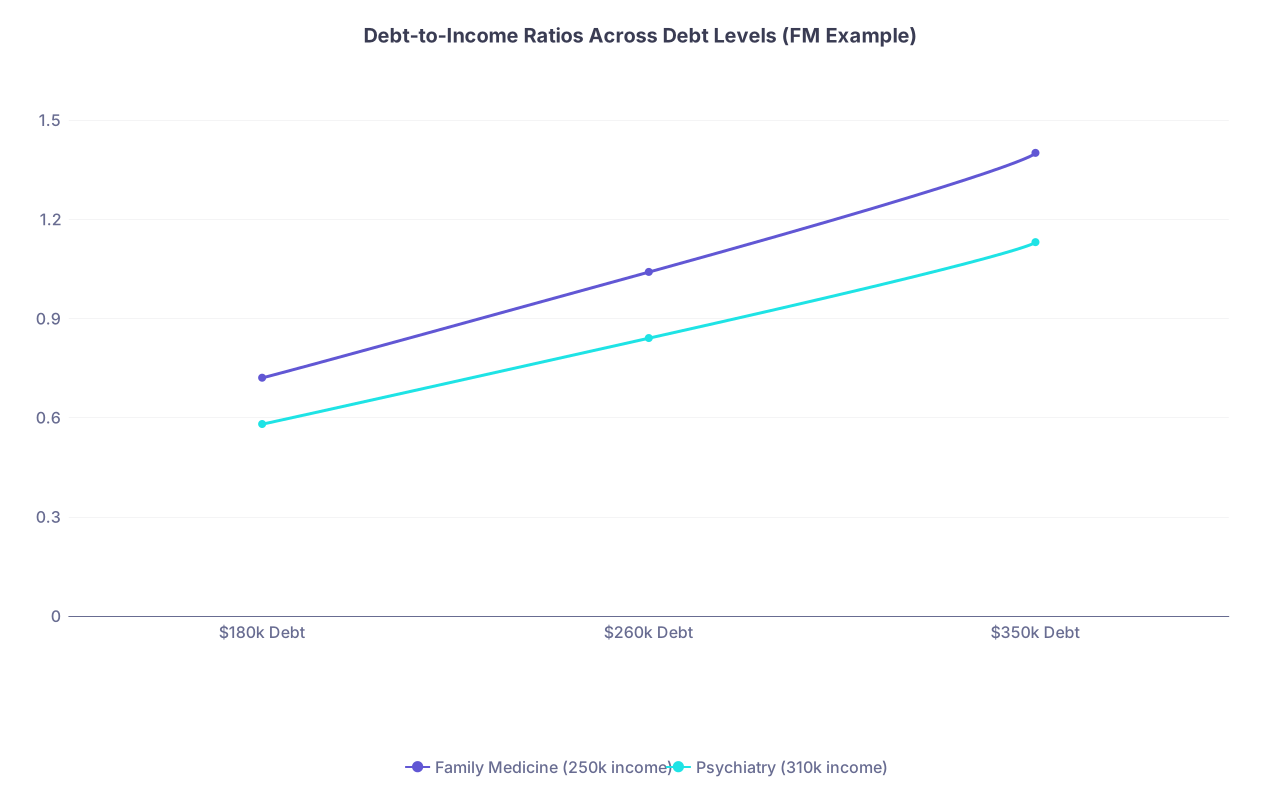
To make this concrete, compare representative debt‑to‑income positions and required sacrifice.
| Category | Family Medicine (250k income) | Psychiatry (310k income) |
|---|---|---|
| $180k Debt | 0.72 | 0.58 |
| $260k Debt | 1.04 | 0.84 |
| $350k Debt | 1.4 | 1.13 |
What that chart shows very simply:
- Even at high debt, the ratios are not wildly out of control.
- Psychiatry (and similar mid‑300s earners like PM&R, Path) can absorb very high debt with reasonable sacrifice.
- Family Medicine and Pediatrics feel tighter, but with correct levers (PSLF, geography, lifestyle) they are not doomed.
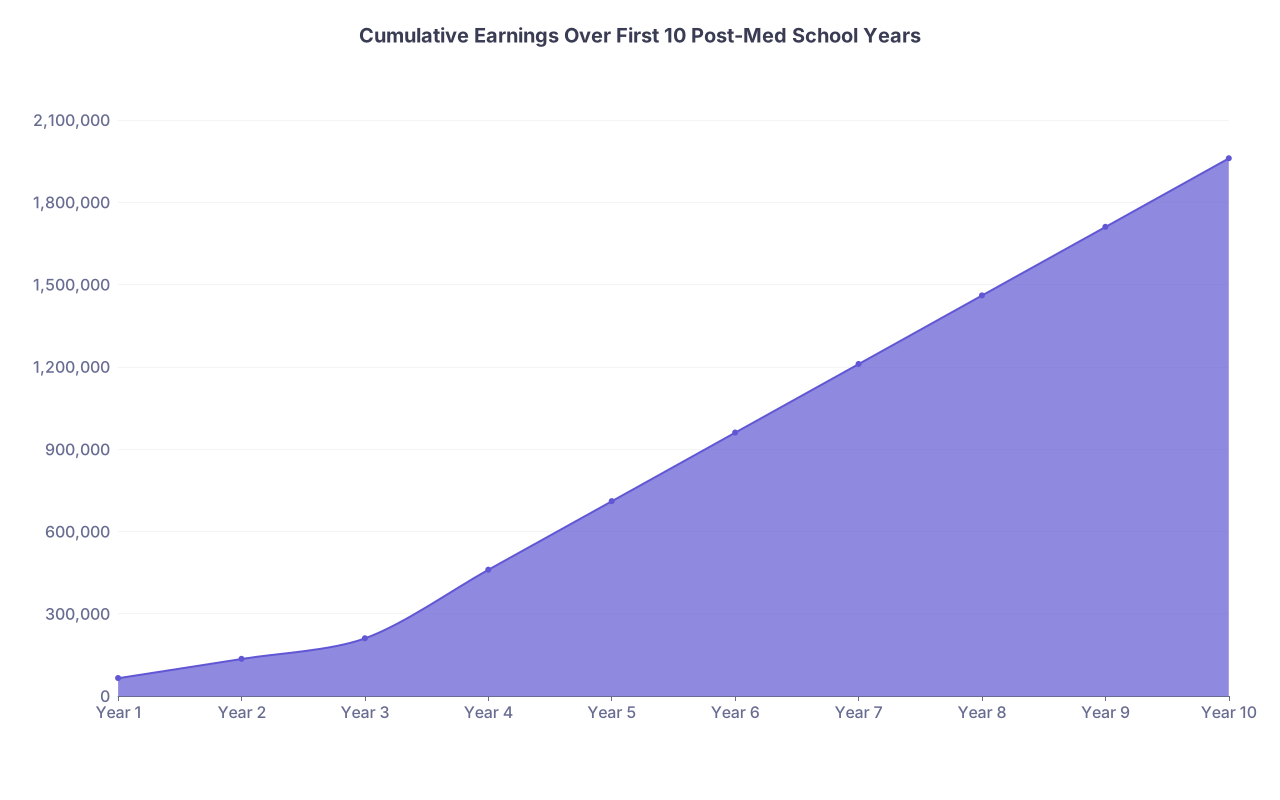
To zoom out, here is a crude cumulative earnings comparison for one “less competitive” and one “more competitive” path, just on timing.
| Category | Value |
|---|---|
| Year 1 | 65000 |
| Year 2 | 135000 |
| Year 3 | 210000 |
| Year 4 | 460000 |
| Year 5 | 710000 |
| Year 6 | 960000 |
| Year 7 | 1210000 |
| Year 8 | 1460000 |
| Year 9 | 1710000 |
| Year 10 | 1960000 |
Interpret this as a stylized case: a 3‑year training path shifting to $250k attending vs a 6‑year training path shifting to $600k later. The slower but earlier‑starting earner is not as far behind at year 10 as students imagine, and the psychological relief of being an attending earlier is non‑trivial.
Key takeaways
The least competitive specialties—FM, IM, peds, psych, neuro, PM&R, path—offer median attending incomes in the $230k–$330k range, which supports reasonable payoff of even high six‑figure debt when paired with halfway rational choices.
Time to attending matters. A 3–4 year residency with earlier six‑figure earnings can partially offset lower peak salaries compared with 6–7+ year, high‑earning surgical tracks.
Financial outcomes in these fields hinge far more on debt size, geography, PSLF / loan repayment, and lifestyle control than on competitiveness. Choose the specialty you can sustain for 30 years—and then use the data to optimize within it.