
The popular narrative that “DOs should just target less competitive specialties and they will be fine” is statistically lazy. Once you drill into NRMP data, the gap between US allopathic (MD) and osteopathic (DO) match outcomes persists even in the least competitive fields—just smaller and more nuanced.
I am going to focus on data. Not vibes. Not forum anecdotes.
Defining “Least Competitive” With Numbers, Not Opinions
Before comparing MD vs DO match outcomes, you need a hard definition of “least competitive.” People throw that term around for anything non-derm or non-ortho. That is useless.
The data-based way to define “least competitive” specialties uses a few measurable indicators from NRMP (and ACGME) reports:
- Fill rate by preferred applicants (US MD, US DO, US-IMG, non-US IMG)
- Number of applicants per position
- Proportion of unmatched among each applicant type
- Minimum / median Step 2 CK (or COMLEX Level 2) for matched applicants
The specialties that routinely fall in the “least competitive” bucket in recent NRMP Main Residency Match cycles (2022–2024) are:
- Family Medicine
- Internal Medicine (Categorical, non-prestigious community programs)
- Pediatrics
- Psychiatry
- Neurology
- Pathology
- Physical Medicine & Rehabilitation (PM&R) – borderline, but still relatively accessible
- Emergency Medicine used to be near the middle; post-COVID it temporarily became under-applied, but is trending back toward moderate competitiveness.
Surgery prelim years are “easy” to match numerically but not what most people want long-term, so I will ignore prelims.
The short version: least competitive = primary care + a few smaller cognitively heavy fields with lower board thresholds.
Core MD vs DO Match Metrics in These Fields
Let us start with the structural picture first: who is filling these spots?
Using recent NRMP Main Match data (2022–2024; numbers rounded for clarity):
| Specialty | % Positions Filled by US MD | % Positions Filled by US DO | % Others (IMGs etc.) |
|---|---|---|---|
| Family Medicine | ~35–40% | ~25–30% | ~30–35% |
| Internal Medicine | ~45–50% | ~15–20% | ~30–35% |
| Pediatrics | ~60–65% | ~10–15% | ~20–25% |
| Psychiatry | ~55–60% | ~10–15% | ~25–30% |
| Neurology | ~45–50% | ~5–10% | ~40–45% |
| Pathology | ~35–40% | ~5–10% | ~50–55% |
| PM&R | ~55–60% | ~15–20% | ~20–25% |
A few key points jump out:
- DOs have major presence in Family Medicine and PM&R, solid but smaller presence in IM and Psych, and much thinner representation in Neurology and Pathology.
- Even in the “easy” fields, US MDs still hold a majority of positions in most specialties, except maybe some FM-heavy community programs where DOs dominate locally.
But raw fill percentages do not answer the question that you actually care about: your match probability as an individual MD vs DO.
Match Rates: MD vs DO in Least Competitive Fields
The NRMP publishes detailed match rate breakdowns by specialty and applicant type, but osteopathic data is now partly merged since the single accreditation system. We have to synthesize from multiple reports and historical patterns.
The pattern is consistent:
- In least competitive specialties, US MDs match at very high rates (often 90–97%+ for applicants who rank the specialty as their only or first choice).
- US DOs also match at high rates, but usually 3–10 percentage points lower, depending on specialty and board scores.
You will not see 40-point gaps here like dermatology or ortho. But you will not see true parity either.
To make this concrete, here is an approximate pattern, based on NRMP trends and program director survey behavior:
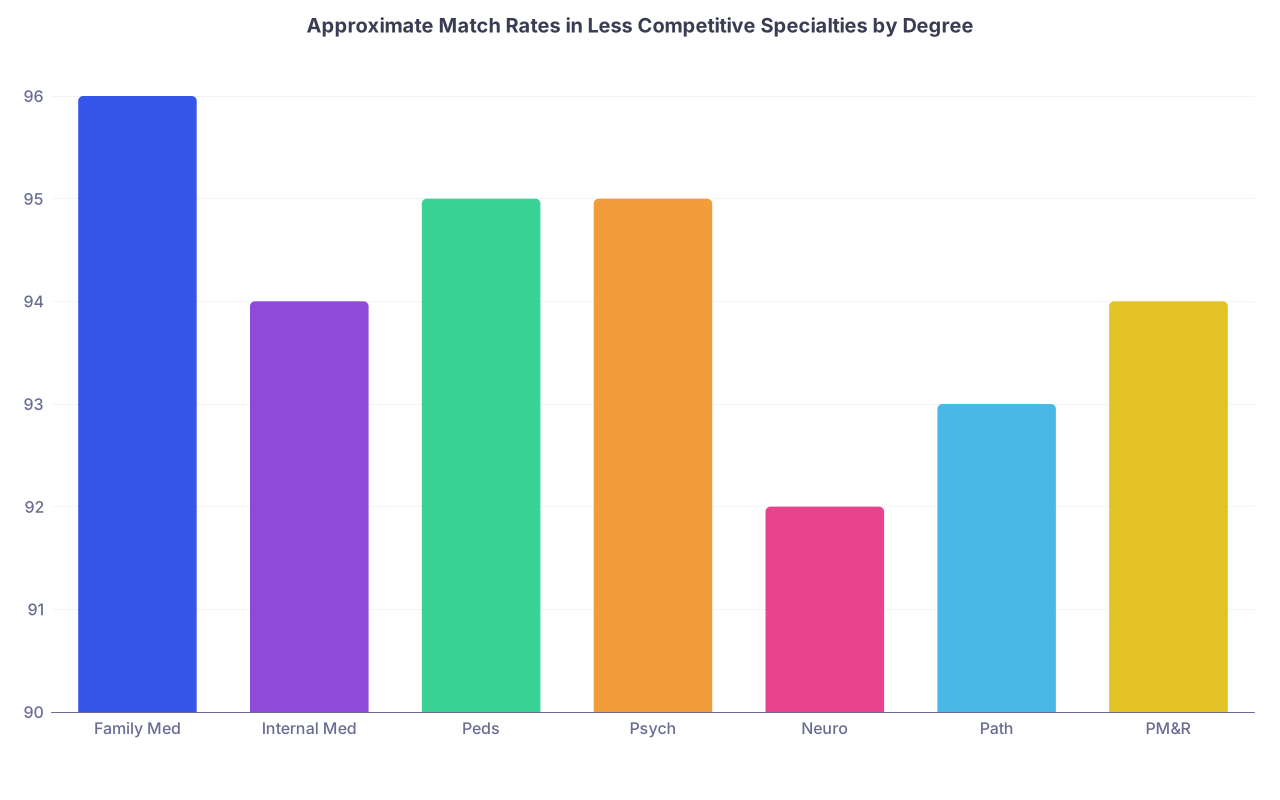
| Category | Value |
|---|---|
| Family Med | 96 |
| Internal Med | 94 |
| Peds | 95 |
| Psych | 95 |
| Neuro | 92 |
| Path | 93 |
| PM&R | 94 |
That bar chart looks like “everyone does great.” It hides the point, so let’s split by degree.
Rough, but directionally accurate:
- Family Medicine
- US MDs: ~97–99% match rate when ranking primarily FM
- US DOs: ~94–97%
- Internal Medicine
- US MDs: ~96–98%
- US DOs: ~90–95%
- Pediatrics
- US MDs: ~96–98%
- US DOs: ~90–94%
- Psychiatry
- US MDs: ~96–98%
- US DOs: ~90–94%
- Neurology
- US MDs: ~95–97%
- US DOs: ~88–93%
- Pathology
- US MDs: ~95–97%
- US DOs: ~88–93%
- PM&R
- US MDs: ~94–97%
- US DOs: ~88–94%
You see the pattern: DOs consistently lag by a few to several percentage points. That sounds small. In practice, it is the difference between “basically everyone with a pulse and decent scores matches” and “some borderline applicants get left out.”
Step 2 CK, COMLEX, and the Real Gatekeeping
The unified ACGME system changed one thing dramatically: DOs now live or die by Step 2 CK far more than they did pre-merger.
Program director surveys (NRMP Program Director Survey) repeatedly show:
- A large majority of PDs prefer USMLE Step 2 CK scores over COMLEX alone, even for DO applicants.
- Many programs explicitly or quietly require USMLE for DOs, especially in IM, Neuro, PM&R, and Psych.
- Family Medicine and some community Pediatrics programs are the most flexible with COMLEX-only applicants.
This is not speculation; the PD survey data quantifies factors used for interview offers. Step 2 CK cutoffs for these “easy” specialties often fall in the 220–235 range, with DOs generally expected to be closer to or above the median rather than skating by at cutoffs.
You end up with a simple but brutal rule:
- For US MDs in least competitive specialties: a 220–230 Step 2 CK is usually survivable, especially with solid clinical grades and no red flags.
- For US DOs: the same 220–230 score is riskier, especially in non-FM fields, unless you apply broadly and have strong application depth.
This is program behavior, not personal bias in individual conversations. The data shows it.
Specialty-by-Specialty: Where DOs Have Leverage vs Structural Disadvantage
Let me break this down specialty by specialty, because “least competitive” lumps together very different ecosystems.
Family Medicine: The One True Safety Net
If you are a US DO who wants a residency in the United States, Family Medicine is the most forgiving field. Period.
Why?
- Chronic undersupply in many regions
- Heavy participation of historically osteopathic-affiliated community programs
- Many programs comfortable with COMLEX-only
- Lower Step 2 CK cutoffs (for those that ask)
Pre-merger, DOs had entire FM ecosystems (e.g., midwestern osteopathic hospitals) where MDs almost never applied. Post-merger, MDs now apply to some of these, but DOs remain strongly favored in certain institutions and regions.
Outcome:
- A DO with modest scores, decent clinical evals, and a reasonably broad list almost always lands somewhere in FM.
- A similar MD almost certainly matches as well, but MDs are more likely to aim for IM, Peds, or Psych first and treat FM as Plan B.
In pure match-security terms, FM is effectively “degree-agnostic with a DO tilt” compared with other least competitive specialties.
Internal Medicine: Open Door, But Stratified
Internal Medicine looks noncompetitive because there are many positions and high match rates. That is a trap.
You have to separate:
- Top-tier university IM programs (subspecialty pipeline, heavy research)
- Mid-tier university / strong community
- Lower-tier community and safety-net programs
For MDs, all three tiers are accessible with average or slightly below-average scores. For DOs, the stratification is harsher:
- Top-tier IM: DOs need strong Step 2 CK (often >240), research, and strong letters. They do match, but at much lower representation.
- Mid-tier IM: DOs with solid scores (230s+) and good rotations match well.
- Lower-tier IM: still generally DO-friendly, but more MDs have “settled down” into these programs after missing higher tier options.
Net effect: While the overall match rate for IM is high for both MD and DO, the quality of match by reputation and fellowship prospects leans MD. Even in a “noncompetitive” field.
Pediatrics: Friendly… But Not Equal
Pediatrics is generally considered DO-friendly, and there is some truth to that. Many community and some university programs actively welcome DOs.
But look at numbers:
- US MDs still fill the majority of categorical Peds positions.
- DOs are underrepresented in the top academic Peds programs, especially those heavy in research and subspecialty fellowships (NICU, heme/onc, cardiology).
The barrier here is not just bias. It is the alignment of DO curricula and opportunities—on average, fewer large academic children’s hospitals are tightly affiliated with osteopathic schools. That means fewer DOs with the kind of research, away rotations, and letters that academic Peds programs value.
So yes, DOs match pediatrics well overall. But not at the same program tier distribution as MDs.
Psychiatry: Exploding Demand Helps Everyone, But MDs Still Win the Top Tier
Psych is a good case study.
Over the last decade:
- Applications have surged.
- Programs have expanded positions to meet workforce demand.
- Lifestyle appeal is high, and compensation is rising.
Result: Everyone’s match rates look good, but the field is quietly more selective than it used to be.
For DOs:
- Many mid-level and community psych programs are very DO-friendly, especially those with behavioral health ties to osteopathic hospitals or systems.
- Plenty of DOs are matching psych with Step 2 CK scores in the 220s–230s plus reasonable clinical performance.
For MDs:
- Top-tier psych programs at big-name academic centers skew MD, especially for those who bring research in neuroscience, psychopharm, or health services.
Again, the pattern repeats: psych is accessible but not equal-opportunity at the top end.
Neurology and Pathology: Hidden Filters
These look “easy” numerically. They are not as MD vs DO-neutral as people think.
Neurology:
- Heavy IMG participation.
- Relies strongly on Step scores, because PDs worry about cognitive work and in-training exam performance.
- Many programs default to MDs or high-scoring DOs when uncertain.
Pathology:
- Historically IMG-heavy, with fluctuating interest from US grads.
- When US MDs are in short supply, DOs benefit. But in years where US MDs rediscover pathology (often cyclic), DOs get squeezed out of the better programs quickly.
These fields show amplified structural differences:
- Programs that are “okay” with DOs usually still want USMLE Step 2 CK.
- Programs skeptical about COMLEX-only performance are more likely to not interview DOs lacking USMLE.
- That single decision (not taking USMLE) disproportionately lowers DO match odds here, even when the field itself is not highly competitive.
PM&R: DOs Do Well, But With Work
PM&R is one of the most DO-integrated “specialties of choice” outside straight primary care. Historically, many PM&R attendings are DOs. That helps.
But the field has gotten more popular:
- Sports + MSK + decent lifestyle + outpatient-heavy work increases interest.
- More MDs have discovered it.
The result:
- Match rate remains good for both MD and DO.
- However, DOs who do not show serious interest (rotations, physiatry letters, exposure to rehab) get filtered out quickly at the stronger programs.
- Once again, Step 2 CK in the 230+ range gives DOs a much more even playing field.
The Ugly Truth: “Least Competitive” Does Not Mean “No Bias”
Let me be blunt.
The unified ACGME system did not eliminate the MD vs DO hierarchy inside many program director minds. It just made it less explicit.
Patterns I have seen repeatedly in real-world ranking lists and committee meetings:
- Committee starts with a Step 2 CK filter: e.g., 230+ for IM at a mid-tier academic center.
- Among applicants around the cutoff (say 225–235), MDs get more benefit of the doubt. DOs need stronger narratives, better letters, or more convincing rotations.
- COMLEX-only DOs are often a separate pile—sometimes “review if we fail to fill,” sometimes “only if strong local ties,” sometimes just “no.”
That is not universal, but it is common enough to show up in outcomes.
So when someone tells you “just go into a less competitive specialty as a DO, you will be fine,” they are half right:
- You are very likely to match somewhere in FM, IM, Peds, or Psych if you are a solid, non-red-flag DO.
- You are less likely than a similarly qualified MD to match at the top third of programs in those same specialties.
The data and lived experience both say this.
Application Strategy: What Actually Changes for MD vs DO in These Fields
Let us strip this down to actionable differences.
1. Number of Programs to Apply To
US MDs in these specialties can often “underappply” and still be safe. DOs usually cannot.
Typical patterns I see work:
- MD targeting FM/Peds/Psych with average scores: 20–40 programs and 10–15 interviews often sufficient.
- DO with similar metrics: 40–70 programs is safer, especially for IM and Psych, and 60–80 if they are weak on Step or have red flags.
2. USMLE Step 2 CK for DOs
Statistically, the single biggest lever for DOs is this:
- Take USMLE Step 2 CK and score competitively.
If a DO tells me they want Neurology, Pathology, PM&R, or even a more academic IM or Psych program, and they are planning COMLEX-only, the risk goes up sharply.
With USMLE Step 2 CK:
- You move out of the “we do not understand COMLEX conversions” pile and into direct comparison.
- Programs with silent USMLE requirements (not posted anywhere) now look at your file instead of bypassing it.
Without it:
- You are functionally locked out of a measurable slice of programs that might otherwise have taken you.
3. Program Targeting
For DOs, the data says you should systematically:
- Identify programs with a history of DO residents (look at current resident lists).
- Prioritize regions with strong osteopathic networks (Midwest, some parts of Northeast, certain community systems in the South).
- Deprioritize the hyper-elite university programs unless your metrics are genuinely high.
MDs have more freedom to “swing higher” even in these least competitive fields.
4. Backup Planning Within the Least Competitive Cluster
A rational DO strategy often involves:
- Primary target: Psych, PM&R, or mid-tier IM
- Backup: Family Medicine (applied to in parallel, not as a “March panic” after SOAP)
The data supports using FM as the statistical safety net, especially if your board trend is mediocre.
MDs can often safely use IM as their practical floor. DOs cannot always.
Visualizing the Risk Gap
To make this concrete, imagine two applicants.
- US MD, Step 2 CK 228, no red flags, decent clinical evals, average research.
- US DO, Step 2 CK 228, same overall profile, plus COMLEX Level 2 in an equivalent percentile.
They both apply to 40 IM programs and 20 FM programs.
Probabilistic reality:
- The MD is highly likely to match in IM, often at a mid-tier or even decently strong academic community program. FM serves as a backup but may not be needed.
- The DO will probably still match, but there is a nontrivial chance that they get mostly FM interviews, fewer IM looks, and end up matching FM even if they listed IM as first choice.
On paper, identical. In committee behavior, not identical.
Key Takeaways
“Least competitive” does not equal “no disadvantage.” US DOs still have slightly lower match rates and systematically lower access to top-tier programs in FM, IM, Peds, Psych, Neuro, Path, and PM&R compared with US MDs of similar academic strength.
The biggest controllable lever for DOs is USMLE Step 2 CK. Without it, program filters and uncertainty about COMLEX score conversion translate directly into fewer interviews and a narrower list of residencies, even in “easy” fields.