
The comforting myth that “low-competition” programs are safe back-ups is statistically wrong. The data shows that applicants systematically abuse, misjudge, and often waste these programs on their rank lists.
You see it every cycle: students brag that they “threw a bunch of prelims and IM community programs at the bottom” as if that guarantees a match. Then March rolls around and the SOAP numbers say otherwise.
Let’s walk through how applicants actually treat low-competition programs by the numbers—and why their behavior is often irrational once you overlay NRMP and specialty-level data.
1. Defining “Low-Competition” Programs By Data, Not Vibes
Before talking behavior, we need a data-based definition. “Low competition” is usually code for:
- Lower average Step 2 scores
- Higher match rates for lower-tier applicants
- Less prestigious institution or location
- Historically higher fill rates by IMGs or DOs
But that is still vague. The NRMP data allows something tighter.
From the last several NRMP Program Director Surveys and Charting Outcomes, you can carve out a “least competitive cluster” roughly as:
- Specialties with:
- Fill rates < 90% by US MD seniors alone, and
- Overall applicant-to-position ratio close to or below 1.1:1
Common examples:
- Family Medicine
- Pediatrics
- Psychiatry (still competitive in certain coastal urban markets, but nationwide more forgiving)
- Internal Medicine categorical at non-university / community programs
- Some transitional year and prelim medicine programs
- Certain pathology and neurology programs depending on region
Now, look at the actual fill data.
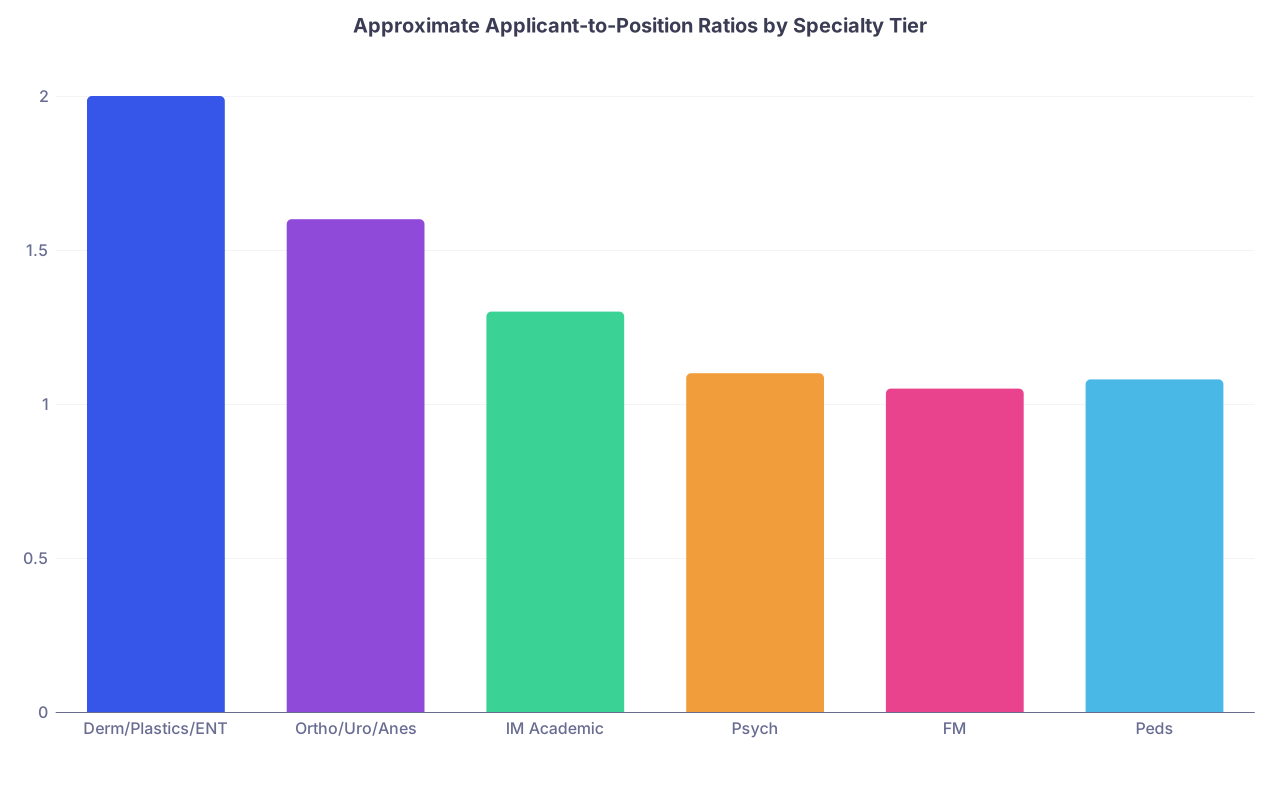
| Category | Value |
|---|---|
| Derm/Plastics/ENT | 2 |
| Ortho/Uro/Anes | 1.6 |
| IM Academic | 1.3 |
| Psych | 1.1 |
| FM | 1.05 |
| Peds | 1.08 |
You see a clear gradient. But “less competitive” does not mean “cannot fail.” An applicant-to-position ratio of 1.05:1 still means someone is not matching.
The mistake applicants make is assuming any value close to 1.0 equals guaranteed safety. It does not.
2. How Applicants Stack Their Rank Lists Around Low-Competition Programs
Here is the pattern I see every year: an applicant building a rank list for a moderately competitive specialty (say anesthesia, EM in some regions, or mid-tier academic IM) behaves like this.
Top-heavy first third:
8–10 aspirational programs (university, coastal cities, brand names)Realistic middle:
3–6 “solid but not glamorous” academic or community-affiliated programsFalse-safety bottom:
3–5 “back-up” programs in less desirable geography, often from least-competitive specialties or lower-tier community IM/FM/Psych
The math problem: the bottom third is usually under-sized and under-diversified relative to the applicant’s actual risk profile.
Let me translate that into numbers.
Take a borderline anesthesia applicant:
- Step 2 CK: 234
- No home program, average letters
- 14 interviews total:
- 7 anesthesia at mid-range programs
- 4 low-competition community IM categorical
- 3 prelim medicine
What happens on the rank list?
Typical behavior:
- Ranks all 7 anesthesia programs first
- Then the 4 community IM categorical
- Then the 3 prelims as the last resort
The thought process is: “If I fail to match anesthesia, the IM categorical will catch me. And if that fails, at least I’ll have a prelim.”
That feels safe. The numbers say otherwise.
The probability of matching somewhere rises sharply as rank length increases, but conditional on being a relatively weak candidate for a specialty, your lower-ranked “backup” pool has to be large and strategically chosen. Instead, applicants throw a small, poorly curated set of low-competition programs at the bottom and call it a safety net.
3. The NRMP Match Algorithm vs. Applicant Fantasy
The NRMP algorithm is applicant-proposing. That bias leads people to overestimate their safety.
Key point: The algorithm favors you, but only across programs that actually want you. If your “back-up” programs ranked you very low or not at all, they are dead weight.
I have seen applicants with 12–14 ranks, including “safe” primary care and prelims, still go unmatched. Not because the algorithm is cruel. Because those low-competition programs did not treat them like backups.
To illustrate the risk curve, look at the relationship between number of ranks and match rate for US MD seniors (NRMP data, rounded):
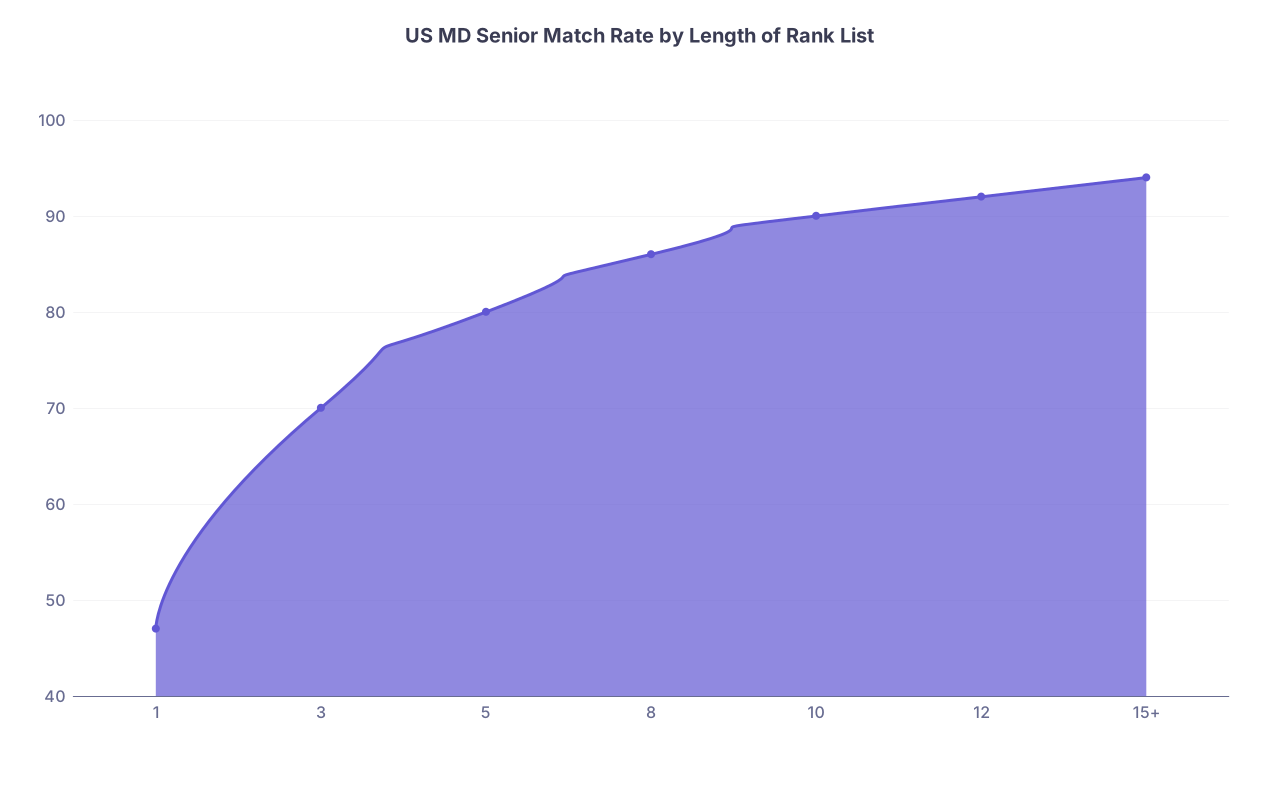
| Category | Value |
|---|---|
| 1 | 47 |
| 3 | 70 |
| 5 | 80 |
| 8 | 86 |
| 10 | 90 |
| 12 | 92 |
| 15+ | 94 |
Two critical observations:
- Going from 1 to 5 ranks massively improves your odds
- Beyond ~10–12 ranks, the marginal gain is small but not zero
Now combine this with the fact that low-competition programs are often the ones that invite a wide range of applicants but rank fewer deeply (for fit, visa policies, geographic loyalty, etc.).
The fantasy: “If I put three community FM programs at the bottom, I am covered.”
The data: Three programs in a specialty where you are slightly off-profile, in a location you do not love (so they sense it), may not rank you high enough to matter.
4. Numerical Behavior Patterns in Least Competitive Specialties
Let us focus specifically on least-competitive specialties and how applicants treat them.
4.1 “I’ll Just Add FM/Psych as Backup” – The Common Move
A common 4th year story:
- Primary specialty: EM or anesthesia or mid-tier IM
- Secondary specialty: Family Medicine or Psychiatry “as backup”
- Number of interviews:
- 10 in primary specialty
- 3–4 in FM/Psych at geographically inconvenient locations
On the rank list:
- Ranks all 10 primary-specialty programs
- Then 3–4 FM/Psych at the end
On paper, that looks diversified. In practice, you have only 3–4 data points in the backup specialty, in programs you probably did not signal first interest to, and may have underperformed at because you “did not really want them.”
Programs in least-competitive specialties are not blind to this pattern. Many FM and Psych PDs will tell you out loud:
“We are wary of people who clearly view us as a dumping ground after their failed derm/ortho/EM dreams.”
Translation: They rank those applicants lower. Sometimes much lower.
So while the raw fill pressure in FM or Psych is lower, the conditional probability of a desperate late applicant matching into one of those 3–4 programs is worse than applicants think.
4.2 IMG and DO Behavior in Low-Competition Programs
Among IMGs and DOs, the behavior is almost the inverse.
For IM, FM, Psych, Peds, and some Path/Neuro programs, IMGs:
- Apply extremely broadly (often 100+ programs)
- Attend 12–20 interviews when they can get them
- Build long, bottom-heavy rank lists: 18–25 ranks is not uncommon
These applicants treat least-competitive specialties not as backups but as primary targets. They build volume.
This is exactly why US MD seniors who toss in “just a few” FM or community IM programs at the bottom as a parachute are competing against people who are taking those spots very seriously, with stronger perceived commitment.
That matters to program directors.
5. Geographic and Prestige Bias: How Applicants Devalue Safe Programs
The ugliest truth in the data: a huge portion of “safety” programs are only “safety” because applicants do not want to live there.
Look at match and fill rates in regions like:
- Upper Midwest community FM/IM/Peds
- Rural South FM/Psych
- Rust Belt community hospitals
Programs there often:
- Have lower average Step 2 scores
- Are more IMG-friendly
- Are less competitive nationally, but competitive among those willing to live there
Applicants treat them like this:
- Interview if travel costs are manageable
- Show up tired, late in the season, with low enthusiasm
- Give generic answers about location preference
- Leave them at the bottom of rank lists or omit them entirely
Programs respond rationally. They prioritize:
- Applicants with genuine regional ties
- IMGs and DOs who clearly want to be there long-term
- People who did rotations or sub-Is nearby
So again: the “low-competition” label is local, not global. Vibe-based “undesirable” locations are still battlegrounds among those who actually want them.
6. How Many Low-Competition Programs Do You Really Need?
You can treat this like a probability problem.
Let’s define a simplified case:
- You have 8 interviews in your dream specialty (moderately competitive)
- Your subjective probability of matching at any one of those is 10–15%
- You have 0 interviews in a backup specialty
Your probability of matching somewhere in that primary pool is:
- If 10% per program, independent (they are not truly independent but this is a useful approximation):
P(no match in 8) ≈ 0.9^8 ≈ 0.43 → 43% chance of no match
So 57% chance of matching
That is coin-flip territory, not safety.
Now, you add backup interviews in a least-competitive specialty. Suppose:
- You pick up 5 FM or Psych interviews at low-to-moderately competitive programs
- Your probability of matching at each of those (because they are more forgiving, and you act like you are serious) is, say, 20–25%
Then:
- P(no match in 5 backups) at 20% per program ≈ 0.8^5 ≈ 0.33
- P(no match anywhere) ≈ 0.43 * 0.33 ≈ 0.14 → 14% chance of not matching
You just turned a coin-flip into an 86% success scenario by adding 5 genuinely pursued low-competition programs.
Now compare that to the usual behavior:
- Applicant adds only 2–3 half-hearted “safeties” in FM or community IM, interviews poorly, and is probably ranked lower there
- Effective match probability per backup program might drop to 10–15%
Now your “safety” net is mathematically thin.
The point: You need both enough volume and real commitment to low-competition programs for them to materially change your match odds. Three symbolic FM interviews at places you obviously dislike are not a serious strategy.
7. What the Program Directors Actually Do With Your Rank Position
Program Director survey data is blunt: in least-competitive specialties, PDs heavily weight:
- Genuine interest in their specialty
- Fit with community or patient population
- Geographic ties
- Performance on rotation at that site or in similar settings
Scores still matter, but less than in orthopedics or neurosurgery. That shifts the competition axis—from pure metrics to preference visibility.
Here is the structural misalignment:
- Applicants think “lower Step averages” = “they will take anyone with a pulse”
- PDs think “we have plenty of people who want this specialty/location; we will rank those who actually look like they want to be here”
The way applicants treat low-competition programs (late-season scheduling, weak interviewing, admitting they are “also applying to X” in a dismissive way) pushes them down rank lists.
The program side behavior is rational. But it nukes the false sense of safety many students build around low-competition programs.
8. Comparing Applicant Strategies: Numbers-First vs Vibes-First
Let me contrast two archetypes.
Applicant A: Vibes-First Strategist
- Specialty: EM
- Step 2 CK: 240
- 12 EM interviews (mixed tiers)
- 3 FM interviews, all in rural states they dislike
- Rank list behavior:
- Ranks all 12 EM
- Then all 3 FM “just in case”
Perceived safety: “I have 15 ranks, I am fine.”
Reality:
- Modest EM competitiveness with a soft market in some regions
- Only 3 backup options, in programs that may not believe they are truly interested
- The effective probability of landing in those 3 FM spots is much lower than they think
This is exactly the profile that sometimes shows up unmatched and stunned.
Applicant B: Data-First Strategist
- Specialty: Anesthesia, but willing to do community IM or FM long term
- Step 2 CK: 232
- 8 anesthesia interviews (mid and low tier)
- 8 IM categorical interviews (including 4 least-competitive community programs)
- 5 FM interviews in regions they would accept long-term
- Rank list behavior:
- Ranks all 8 anesthesia
- Then 8 IM
- Then 5 FM
This person has:
- 21 total ranks
- 13 of those in least-competitive or moderately competitive primary care routes where they show strong interest
Statistically, Applicant B has created a much thicker tail of match probability, despite weaker raw board scores. Because the behavior towards low-competition programs is serious, not symbolic.
9. How To Use Low-Competition Programs Rationally
If you want to treat least-competitive programs as part of your strategy, not just a security blanket, the data suggests a few disciplined rules.
First, decide whether those programs are:
- True long-term acceptable paths (FM, Psych, community IM where you would actually work)
- Or simply a one-year damage-control option (prelim medicine, TY)
Then build rank behavior accordingly.
Here is a simple comparative structure:
| Strategy Type | Low-Competition Program Behavior |
|---|---|
| Irrational | 2–3 backup interviews, bottom of list, no real interest |
| Rational-Min | 5–7 backup interviews, realistic locations, neutral interest |
| Rational-Strong | 10+ backup interviews across IM/FM/Psych, genuine geographic and specialty interest |
Irrational use generates psychological comfort but minimal statistical protection.
Rational use means:
- Applying broadly enough to build volume in those specialties
- Actually interviewing like you might end up there
- Being honest with yourself about which “least competitive” paths you can truly live with
Then your rank list is no longer top-heavy fantasy plus a symbolic safety net. It becomes a spectrum of outcomes where most endpoints are better than SOAP.
10. Where This Leaves You
The central error in how applicants treat low-competition programs is simple: they conflate lower competitiveness with guaranteed rescue.
The data does not support that.
What actually helps:
- More total interviews
- A larger fraction of those in specialties and locations that are realistically friendly to your profile
- Serious, not performative, engagement with programs you consider backups
Least-competitive specialties are not the garbage bin for failed derm and ortho applicants. They are primary targets for tens of thousands of IMGs, DOs, and US grads who treat them as careers, not consolation prizes.
Programs see that difference in behavior and rank accordingly.
Your job is to stop treating these programs as abstract safety concepts and start treating them as real statistical levers. If you want them to function as insurance, you must give them enough weight—on your application list, on your travel schedule, and on your rank order list.
Once you understand that, your next step is not to obsess about whether EM is “dying” or whether Psych is “getting more competitive.” It is to map your own risk and decide, with numbers not vibes, where the lower-competition paths fit into a coherent match strategy.
With that mindset in place, you can start designing a rank list that actually reflects probability, not optimism. The rest—how to tweak that strategy by specific specialty—is the next layer of analysis.