
The most dangerous ranking mistakes happen in “less competitive” residencies because people wrongly think they are safe.
If you are applying to a supposedly low-competition specialty and planning your rank list on autopilot, you are exactly the person who gets burned. Not the person aiming for derm. You.
Let me walk you through the traps I keep seeing with applicants to family medicine, psychiatry, pediatrics, pathology, internal medicine prelim, PM&R, neurology, and similar so‑called “less competitive” residencies.
The Myth That Will Wreck Your Rank List
The core mistake: believing that because the specialty is “less competitive,” your ranking strategy does not really matter.
Variants of that lie:
- “I can match almost anywhere in FM/psych/peds, so I will just rank places I liked in whatever order.”
- “I do not need that many programs, this specialty is easy to match.”
- “Community programs will be my safety net automatically.”
That is exactly how you end up unmatched in a specialty where you absolutely should have matched.
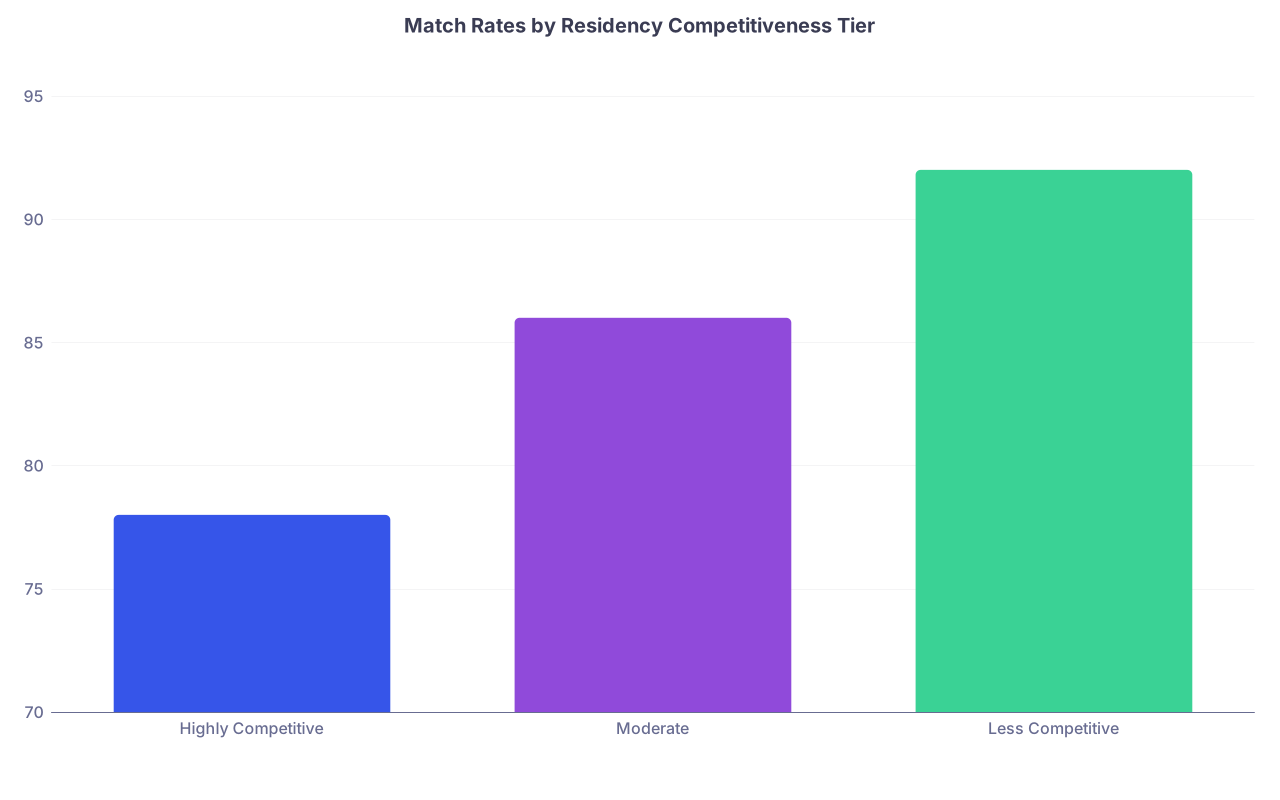
| Category | Value |
|---|---|
| Highly Competitive | 78 |
| Moderate | 86 |
| Less Competitive | 92 |
Look at that and do not get complacent. “Less competitive” does not mean “everyone matches.” It means the average applicant with a sane, realistic rank list matches. The outliers—the ones who ignore strategy—still fall through the cracks.
The rank order list (ROL) is not a formality. It is the one part of the process fully under your control after interviews. Misplay it, and no amount of “but this specialty is less competitive” will save you.
Pitfall #1: Building a Fantasy Rank List Around Your Ego
This is the big one.
You interviewed at:
- 3 well-known academic programs in big coastal cities
- 4 mid-tier academic/community hybrids
- 6 smaller community programs in less “desirable” locations
Your brain immediately labels them: “top,” “mid,” and “backup.” Then ego walks in and says:
“I am not spending three years in [Midwest town I have never heard of]. I will just rank the big-name and city programs top. I will probably match there anyway. This specialty is not that competitive.”
I have watched that exact applicant go unmatched in a “less competitive” specialty.
The mistake is not ranking programs you like more. That is correct. The mistake is pretending your desirability to those “top” places is stronger than it actually is, then failing to build a list that protects you from overestimating yourself.
You need brutal self-assessment:
- Board scores
- Red flags (remediation, LOA, failed Step, gap year, professionalism issues)
- School reputation and clinical grade pattern
- Visa status, if applicable
- Whether you actually connected with the program or were just another face on Zoom
If you are a mid‑pack applicant interviewing across the spectrum, you do not have the luxury of building a fantasy list. Every spot on that list needs to be doing real work for you.
Do not confuse “less competitive specialty” with “I’m a strong candidate everywhere in this specialty.” Those are not the same thing.
Pitfall #2: Underestimating Location Bias—On Both Sides
Location crushes more rank lists than Step scores do.
Here are the two opposite but equally bad mistakes:
- Ranking only your dream city (or coast)
- Ranking programs in places you actually will not move to
I have seen this sentence too many times in February:
“I ranked that rural program highly as a backup, but I never actually thought I would end up there. I do not know if I can live there.”
That is not strategy. That is denial.
Your rules:
- If you would not actually move there and complete three to four years, do not rank it. At all.
- If you are not willing to expand your geography, you must massively increase the number and variety of programs in that constrained region.
- If you are tied to a specific city for family/partner reasons, you are not allowed to pretend your risk is the same as everyone else’s. It is higher. You need to rank accordingly.
And from the program side: “less competitive” does not mean they are desperate. Many family med or psychiatry programs are heavily biased toward:
- Their own medical school
- Their own region
- Applicants with genuine ties to the area
If you are an IMG with no US ties, ranking a bunch of small community programs in random states without any geographic connection is not protection. It is a false sense of security.

Ask yourself for each program: could I make a convincing case that I actually want to be in this region? If the answer is “not really,” you need more programs where the answer is yes.
Pitfall #3: Not Respecting Program-Specific Filters (Especially for IMGs)
This one is brutal because it is invisible if you do not ask.
Common self-sabotage move: an IMG or DO applicant applying to less competitive specialties assumes that any program that offered an interview will rank them “normally,” without realizing some programs—
- Never rank visa‑requiring applicants to their top half
- Routinely put IMGs at the bottom of the list
- Or bring in IMGs mainly as interview padding but almost never actually match them
Not illegal. Not pretty either. But real.
If you are in a higher‑risk category (IMG, DO in certain specialties/regions, red flags, low scores), you cannot treat all interview invitations as equal.
You need to know:
- Has this program matched IMGs/DOs in the past 2–3 years?
- Roughly how many? (One token spot vs a regular pattern.)
- Are they even able to sponsor your visa type?
If the answer is “no IMGs in the last 3 years,” that program drops dramatically in protective value on your rank list. Rank it where your heart wants, but do not let it displace safer programs that actually match people like you.
Pitfall #4: Believing “Any Interview = High Match Chance”
This is the lazy logic:
“Everyone says if you have 10–12 interviews in a less competitive specialty you are basically guaranteed to match. I have 9 or 10. I am probably fine.”
No. That is how you sleepwalk into SOAP.
You are ignoring two huge variables:
- Quality of your interviews (you know when you crashed and burned)
- The type of programs those interviews are at
| Scenario | Interview Count | Program Mix |
|---|---|---|
| A | 9 | 7 community, 2 mid-tier university |
| B | 9 | 8 big-name academic, 1 community |
| C | 9 | 6 programs that rarely rank IMGs, 3 that regularly do |
All three are “9 interviews.” Only one of those is remotely safe.
If your interview set is heavily skewed to:
- Famous university programs in big cities
- Programs that rarely match your applicant type
- Places where you felt the interview went poorly
…then your true risk is much higher than the raw count suggests.
Programs in less competitive fields can still be extremely selective once you control for geography, university affiliation, and applicant type. Your rank list must reflect actual probability, not a wishful interpretation of your interview count.
Pitfall #5: Overcorrecting for Fear and Underranking Better-Fit Programs
The flip side of arrogance is panic.
I see this a lot in applicants with a failed Step 1, repeated year, or IMGs with marginal scores. They finally get 6–8 interviews at a mix of programs and then do this:
- Rank all the “safer‑seeming” community programs first
- Push a genuinely good‑fit academic or hybrid program way down “because I probably will not match there anyway”
That is also a mistake.
The match algorithm actually favors your preferences, as long as the program ranks you at all. Your job is not to second-guess where you think they will rank you. Your job is to list where you truly want to be, in order, while still including enough realistic options lower down to protect you.
What you must not do:
- Flip your list upside down based solely on insecurity
- Put your best‑fit training opportunity at #7 because “it is a reach”
Rank the program you genuinely like best first, even if it feels aspirational, as long as:
- You did not bomb the interview
- You meet at least the basic profile of their historic matched residents
Then protect yourself with breadth and realistic programs further down. “Hope at the top, realism throughout, honesty at the bottom” is the right structure.
Pitfall #6: Using SOAP as a Backup Strategy Instead of a Last Resort
The least honest sentence I hear in January:
“If something weird happens and I do not match, I will just SOAP into a less competitive specialty. It will be fine.”
No. That is not a strategy. That is a fantasy.
SOAP in less competitive specialties is still:
- Chaotic
- Limited
- Brutally fast
- Biased toward US grads and people already somewhat on their radar
And many of the “less competitive” specialties you are thinking of—family med, psych, peds—are increasingly filling in the main match. Some years, there are almost no SOAP spots in the locations you would actually move to.
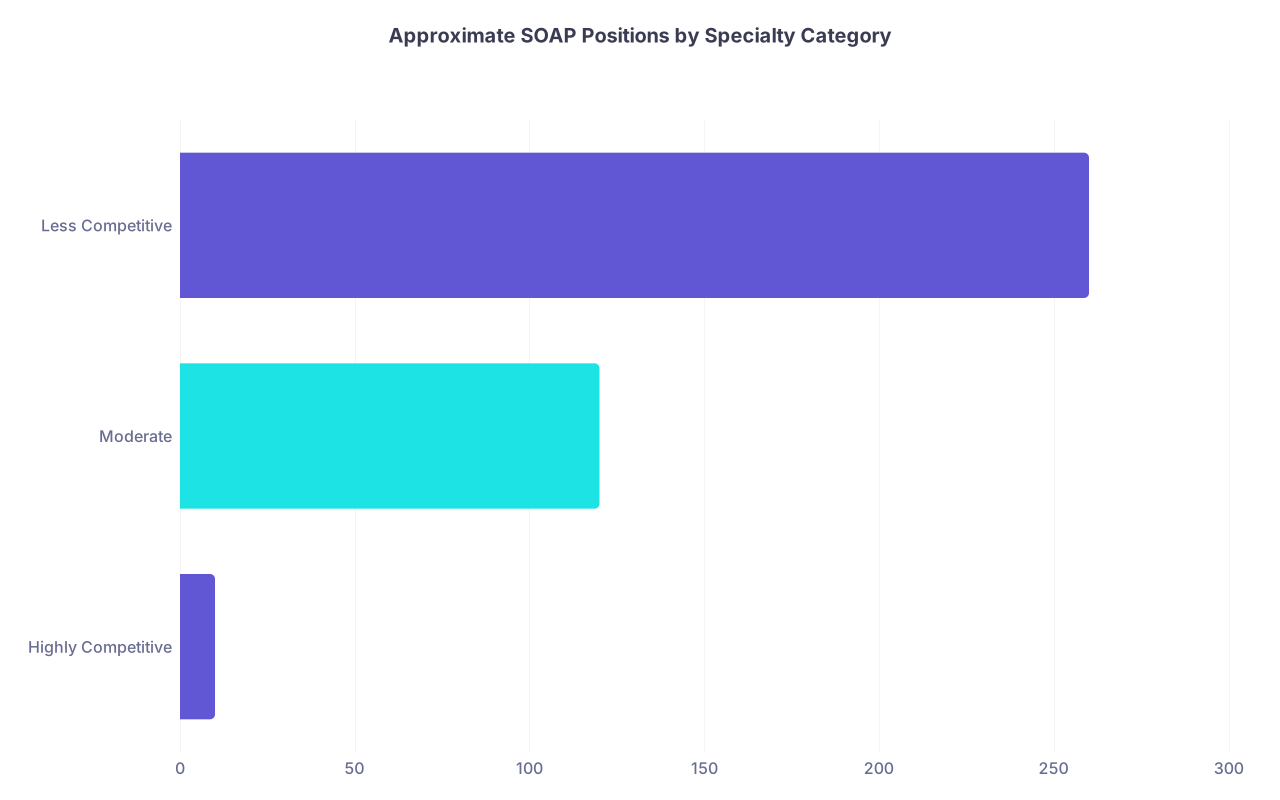
| Category | Value |
|---|---|
| Highly Competitive | 10 |
| Moderate | 120 |
| Less Competitive | 260 |
Those 260 “less competitive” SOAP spots are spread across the entire country, including locations and programs you have never heard of and may not want. Many will not sponsor visas. Many will not touch red-flag applications.
SOAP is not where you go to fix a sloppy or arrogant rank list.
If you are already thinking, “I can always SOAP,” treat that as a warning siren that your current rank list is underbuilt. Fix it now while you actually have leverage.
Pitfall #7: Ranking Programs You Know Are a Bad Fit “Just in Case”
I know someone told you, “Rank everything. Do not try to game the algorithm.” And they were half right.
You should not game the algorithm. But you must be honest about yourself.
If you know that:
- You will be miserable in a program with heavy inpatient and very little outpatient
- You will not survive a malignant call schedule with no support
- Your partner absolutely cannot relocate to certain states
Then ranking those programs anyway is not “smart insurance.” It is voluntary self-sabotage.
I have seen students match at places they ranked 11th or 12th “just as backups” and then spend PGY‑1 fighting depression, marital strain, and thoughts of quitting medicine entirely.
The rule is simple and harsh: if you would rather reapply than train there, do not rank it. A supposedly “less competitive” specialty does not magically make a toxic or incompatible program survivable.

Pitfall #8: Ignoring the Count Problem—Too Few Programs Ranked
You cannot talk about rank lists without talking about volume.
In less competitive specialties, people hear:
“You do not need that many programs, it is more about fit.”
Then an average applicant to psychiatry ranks 6–7 places and wonders how they ended up unmatched.
No one can give you a universal safe number. But there are clear mistakes:
- Ranking fewer programs than you interviewed at (unless you are removing true bad fits)
- Stopping your list prematurely based on pride (“I will not go lower than this tier”)
- Not adjusting your target count upward when you have red flags or are geographically rigid
Less competitive does not mean safe with 4–5 programs. The NRMP data repeatedly show unmatched applicants in these fields with short lists.
If you had 12 interviews and only rank 7 where you would realistically be content, you just threw away 5 chances. You gained nothing. The algorithm does not punish you for ranking more.
Pitfall #9: Failing to Recalibrate After a Weak Interview Season
Some of you already know your interview season did not go how you hoped.
You applied broadly to a less competitive field and still only got 4–5 interviews. Or you got plenty of interview offers, but mostly at programs that are long shots for your profile.
The worst thing you can do now is pretend you are in the same risk category as your classmates with 10 strong interviews and proceed as if everything is fine.
You must recalibrate:
- Be more conservative about where you place programs that are long shots or poor fits for your profile
- Rank every program where you would actually go, no matter how “low-tier” it feels to your ego
- Abandon the fantasy that this is the year you can be picky—your priority is matching, not prestige
This is where people applying to “less competitive” specialties get in trouble. They cling to the narrative that these fields are easy to match and ignore the clear signal that, for them personally, the match is not guaranteed.
Pitfall #10: Not Using Data and History When You Could
You would be surprised how many applicants build rank lists in total isolation.
They do not:
- Ask residents at their home program what realistic looks like for someone with their profile
- Look at NRMP’s Charting Outcomes and Program Director Surveys for their specialty
- Review where prior graduates from their school with similar stats have matched
- Check whether a program actually matched people like them (DO, IMG, low‑score, red flag, visa) in prior years
So they build a list based on vibes and vague reputational cues (“I heard that program is chill”) rather than probability.
You do not need a perfect data model. But you do need to know:
- Which programs are clear reaches
- Which are realistic, if not glamorous
- Which are truly safety programs that historically rank and match applicants like you
Your rank list should be top‑heavy with “realistic plus” programs: places that will train you well, where your chances are solid, not illusions.

| Step | Description |
|---|---|
| Step 1 | Self assessment |
| Step 2 | Identify risk factors |
| Step 3 | Review interview list |
| Step 4 | Consider adding more applications or prelim options |
| Step 5 | Order by true preference |
| Step 6 | Remove programs you would not attend |
| Step 7 | Check for geographic balance |
| Step 8 | Finalize rank list |
| Step 9 | Enough realistic programs? |
That is the bare minimum. Skipping those steps because your specialty is “less competitive” is how people end up shocked on Monday of Match Week.
FAQs
1. If I am applying to a less competitive specialty, how many programs should I rank to be safe?
There is no magic number, and anyone who gives you one without knowing your profile is guessing. For a typical US MD in a genuinely less competitive specialty with no red flags and 10–12 interviews, ranking essentially all programs where you would be content is usually sufficient. If you are a DO, IMG, have low scores, visa needs, or are geographically restricted, you should be thinking “more, not fewer.” The mistake is ranking 4–6 programs and calling it a day because “this specialty is easy.”
2. Should I ever leave a program I interviewed at off my rank list?
Yes. If you know you would rather go unmatched and reapply than spend three or more years there, do not rank it. The match is binding. Forcing yourself into a malignant or truly unlivable situation is not smart. The error is dropping programs for superficial reasons (not famous enough, not big city enough) while simultaneously being terrified of going unmatched. Only remove places that are genuine deal-breakers, not just imperfect.
3. How do I balance ranking “reach” programs versus safer ones?
Start with your genuine order of preference, not your fear. Rank your true #1 first as long as it is not completely delusional for your profile and you did not obviously crash the interview. Then fill the middle of your list with realistic programs where your chances are solid and the training is acceptable. Make sure you have enough of these. Finally, include safer programs lower down that you would still be willing to attend. The mistake is either stacking the top with only big-name reaches or swinging the other way and burying all good options under fear-based “safeties.”
Key points:
- “Less competitive specialty” does not protect you from a bad rank strategy; arrogance and denial still get punished.
- Every program you rank should be one you are truly willing to attend; do not use SOAP as a fake safety net.
- Build your list on honest self-assessment, real data, and enough realistic programs, not on prestige, rumor, or wishful thinking.