
The way most applicants talk about “higher match rates” is dangerously misleading.
You hear it in every hallway outside the med school library: “Oh, that specialty has a 92% match rate. It is basically a safety.” That sentence has tanked more careers than any single bad Step score ever did.
If you are using overall match percentages to decide what is “least competitive” or “safer,” you are playing with fire. Especially if you are targeting supposedly less competitive specialties.
Let me walk you through how people get burned.
The First Big Lie: “High Match Rate = Easy Match”
The ugliest mistake: looking at a chart that says “Internal Medicine – 96% match rate” or “Family Medicine – 99% match rate for US MD seniors” and concluding, “I will be fine.”
No context. No nuance. Just vibes.
Here is what those numbers do not tell you:
- Who is in the denominator
- Who is filtered out long before Match Day
- How self-selection hides competition
- How program preferences differ inside a “less competitive” specialty
I have watched average students assume that high match rate equals low risk, apply lazily to “backup” fields like FM, psych, or peds, then sit stunned on Match Day with an email no one wants to open: “We are sorry to inform you…”
The number they trusted was not wrong. They just misread it.
Denominator deception: the people who never got counted
NRMP data looks “clean” because it only includes people who actually submitted a rank list. That means:
- People who were quietly discouraged from applying in that specialty
- People who never got enough interviews to create a viable rank list
- People who retracted their applications and scrambled toward prelim years or a different field
…are invisible in those match percentages.
So when you see “98% of US MD seniors in Specialty X matched,” what you are really seeing is:
“Of the people who:
- made it to application season,
- got enough interviews,
- did not pull out in panic,
- and submitted a rank list,
98% matched somewhere.”
That is not the same as “98% of anyone who wants this specialty will get in.” Not even close.
Self-Selection: How Weak Numbers Magically Disappear
Low-competitiveness specialties often look deceptively welcoming because of self-selection. The applicant pool screens itself.
Here is the pattern I have seen repeatedly:
- Top 10% students with 260+ scores often bypass FM, peds, or psych entirely (or use them as distant backups).
- Mid-range students with solid but not flashy applications cluster in these specialties.
- Students with major red flags—low scores, failed attempts, no exams yet, professionalism issues—are frequently counseled away from competitive specialties and toward “easier” ones.
By the time ERAS locks, the group applying to a so-called least competitive specialty has already been filtered. A lot.
| Category | Value |
|---|---|
| US MD | 94 |
| US DO | 86 |
| IMG | 60 |
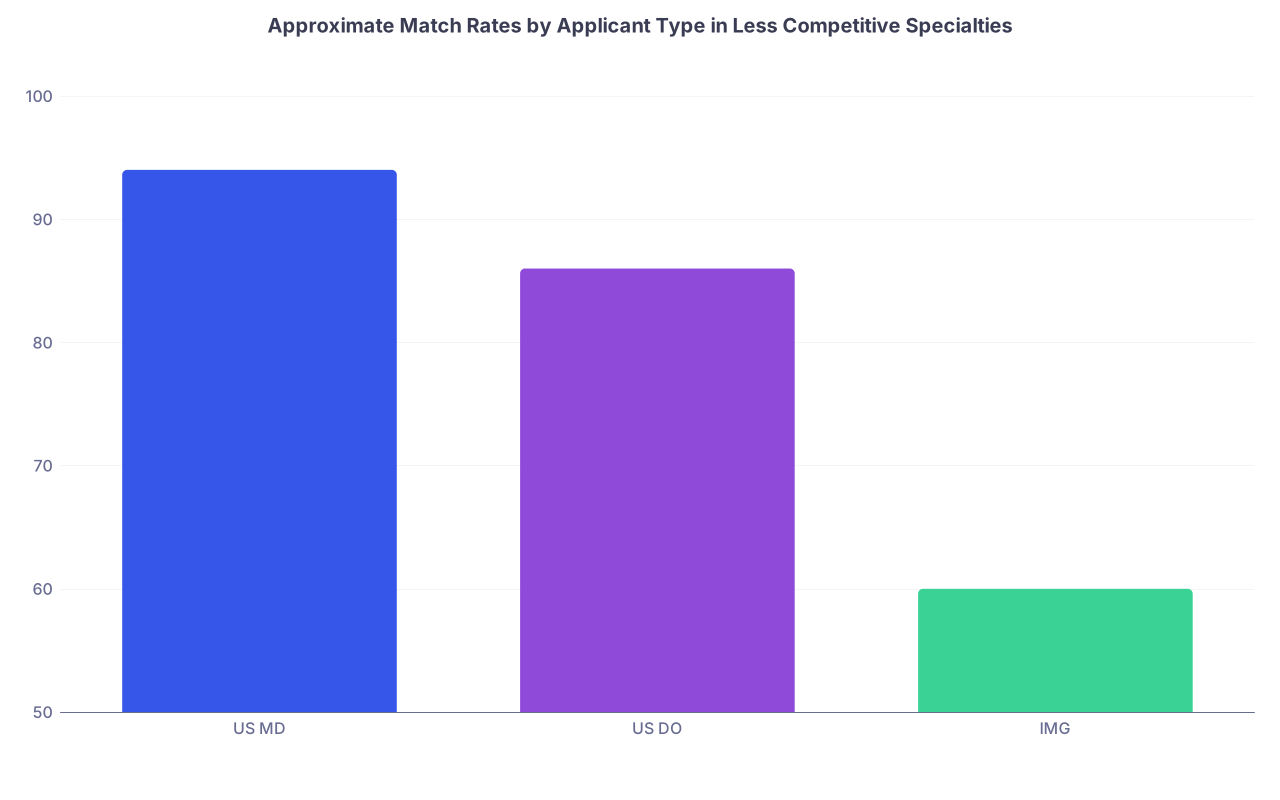
Those are illustrative, not exact, but the pattern is real: yes, US MD seniors in less competitive specialties often match at very high rates. DOs and IMGs? Much more risk. Yet applicants lump all this together as “high match rate.”
So the student who is a US IMG with a Step 2 of 226 looks at a 96% match rate in peds and thinks they are “safe.” They are not. That 96% is not their number.
You must always ask:
“High match rate for whom? With what background?”
If you do not separate that, you are borrowing someone else’s chances and pretending they are yours.
The “Least Competitive Specialty” Myth Trap
There is another subtle error that quietly wrecks rank lists: treating an entire specialty as a single competitive unit.
Applicants say things like:
- “Psych is chill right now.”
- “FM is basically guaranteed.”
- “Path is wide open.”
No.
Within every “less competitive” specialty, there are wildly different tiers:
- Academic vs community programs
- Big city vs rural
- Coastal vs Midwest/South
- Lifestyle-famous locations vs places nobody brags about on Instagram

One specialty, two different worlds
Take family medicine as an example.
Everyone loves to quote the “FM is easiest” line. But the student matching a community FM program in a mid-sized Midwestern city is not competing in the same way as the student trying to match an academic FM program in Seattle, Boston, or San Diego.
Same specialty label. Different reality.
Inside any “less competitive” specialty, you will find:
- Programs that eagerly consider IMGs, DOs, or lower scores, especially in underserved or rural areas.
- Programs that are essentially mini-competitive strongholds: they want high Step 2 scores, meaningful research, strong letters, and clear commitment.
If you fixate on the overall match rate for a specialty without drilling down to the program level, you commit a classic mistake: confusing field-level openness with program-level generosity.
You do not match a specialty. You match a program.
The “Backup Specialty” Fantasy
One of the worst ways people misuse match data is by creating a “backup” specialty based solely on a higher match rate.
The script usually goes like this:
- “Derm is my dream, but IM has >95% match. I will use it as a backup.”
- “I am shooting for ortho, but I will throw in some gen surg or EM as my safety.”
- “If I do not get ENT, I will pivot to anesthesia last minute. They have pretty good match numbers.”
Dangerous thinking.
Here are the mistakes baked into that logic:
- Assuming your application is equally convincing for your backup specialty
- Assuming programs in “easier” specialties are fine with being Plan B
- Assuming letters, experiences, and your personal statement transfer cleanly across fields
- Assuming you understand how many interviews you actually need to feel safe

| Step | Description |
|---|---|
| Step 1 | Choose Dream Specialty Only |
| Step 2 | See High Match Rate For Another Field |
| Step 3 | Declare It Backup Without Planning |
| Step 4 | Apply Weakly To Backup Programs |
| Step 5 | Few Backup Interviews |
| Step 6 | Overconfident Because Of Match Data |
| Step 7 | Risk Going Unmatched |
I have seen more than one applicant with a “competitive” application in one tight specialty, plus a scattered, unconvincing backup attempt in a so-called easier field, end up with… nothing. Their “backup” never saw them as serious.
Higher match rate does not compensate for a poorly tailored application.
If you want a backup, you need:
- Genuine specialty-aligned experiences
- Strong, field-specific letters
- A coherent narrative for why you want that field
- Enough programs on your list (and enough interviews) to mathematically make sense
Otherwise, you are not backing yourself up. You are just writing a second weak story and hoping the numbers will save you.
They will not.
Misreading “Unfilled Positions” As Free Real Estate
Another seductive, wrong interpretation: you see that some specialties have unfilled positions post-Match and assume that means the field is “desperate” and will take anyone.
I watched one applicant look at unfilled positions in internal medicine and say, “Worst case, there are tons of unfilled IM spots every year. I will land somewhere.”
Careless. And wrong in several ways.
Here is what unfilled positions often really mean:
- Programs in less desirable locations (geographically or reputationally)
- Programs with specific visa limitations
- Programs that are IMG-heavy or DO-heavy and more cautious about certain profiles
- Programs that did not get enough ranked applicants they trusted, not that they had zero applicants
| Category | Value |
|---|---|
| Highly Competitive | 1 |
| Moderately Competitive | 5 |
| Less Competitive Rural | 40 |
| Less Competitive Urban | 10 |
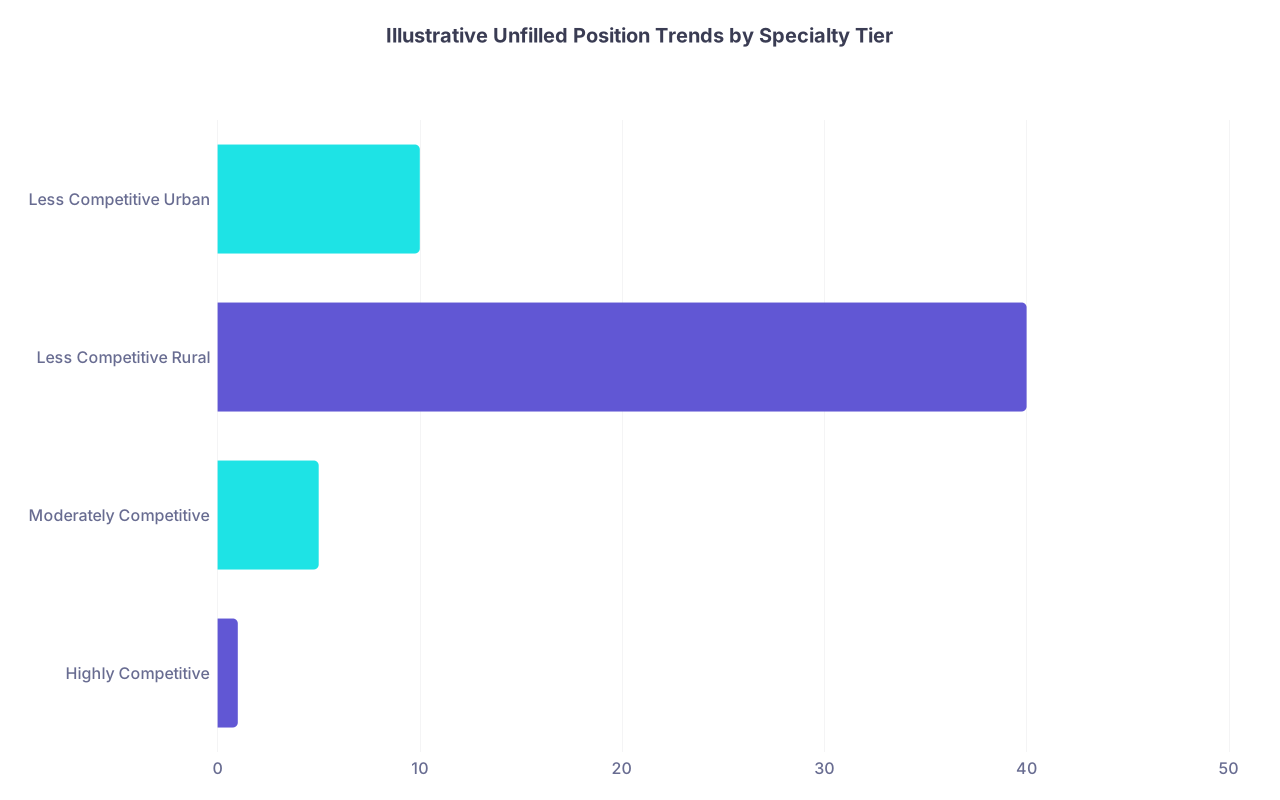
Again, this is conceptual, but the structure is correct: some of those unfilled positions are in programs you never actually applied to, do not want, or are not eligible for.
You cannot treat “unfilled” as “available to me personally.”
And if your entire strategy is “I will fall back into SOAP because there are always open spots,” understand this: SOAP is a meat grinder. You will be competing against hundreds of other panicked, overqualified, and underqualified people for a handful of positions, many in places and programs you never seriously considered.
Relying on SOAP because “less competitive specialties always have room” is a mistake I have watched people deeply regret.
Ignoring Applicant-Type Differences
People love quoting combined match percentages, blending US MDs, DOs, and IMGs like they all face identical odds. That is fantasy.
If you are not looking at match data broken down by:
- US MD senior
- US MD graduate (out of school)
- US DO senior
- US DO graduate
- US IMG
- Non-US IMG
…you are probably giving yourself false comfort.
| Applicant Type | “Easier” Specialty Match Rate* |
|---|---|
| US MD Senior | 94% |
| US DO Senior | 86% |
| US IMG | 60% |
| Non-US IMG | 50% |
*Not real numbers, but extremely realistic patterns.
The DO student who hears, “Psych is easy to match,” but does not look at DO-specific data is setting themselves up for a nasty surprise.
The IMG who hears, “FM is wide open, there are tons of unfilled spots,” but only applies to big-city academic programs in California and New York is ignoring every line of meaningful data.
“High match rate” is not a universal truth. It is conditional. You have to know which category you belong to.
Over-trusting Historical Data In a Moving Target
Another trap: using historical match data as if the next cycle will behave exactly the same.
I have lived through cycles where:
- One year, psych looks open. Strong match rates, decent interview availability.
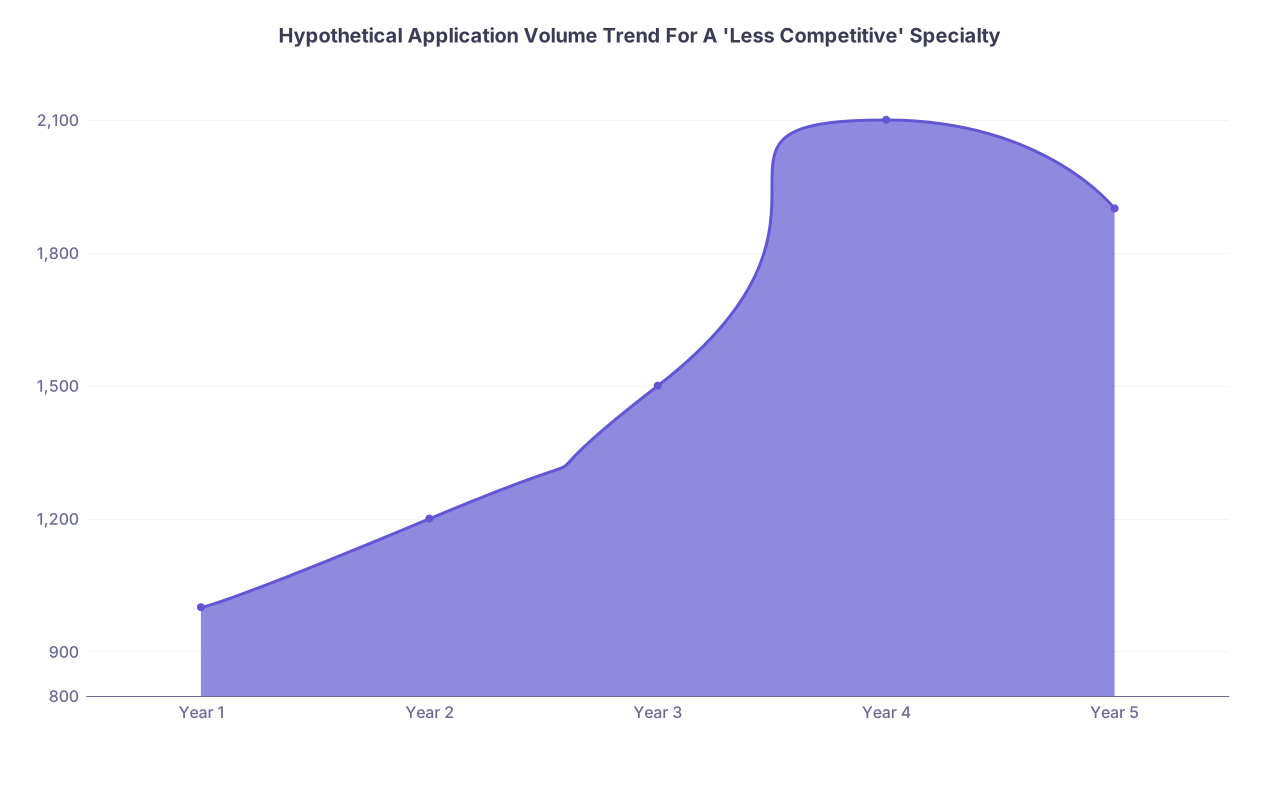
- Two years later, lifestyle hype, social media talk, and rumors hit. Application numbers spike. Now psych is quietly much tighter.
Same story with EM recently: once sold as a flexible, lifestyle-friendly field, then oversaturated, then many students backed off. The numbers swung. A lot.
| Category | Value |
|---|---|
| Year 1 | 1000 |
| Year 2 | 1200 |
| Year 3 | 1500 |
| Year 4 | 2100 |
| Year 5 | 1900 |
The mistake is thinking: “Last year’s chart says 97% match rate. Therefore it will be like that when I apply.”
But:
- Class sizes change.
- Boards go pass/fail, and pressure shifts to Step 2 or other metrics.
- Rumors about job markets ripple through cohorts.
- One TikTok-famous attending glamorizes a field and suddenly application numbers surge.
Match data is not a contract. It is a snapshot.
Treating a static PDF report as if it guarantees your personal outcome two years from now is sloppy planning.
Ignoring Program-Level Filters Behind The Numbers
All those lovely PDFs never tell you the filter wars happening behind the scenes.
Common misread: “This specialty has a high match rate, so programs must be flexible.” Then you find out later:
- Many programs auto-screen below a specific Step 2 threshold.
- Some quietly prefer AOA or honor society members, even in ‘chill’ fields.
- Some heavily weight home students or regional ties.
- Some throw out applications with more than one failed attempt, regardless of specialty.

So you look at aggregate match numbers and tell yourself, “I am right in the average range, I should be fine.” Meanwhile, 40–60% of programs may never even open your application because of a simple numerical filter.
Then you are shocked when your interview count is half your classmates’ despite similar specialty choice.
If you are not studying program websites, talking to mentors, and cross-checking your scores and profile against actual program criteria, you are misusing match data. Period.
The Interview Count Blind Spot
Applicants obsess about match rates but underestimate one of the most practical realities: interviews.
Every program director I have talked to says some version of the same thing: “Once you have enough interviews, your personal odds improve dramatically. Before that, the numbers do not matter.”
But many applicants do this lazy mental math:
- “Match rate is 95%. I will apply to like 20 programs. Should be okay.”
They never ask:
- How many interviews do people with my stats actually need in this field?
- What did the unmatched cohort’s interview numbers look like?
A common unofficial rule in many less competitive specialties: once you are in the 10–12 interview range, your chance of matching somewhere becomes very high. But that is not absolute, and it certainly is not guaranteed.
The dangerous part is this: someone in a “lower” specialty with only 4–5 interviews reading “95% match rate” and feeling falsely safe.
I have seen that person. More than once. It rarely ends well.
How To Use Match Data Correctly (Without Lying To Yourself)
You do not need to throw out NRMP data. You need to stop misreading it. Use it like a cautious scientist, not a gambler looking for justification.
Here is the safer way to approach it:
Start with your category.
Look up data for your exact applicant type: US MD senior vs DO vs IMG. Ignore everyone else’s percentages. They are noise for you.Then look at trends, not just one year.
Is interest in that specialty rising or falling? Are unfilled positions increasing or shrinking? A single year can be an anomaly.Dig into program-level reality.
Pick 10–15 programs across the range you are interested in and actually read their requirements:- Minimum Step 2?
- DO-friendly or not?
- Will they sponsor visas?
- Any explicit red flag policies?
Estimate interview needs based on honest advising.
Ask recent grads from your school, specialty advisors, and residents: “With my profile, how many interviews should I target for a reasonable chance?” Then build your application strategy backward from that, not from a seductive “95% match rate” line in a chart.Be brutally honest about backup plans.
If you are using a “less competitive” field as a backup:- Do you actually have that field on your CV?
- Do you have at least one strong letter from that specialty?
- Will your personal statement sound real to them, not like Plan B?
If the answer to those is no, your backup is fake. Fix it or drop it.
Your Next Step (Do This Today)
Open the most recent NRMP Charting Outcomes report or program-specific match data for the specialty you are considering. Do not look at the overall match rate first.
Instead, scroll directly to the section broken down by applicant type and Step 2 (or COMLEX) ranges.
Now ask yourself, in writing:
“Which line on this chart is actually me?”
Circle it. Screenshot it. Whatever. But stop comforting yourself with someone else’s number.