
The idea of “easy” matches is a lie that quietly kills careers.
If you walk into the Match thinking “I’ll be fine, my specialty is non-competitive,” you’re already in the danger zone. The people who get burned the worst aren’t the ones aiming at neurosurgery with a 220 Step score. It’s the ones who think Family, Psych, Peds, IM, PM&R, Path, or Neurology are “safeties.”
They are the ones who end up staring at an “UNMATCHED” screen, absolutely blindsided.
Let me walk you through the traps I’ve seen over and over—because the pattern is painfully predictable.
The Core Myth: “Least Competitive” ≠ “Guaranteed Match”
Here’s the first mistake: treating competitiveness as a single national number and assuming it applies to you.
You look up a chart, see that Family Medicine has a 95–98% match rate for US MD seniors, and you breathe out. “Okay. I’m fine. I’m above average. I’ll match somewhere.”
That’s not how this works.
Programs don’t admit “the national average applicant.” They admit based on:
- Local preferences
- Institutional biases
- Visa status
- Your school’s reputation
- Step scores, sure—but also red flags, gaps, weird narratives
And crucially: they admit from the pool that actually applies to them, not the whole specialty.
So yes, nationwide, Psych might look “less competitive” than Derm. But that doesn’t protect you if:
- You only applied to 12 name-brand academic psych programs in coastal cities
- You failed Step 1 and “redeemed yourself” with a pass, but never addressed it
- You have no psych letters of recommendation because you were sure your generic medicine letters would “transfer”
Overconfidence builds this illusion: “the specialty is easy, so I don’t have to be sharp.” That’s how people walk straight into an unexpected unmatch.
Where Overconfidence Shows Up (and Blows Up)
You can spot the overconfident future-unmatched applicant by their behavior months before ERAS opens. They all make versions of the same errors.
1. Under-applying because “I’m solid”
This is the classic.
“I’m going into Family, I don’t need to apply to 30+ programs. I’ll be reasonable—like 10–12, mostly in the cities I like.”
I’ve literally heard:
“I don’t want to waste money on backup programs. Everyone matches FM.”
Then February comes. No rank list. SOAP.
What goes wrong:
- They misjudge their competitiveness relative to others in those specific regions
- They only apply to big-name academic centers that are not actually “easy”
- They underestimate how many others are using the same “safety specialty” strategy
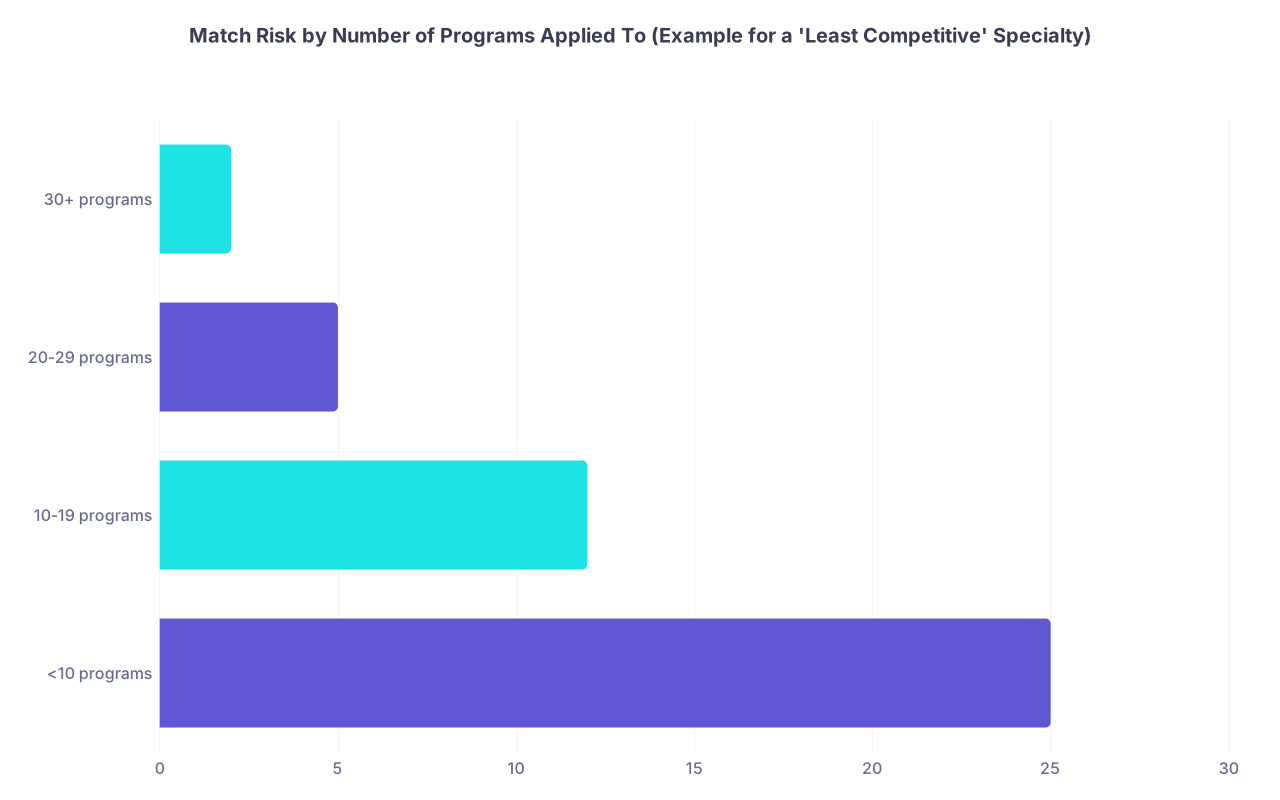
| Category | Value |
|---|---|
| <10 programs | 25 |
| 10-19 programs | 12 |
| 20-29 programs | 5 |
| 30+ programs | 2 |
Those aren’t exact official numbers; they’re the pattern I’ve seen in real life and in NRMP data trends: fewer applications, higher unmatched risk—even in “easy” specialties.
The mistake: treating “historically high match rate” as a license to apply way below recommended ranges.
2. Ignoring geographic reality
People love to say: “Psych is easy, everyone’s going into psych now.”
Then they only apply to:
- New York City
- Boston
- Bay Area
- Seattle
- LA
- One random program near their partner
Guess what? Those exact cities attract:
- Top Step scorers who didn’t want surgical lifestyles
- Applicants with big-name research and home programs
- People couples-matching who drag in their hyper-competitive partners
Geography is the great equalizer. A “low-competitive specialty” in Northern Idaho is not the same as that same specialty in downtown Manhattan.
I’ve seen:
- A 245+ US MD unmatched in Psych because they only applied to 15 programs in 3 cities they liked
- A mid-220s DO get 15 interviews in the same specialty by casting a wide, realistic geographic net
The mistake: assuming competitiveness is uniform across regions. It isn’t. At all.
3. Using weak or generic letters because “letters are just a formality”
Overconfidence makes people lazy about letters in “easier” fields.
You hear:
“Any IM letter is fine for FM.”
“My surgery letter is strong, I’ll just use that for PM&R.”
“I liked that attending, but they don’t know me that well—it’s okay, I’m not going for Derm.”
Programs in these specialties can tell. They know when:
- You rotated with them but never got a letter from their faculty
- Your letters never mention the specialty once
- Your “strongest” letter is from a field unrelated to what you’re applying for
For “least competitive” specialties, letters are often how they separate:
- The applicant who actually wants this field
- From the one who’s just trying to “find something easy”
The mistake: assuming you can get by with generic, lukewarm letters because “they’ll just be glad to get applicants.”
They won’t. The good programs are picky. The bad programs still have minimum cutoffs.
Specialty-Specific Overconfidence Traps
Let’s talk about specific fields that get labeled “easy” and the particular ways overconfidence wrecks people in each.
Family Medicine: “Everyone matches FM”
I’ve heard more dismissive comments about FM than any other field. That arrogance is exactly why some people still miss it.
Common overconfidence behaviors:
- Applying to 8–10 total programs, all in wealthy suburbs or big academic centers with OB tracks and sports fellowships
- No true continuity clinic experience, just hospital-centric IM rotations
- Zero FM letters—only IM and maybe a random research letter
- Personal statement that reads like: “I wanted other fields, but I value work–life balance”
Red flags programs quietly notice:
- Multiple failed or barely passed Step/Level exams without clear improvement
- No evidence you’ve worked with underserved populations, yet you’re applying to community-heavy FM programs
- Inconsistent interest—your CV loaded with surgical research, nothing primary care related
FM can save careers. But it’s not an infinite safety net that ignores patterns and red flags.
Psychiatry: “Chill field, easy lifestyle”
Psych has gotten more popular. A lot more popular.
Overconfident applicants do this:
- Apply to 12–15 psych programs because “my Step is above average for psych” (using 5-year-old data)
- Have zero psych-specific research and maybe one short rotation
- Use letters from Medicine and Neurology only, because they didn’t bother to ask psych attendings
- Flaunt “strong interest in psychopharmacology” but have no real longitudinal psych exposure
Programs in psych are on high alert for:
- Unaddressed personal mental health issues that might affect training safety
- Unprofessional behavior or odd interpersonal vibes in interviews
- People clearly using psych as a fallback while still talking about surgery or EM
The surprise unmatch often happens when:
- Applicants underestimate how much psych programs care about “fit,” communication, and insight
- They over-index on Step scores and forget the soft stuff
Pediatrics: “I like kids, so I’m a shoo-in”
Pediatrics looks friendly from the outside. That doesn’t mean lazy applications get through.
Overconfident peds applicants:
- Apply mainly to big-name children’s hospitals with brand clout
- Have no true peds continuity or advocacy projects
- Assume their general IM letters or generic medicine LORs are “close enough”
- Think, “Peds is desperate, they’ll take me,” while offering a half-baked personal statement
Programs watch for:
- Poor communication skills—if you can’t explain things clearly, you’re a problem in peds
- Low Step scores with no remediation plan or evidence of improvement
- Weak or absent peds-specific letters, especially from those who actually saw you work with children and families
The quiet killer in peds: underestimating how many strong applicants also love kids and actually built a coherent peds application.
Internal Medicine (Community / Mid-tier): “IM is always open”
People assume IM is bottomless. It is not.
Overconfident IM applicants going for “non-competitive IM” will:
- Apply to mostly university-affiliated programs in highly desirable cities
- Skip less glamorous community or suburban programs entirely
- Lean on the idea that “IM will always need bodies” while having failed attempts, gaps, or professionalism issues
For IM, the trap is preferring “no match” over “less prestigious match” while not applying broadly enough to secure either.
Programs are swamped with:
- International grads
- DOs and MDs switching out of more competitive fields
- Research-heavy candidates aiming at fellowship tracks
If you assume “I’ll be fine, this is just IM,” you’re not seeing the whole field.
The Data Trap: Misreading Competitiveness
A lot of overconfidence starts with misreading match data tables.
People love to quote:
- “X specialty has a 97% match rate for US MD seniors”
- “Look, the average Step 2 score for matched applicants is only 235”
So they think: “I have a 238, I’m in. I’m above average.”
Here’s what they’re missing:
- Those are averages, not minimums
- They blend in people who applied smartly vs stupidly
- They don’t show subgroups: IMGs vs US grads, DO vs MD, red flags vs clean records
- They don’t reflect region or program tier
| Thought Error | Reality Check |
|---|---|
| “I’m above the average score, I’m safe” | Distribution still has unmatched applicants above average |
| “High match rate = easy match” | High rate reflects smart application behavior, not guarantees |
| “My specialty is non-competitive” | Some programs in that specialty are brutally selective |
| “I only need to apply to a few places” | Low numbers magnify every other weakness you have |
The nasty surprise is realizing too late that “average matched score” is not your personal safety floor. It’s just a central tendency of those who already played the game well.
Hidden Overconfidence: Weak SOAP/Safety Planning
The most brutal unmatches I’ve seen share one additional pattern: zero real contingency plan.
Overconfident applicants tell themselves:
- “I won’t need SOAP; that’s for problem applicants.”
- “I’ll match somewhere, and if not, I’ll just pick something else in SOAP.”
Reality in SOAP for “easy” specialties:
- Spots are limited and vanish fast
- Programs can see your whole application and know you weren’t genuinely interested in their field
- If your original application to that specialty was lazy, SOAP will not magically fix that
I’ve watched:
- People applying to Psych with no true SOAP backup because “I don’t want to think about not matching; it’ll psych me out”
- People who decided in SOAP they’d “just do FM,” but had no FM letters, no FM personal statement, nothing ready
SOAP is not a casual redo. It’s a high-speed triage.
The mistake isn’t just overconfidence in Match. It’s overconfidence that you’ll never need a backup scenario.
Subtle Ways Overconfidence Leaks Into Your Application
Even if you don’t say “this specialty is easy” out loud, program directors can see it between the lines.
I’ve seen these red flags repeatedly:
- Sloppy personal statements: vague, cliché, clearly copy-pasted between specialties
- Inconsistent story: CV says you’ve been doing ortho research for 3 years, but you claim to be “lifelong passionate about psychiatry”
- Late ERAS submission: “It doesn’t matter if I submit in October; my field isn’t that competitive”
- No away rotations or targeted exposure: “I don’t need an away; there’ll be plenty of spots”
- Unprofessional emails: casual tone, misspellings, or vague “just checking in” notes that show you haven’t done basic homework about the program
Programs in so-called “least competitive” specialties may not have the brand prestige of derm or ortho, but their PDs aren’t stupid. They know when they’re being treated like a backup plan.
And they act accordingly.
How to Be Confident Without Being Stupid
You do not need to be anxious, self-loathing, or paranoid to avoid unmatching. What you do need is accurate self-assessment and respect for the process—especially in these “easy” fields.
Here’s how to keep your confidence from turning into arrogance:
Anchor to realistic application numbers
- Use NRMP charting outcomes AND your dean’s office guidance
- If the recommended number is 25–30, don’t decide you’re special at 10
- If your application is weaker (red flags, low scores, IMG/DO without home program), you probably need more, not fewer, apps
Treat geography like a major variable, not an afterthought
- Tier your programs: dream, realistic, safety
- Include less desirable locations or smaller cities if you truly care about matching
- Do not cluster all your applications in 2–3 high-demand metros and call that “broad”
Align your letters and experiences with the field you claim to want
- Get at least 1–2 strong letters from attendings in the specialty
- Stop using “generic strong medicine letter” as a crutch
- Make sure your CV has at least a few activities clearly relevant to that specialty
Confront your red flags early
- Failed exams, leaves of absence, professionalism issues—do not pretend they don’t matter
- Work with advisors to craft a coherent narrative and mitigation steps
- Understand you may need to buffer your risk with more programs and wider geographic spread
Have a sober SOAP plan before Match Week
- Know which other specialties you’d consider and prepare at least a rough personal statement for them
- Have a list of programs and fields that routinely have SOAP spots
- Do not assume “I won’t need it” just because your specialty is not called Neurosurgery
The Real Question You Need to Ask Yourself
Drop the word “easy.” It’s useless.
Instead, ask:
“If I only match at my weakest realistic program in this field, would I still rather train there than not match at all this year?”
If your honest answer is yes, then act like it. Apply in a way that respects your goal—not in a way that flatters your ego.
Because the unmatches that really haunt people aren’t the long-shot derm or plastics attempts. They’re the people who aimed at “least competitive specialties,” convinced they were safe, and then discovered the hard way that:
- Programs are selective
- Geography matters
- Numbers are not guarantees
- And overconfidence is invisible right up until Match Day
Do not be that story.
Do this today:
Open your specialty list and your tentative program spreadsheet. For each “easy” field you’re considering, add:
- 5–10 additional realistic programs in less glamorous locations
- A column noting whether you have at least one field-specific strong letter already lined up
If either column looks empty or sparse, you’re not as safe as you think. Fix that now—before the Match fixes it for you.