
The myth that “chair letters don’t matter in less competitive specialties” is dead wrong. In low-competition matches, chair letters often matter more—because they become the quiet tiebreaker when everything else looks the same.
You want to understand why some perfectly adequate applicants in FM, IM, psych, peds, pathology, PM&R, even neurology mysteriously slide onto a rank list while others with nearly identical stats don’t? Sit in on a rank meeting. Watch how a single sentence from a chair letter tilts the room.
Let me walk you through what actually happens behind those doors.
Why Chair Letters Are Weirdly Powerful in “Easy” Matches
In derm or ortho, your application is a blood sport of numbers, home rotations, research portfolios, and direct whispers from big-name faculty. No one’s casually skimming anything. Every detail is over-scrutinized.
In low-competition specialties—family med, peds, psych, categorical IM at mid-tier places, community programs—most applicants clear the basic bar. Step scores are acceptable. No one failed three rotations. They’re all “fine.”
That’s exactly where chair letters become dangerous.
Program directors in these fields are not trying to pick the “best 12 in the country.” They’re trying to answer three quieter questions:
- Will this person actually show up, do the work, and not crumble?
- Are they low-drama?
- Can they handle responsibility without being dangerous?
The chair letter is one of the only standardized signals across schools that attempts to answer those questions. Not perfectly. But better than the personal statement fluff or that letter from the research PI who saw you twice.
So in low-competition fields, this is what really happens:
- If your chair letter is clearly strong → you go in the “safe to rank high” pile.
- If your chair letter is neutral → you stay in play, but someone will look harder for red flags.
- If your chair letter is even slightly lukewarm or coded negative → you quietly slide down or off the list.
Not because anyone hates you. Because no one in that room is taking a risk on an unknown when they can pick someone with a clean, confident endorsement.
What Actually Gets Read (And How Deep They Go)
Let me be blunt: for many low-competition specialties, PDs are not reading every word of every letter in August or September. They don’t have the time or the patience.
But later? Different story.
Early on, letters are skimmed to screen for obvious disasters. Later—in November, December, and especially before rank meetings—that chair letter becomes a key narrative tool to differentiate you from the blob of “acceptable.”
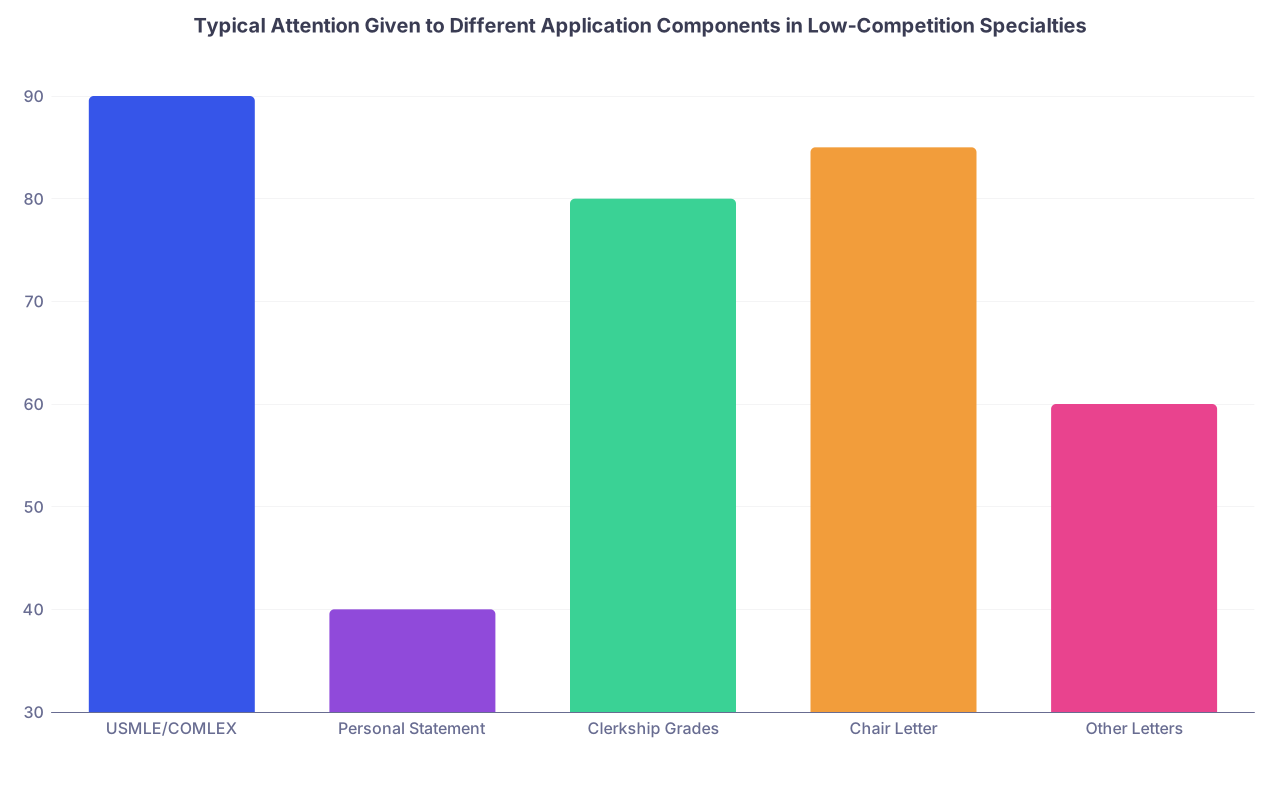
| Category | Value |
|---|---|
| USMLE/COMLEX | 90 |
| Personal Statement | 40 |
| Clerkship Grades | 80 |
| Chair Letter | 85 |
| Other Letters | 60 |
Here’s roughly how deep people go at different phases:
Early application review (screening for interviews):
- Many PDs read only the first and last paragraphs of chair letters.
- They’re scanning for landmines: “concerns,” “with support,” “improvement,” “adequate,” “reliable but quiet.”
- Wildly enthusiastic praise? Good. Generic but positive? Fine. Anything hedged? Dangerous.
Post-interview / rank list creation:
- This is where the chair letter is dissected. Especially if the interview impressions are mixed.
- Faculty will literally quote one sentence from your chair letter in a rank meeting as if it’s gospel. “Her chair says she’s in the top 10% of students over the last 10 years—that’s pretty strong.”
- Or worse: “The chair said he ‘completed his responsibilities reliably’—I’m not hearing ‘top student.’”
If you think no one has time to read them, you’re half right. They don’t read them for everyone. They read them for the people they’re actually considering.
What Chairs Really Say (And What PDs Hear Between the Lines)
Chairs—especially in lower-competition specialties—rarely write, “This student is a problem.” They pick their words carefully. Polite academic throat-clearing hides a lot of content.
Program directors and associate PDs know this code. They speak it fluently.

Here’s an insider translation table you’re not going to see on any official website:
| Chair Phrase | PD Interpretation |
|---|---|
| “Completed all requirements satisfactorily” | Bare minimum. Nothing special. |
| “Reliable, dependable” | Safe, not a star. Possibly quiet. |
| “Improved significantly over the year” | Early concerns. Needed remediation. |
| “Will be a solid resident in the right program” | Might not be solid in *our* program. |
| “I have no reservations recommending” | Not strong; this is baseline. |
| “Top third of our class” | Good, but not top choice material. |
| “Among the top 10% of students I’ve worked with” | Strong endorsement. Moves you up. |
What moves the needle in your favor in low-competition specialties isn’t just praise. It’s specificity plus comparisons.
For example, a psych chair letter that says:
“In my 15 years as chair, I recall very few students who combined her level of clinical maturity, insight into patient dynamics, and reliability. She is among the top 5–10% of students I have supervised.”
That applicant jumps up the rank list. Even if her Step score is modest. Because the chair is telling the room: “You won’t regret taking this one.”
Conversely, something like:
“He fulfilled all of his rotation responsibilities satisfactorily and worked well with his team.”
You just got moved to “backup list.” No one will say why out loud. They’ll talk about “fit” instead.
The Chair Letter’s Special Role in Low-Competition Fields
The less competitive the specialty, the more the PD is juggling these two realities:
- They can fill their program pretty easily.
- They absolutely cannot afford a resident who will implode, neglect duties, or require constant remediation.
So they lean on chair letters as a risk filter.
Think about family medicine at a community program, or peds at a mid-tier academic hospital. They’re not drowning in 270 Step scores. They’re sifting through 220–240 range with reasonably okay narratives. The question isn’t “Who’s brilliant?” It’s “Who won’t make our lives harder?”
That’s why chair letters quietly decide outcomes in these situations:
Unknown schools / lower-tier schools:
If you’re from a less-known or newer school, the chair letter is one of the only “trusted” signals they have. A strong letter from a respected, responsive chair can erase a lot of doubt.Borderline metrics:
Step 2 of 217. Some remediation. A leave of absence. In low-competition specialties, that’s not an automatic death sentence—if the chair letter carries a clear, confident endorsement. If the chair hedges, you’re done.Non-traditional or “off-trajectory” applicants:
Older applicant. Prior career. Maybe a prior degree. PDs will absolutely look to the chair to reassure them: “Yes, we’ve tested this person clinically. They’re not just a good talker.”Programs that get burned once:
Every PD has a story: “We took a risk on someone with a weak chair letter once. Never again.” After that, they treat even mild hedging like a smoke alarm.
How Rank Meetings Actually Use Chair Letters
You think rank meetings are some hyper-objective algorithmic discussion? They’re not. They’re messy, political, and heavily influenced by who speaks up and what they can quote.

| Step | Description |
|---|---|
| Step 1 | Interview Season Ends |
| Step 2 | Initial Rank Draft by PD |
| Step 3 | Faculty Review Applicants |
| Step 4 | Keep Position |
| Step 5 | Reopen File |
| Step 6 | Re-read Chair Letter |
| Step 7 | Move Applicant Up |
| Step 8 | Leave or Slight Move Down |
| Step 9 | Slide Down List |
| Step 10 | Tie or Disagreement? |
| Step 11 | Chair Strong or Weak? |
Here’s what I’ve watched happen over and over in low-competition specialties:
There’s a block of applicants from roughly rank 8 to 20 who all interviewed “fine.” No disasters, no obvious stars. The room gets tired. People mentally check out.
Then someone says, “Wait, what did the chair say about her?” and opens your letter.
If they read something like:
“She consistently took ownership of her patients, anticipated team needs, and demonstrated a maturity beyond her level of training.”
You jump from #14 to #9. No debate.
If your letter is flat, the PD shrugs and keeps you in the middle of the pack. If your letter has even one passive-aggressive sentence, you mysteriously slip to #18 and no one brings you up again.
That’s what “quietly deciding outcomes” actually looks like.
Low-Competition ≠ Low Scrutiny
One of the dumbest assumptions I hear from students is: “I’m going into [FM, peds, psych, PM&R, path, neurology]; they don’t care about chair letters as much.”
Wrong. They care differently.
Competitive surgical subspecialties use chair and PD letters as weapons: “This is my #1; you owe me.” In lower-competition fields, the letter is less about flexing and more about reassurance.
The scrutiny often comes later and in a more surgical way:
- They don’t pour over all 4 pages for every applicant.
- But when they’re on the fence, they dig into the chair letter more deeply than any other part of your file.
And remember: these specialties tend to have smaller, more tight-knit departments. Chairs and PDs often personally know each other. They talk. They remember.
When a PD sees a letter from a chair they’ve known for ten years, three thoughts run through their head:
- “How generous is this person usually?”
- “What does it mean that this chair said that phrase?”
- “If this applicant implodes, will my colleague be surprised? Or will they say, ‘Yeah… I was trying to warn you’?”
That’s the meta-game you’re not seeing.
How the Chair Letter Differs Across “Easier” Specialties
Not all low-competition specialties use chair letters in exactly the same way. Let me draw some lines for you.
| Specialty | Chair Letter Weight | Typical Use Case |
|---|---|---|
| Family Med | Moderate–High | Reliability, community fit |
| Pediatrics | High | Work ethic, empathy, teachability |
| Psychiatry | High | Maturity, professionalism, boundaries |
| Pathology | Moderate | Diligence, attention to detail |
| PM&R | High | Teamwork, motivation, resilience |
| Neurology | Moderate–High | Clinical reasoning, follow-through |
A few patterns from what I’ve seen:
Peds & psych care a lot about interpersonal maturity and reliability. Their chairs tend to include specific anecdotes about how you handle stress, conflict, or challenging patients. Those anecdotes travel.
Family med chair letters are very sensitive to whether you’re actually going to show up and stay. Programs burned by residents leaving or underperforming will scrutinize any hint of flakiness.
PM&R is a small world. Chairs and PDs know each other. If your chair makes a strong comparative statement—“top 5 of my last 100 students”—you’re golden. If they’re vague, everyone hears the silence.
Pathology cares less about the glowing personality narrative and more about conscientiousness and consistency. Language about “attention to detail,” “diligent,” “meticulous” matters more than flowery praise.
Neurology is often in that weird middle ground—more competitive than FM, less insane than neurosurgery. For borderline applicants, a neurologist chair saying, “She demonstrated strong localization skills and independent follow-through” carries real weight.
How Students Quietly Sabotage Their Chair Letters
Here’s the part no one tells you: a lot of mediocre and weak chair letters are earned. Not because the student is bad. Because they treated the chair letter like a formality instead of a relationship.
I’ve seen all of these:
- The student who barely interacted with the department, then asks for a chair letter in October with a two-line email.
- The one with spotty attendance on core rotations, then expects an enthusiastic endorsement.
- The student who never followed up after a strong sub-I, never met with the chair, and somehow thinks the chair magically “knows” them.
You want a chair letter that quietly tips decisions in your favor in a low-competition match? Then you cannot treat the chair like a box to check.
You need to make it easy for them to do three things:
Remember you clearly
Chairs see dozens of students a year. If you’re going into their specialty, you should not be a blurry face. Meet with them. Show up. Ask reasonable questions. Let them see who you are.Tell a concrete story
They need material—patient encounters, times you stepped up, situations you handled with maturity. If you never took initiative or stood out in any way, you’re asking them to write fiction. Most won’t.Rank you meaningfully
They don’t have to put a hard number, but they need some comparative signal. If they can’t truthfully call you top third, they’ll dance around it. PDs will notice.
Do not assume “no news is good news.” With chair letters, “no news” is neutral at best, and neutral sinks you in borderline cases.
What Happens When the Chair Doesn’t Like You (Or Barely Knows You)
There are two quiet disasters in this game: the chair who actively doesn’t like you, and the chair who barely knows you but has to write something.
The chair who doesn’t like you
If you had professionalism issues, inconsistent effort, or you rubbed the department the wrong way, chairs in low-competition specialties are very careful. They won’t usually nuke you outright. They’ll damper you.
The result looks like this:
“He completed his responsibilities and interacted professionally with staff and patients. I believe he will be an adequate resident with appropriate supervision.”
Program directors read that and think: “Okay, that chair is telling me: don’t put your name next to this person.”
The chair who barely knows you
Honestly, this might be worse. That letter will be vague, generic, and unconvincing:
“I had limited direct contact with Ms. X during her time in our department, but faculty members report that she performed well on her rotations.”
That’s a chair saying, “I’m not sticking my neck out.” In a high-competition specialty, maybe your other letters rescue you. In a low-competition specialty, where the chair letter is often the only standardized field, you just lost your edge.
If you’re in this situation, you don’t fix it by begging for stronger words. You fix it months earlier by being present, noticeable, and competent in that department.
A Quiet Reality: Some Chairs Are Known “Inflaters” or “Deflaters”
Here’s another layer you will never see on an official website.
Over time, PDs collect mental data on chairs: who writes over-the-top letters for every warm body, who’s stingy with praise, who only writes for their true favorites.
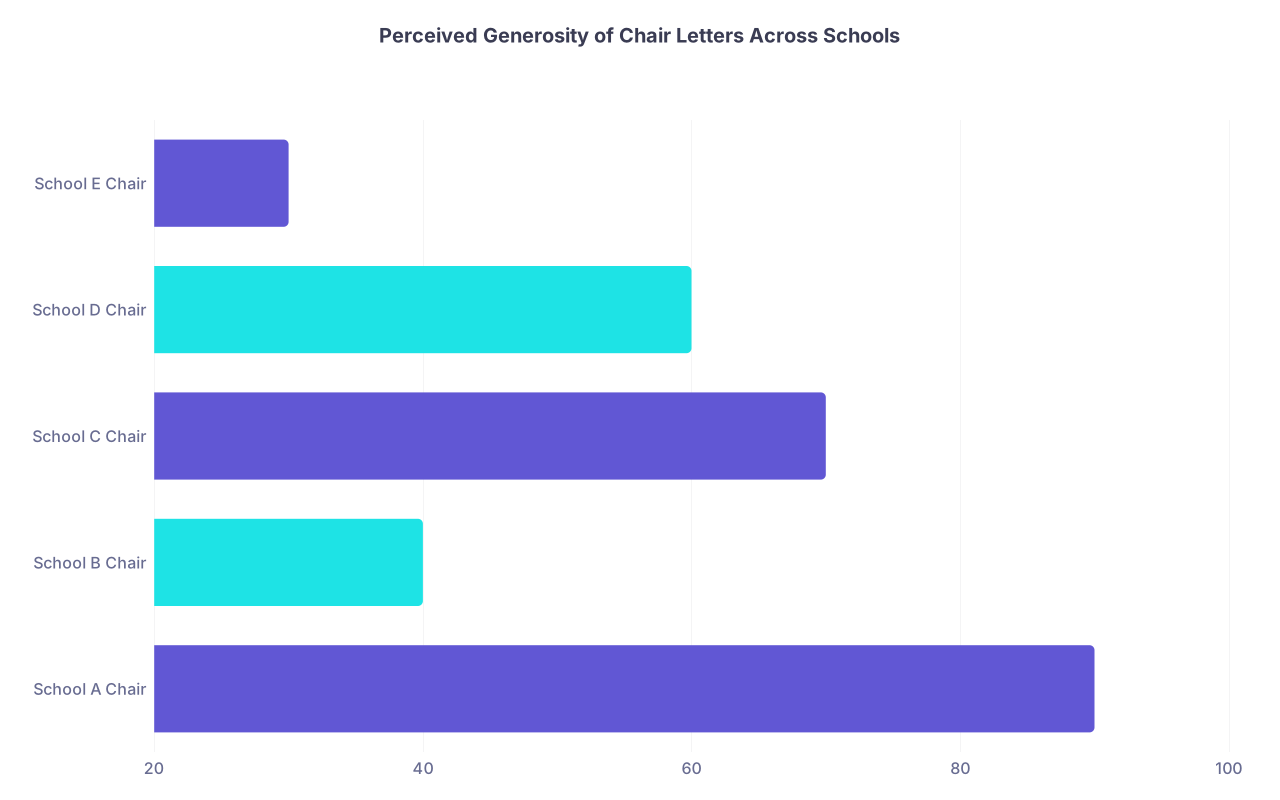
| Category | Value |
|---|---|
| School A Chair | 90 |
| School B Chair | 40 |
| School C Chair | 70 |
| School D Chair | 60 |
| School E Chair | 30 |
A chair known for calling every other student “top 10%” loses credibility. PDs mentally discount those letters. So a “top 10%” from that chair might be treated like “top third” from another.
On the flip side, a notoriously stoic chair who rarely hands out superlatives carries massive weight. If that person says “top 5 students in the last decade,” the room pays attention.
You can’t fully control that. But you should understand why sometimes your friend at another school gets more mileage out of a shorter, less flowery letter: the sender matters.
Your Real Job: Set Up a Chair Letter That Can Carry You
You’re not writing the letter. You’re writing the prequel.
If you’re targeting a lower-competition specialty and you want the chair letter to quietly work for you, you need to intentionally build the conditions for a strong letter long before ERAS opens:
- Do a strong home rotation in that specialty early enough that the chair can hear about you from attendings.
- Ask explicitly: “I’m very interested in [specialty]. Is there anything you recommend I do within the department to be a strong applicant?” Then actually do it.
- Meet with the chair 1–2 times. Not to grovel. To let them see you’re serious, grounded, and not a disaster.
- Give them substance when you request the letter: updated CV, personal statement draft, and a short bullet list of meaningful patient encounters or responsibilities you took on. You’re giving them story material.
- Don’t vanish. People write better about students they see and remember.
Because when that rank meeting happens and they’re stuck between you and three nearly identical applicants, it won’t be your Step score that saves you. It will be that one quiet, specific sentence in your chair letter:
“I would be delighted to have her as a resident in our own program.”
That’s the line that gets quoted. That’s the line that moves you up three spots on a list you’ll never see.
And once you understand that, your whole approach to “easy” matches should shift.
You’ve got your eye on a low-competition specialty. Fine. But if you want to actually land where you’d like to train—not just anywhere with open slots—then your next step is obvious: start building the kind of relationship with your department and your chair that leads to a letter they’re willing to stand behind.
You get that piece right, and suddenly the “easy” match stops feeling so random. The interview trail, the subtle politics of ranking, the game of signaling—those are next. But none of that works for you if your chair letter whispers the wrong story.