
The real reason community programs stay “least competitive” has almost nothing to do with your Step score and everything to do with money, prestige, and lifestyle math that PDs and residents quietly make—but rarely say out loud.
You’ve been told: “Community programs are easier to match because they’re less academic.” That’s the surface-level truth. The real story underneath is much more ruthless and much more predictable. I’ve watched it play out in program director meetings for a decade.
Let me walk you through how this actually works.
What “Least Competitive” Really Means Behind Closed Doors
People throw around “least competitive” like it’s a moral judgment. It’s not. It’s a market label.
When a program stays least competitive year after year, it usually means three things are happening simultaneously:
- Strong applicants don’t rank it high unless they have to.
- The program knows this and quietly adjusts standards to keep their service staffed.
- The specialty’s national brand and the program’s local realities are out of sync.
Program directors don’t sit around thinking, “We want to be a bottom-tier program.” What they actually say—and I’ve heard this verbatim in rank meetings—is something like:
“We just need people who will work, not complain, and get through the year.”
That sentence right there explains why so many community programs sit in that permanent “backup option” slot on applicant rank lists.
The program’s priority is service coverage. Your priority is training, lifestyle, and future options. Those two priorities are often not aligned—and everyone in the room knows it.
The Uncomfortable Math: Service vs. Training
Community hospitals exist to move patients through beds. Residency exists inside that machine, not above it.
At academic centers, the pitch is:
“Come for the brand, the research, the fellowships.”
At many community programs, the unspoken pitch is:
“Come keep this place functioning.”
Here’s the part no one writes in brochures: the less desirable the work-life-reputation combo, the more a program depends on the NRMP safety net to fill its spots. That’s where “least competitive” lives.
Let me give you the actual internal calculus.
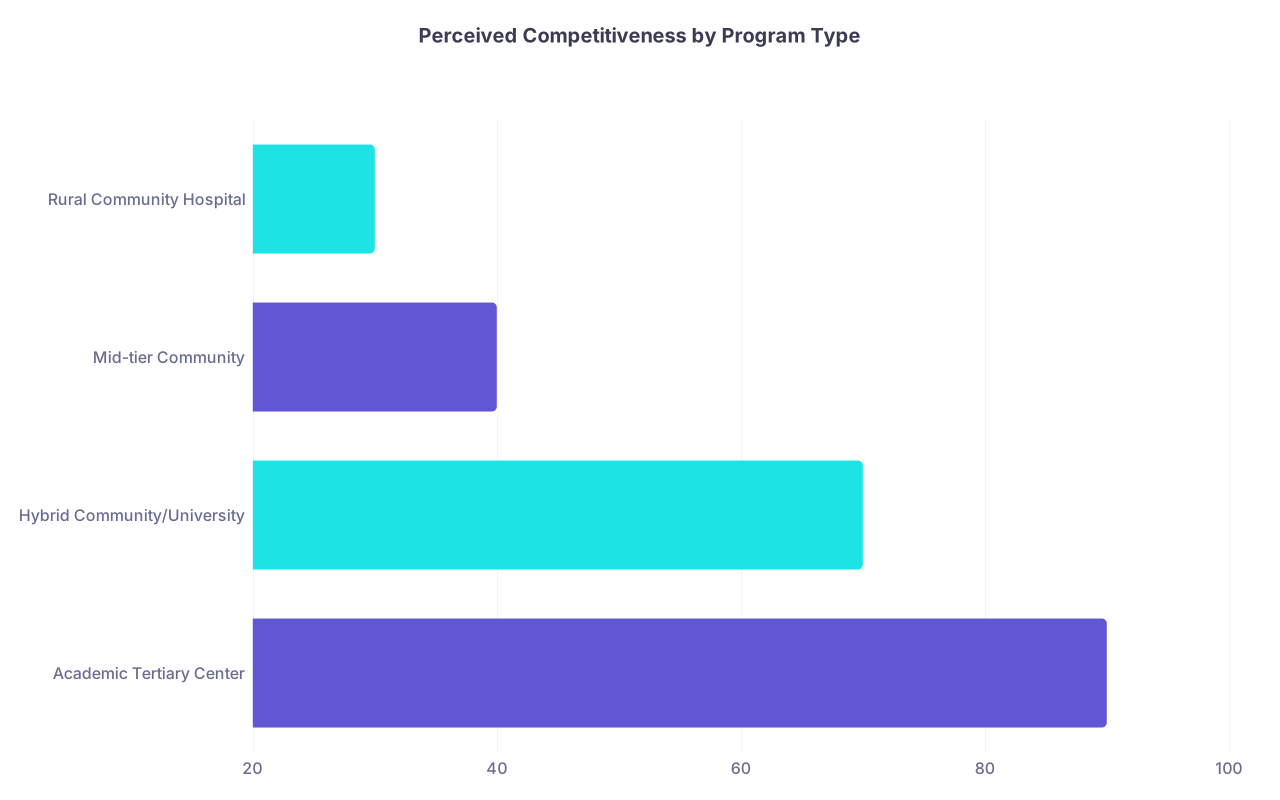
| Category | Value |
|---|---|
| Academic Tertiary Center | 90 |
| Hybrid Community/University | 70 |
| Mid-tier Community | 40 |
| Rural Community Hospital | 30 |
Those numbers aren’t official. But they’re very close to how program leadership thinks about their applicant pool strength when they strategize:
- The academic hospital assumes: “We’ll have more good applicants than spots.”
- The mid-tier community program hopes: “We’ll fill, but we’ll go deeper into the list.”
- The struggling community site fears: “We might end up in SOAP if we aim too high.”
So what happens? Year after year, they don’t aim too high. And that becomes their identity.
The Money Angle Nobody Talks About
You will not see this printed in any program’s marketing materials, but you should understand it:
Residual service work flows downstream to community hospitals. So do tighter margins and weaker negotiating power.
Many community programs are funded on thin financial ice. They:
- Depend heavily on resident labor to staff ED admits, night float, and floor cross-cover.
- Can’t offer competitive stipends or benefits compared to big academic name brands in the same metro area.
- Have less leverage to negotiate lighter resident workloads with hospital administration, because the hospital’s survival depends on squeezing every FTE.
Here’s the vicious cycle:
| Stage | Effect |
|---|---|
| Lower funding | Fewer perks, older infrastructure |
| Fewer perks | Weaker applicant interest |
| Weaker interest | Lower average incoming metrics |
| Lower metrics | Harder to argue for more resources |
I sat in one budget meeting where a community IM program director tried to fight for a second night float resident to reduce brutal 28-hour calls. The hospital CFO literally said:
“If you want another body at night, cut something in the daytime.”
Translation: you’re not adding cost unless something revenue-neutral disappears. That same year, their match list slipped again, and they went into SOAP for two prelim spots. And then the whispers started: “That program’s weak. Easy match.”
You’re seeing the output. Not the structural constraint.
Prestige, Brand, and the Hidden Ranking Game
Here’s the harsh truth: applicants decide what’s “competitive,” not programs. Programs can try to select, but applicants are the ones assigning prestige with their rank lists.
Community programs get stuck at the bottom of that prestige pile for three predictable reasons:
No flashy academic badge
Residents care about logos. “MD Anderson,” “Mass General,” “Mayo” open doors almost by name alone. “County Regional Medical Center” does not, even if the clinical exposure is intense.
PDs know this. I’ve heard, “If we were just linked to [big-name university], our applications would double.”Limited pipeline to dream fellowships
If your goal is heme/onc, GI, cardiology at top-tier places, most students will default to university programs. Fair or not, community programs get stereotyped as “endpoints,” not launching pads.
That’s less true than it used to be, but perception drives behavior. Perception doesn’t update fast.Word-of-mouth rankings among students
Fourth-years talk. In group chats. On rotations. After away rotations. If one upperclassman says, “That program works you like a dog and nobody there is subspecialty matched,” that rumor lingers for cycles.
PDs rarely know the details, but they can read the application volume trend line and GPA/Step distribution just fine.
Lifestyle: What Residents Actually Tell Students Off the Record
You’ve probably had this happen: you ask a current resident, “How’s the program?” and they say, “It’s…good. You work hard.” That pause tells you more than the content.
Here’s what residents in some community programs actually say to students when faculty aren’t listening:
- “We’re solo at night with 80–100 patients cross-cover.”
- “Our attendings are mostly nice, but they’re burned out and not around much.”
- “You’ll be competent, but you’ll be tired all the time.”
- “You’re here to make the hospital run. Teaching is extra.”
Compare that to what you hear at well-resourced university programs:
- “Our nights are busy, but there’s a fellow or nocturnist around.”
- “There’s a structured curriculum; noon conference is protected.”
- “We place a ton of lines and chest tubes, but you have backup.”
Residents communicate these differences in every informal conversation, and that data spreads like wildfire. Over just a few years, programs acquire reputations that stick like glue.
Once a program is labeled in student circles as “workhorse, minimal teaching,” it becomes a self-fulfilling prophecy: stronger candidates rank it lower, the program’s leverage decreases, hospital admin loosens its belt even less, and the pressure on residents ramps higher.
Least competitive, locked in.
Why Some Community Programs Stay Competitive—and Others Sink
Here’s an important nuance: “community” is not synonymous with “weak.” I’ve seen community-based programs that are absolutely cutthroat to get into, and others 30 minutes away that go half-filled into SOAP.
The difference is almost never just case volume. It’s how the program is positioned.
The community programs that stay relatively competitive over time usually nail three things:
Clear identity
They tell applicants, honestly:
“We are a high-volume clinical program with great procedural exposure, strong board pass rates, and a history of placing people into solid fellowships. We are not a research powerhouse.”
Strong applicants who actually want to be clinicians eat that up.Protected culture
They fight admin hard to keep teaching time, consult backup, and humane call schedules. When residents feel like learners instead of cheap labor, they sell the program for you on interview day.Consistent outcomes
Not miracles. Just consistency. Cards at solid university sites. Hospitalist jobs with good salaries. A few niche fellowships. Word gets around: “If you work, you’ll be fine coming from there.”
Contrast that with the truly struggling community programs, where the unspoken message is:
“This place barely stays afloat and residents graduate by sheer force of will.”
Applicants can feel the difference in a half-day interview.
The PD Reality: Why They Lower the Bar and Keep Going
I’m going to say something blunt: most community PDs are not idiots, and they’re not indifferent to quality. They’re trapped by constraints you don’t see.
When you look at a program that routinely takes low Step 2 scores, multiple exam failures, or many IMGs with weaker applications, here’s what’s usually happening from their side:
- They’ve been burned in the past by aiming higher and ending up in SOAP for 3–5 spots. That nearly killed their credibility with hospital leadership.
- Administration has made it clear: “You may not leave positions unfilled.” Open positions mean uncovered call. That’s non-negotiable.
- The program is one adverse ACGME citation away from being “under review,” so they’re constantly balancing service, education, and survival.
So in the rank meeting, the conversation shifts from, “Who’s the best fit?” to:
“Will this person show up, get along, and not fail out?”
At that point, “least competitive” becomes policy, not accident. Year after year.
Why These Programs Stay Least Competitive for Years, Not Just a Cycle
Programs don’t move up and down the competitiveness ladder as fast as Reddit makes it sound. A few interview-day cancellations don’t suddenly drop you from “mid” to “bottom.”
Lasting change—better or worse—takes repeated cycles.
Here’s the long game that keeps certain community programs cemented at the bottom:
Reputation lag
Even if leadership improves call schedules or adds structured didactics, the old class of seniors is still out there telling stories from the bad era. It takes 3–5 graduating classes for word-of-mouth to fully reset.Leadership turnover
Community PDs burn out. A good PD who is slowly lifting a program’s reputation gets replaced, often by someone with fewer connections or less political capital. Momentum dies.Inflexible hospital administration
Academic centers live and die by “recruiting the best.” Community hospitals live and die by “keeping the beds full.” That tension doesn’t go away. Most C-suites will not spend serious money just to raise NRMP appeal.Applicant herd behavior
Once a place is known among students as “safety only,” it stays there long after circumstances change. Applicants treat it like an insurance policy, then act shocked when it fills anyway and their “true safety” was not so safe.

| Step | Description |
|---|---|
| Step 1 | Heavy Service Burden |
| Step 2 | Resident Burnout |
| Step 3 | Negative Word of Mouth |
| Step 4 | Weaker Applicant Pool |
| Step 5 | Lower Program Leverage |
| Step 6 | No Resources for Change |
That loop is why some names have been “bottom of the list” for a decade in student gossip, even though their ACGME status is perfectly fine.
What This Means If You’re Applying
You’re not reading this as a sociological exercise. You want to know what to do with this intel.
Here’s the uncomfortable advice no one gives you directly:
Stop confusing “least competitive” with “worthless.”
Some community programs will train you brutally well, and you’ll come out competent, employable, and ready for hospitalist or primary care careers immediately. They never get Instagram love because they’re not sexy. Doesn’t matter.But don’t romanticize “you’ll see a lot of pathology” as a cover for dysfunction.
Every bad program markets exactly that line. You need to ask: “Who’s supervising? What’s the culture? Where do grads go?”If you’re aiming high (fellowships, academics), judge community programs by outcomes, not vibes.
Ask for a list of fellowship matches from the past 3–5 years. Not a cherry-picked slide. The whole list. If they dodge the question, they’re telling you something.Use the “resident off-the-record” test.
One specific question: “If you could redo the Match with what you know now, would you still come here?”
Then shut up and watch their face before they answer.Understand your leverage.
If your application is borderline and you need a match this year, a “least competitive” community program might be your lifeline. That doesn’t make you a failure. It just means your next move is to make the most of it and be strategic for your first job or fellowship.
Hard Truths for Different Applicant Types
Let’s be even more direct.
US MD with solid Step 2 and no red flags:
You will likely only land at chronically least competitive community programs if your interview performance is poor, your application list is too narrow, or you severely misjudge geography. If you end up there, it’s partly by your own rank choices.US DO or US IMG with mid-range stats:
These are often your main path into certain specialties. Many DOs and IMGs build outstanding careers from community bases. But you should be laser-focused on picking the best of the community tier, not just anyone who shows interest.Non-US IMG with multiple attempts or gaps:
For you, the “least competitive” programs may be the only ones realistically reviewing. Your strategy becomes: minimize toxicity, maximize training value, and think long-term: where can this get me five years from now?
Here’s how PDs casually sort their applicant piles when they’re tired and behind schedule:
| Tier | How PDs Often View It |
|---|---|
| A | Strong US grads, clean record |
| B | Solid DO/IMG, minor weaknesses |
| C | Multiple red flags, attempts, or big gaps |
Least competitive community programs often end up pulling heavily from Tier B and C. Not because they “don’t care,” but because everyone above them on the food chain sucked up most of Tier A and B already.
How to Read Between the Lines on Interview Day
You cannot trust websites. You can only halfway trust interview-day presentations. The only reliable way to read a community program is to decode what they avoid saying:
- If they never show resident workrooms, nights, or ED admits: service is probably rough.
- If all their resident testimonials are recorded, scripted, and watched by faculty: you’re not hearing the real story.
- If they emphasize “we are like a family” but dodge questions about schedules and backup, assume chronic understaffing.
Ask these three questions and listen very carefully:
“What has changed here in the last 3–5 years based on resident feedback?”
If the answer is “we added wellness events,” run.“What are the top 3 things residents complain about?”
Good programs answer this directly. Bad programs say, “Oh, nothing specific, just the usual stress of residency.”“Who usually responds when you’re overwhelmed on nights?”
The difference between “always someone” and “you figure it out” is the difference between survivable and miserable.
FAQs
1. Are least competitive community programs automatically bad training?
No. Some are bad, some are excellent clinically but unattractive on paper (location, pay, schedule), and some are just invisible in the prestige game. “Least competitive” often reflects that higher-tier applicants simply don’t rank them, not that the training is garbage. The key is whether grads pass boards, feel supported, and land the jobs or fellowships they want. Look there, not just at social media noise.
2. Can I still get a competitive fellowship from a community program?
Yes, but you’ll work harder for it and need a focused strategy. That means high in-training scores, strong letters from respected faculty (who actually know people), research or QI projects that you finish, and early networking with fellowship directors. From some long-standing community programs with a history of producing specialists, it’s very doable. From chronically weak, high-burnout programs with no fellowship track record, it’s significantly harder.
3. How do I know if a community program is “good but just less competitive” vs genuinely toxic?
Watch outcomes and behavior, not branding. A “good but less competitive” program will have: stable leadership, honest answers about workload, clear schedules, and a consistent board pass and job/fellowship record. Residents there will look tired but not broken, and they’ll say, “Yeah, I’d come here again.” Toxic programs will avoid specifics, minimize serious concerns, have lots of PGY-2/3 attrition stories, and give you that tight, brittle energy when you ask about nights, backup, or grievance processes. Trust that read.
If you remember nothing else: community programs stay least competitive for years because the system needs someone at the bottom of the prestige food chain to keep the lights on. Your job isn’t to judge that—it’s to decide whether you can get what you need out of one of them without burning yourself to ash.