
It’s 11:47 p.m. Your friends are in the group chat talking about Derm, Ortho, ENT, maybe Cards down the line. Somebody just dropped their 255 Step 2 score and their 8 pubs like it’s no big deal. You’re staring at your own stats, scrolling through Reddit threads about “least competitive specialties,” and this awful thought hits you in the gut:
“I think I’m only competitive for the low-competition specialties. Am I basically admitting I’m ‘less than’ if I go for one of those? Am I locking myself into something because I’m not good enough?”
And then it spirals:
What if I hate it?
What if I never get the respect that the “prestige” specialties get?
What if people assume I just couldn’t cut it?
Let’s walk through this without sugarcoating it, but also without the panic-brain distortions.
First: Are These Specialties Actually “Low-Competition” Or Is That Just Reddit?
Half the anxiety here is that phrase: “low-competition specialties.” It sounds like code for “where the weaker applicants end up.” That’s the fear, right?
Reality is messier.
| Specialty | Online Reputation | Actual Competitiveness* |
|---|---|---|
| Dermatology | Insane | Very High |
| Orthopedics | Insane | Very High |
| Internal Med | Chill | Ranges by program a lot |
| Family Med | Low | Lower, but not a free pass |
| Psych | Used to be low | Now moderate-high |
| Pathology | Quiet | Lower, but niche |
*“Competitiveness” = combo of scores, research, applicant volume, and program selectivity, not “intelligence ranking.”
People throw around “least competitive specialties” like it’s a stable category. It’s not. Psych was considered a fallback 10–15 years ago. Now it’s solidly competitive in many regions. Same trajectory with EM before it got over-saturated and then weird after COVID.
So when you say, “I only feel competitive for low-competition specialties,” what you probably mean is:
- My scores / grades / research aren’t screaming “Derm/Ortho/Neurosurg.”
- I’m looking at specialties where average matched stats are closer to mine.
- I’m afraid that means I’m “less capable.”
That last one is not data. That’s shame talking.
The Hard Part: Admitting You’re Not Competitive For Everything
Let’s not pretend: it stings to look at your Step score, your class rank, your evals, and quietly admit:
“Yeah… I’m probably not matching Neurosurgery at UCSF.”
That grief is real. You’re mourning the version of you that matched something shiny and ultra-selective. The version you could brag about at reunions.
Here’s the brutal truth I’ve seen over and over:
The people who get hurt the most in this process aren’t usually the “weak” applicants. It’s the ones who refuse to accept their risk profile.
I’ve watched people:
- Apply almost only to ultra-competitive fields with marginal stats
- Refuse hybrid plans (like IM + gas backup)
- End up SOAPing into something they never considered or going unmatched completely
Not because they weren’t smart enough for medicine. Because they built an application strategy around fantasy, not probability.
You even thinking about “least competitive specialties” already puts you ahead of a lot of denial-driven disasters.
What “Low-Competition” Actually Buys You (And What It Doesn’t)
Let me be honest: there are specialties where, statistically, it’s easier to match with mid-range or even lower-range numbers. That’s just true.
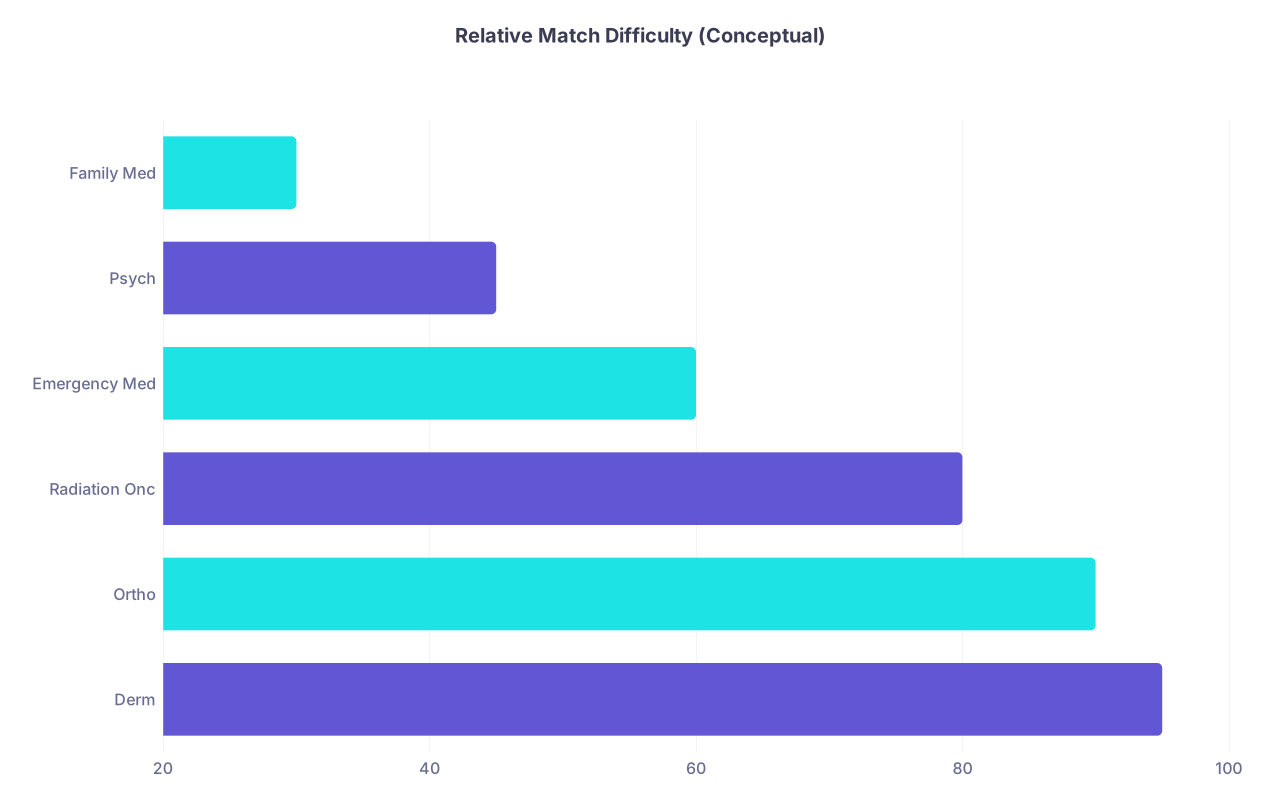
| Category | Value |
|---|---|
| Derm | 95 |
| Ortho | 90 |
| Radiation Onc | 80 |
| Emergency Med | 60 |
| Psych | 45 |
| Family Med | 30 |
(Think of those numbers as “difficulty level” not exact data.)
So what do you actually get if you lean into a lower-competition specialty?
You do NOT get:
- A guaranteed match
- Protection from malignant programs
- A “less stressful” life by default
You DO get:
- A much wider band of acceptable scores and experiences
- More programs that are realistically in play
- More flexibility in location, sometimes
But the real tradeoff is different: in those specialties, things like personality, fit, communication skills, professionalism, and steady work ethic matter more than some arbitrary Step cutoff. People actually care whether you’re normal to work with for 3+ years. Wild concept.
So if your fear is:
“I’m only competitive for low-competition specialties, therefore I must be a worse doctor,”
that’s just false. These fields still screen out people who can’t function. They just don’t fetishize a 260.
The Shame Piece: “Everyone Will Think I Settled”
This is the part that actually keeps people up at night.
You’re imagining:
- Being at graduation when someone says, “Oh, I matched Derm at Mayo, what about you?” and you mumble, “…Family Med in [insert not-glamorous city].”
- Your extended family, who only understands “surgeon = top doctor,” giving you that slightly disappointed look.
- Your classmates silently ranking who “won” Match Day.
Let me be clear: some people will absolutely judge specialties by perceived prestige. Some attendings will, too. I won’t pretend otherwise.
But here are three counterpoints I’ve watched play out repeatedly:
- The loud prestige-obsessed people are a tiny, vocal minority. Most physicians care more about “Are you competent?” than “Are you in a sexy field?”
- The classmates who secretly pity you now will be texting you in 5 years asking how to get out of their malignant fellowship or how you seem less burned out.
- Patients don’t give a damn about relative specialty competitiveness. They care about “Do you listen?” and “Do I feel safe with you?”
The weirdest part? A lot of the so-called “low-competition” specialties give you:
- More longitudinal relationships
- More control over your schedule (not automatically, but more options)
- More room to shape your career over time (outpatient, inpatient, admin, teaching, niche clinics)
You might not get “Wow, that’s so competitive!” at dinner parties. You might get, “Oh god, I’ve been meaning to find a good [FM/Psych/etc]—can I ask you something?”
Prestige fades so fast in the real world it’s almost funny.
How To Tell If You’re Actually A Good Fit vs Just “Settling”
This is where your brain whispers, “What if I only want this because it’s easier? What if I’m making a huge mistake because I’m scared to stretch?”
Let’s separate defensive choosing from realistic choosing.
Signs you’re only picking it for safety:
- You never enjoyed the rotation, you were just less miserable than on surgery.
- You can’t name a single clinical scenario in that field that made you feel “I want to do more of this.”
- When you imagine doing the day-to-day work for 20 years, your whole body says “absolutely not.”
- You’re obsessed with the hours or prestige inversion narratives, not the actual patient care.
Signs you might actually be a hidden good fit:
- You consistently liked talking to those patients more, even if the rotation felt “slow.”
- You secretly liked the continuity and follow-up while your classmates were bored.
- You felt more like yourself around residents/attendings in that field.
- You can imagine a version of yourself building a niche in it (sports FM, addiction psych, women’s health, procedural FM, etc.).
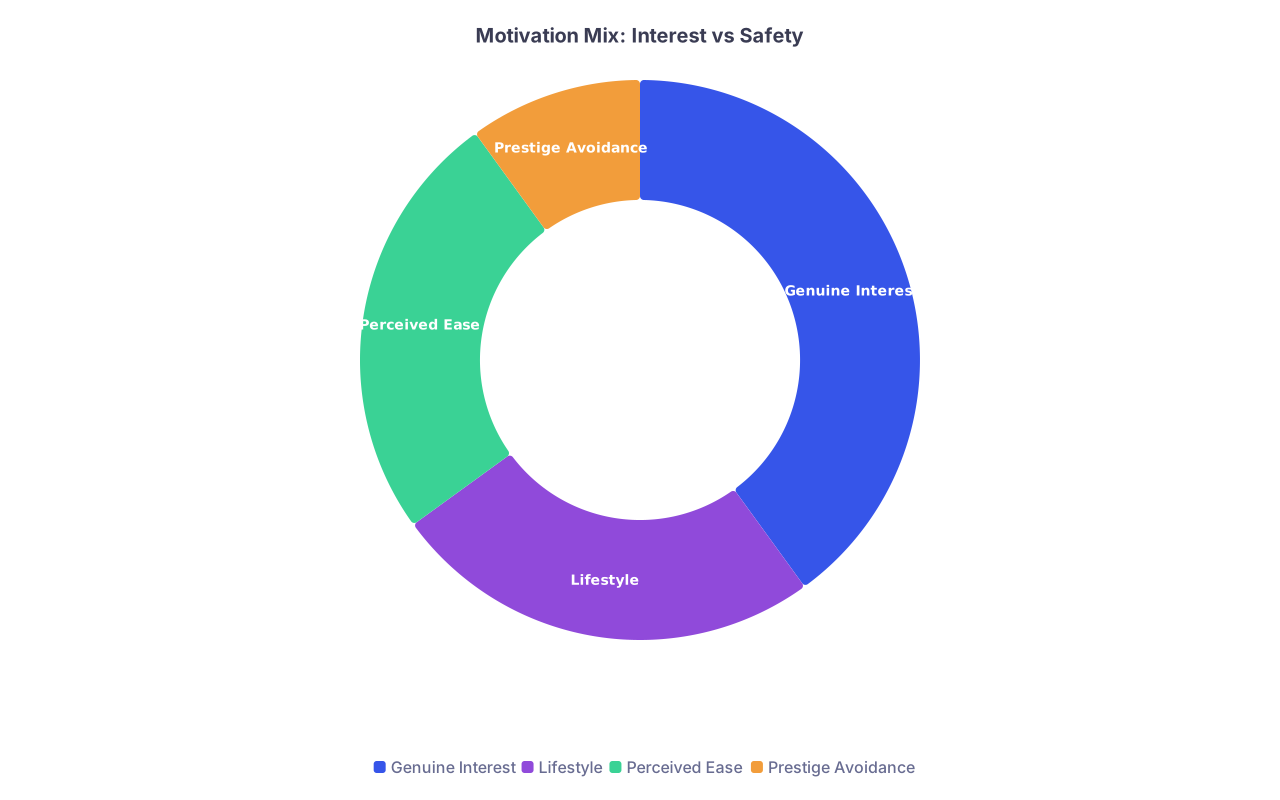
| Category | Value |
|---|---|
| Genuine Interest | 40 |
| Lifestyle | 25 |
| Perceived Ease | 25 |
| Prestige Avoidance | 10 |
You’re allowed to have “safety” and “interest” both in the mix. Nobody picks a specialty in a vacuum. The people yelling “pure passion only” are conveniently ignoring their own Anchoring in lifestyle or salary.
You just don’t want to anchor solely on fear.
Concrete Steps If You Feel “Only” Competitive For Lower-Competition Fields
Here’s what you actually do, instead of doomscrolling NRMP charts at 1 a.m.
1. Get a reality check from someone who’s not invested in your ego
Not your parents. Not your class group chat. Someone who:
- Knows match outcomes from your school (like a dean, advisor, or PD)
- Can say, “Yeah, your app is risky for X, but reasonable for Y and pretty solid for Z.”
Ask them directly:
- “If I applied to [specialty A] only, what’s my risk of not matching?”
- “If I added [less competitive specialty B] as backup, how would that change things?”
- “Based on recent grads like me, what did they successfully match into?”
You want numbers and patterns, not vibes.
2. Actually look at the day-to-day work, not just the competitiveness
You owe yourself at least:
- A full rotation in that field if possible
- Shadowing in different practice settings (academic vs community vs outpatient)
- 2–3 honest conversations with residents/fellows about what sucks in that field
If you’re considering FM, for example:
- Sit in on chronic disease management days, not just sports clinic or procedures.
- Watch how they handle 15 min visits with 6 issues.
- Listen to how they talk about burnout and long-term sustainability.
Same for psych:
- Don’t just romanticize therapy and diagnosing; watch discharge planning, med management, chronic borderline patients, substance use relapses.
3. Build a respectable application, not a “fallback” application
If you’re going to do this, don’t half-commit. Programs can smell “I’m only here because I couldn’t get something better” from a mile away.
You want:
- A couple of strong letters from people in the field
- Some signal that you did more than stumble into it (small QI, case report, student interest group involvement, whatever)
- A personal statement that doesn’t read as: “Well, I didn’t get the score for ortho so… here we are.”
You don’t have to pretend it’s your childhood dream. But you do have to show you’ve thought about what the work actually is and why it fits you.
Worst-Case Scenarios (Because You’re Already Thinking Them)
Let’s walk through the nightmares.
Nightmare 1: “I pick a low-competition specialty and hate it forever.”
This is the big one. “What if I trap myself.”
Reality:
Changing specialties is not easy, but it’s not mythical either. People do prelim years and re-apply. People switch after a year or two when they realize the fit is awful.
Is it painless? No.
Is it career-ending? Also no.
The more likely version is:
You don’t hate it. You have days you hate (like literally everyone in every specialty). But it’s livable. You might pivot within the field—outpatient vs inpatient, academic vs private, different patient populations.
Medicine is a long, messy path. You’re not signing blood oath papers right now.
Nightmare 2: “People will think I wasn’t good enough.”
Some will. That’s baked in.
But ask yourself:
Are you living your entire 30-year career to impress the 24 people in your med school class who still worship Step scores?
The attendings you actually respect? They know the game. They’ve seen rockstar doctors in every specialty and weak ones in every specialty. They’ve watched people burn out in plastics and thrive in FM, and vice versa.
The people whose opinions actually matter will judge you on:
- How you take care of patients
- How you treat staff
- Whether you’re safe and reliable
And that’s it.
Nightmare 3: “I still don’t match, even in a ‘less competitive’ field. Then what?”
It can happen. Especially if:
- You apply too narrowly (few programs, super geographic restriction)
- Your application has big red flags (fails, professionalism issues, big gaps)
- You treat it as a fallback and don’t put in effort
Worst case if you don’t match:
- You SOAP into a prelim or another specialty
- You take a research/clinical gap year and re-apply smarter
- You reassess your goals with more data
I’ve seen people go FM after failing to match EM, and end up genuinely happier. I’ve seen people SOAP into prelim IM, kill it, then match into their desired field or something better suited.
It feels like the end when you’re in it. It really, really isn’t.
Quick Reality Check On Some “Low-Competition” Myths

Myth: “Low-competition specialties are for people who couldn’t cut it.”
Reality: They’re for people whose stats, interests, and life goals align with those specialties. Yes, some people fall into them. Lots of others choose them intentionally and never look back.
Myth: “You won’t make good money.”
Reality: Depends how you structure your life. An FM doc in a smart practice setup can out-earn an academic subspecialist easily. Psych, anesthesia, rads, GI, etc. all blow that myth up instantly.
Myth: “You’ll be bored.”
Reality: Not if you actually engage with the work. Managing 10 comorbidities, complicated psych patients, or complex diagnostic puzzles isn’t boring. It’s just not always glamorous on Instagram.
One More Thing Nobody Says Out Loud
If you constantly feel “only competitive for the low-competition specialties,” be careful not to internalize that as your identity:
“I am the mediocre one. I am the backup-plan person. I am lesser.”
Because then what happens is:
- You show up to interviews like you’re apologizing for existing.
- You downplay your strengths so much that programs start to believe you.
- You avoid taking risks or leadership roles because you assume someone “better” should do them.
You’re in medical school or beyond. That alone took years of work and a level of ability most people never touch. You are not a charity case for any specialty.
You’re a slightly dinged-up, imperfect, real human trying to build a workable, meaningful career. Same as everyone else in this mess.

| Step | Description |
|---|---|
| Step 1 | Self assessment |
| Step 2 | Consider competitive fields plus backup |
| Step 3 | Focus on moderate or lower competition |
| Step 4 | Re explore other fields |
| Step 5 | Commit and build strong app |
| Step 6 | Apply broadly and realistically |
| Step 7 | Stats match high competition? |
| Step 8 | Do you like the work? |

FAQ (Exactly 5 Questions)
1. If I choose a lower-competition specialty, am I closing doors forever?
Not forever, but some doors get harder to reopen. It’s way easier to subspecialize within a field (e.g., sports FM, addiction psych) than to switch from, say, FM to neurosurgery. But intra-field flexibility is huge. And people do switch specialties sometimes, especially in the first 1–2 years. It takes work, but it’s not impossible.
2. Should I apply to a competitive specialty I love and a lower-competition backup?
If you genuinely love the competitive one and have some shot, yes—hybrid strategies can be smart. But you have to commit to the backup too: get letters, do rotations, and not treat it like a consolation prize. Be prepared emotionally for both outcomes. And get an honest advisor read on how risky your “reach” field really is.
3. Will programs in lower-competition specialties look down on me if my scores are high?
No. They’ll just want to know you’re serious and not using them as a parachute. High scores don’t hurt you; flaky vibes do. If your narrative and experiences show you actually care about their field, they’ll love having a strong candidate. Just don’t go in acting like you’re slumming it.
4. What if I like a low-competition specialty but feel guilty I’m not “aiming higher”?
You’re not obligated to suffer in a prestige specialty just to prove something. “Aiming higher” should mean aiming for a life and career that fit you, not a line on a list. Guilt usually comes from comparing yourself to imaginary expectations—parents, classmates, some made-up “ideal doctor.” That’s not a good compass for a 30-year career.
5. How do I stop obsessively comparing my specialty choice to my classmates’ choices?
You probably won’t stop completely, but you can blunt the damage. Mute the group chats during match talk. Stop reading “ranked by competitiveness” threads like they’re moral hierarchies. Spend time with residents and attendings who actually like their lives, not just their CVs. The more you see how different people build good careers in “uncool” fields, the less power those comparisons have.
Key points:
- Feeling “only competitive for low-competition specialties” does not mean you’re a worse doctor; it means you’re being realistic about match odds.
- Lower-competition fields can still offer complex, meaningful, and flexible careers—if you choose them intentionally, not just out of panic.
- Your job now is to get honest data on your chances, seriously explore the day-to-day work, and build a real application for the field you’re actually willing to live in—not the one that looks coolest on paper.