
It’s Sunday night. You’re at the kitchen table, still in your wrinkled scrubs from your last call, and someone — your dad, your aunt, your cousin who once shadowed an orthodontist for two days — casually asks, “So… what are you going into? Surgery? Cards? Derm?”
You take a breath and say the words that feel like you’re confessing a crime:
“I’m actually thinking… family med / psych / peds / PM&R / pathology / anesthesia / something not top‑of‑the‑US‑News-macho-list.”
And immediately, you see it.
That half-second face flicker. The micro-judgment. The “oh.”
Now your brain is screaming:
Did they just decide I wasn’t smart enough?
Did I disappoint everyone?
Did I just admit I’m “settling”?
Is my entire career now branded as “couldn’t hack it”?
Let’s go straight into the thing you’re probably too embarrassed to say out loud.
The Fear Underneath It: “They’ll Think I’m Not Good Enough”
You’re not actually scared of the specialty. You’re scared of the story people will invent about you.
“Less competitive” specialties come with all the baggage:
“Oh, that’s for people who couldn’t match something harder.”
“Isn’t that like… easy?”
“Why would you waste your scores on that?”
You’re imagining your relatives comparing you to your med school friends:
- “She got ortho.”
- “He’s doing radiology at a big-name place.”
- “And you’re doing… that?”
Your mind goes worst-case:
- I’ll forever be “the cousin who could’ve done something big but didn’t.”
- My parents will lie to their friends about what I do.
- My attendings will think I “aimed low.”
- My partner will secretly be disappointed.
Here’s the messed-up part: you might even have attendings who say the quiet part out loud.
I’ve heard versions of:
- “With your scores, why would you waste them?”
- “You’re too smart for that specialty.”
- “You’ll be bored.”
So you start internalizing it.
If I don’t pick something “hard,” maybe I’m admitting I’m not “enough.”
Let me be blunt: this whole idea is garbage. But I get why it has its claws in you.
How “Competitiveness” Got So Twisted In Your Head
You’ve been marinating in a weird medical culture stew for years. It goes like this:
- Step/COMLEX scores = human value.
- Match rate = worth.
- Procedural = impressive. Cognitive + relational = “soft.”
- Fellowship-heavy specialties = “elite.” Lifestyle or primary care = “settling.”
Nobody says it exactly like that on the record. But in call rooms, in group chats, in the way people react to “I’m going into derm” versus “I’m going into peds,” it’s obvious.
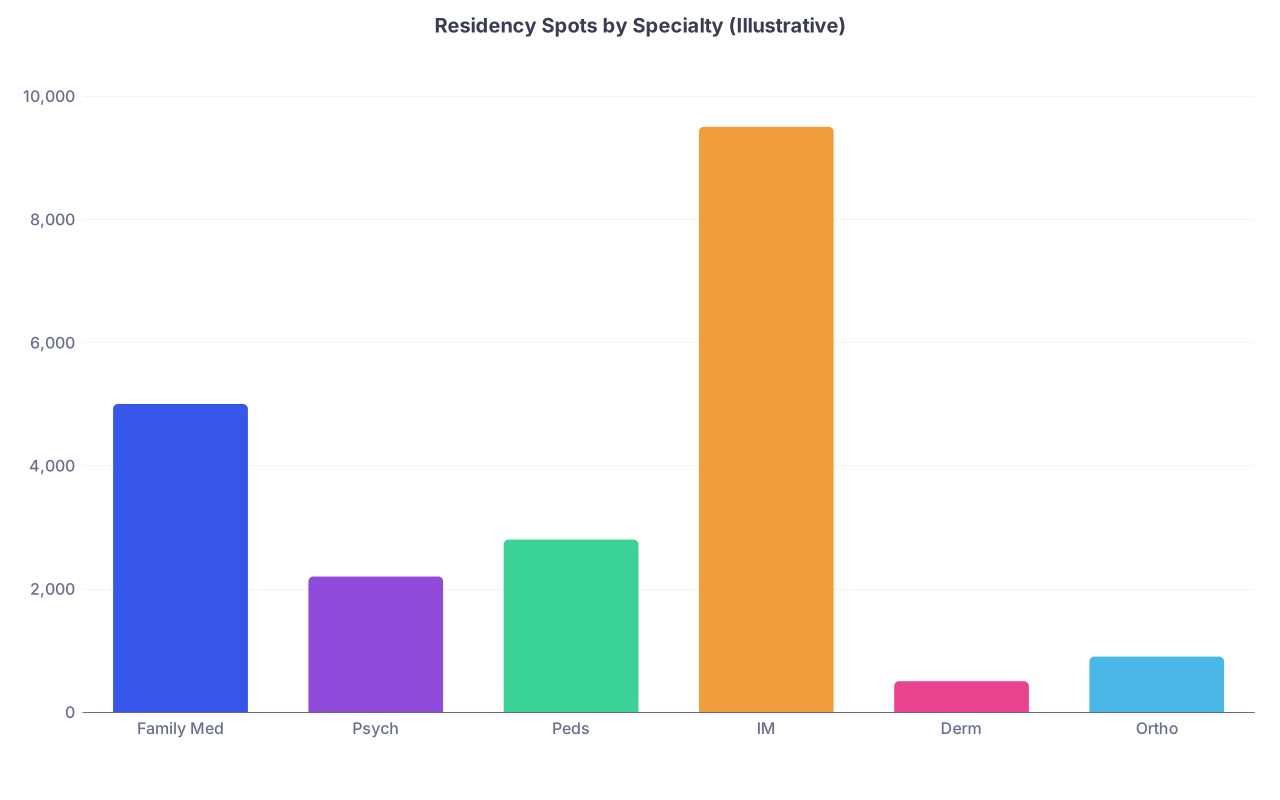
Here’s the annoying truth: “competitive” is mostly about supply and demand, not “hardness” or intelligence.
| Category | Value |
|---|---|
| Family Med | 5000 |
| Psych | 2200 |
| Peds | 2800 |
| IM | 9500 |
| Derm | 500 |
| Ortho | 900 |
Derm isn’t more “noble” than family med. Ortho isn’t harder than psych because it’s harder to match. There are just:
- fewer derm spots
- more people chasing them
- a culture that glorifies prestige and procedure-heavy fields
Your aunt Karen at Thanksgiving doesn’t know any of this. She just hears “dermatology = fancy” and “family medicine = my old doctor in a strip mall clinic.”
So yeah, of course you’re bracing for judgment. The whole system trained you to.
But let’s talk about your actual life. Your actual day-to-day existence for the next 30–40 years. Because that’s what you’re trading for a moment of external validation.
What “Less Competitive” Really Looks Like in Real Life
Pull back from the labels for a second. Forget what your uncle’s golf friend thinks.
Here’s what actually matters:
- Do you like the patients you’ll see all the time?
- Can you tolerate the worst days of that specialty?
- Will you physically survive the hours and lifestyle?
- Does the work align with how your brain works? Hands-on? Cognitive? Long-term continuity?
“Less competitive” specialties often win in the only category that matters: your long-term sanity.
Think about this:
- Family med: You’ll know families for years. You’ll catch cancers early. You’ll manage everything from depression to diabetes. Your job security is insane, especially in underserved areas. You can shape your practice to your life.
- Psych: You’ll change the trajectory of someone’s entire life. You’ll treat things that literally kill people (suicide, addiction), but nobody glamorizes it. And yes, the lifestyle can be objectively better than a lot of fields.
- Peds: You’ll be the doctor families trust with their kids, which is… huge. Less prestige at parties, maybe. Much more direct impact.
- PM&R: You’ll help people regain function after strokes, spinal cord injuries, trauma. Highly specialized, highly needed. Most non-medical people don’t even know what it is, so they can’t judge it accurately.
- Pathology: You will literally be the one who decides the diagnosis behind the scenes. No path, no answer. No answer, no treatment. Good luck explaining that to your cousin, but who cares — the surgeons sure as hell respect you.
- Anesthesia: Half the OR show literally doesn’t happen without you. If you disappear, everyone panics. But no, your uncle will still say, “So you just put people to sleep?”
You know what doesn’t show up in flashy “competitiveness” graphs? Divorce rates. Burnout. Regret. The “I picked it for prestige and now I hate every day” stories.
I’ve seen residents in hyper-competitive surgical subspecialties who are absolutely miserable but too proud — or too scared — to admit they chose wrong. That’s a much darker outcome than having your aunt mildly judge you over pumpkin pie.
How to Handle Actual Family Judgment (Because Yeah, It Might Happen)
Let’s assume the worst. Let’s assume your family does react exactly how you’re afraid they will.
You say: “I’m leaning toward family medicine.”
They say: “Oh. Couldn’t you do something more… advanced?” or “But you did so well, why not something bigger?”
Here’s the quiet part: their reaction says nothing about your intelligence and everything about:
- their ignorance of how medicine actually works
- their obsession with prestige
- their own unfulfilled stuff (yes, projecting hard)
You need a strategy for that moment. Not just to “educate them,” but to protect your own mental space.
You can pick one of three modes:
The Calm Educator
“Actually, family med is incredibly broad. I’ll manage everything from chronic diseases to mental health, and I’ll be people’s first contact with the healthcare system. There’s a huge need, and I’ll have a ton of flexibility in where and how I practice.”The Boundary Enforcer
“I’ve spent years in this system. I chose this intentionally. I’m not interested in comparing specialties like trophies.”The Short-and-Done
“I picked what fits me and my life. I’m happy with it.”
Then change the subject: “How’s work been for you?”
You don’t owe anyone a PowerPoint on residency competitiveness. You especially don’t owe that to relatives who think “cardiologist” and “cardiac surgeon” are the same thing.
The Medical Culture Problem: Even Other Doctors Might Judge You
Sometimes it’s worse when the judgment comes from inside medicine.
The surgeon who says, “Must be nice to work 9–5.”
The subspecialist who asks, “Why didn’t you at least do IM first and then specialize?”
The classmate who says, “I’m only picking high-tier stuff; I didn’t spend all this time to do primary care.”
You’ll hear this nonsense. Guaranteed.
Here’s the irony they won’t admit: a ton of “higher-prestige” specialties literally depend on the so-called “less competitive” ones.
No primary care → nobody catching early disease.
No psych → missed diagnoses for years that finally explode in crisis.
No anesthesia → no surgeries.
No pathology → no diagnosis, no oncology plan, no targeted therapy.
No PM&R → patients rot in beds post-stroke with no meaningful recovery.
The hierarchy is fake. The interdependence is real.
| Specialty | Common Stereotype | Reality of Work Impact |
|---|---|---|
| Family Med | "Just colds and checkups" | Manages complex chronic disease, coordinates care |
| Psych | "Talks all day" | Treats life-threatening mental illness, addiction |
| Peds | "Cute babies all day" | High-acuity care, child advocacy, complex conditions |
| PM&R | "Glorified PT" | Manages neuro, spine, pain, function recovery |
| Pathology | "Never sees patients" | Central to every cancer and major diagnosis |
The people who truly understand a specialty’s value usually… already work closely with it. Everyone else is just guessing based on random stereotypes.
What If You “Wasted” Your Scores or CV?
This one stings.
You worked your ass off. You got strong scores, great letters, solid research. You could be competitive for something flashier. And that voice in your head whispers:
“If you pick something less competitive, you threw all that away.”
No. You didn’t.
First, programs in less competitive fields still notice strong apps. You might land:
- better training environments
- more selective academic programs
- leadership and teaching opportunities early
- fellowships later (sports med, addiction, pain, ICU, etc., depending on field)
Second, you didn’t do all that work solely to “unlock” a prestige badge. You became a more competent, reliable, thoughtful physician in the process. That comes with you anywhere.
Third, your future self will not care that you “could’ve done derm” if you’re actually fulfilled in psych. Your future self will care if you’re in a field that drains you every day just so your med school classmates think you’re impressive.
I’ve watched people pivot in fourth year, choosing “less competitive” fields after being “on track” for something more elite. You know how many of them regret it long-term? Almost none.
You know how many who forced the prestige choice and burned out or switched later? Way more than people admit.
Dealing With Your Own Internal Judgment (Because That’s the Loudest Voice)
Here’s the uncomfortable part: sometimes it’s not actually your family. It’s you.
You might be preemptively using them as a shield for your own doubts: “I can’t pick this, my family won’t get it,” when the real thought is, “If I pick this, I will feel less impressive.”
You’ve tied your identity to being “the high-achieving one.” The one who matches into “something hard.” And now you’re considering a path that might not get you the same external applause.
So you feel like you’re shrinking.
You’re not. You’re stepping out of a rigged comparison game.
Ask yourself brutally honest questions:
- If nobody knew match rates or prestige, and we just described the day-to-day work, which specialty would you choose?
- If your future kid or someone you love needed a doctor, what kind would you genuinely respect and want them to see?
- If your med school group chat disappeared and you never had to tell anyone your field, what would you pick?
If your answer keeps circling back to one of these “less competitive” specialties, your anxiety isn’t about the work. It’s about optics.
Optics don’t keep you from burning out at 2 a.m. on call. Alignment does.
A Way to Talk About Your Choice That Protects Your Confidence
You don’t need a full TED Talk, but having a 1–2 sentence “anchor explanation” can help you not spiral every time someone raises an eyebrow.
Something like:
- “I chose psych because I want to treat illnesses that silently destroy people’s lives and families. There’s a massive need and I like the complexity.”
- “I’m doing family med — I want long-term relationships with patients and the flexibility to shape my practice. It fits the life I actually want.”
- “I picked peds because I want to be the person parents trust with their kids’ health. It’s a privilege, even if it’s not flashy.”
- “I’m going into PM&R. I help people regain function after life-changing injuries and strokes. It’s incredibly rewarding and specialized.”
- “I’m doing pathology. I’m the one who actually makes the diagnosis that drives treatment. I like high-res thinking, even if it’s behind the scenes.”
You’re not just defending yourself to them. You’re reminding yourself this is an intentional choice, not a consolation prize.
| Category | Value |
|---|---|
| Very Low | 20 |
| Low | 18 |
| Medium | 25 |
| High | 30 |
| Very High | 35 |
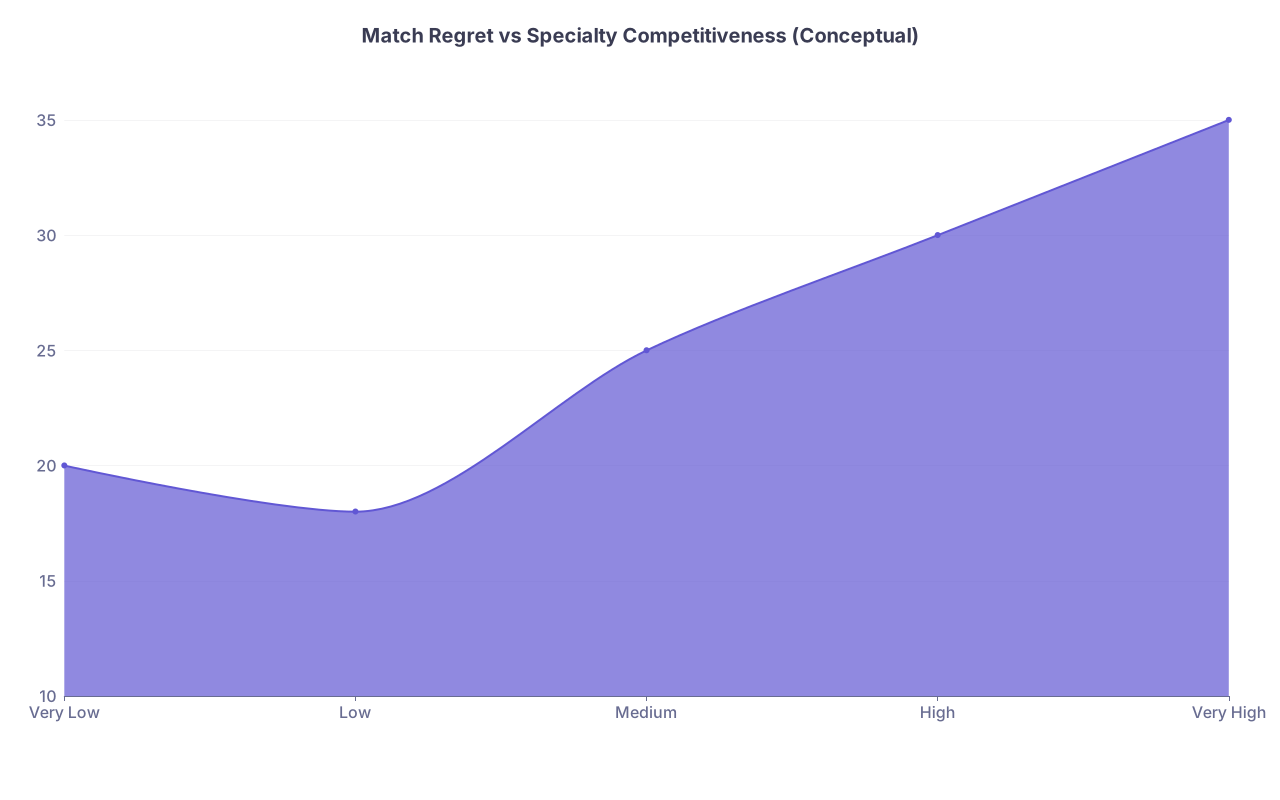
High competitiveness doesn’t magically protect against regret. Alignment does.
Quick Reality Check: Who Actually Lives With This Decision?
Not your aunt.
Not your dad’s coworker who asks, “Are you going to be like Grey’s Anatomy?”
Not your cousin who says, “Oh, I thought you were gonna do something more… intense.”
You.
You’re the one waking up at 4:30 a.m. for years. You’re the one on call. You’re the one sitting with the hard cases, the complications, the moral distress, the charting at midnight.
They go home from the family dinner and forget what specialty you picked until the next holiday. You live it every day.
So if you’re going to disappoint someone, let it be the person who only cares in passing. Not the version of you 10 years from now asking, “Why didn’t you just pick what you actually liked?”
FAQ (Exactly the Stuff You’re Afraid to Ask Out Loud)
1. What if my parents are genuinely disappointed and keep bringing it up?
Then it’s a boundary problem, not a specialty problem. You can say: “I hear that this isn’t what you imagined. But I’ve spent years in training and I chose this because it fits my strengths and the life I want. I need you to respect that, even if you don’t fully understand it.” If they keep poking, stop explaining. Change the subject. You’re not required to keep defending a decision that’s already made.
2. Will program directors in ‘less competitive’ specialties think I’m weird for being “overqualified”?
No. Strong applicants are never a problem. The only mild red flag is if your story doesn’t make sense — like, you were all-in on ortho until December and then suddenly say “I’ve always loved psych” with no evidence. As long as your application shows some consistency — electives, letters, a coherent narrative — PDs will usually be thrilled you chose their field intentionally, not as a backup.
3. What if I regret not at least trying for a more competitive specialty?
Regret comes from feeling like you didn’t choose, you defaulted. So make this a conscious decision. Do a sub-I in the “fancy” specialty you’re tempted by. Talk honestly with residents in both fields. Imagine your worst day in each and ask which one you’d rather tolerate. If after that you still pick the “less competitive” one, that’s not chickening out. That’s clarity.
4. Are ‘less competitive’ specialties going to stay that way, or am I picking something that’s getting harder to match into?
Trends shift. Psych and PM&R, for example, have been heating up. But here’s the thing: you shouldn’t pick or avoid a specialty based on where it sits on a competitiveness graph this year. You only do this once. If you love it, it’s worth it even if it gets harder for the class below you. Carving your life around next year’s match stats is a great way to end up miserable.
5. How do I stop comparing my choice to my classmates doing ‘prestige’ specialties?
You probably won’t stop completely. Comparison is baked into med training. But you can blunt it. Mute the group chats that are just flexing about match lists. Spend more time with people in your chosen field who actually like their lives. Pay attention to which residents look dead inside versus which ones seem genuinely okay. And remind yourself: match day is one loud day. You’ve got thousands of quiet ones after that where nobody’s clapping — just you and your work. That’s what has to feel right.
Open your notes app right now and write a single, honest sentence:
“I’m choosing [specialty] because [real reason that actually matters to you].”
Not to your parents. Not to your classmates. To you. That’s the only person who has to live with it.