
Most people give way too much power to a single advisor conversation.
You walk in vaguely hopeful and walk out convinced your dream specialty is delusional, you’re not competitive, and you should quietly downgrade all your aspirations to “just matching somewhere.”
I’ve watched that happen. More than once. The advisor says a few “concerned” phrases—“realistic,” “backup,” “this year is very competitive”—and suddenly you’re googling “least competitive specialties” at 2 a.m. and wondering if you should blow up years of plans in a 30‑minute meeting.
Let’s talk about that exact panic: when your advisor starts nudging you—subtly or not—toward “easier matches,” and you’re stuck between fear of not matching and fear of giving up on what you actually want.
You’re not crazy for feeling torn. You are in danger of overreacting.
First: What “You’re Not Competitive” Often Really Means
This is the part no one says out loud: advisors are often more afraid of their match list stats than you are of your own future.
I’m not saying they don’t care about you. Many do. But they also care about:
- The school’s match rate
- Not having students go unmatched
- Not getting angry emails from deans or parents
- Keeping their “advising success” reputation
So when they look at you—maybe an average Step 2, some wobbly grades, no famous PI letter—and they hear “I want derm/ortho/plastics,” their brain screams: RISK.
And what do humans do with risk? They try to control it.
So you start hearing things like:
- “Have you thought about family medicine? Much safer.”
- “You might be happier in internal medicine—more options, better lifestyle.”
- “Radiology is getting more competitive; maybe look at prelim medicine and reapply.”
Here’s the key: “You’re not competitive” is not a precise statement. It’s often shorthand for one of these:
- “You’re not competitive for the tier of programs you’re imagining.”
- “You’re not competitive if you only apply to 20 reach programs.”
- “You’re not competitive if you refuse to do a backup specialty.”
- “You’re not competitive according to my outdated understanding of this specialty.”
That nuance gets lost. You just hear: “You’re going to fail if you try.”
And then your brain runs:
- “If I ignore them and go for my dream, I won’t match.”
- “If I give in and pick the ‘easy’ specialty, I’ll be miserable forever.”
- “Other people are braver than me. I’m weak because I’m even considering backing down.”
It’s awful. But it’s also solvable—if you stop treating advisor opinions like prophecy and start treating them like data points.
Step 1: Separate Your Fear From the Actual Numbers
Before you torch your dream or your sanity, you need something more solid than “my advisor seemed concerned.”
Two different things are happening in your brain:
- Catastrophic story: “If I apply to this competitive specialty, I will definitely go unmatched and ruin my life.”
- Reality: There’s a risk distribution based on scores, school type, research, letters, etc. It’s not 0% vs 100%; it’s probabilities and strategy.
You need to drag yourself back to #2.
Start with actual data. Not vibes.
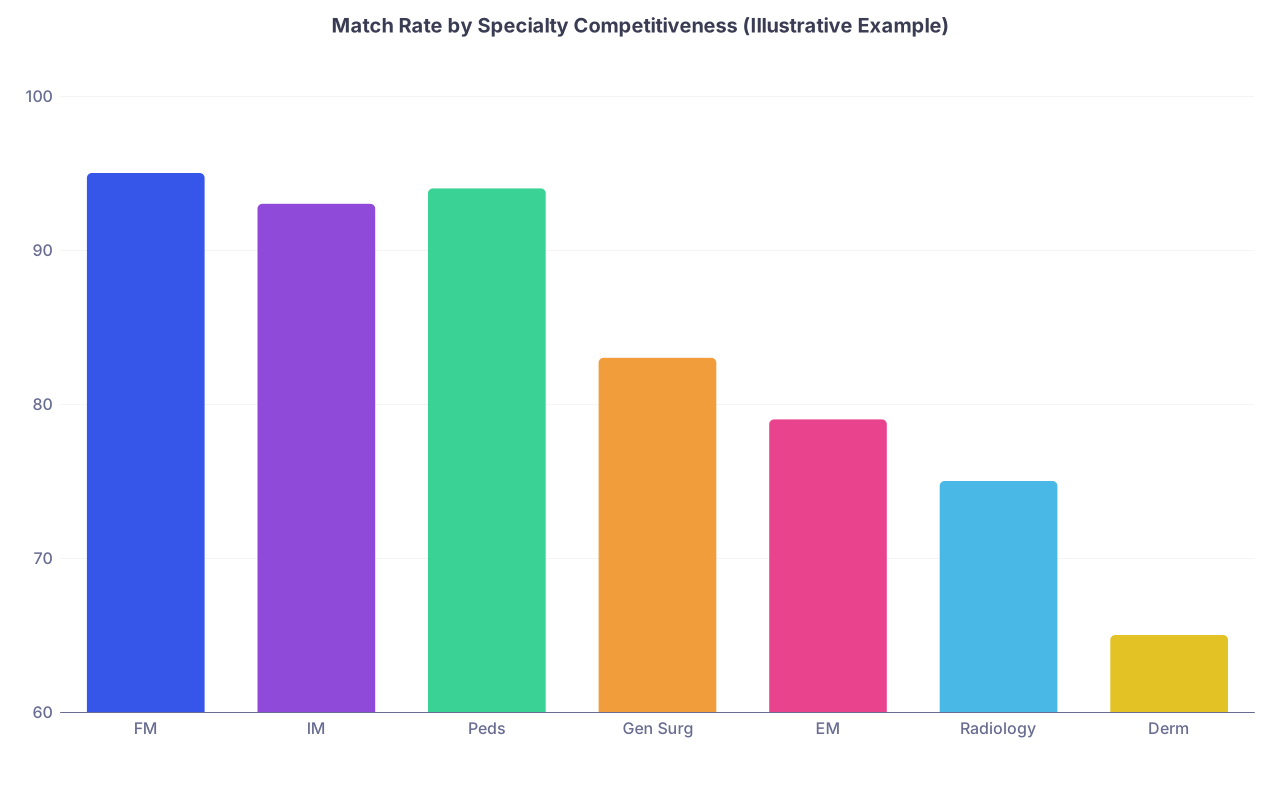
| Category | Value |
|---|---|
| FM | 95 |
| IM | 93 |
| Peds | 94 |
| Gen Surg | 83 |
| EM | 79 |
| Radiology | 75 |
| Derm | 65 |
Numbers like these (not exact, just directional) tell you:
- Least competitive specialties (FM, Peds, Psych, Path, some IM programs) really do have high match rates.
- Competitive ones (Derm, Ortho, Plastics, ENT, some Rads, some EM) have lower match rates and harsher screening.
But here’s where your advisor might be oversimplifying: they’re lumping you into the weakest part of the applicant pool without really parsing your specifics.
Ask yourself very concrete questions:
- What’s my Step 2 score compared to the average matched applicant in this specialty?
- Are my clinical grades mostly passes, or do I have some honors in relevant rotations?
- Do I have at least one strong letter from someone in the specialty?
- Did I do away rotations? How did they go—really?
- Am I at a school that this specialty/program type historically respects?
If you don’t know, that’s your homework. Not “give up” vs “double down.” Find out.
Because your fear is filling the gap where actual information should be.
Step 2: Decode What Your Advisor Is Actually Pushing
When your advisor says you should consider an “easier match,” they might mean wildly different things, ranging from reasonable to downright lazy.
Here’s how to translate.
| What They Say | What It Might Actually Mean |
|---|---|
| "You should have a backup specialty." | Your odds are decent but not guaranteed. |
| "This specialty is very unrealistic." | You’re far below typical metrics for that field. |
| "Think about less competitive options." | They don’t want you to go unmatched on their watch. |
| "You’d be great in [easier field]." | They’re steering you toward safer match statistics. |
| "I’m concerned about your application." | They might not know the niche paths that exist. |
Now, is their concern sometimes justified? Absolutely.
If you have:
- Multiple exam failures
- No meaningful connection to the specialty
- Unexplained red flags (probation, major professionalism issues)
- A very late turn‑around (e.g., suddenly deciding on ortho in August of 4th year)
Then backing into a less competitive specialty might actually protect you.
But if your “issue” is:
- Average Step 2 instead of stellar
- One lower grade in a core rotation
- Non‑home specialty with only one away rotation
- You’re not AOA or from a big‑name school
That doesn’t automatically mean “give up on all competitive fields.” It often means “you need a smart, maybe slightly riskier plan—not a total surrender.”
The problem is, advisors sometimes default to the most conservative option because it’s the one least likely to blow back on them.
They’d rather gently push 10 students into FM who might have matched EM or anesthesiology, than have 1 student swing at ortho and go unmatched.
You are that 1 student in their mental math. And they aren’t the one living your life afterward. You are.
Step 3: Reality‑Check Your Risk Tolerance Honestly (Not Aspirationally)
Here’s the part that hurts: some of your anxiety is accurate. You might not match if you go all‑in on a very competitive specialty with a middle‑of‑the‑road app.
You can’t make good decisions if you refuse to stare that in the face.
The key question isn’t “Do I want this specialty?” It’s:
How much risk can I tolerate without destroying my mental health and financial stability?
Think in concrete scenarios, not vague dread.
Scenario A: You take your advisor’s advice. You target a “least competitive” specialty (FM, Psych, Peds, some IM, Path).
- You almost certainly match somewhere.
- You may not love the field.
- You may resent that you didn’t even seriously try for your original dream.
- But you start residency on time, with an income, and a relatively secure path.
Scenario B: You ignore them. You apply only to your competitive dream specialty, no backup.
- Best case: You match. Incredible. Your advisor was overly cautious.
- Middle case: You get a couple of interviews, don’t match, scramble/SOAP into something you never really considered.
- Worst case: You don’t match and don’t SOAP, lose a year, reapply from a weaker position, with more loans and more anxiety.
Scenario C: You hybrid it. You apply to your dream specialty and a safer backup simultaneously (dual apply).
- You slice your money, time, and focus between two sets of programs.
- You risk frustrating some programs who sense you’re “not all in.”
- You give yourself more total match chances at the cost of some clarity and emotional chaos.
None of these is inherently “correct.” They’re trade‑offs.
Your advisor tends to fixate on avoiding Scenario B and C worst‑case.
Your brain tends to fixate on Scenario A regret.
You need to sit with yourself—away from everyone—and ask:
- If I ended up in FM / IM / Psych / Path, would my life be “ruined,” or would it just be… different?
- If I no‑match this year, can I emotionally and financially handle an extra year, maybe in a research or prelim spot?
- What’s actually more terrifying to me: a year unmatched, or 30 years in a specialty I never really wanted?
Answering that honestly is way more important than your advisor’s comfort level.
Step 4: Get a Second (and Third) Opinion—from People Who Actually Work in the Field
If your advisor doesn’t live and breathe the specialty you’re aiming for, they’re not the final authority. Period.
You need voices from:
- Attendings in your target specialty
- Recent residents/fellows who matched in that field
- Maybe even current PGY‑1s who matched with similar stats
Ask them targeted questions, not just “Do you think I can do it?”
Try:
- “Here are my scores, grades, and experiences—would you rank me if you saw this on paper?”
- “What kind of programs (community vs university, geographic regions) should I realistically target?”
- “Have you seen anyone with my profile match into this field? What did they do?”
- “If you were me, would you dual apply, and to what?”
Most of them will be more blunt than your advisor but also more nuanced about paths like:
- Transitional year + reapply
- Prelim surgery + switch
- 1–2 years research in the specialty then reapply
- Targeting specific geographic regions with historically more open doors
They may actually say, “Yeah, this is a long shot, but not impossible if you’re willing to take a non‑linear route.” Your advisor may never say that because “non‑linear” is messy and doesn’t fit in their algorithm.
And if multiple people inside the specialty say, “I would not roll the dice on this,” that’s worth more weight than one general advisor gently steering you away.
Step 5: Use Backup Specialties Strategically—Not as a Punishment
“Easier match” doesn’t have to mean “I sold out.” It can mean “I gave myself more options while protecting myself from disaster.”
If you decide to consider least competitive specialties (FM, Psych, Peds, Path, some IM), don’t treat them like the trash can you fall into if you fail your “real” dream. That’s a great way to be miserable later.
Do some real exploration:
- Talk to residents in those fields
- Ask them what surprised them (in good and bad ways)
- Shadow for a couple of full days and stay through notes, calls, and late issues
- Ask them what they hate about their job. Not just the brochure stuff.
You might realize:
- Psych gives you fascinating pathology and real patient relationships.
- FM in certain settings (sports, addiction, academic, rural) is actually pretty badass.
- Path gives you high diagnostic impact without constant pager hell.
- Peds can be emotionally intense but deeply meaningful if you like working with families.
If you end up in a less competitive specialty, you want it to be because you see value in it, not because you were bullied into it and never questioned the narrative.
Dual applying example (very rough, just to illustrate):

| Step | Description |
|---|---|
| Step 1 | Choose Dream Specialty |
| Step 2 | Assess Stats and Risk |
| Step 3 | Apply Single Specialty |
| Step 4 | Apply Primarily Dream, Few Backups |
| Step 5 | Equal Split Dream and Backup |
| Step 6 | Competitive? |
| Step 7 | Risk Tolerance High? |
You’re allowed to craft something in the middle: “I’m going to apply to EM and Psych,” or “I’ll apply to anesthesiology and IM.” That’s not failure. That’s being realistic and still reaching.
Step 6: Plan for the Worst‑Case—So It’s Not So Terrifying
You’re the Worried Applicant. You’re already living in the absolute worst‑case scenarios in your head. So use that.
Instead of just looping the fear, write down:
If I don’t match in my dream specialty, here’s my Plan B, C, and D.
For example:
- Plan B: Dual apply to [backup] and commit to ranking all programs I could truly attend without hating my life.
- Plan C: If I don’t match at all, I’ll pursue:
- A research year in the specialty (already reaching out now)
- A prelim year in IM or surgery at a place with the specialty I want
- Improved letters and additional step scores if relevant
- Plan D: If I end up in my backup specialty, what subspecialties or niches could make it feel closer to what I originally wanted?
Once you outline that, something shifts. The “if I fail, my life is over” voice has less power, because you have actual steps—not just existential doom.
You’re not ignoring risk. You’re containing it.
Step 7: Have the Hard Conversation With Your Advisor—On Your Terms
You don’t have to accept their verdict. But you also don’t have to storm out and pretend you’re not scared.
Try going back with a script something like:
“After our last meeting, I was really anxious. I understand your concern about my competitiveness for [specialty]. I’ve since talked to [Dr. X in the specialty, recent resident, looked at NRMP data]. I still want to pursue [specialty], but I’m willing to be strategic and consider a backup. Can we create a plan that acknowledges both my goals and the match risks?”
And then get specific:
- “How many programs in [dream specialty] do you think I should apply to, realistically?”
- “What would a safe number of [backup specialty] programs look like?”
- “Are there geographic or program tiers you think make sense for my profile?”
- “If I do end up unmatched, what structures does our school have to support reapplicants?”
If your advisor doubles down with only, “Just don’t do it, it’s too hard,” that tells you something: their bandwidth for nuance is low. You’re going to need other mentors more.
But at least you’ll know you tried to have an adult, data‑driven conversation instead of silently absorbing their fear as truth.
Your advisor is not the villain. Your fear is not irrational. The match is genuinely risky. All those things can be true at the same time.
But letting one cautious conversation push you entirely into an “easier” specialty you never seriously examined—that’s how you wake up five years from now wondering whose life you’re living.
There’s no version of this where you get zero anxiety. You’re going to feel afraid whether you swing big or play it safe. The real question is which fear you’re more willing to live with: fear of not matching, or fear of never really trying.
Years from now, you probably won’t remember every detail of this advisor meeting. You’ll remember whether you made your decision from a place of panic—or from a place of informed, uneasy, but deliberate choice.