
The fear of “settling” for an easier specialty ruins more careers than a low Step score ever will.
I’m not exaggerating.
You’re not just scared of not matching. You’re scared of waking up at 40 as a “backup plan doctor” in a field you never really wanted, scrolling through Instagram watching your classmates post OR pics or cath lab shots while you’re grinding through another clinic day… and thinking, “I sold out because I was scared.”
That’s the nightmare, right?
Let’s talk about it properly. No sugarcoating. No “follow your passion” nonsense. Just the ugly in-between where most of us actually live: wanting something competitive, eyeing “easier” fields, and feeling like every choice is a trap.
The Real Problem Isn’t “Easier Fields” — It’s Living With Regret
Here’s the harsh truth: every specialty has people who feel like they settled, even in the “dream” ones.
I’ve seen:
- A derm resident on a night float with medicine, half-whispering, “Sometimes I miss acute stuff. I kind of ran from it.”
- A family med doc saying, “I always wanted EM, but I panicked about matching. I still wonder sometimes.”
- A surgical prelim who tried twice for categorical and then ended up in IM, saying, “I wish I’d had a backup plan earlier instead of stretching this out.”
So no, “backup = guaranteed regret” is not true.
What actually causes long-term regret is something else:
- You never clearly decided what you value (lifestyle, procedural work, prestige, flexibility, location, money, etc.).
- You made choices purely out of fear or ego.
- You didn’t give yourself permission to change course when new information came in.
That’s the pattern.
The real question isn’t “Will I regret going into an easier field?”
It’s: “How do I choose a less competitive field in a way that I can live with 10–20 years from now?”
What People Get Wrong About “Least Competitive” Specialties
Let me cut through a big misconception: “Least competitive” does not mean “only losers go there” or “no one actually wants these fields.”
That’s anxious-brain trash talk.
There are specialties that, statistically, are easier to match into, especially for US grads, DOs, or IMGs. That’s just reality. But plenty of people actively want them.
Here’s how some of the “easier” fields stack up conceptually:
| Specialty | Overall Competitiveness* | Lifestyle Perception | Procedural vs Cognitive |
|---|---|---|---|
| Family Medicine | Low | Good / flexible | Mostly cognitive |
| Psychiatry | Low–Moderate and rising | Good | Mostly cognitive |
| Pediatrics | Low–Moderate | Good, lower pay | Mixed |
| Internal Med | Moderate (broad range) | Variable | Mostly cognitive |
| Pathology | Low–Moderate | Good, lab-based | Diagnostic/procedural |
*Not a ranking, just general trends based on recent NRMP data.
Do some programs in these fields still fill with insanely strong applicants? Yes. Always. There are competitive FM, psych, and peds programs that turn people down every year.
But if your anxiety is screaming, “If I don’t do ortho/derm/ENT, I’m a failure,” that’s not about data. That’s about identity and fear.
Step One: Name What You’re Actually Afraid Of
You can’t make a sane decision while fighting ghosts.
Be brutally specific: what scares you about “settling” into an easier field?
- “I’ll always feel like I wasn’t good enough for something harder.”
- “My family will think I failed.”
- “I’ll be bored.”
- “I’ll make less money and resent it.”
- “I’ll lose the procedural adrenaline I like.”
- “I’ll hate clinic.”
Good. Now flip it.
What scares you about sticking with your original highly competitive choice?
- Not matching at all.
- Ending up in a prelim year and scrambling.
- Burning another year reapplying and feeling stuck.
- Being geographically forced into a place you hate just to match.
- Having your whole self-worth ride on one Match result.
You’re not choosing between “dream vs. settle.” You’re choosing between two different sets of risks.
Step Two: Stop Treating “Backup” Like a Dirty Word
One of the most toxic ideas in med school culture is that having a backup equals not believing in yourself.
I’ve watched people:
- Apply only to hyper-competitive specialties with zero safety net.
- Get no interviews or go unmatched.
- Spend the next year in limbo, doing research or prelim spots while their classmates move on.
And then many of them do the “backup” field anyway. But with an extra year of pain first.
Having a realistic backup actually does three things:
- Lowers your anxiety enough that you can interview like a human instead of a desperate robot.
- Gives you optionality if things don’t go the way you want.
- Forces you to confront: “What else could I be okay with? Not thrilled at first maybe… but okay long-term?”
Backup done right is not Plan B = trash. It’s Plan B = a path you’ve vetted, in a specialty that fits at least 60–70% of what you want from your life.
Step Three: Decide What You Actually Want From Your Life, Not Just Your CV
You will never feel at peace picking a “less competitive” specialty if your criteria are:
- “What looks impressive?”
- “What will shock my relatives at Thanksgiving?”
- “What was the hardest specialty to get into at my med school?”
You need different metrics.
Here’s a crude exercise that helps anxious brains calm down because it makes the trade-offs visual.
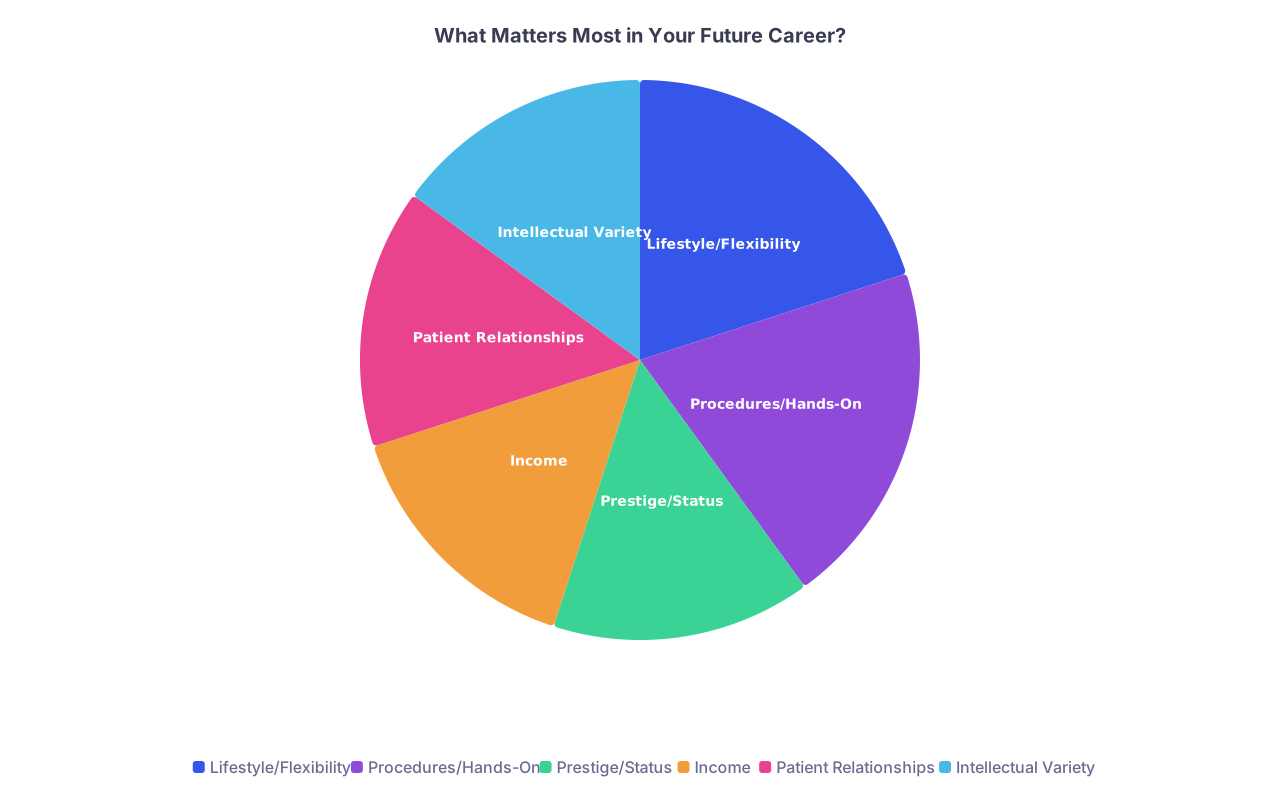
| Category | Value |
|---|---|
| Lifestyle/Flexibility | 20 |
| Procedures/Hands-On | 20 |
| Prestige/Status | 15 |
| Income | 15 |
| Patient Relationships | 15 |
| Intellectual Variety | 15 |
Adjust those percentages mentally. If you had to “spend” 100 points across those categories, where would they go?
Now compare that to how different “easier” fields actually deliver:
- Family Med – High lifestyle flexibility, great patient relationships, broad variety, lower pay ceiling but solid. Procedures possible if you seek them (OB, scopes, MSK).
- Psych – High lifestyle, deep relationships, cognitive-heavy, pay improving, minimal procedures.
- Peds – Lifestyle decent but variable, strong relationships, lower pay, some procedures, emotionally heavy for some people.
- Pathology – Structured hours, behind-the-scenes, minimal direct patient contact, intellectually dense, good pay.
- IM – Wide range. Can go hospitalist, outpatient, fellowship (cards, GI, pulm/crit). Not automatically “backup,” but used as one a lot.
You’re not choosing “real doctor” vs “backup doctor.” You’re choosing which mix of these variables you want to live inside for 30+ years.
Step Four: Test Reality Instead of Fantasies
Anxiety is loud. Reality is quieter but way more useful.
If you’re considering “easier” fields and terrified of regretting it, you need actual data from your own experience, not just vibes and Reddit threads.
Concrete things to do:
- Targeted shadowing. Not random half-day tours. I mean: two or three full days with a doc in FM, psych, peds, path, etc., asking blunt questions like:
- “What do you hate about this job?”
- “If you could go back, would you pick this again?”
- Ask residents off the record. Catch them away from attendings. Ask, “If you had matched into your first-choice specialty instead of this, would you still be happy?”
You’ll be surprised how many say, “Honestly, I’d probably still choose this.” - Track your own energy. During different rotations, log briefly each day:
- How drained or energized was I (1–10)?
- Did I like the pace? The patients? The type of thinking? Patterns beat stories you tell yourself.
You can even map it out.
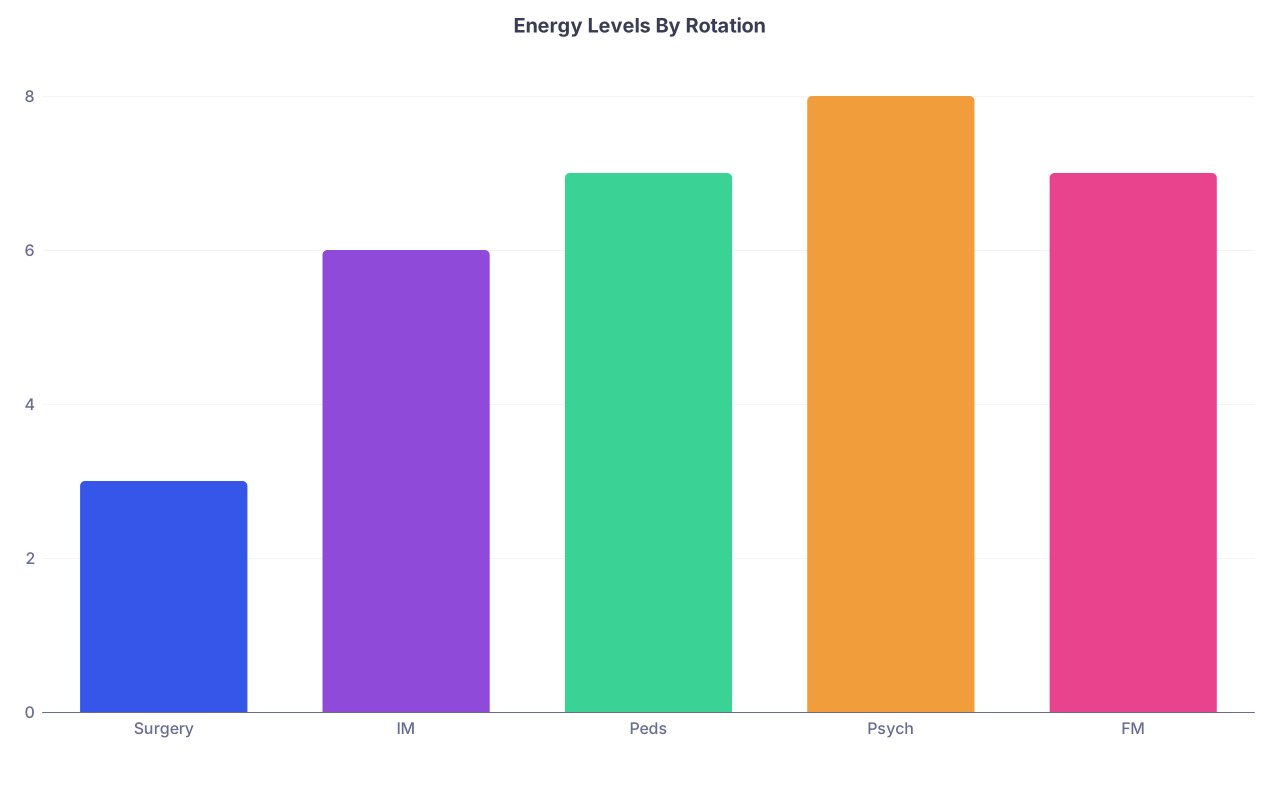
| Category | Value |
|---|---|
| Surgery | 3 |
| IM | 6 |
| Peds | 7 |
| Psych | 8 |
| FM | 7 |
That doesn’t mean, “Go into the highest bar.” But if surgery is a 3 and psych is an 8, yet your brain is screaming “But surgery is cool,” you need to ask whether you’re chasing an image more than a life.
Step Five: Understand How Regret Actually Works Over Time
I want to be very clear about something: the intensity of your current fear is not a good predictor of long-term regret.
Most people drastically overestimate how much their future self will care about:
- What specialty they “couldn’t get.”
- How others perceived their match.
- Whether their job sounds impressive in one word.
And they drastically underestimate how much their future self will care about:
- Whether they’re constantly exhausted.
- Whether they dread Mondays.
- Whether their job fits having kids, hobbies, or a life outside the hospital.
- Whether they can move cities if they need to.
Look at the big arc, not just the next two years.
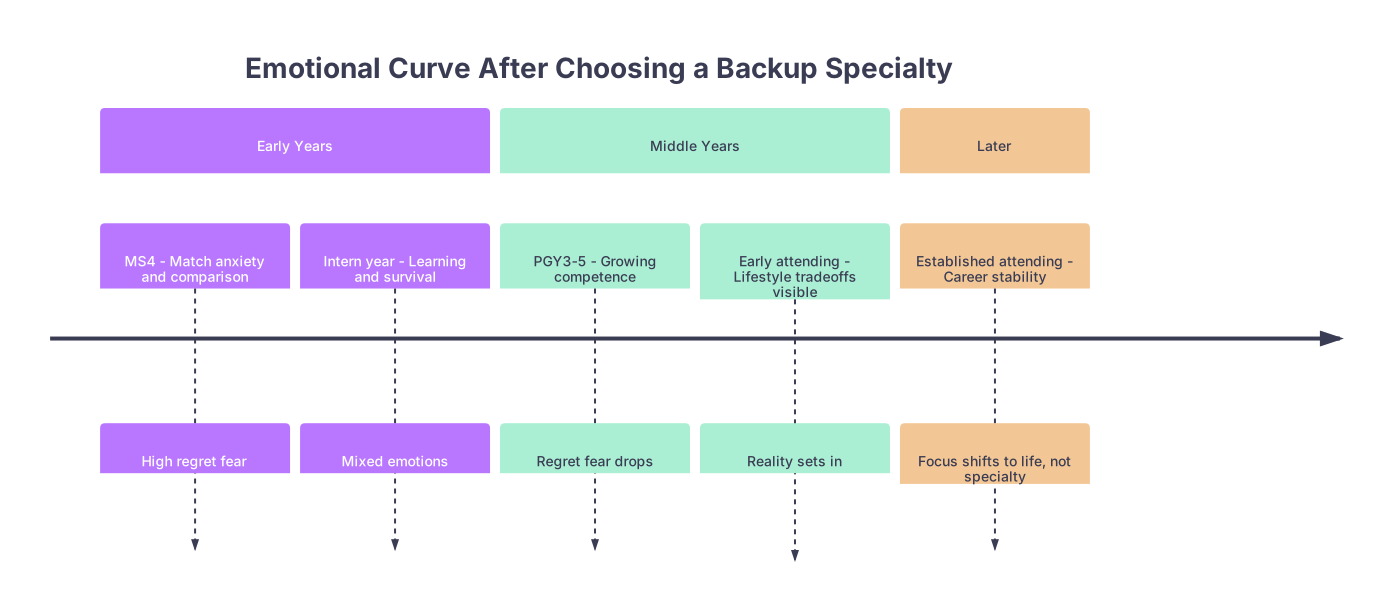
| Period | Event |
|---|---|
| Early Years - MS4 - Match anxiety and comparison | High regret fear |
| Early Years - Intern year - Learning and survival | Mixed emotions |
| Middle Years - PGY3-5 - Growing competence | Regret fear drops |
| Middle Years - Early attending - Lifestyle tradeoffs visible | Reality sets in |
| Later - Established attending - Career stability | Focus shifts to life, not specialty |
You might have a pang of “what if” in PGY1 when your ortho friend posts a cool OR shot. But 10 years out? You’ll be thinking about your kids’ school, your mortgage, your time off, your sanity. Not your Step score.
Regret isn’t about whether a specialty was “backup” on a spreadsheet.
It’s about whether the day-to-day life in that specialty fits who you actually are.
Step Six: Building a Match Strategy That Doesn’t Feel Like Self-Betrayal
You’re scared of two extremes:
- Going all-in on something super competitive and ending up unmatched or miserable.
- Over-correcting into a “safe” field you don’t respect and resenting it forever.
The middle path looks like this:
- Decide on a primary specialty you’re genuinely excited about (whether competitive or not).
- Identify 1–2 realistic backup fields that match at least most of your values.
- Make sure your application tells a coherent story that could support both.
Example:
“Original dream” = EM.
“Realistic backups” you might be okay with = FM, psych.
You can:
- Do EM and FM rotations, plus maybe a psych elective.
- Get letters from people in more than one field.
- Do some research or QI that touches acute care or population health (fits both).
- Apply primarily to EM + a thoughtful number of FM and/or psych programs that you’d actually go to, not just “whatever.”
It’s not traitorous to do this. It’s strategic.
And if you’re already leaning toward a less competitive field because you actually liked it? That’s not settling. That’s you refusing to torture yourself just to satisfy some internalized hierarchy.
How to Know You’ll Be Able to Live With Choosing an “Easier” Field
Ask yourself these questions and answer them like you’re talking to a friend you actually care about:
- Can I picture a version of my life in this field where I’m not just “okay,” but actually content 70–80% of days?
- Do I respect physicians in this specialty when I see them doing their work well?
- Am I more in love with the idea of the competitive specialty than with what those doctors actually do all day?
- If someone I love had my stats, my debt, and my fears, would I honestly tell them to roll the dice without a backup?
- If I woke up in 10 years as a competent, respected attending in this “backup” field, would I really call that a failure?
If your honest answers lean toward peace rather than panic, that’s your answer. Even if your ego hates it.
FAQ – 5 Questions You’re Probably Still Stressing About
1. If I choose a “backup” field now, am I closing the door forever on my dream specialty?
Usually, yes for some fields, no for others, and “it depends” for a few. Switching later, especially from a less competitive to a more competitive field, is absolutely possible but not easy. I’ve seen IM interns switch into radiology, FM into psych, even prelim surgery into anesthesia. But you can’t bank on that. You should only choose a backup field you’d be okay staying in permanently, with switching being a bonus option, not the plan.
2. Will programs in “easier” specialties judge me if it’s obvious I wanted something else first?
Some will. Many won’t. The key is the story you tell. If your whole application screams ortho but your PS for FM says, “I’ve realized I value continuity and holistic care,” they might side-eye you. But if you’ve got at least some experiences, letters, or honest reflection that connect you to that field, people are more understanding than your anxiety thinks. Admissions folks know people change their minds or recalibrate.
3. What if I match into a backup and feel miserable right away?
First, that does happen. To people in every specialty. Not just backups. Early misery is often about the transition to residency, not the field itself. Give it at least 6–12 months before calling it. In that time, talk to seniors and attendings about how they feel long-term. If you’re still deeply unhappy and it’s clearly the specialty, then you start looking into transfers or reapplying. Painful, but not a life sentence.
4. How much should Step/COMLEX scores actually influence my decision?
More than people like to admit, but less than your fear is telling you. If you have a 230 Step 2 and want derm, you’re not doomed, but you are in a high-risk play. If you’re in that middle ground where your stats aren’t fatal but aren’t stellar, then yes, your score should factor in. Not as, “I must run to the easiest specialty,” but as, “What’s the risk-reward ratio I’m realistically willing to tolerate?”
5. Is it better to do a prelim/transitional year and reapply to my dream specialty than to go straight into a backup?
It depends on your tolerance for uncertainty and delayed life plans. A prelim year plus reapplying is emotionally brutal for many people. Some succeed and are thrilled. Others burn a year, don’t match again, and end up going into the same backup specialty later anyway with extra scars. If you’re already seriously drawn to a less competitive field and just clinging to the dream for ego, going straight into the “backup” can be the kinder choice to your future self.
Years from now, you won’t be grading your life on whether you “settled” or “won” the Match prestige game; you’ll be weighing whether you built a career that lets you be a whole, human person.