
Last March, I watched a classmate in the student lounge hitting refresh on her email like it might change fate if she just clicked hard enough. Family medicine. Community programs. “Safe” list. She did everything they tell you to do when you’re not a superstar applicant. And she still opened that Monday morning email: “We are sorry to inform you that you did not match.”
So yeah. Let’s talk about that nightmare we all shove to the back of our brains: what if you don’t match even in one of the “least competitive” specialties?
Because it happens. And pretending it doesn’t just makes it worse.
First: You’re Not Crazy for Being Terrified
There’s this quiet assumption in med school that goes something like: “Well if I can’t do derm or ortho or rad onc, I’ll just do FM/IM/Peds/psych and I’ll be fine.” As if those are backup plans that magically guarantee a spot.
Then you see the actual data. Even for “least competitive” specialties, people still go unmatched. Not thousands, but enough that you can’t just ignore it.
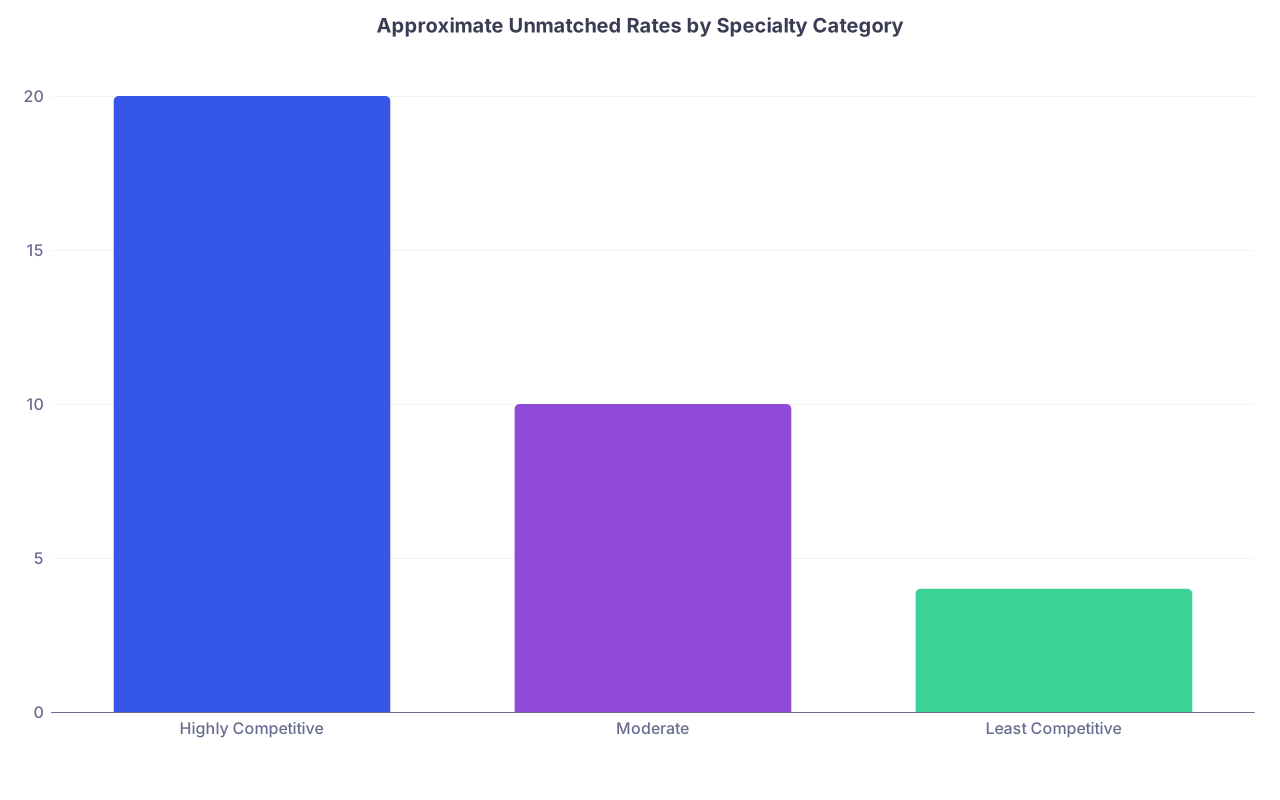
| Category | Value |
|---|---|
| Highly Competitive | 20 |
| Moderate | 10 |
| Least Competitive | 4 |
And if your brain is like mine, it doesn’t care that the unmatched rate is “only” a few percent. It fixates on one thing: somebody has to be in that 4%. What if that somebody is you?
So you start catastrophizing:
- “If I can’t even match FM, doesn’t that mean I’m just… not cut out to be a doctor?”
- “Are PDs going to look at my application and think I’m a walking red flag?”
- “What if I don’t match SOAP either? What then? What do I even do with my life?”
Let me be blunt: not matching in a less competitive specialty is a hit. It feels like public proof that every imposter-syndrome thought you ever had was correct. But it’s not the end. It just feels like it for a while.
Why People Don’t Match Even in “Safe” Specialties
I’m not going to insult you with “just apply broadly” and “have a backup plan.” You already know that. The question you’re secretly asking is: “How does this actually happen to people like me?”
Here are the real reasons I’ve seen, over and over.
1. Applying “least competitive”… but not actually being that broad
People hear “family med is not competitive” and apply to:
- 15–20 programs
- Mostly in big cities
- All “solid reputation” university programs
That’s not a safety strategy. That’s wishful thinking dressed up as realism.
The moment you’re in any risk category—average or below-average scores, late Step 2, visa needs, DO applying to MD-heavy areas, older grad year—you’re competing for the more limited subset of programs willing to look at you. Not the full list on FREIDA. The smaller, filtered list in PDs’ heads.
I’ve seen people apply to 25 internal medicine programs and then be shocked when they got 3 interviews. Shocked again when those 3 didn’t turn into a match.
The sad part? If those same people had applied to 80–100 programs (with a ton of community and less “fancy” places), they probably would have matched.
2. One or two landmines in the application
I’m talking about:
- A Step fail (even one)
- A big gap without a clean explanation
- A really bad dean’s letter or “concerns” comment
- Very weak or generic letters of recommendation
- Rotations where you were “fine” but nobody loved you enough to fight for you
Each of those doesn’t doom you. But they move you from “safe” to “we’ll see.” And if you pretend they don’t matter because “FM always needs people,” you don’t plan aggressively enough.
3. Weak interview performance in a numbers game
If you get 6–8 interviews in a less competitive specialty, people will soothe you with, “That’s enough, you’ll match.” Usually that’s true.
But if:
- You ramble
- You overshare about mental health in a way that worries programs
- You can’t explain red flags well
- You give off “I don’t want to be here, this is my backup vibe”
- Or you just have 2–3 bad days in a row
Suddenly that “should be fine” number of interviews doesn’t carry you.
And no, this doesn’t mean you’re socially broken or unfixable. It just means you were learning the skill of interviewing in real time… during the only season that really counts.
The Day-Of Nightmare: “We Are Sorry To Inform You…”
Let’s walk through the worst-case scenario so your brain can stop turning it into a black hole.
You open your email Monday of Match Week. You get the unmatched message.
Your mind does this:
“I am ruined. Everyone will know. My advisor will be disappointed in me. My parents will ask what happened. My classmates will whisper. My future is over.”
Here’s what actually happens next, logistically:

| Step | Description |
|---|---|
| Step 1 | Unmatched Email Monday |
| Step 2 | School Contacts You |
| Step 3 | Meeting With Dean or Advisor |
| Step 4 | Prepare SOAP Application |
| Step 5 | Plan Gap Year |
| Step 6 | SOAP Rounds Mon-Thu |
| Step 7 | Start Prelim or Categorical Spot |
| Step 8 | Post Match Planning - Reapply |
| Step 9 | SOAP Eligible |
| Step 10 | SOAP Match? |
So no, it’s not immediate exile from medicine. There’s a messy, stressful, structured process. And you won’t be doing it alone; your school absolutely does not want their match list to look worse, so they will help you.
SOAP is brutal, but it’s not fake.
SOAP Reality Check: How Bad Is “Not Even Matching There”?
Here’s the part everyone whispers about but doesn’t really explain:
You can fail to match your “least competitive specialty” and still match in SOAP. Sometimes even into that same specialty. Sometimes into a related one. Sometimes into a prelim year that keeps the door open for next cycle.
What SOAP actually looks like:
- You sit in a room (or on Zoom) with an advisor
- They tell you what’s unfilled—FM, IM, prelim surgery, psych, peds, transitional, random things
- You submit targeted applications in rounds
- Programs speed-screen on stats, location, timing, vibes
- If you get calls, you basically do rapid-fire mini interviews
- Then you just… wait and pray
The sickening part is the lack of control. You can’t spam 80 programs like ERAS. You’re working in limited waves. Your brain fills in that silence with the worst explanations.
But a lot of people who don’t match on Monday are wearing white coats on July 1. They just took a more chaotic path to get there.
If SOAP doesn’t work out either? Yeah. That’s the extremely dark version your brain fixates on at 3 a.m. Let’s go there too.
If You Don’t Match At All: What Your Next Year Might Actually Look Like
You’re imagining a void. A year of shame where you hide in your room while everyone else posts “First day of residency!” photos.
Here’s what I’ve actually seen people do.

1. Dedicated reapplication year in that same “least competitive” specialty
This is common. Especially in FM, IM, peds, psych.
People will:
- Do a research year tied to that department
- Work as a clinical research coordinator, sub-investigator, or part-time hospitalist scribe
- Do extra electives or sub-Is as a visiting student or post-grad
- Get fresh letters from people who can say, “I worked with them recently and they are solid”
You go from being yesterday’s applicant to “oh yeah, I know them, they’ve been here all year.”
2. A prelim or transitional year, then reapply
Some unmatched people manage to SOAP or scramble into a prelim medicine or surgery year or a transitional program. It’s not categorical. You don’t automatically continue there. But:
- You’re now a PGY-1 with real evaluations
- You work closely with attendings who can write very strong letters
- You show you can function in a hospital without imploding
If you originally didn’t match IM or FM, doing a prelim year can massively change how PDs see you the next cycle.
3. Reframing specialty choice (and this one hurts)
I’ve seen people not match psych, then match FM the next year. Not match IM categorical, then match IM prelim + FM categorical later. Some eventually move back toward what they want; some find out the thing they thought was “second best” is actually fine.
The nightmare in your head is: “If I reapply to something ‘less prestigious’ than what I wanted, that proves I failed.”
Reality: PDs care more about whether you’re in a lane that fits your track record and strengths than what’s on your med school graduation announcement.
What PDs Actually Think When They See “Previously Unmatched”
This is the part you obsess over but nobody gives a straight answer on.
There are basically three PD reactions I’ve seen:
“Unmatched = automatic no.”
A small but real group, usually in uber-competitive or image-conscious programs. They want clean files. You weren’t going to land there anyway.“Unmatched = tell me the story.”
The majority in FM/IM/peds/psych/less competitive fields. They want to know:- Did you have unrealistic lists last time?
- Did you have a Step fail you’ve now compensated for?
- Did you grow? Own it? Do something useful with the gap year?
“Unmatched but look at what they did after.”
This is the surprisingly hopeful group. If you used your year well—strong letters, meaningful work, clear reflection—they sometimes prefer you to a fresh grad with nothing but safe numbers. You’ve been punched in the face by the system and still came back; that matters.
You have more control over which bucket you land in than you think.
How to Plan Now So That “Not Matching” Isn’t the End of the Road
Your anxious brain wants guarantees. I can’t give you that. What I can give you is a way to reduce how catastrophic “not matching” would be, even in your “safe” specialty.
| Risk Level | Typical Profile | Programs to Apply |
|---|---|---|
| Low | Solid scores, no fails, good evals | 30–50 in least competitive |
| Moderate | One concern (score slightly low, one weak eval, late Step 2) | 60–80, heavy on community |
| High | Step fail, gap, old grad, visa, multiple red flags | 100+ across broad geographies |
If you’re high risk and applying like you’re low risk, that’s how you end up in the “how did I not match FM?” camp.
A few things you can start doing immediately:
- Get brutal feedback on your personal statement and whole app. Not from your best friend. From someone who reads dozens every year and isn’t afraid to say, “This comes off bad.”
- Practice interviews with people who will actually tell you, “You sound arrogant/apologetic/uncertain here.”
- Fix letters now. If you have a lukewarm letter, replace it. Ask directly for “a strong letter of recommendation” and give them an out if they can’t.
- Build a Plan B for the year before Match week. Research mentors. Clinical jobs. Volunteer or paid positions that could turn into letters.
It feels gross to plan for failure. But the people who do? They’re the ones who, even if they get that unmatched email, already have a playbook.
The Thing You’re Really Afraid Of
Let’s stop pretending this is just about residency.
The fear under all of this is: “What if this proves I’m not good enough to be a doctor?”
Here’s the ugly truth: the Match is not a pure reflection of your worth. It’s a chaotic system with bottlenecks, biases, and spreadsheets run by tired faculty trying to predict the future off 20-minute conversations.
Good people go unmatched. Smart, kind, hard-working, “should have been fine” people.
If you don’t match—even in a so-called easy specialty—that says something about:
- Strategy
- Timing
- Fit
- How you showed up on paper and in person
It does not get to rewrite the entire story of your intelligence, your compassion, or your ability to take care of patients.
You will feel like a failure. For a while. You’ll avoid group chats. You’ll stop opening Instagram. You’ll rehearse what you’re going to tell your family a thousand times.
And then—usually much faster than you’d expect—you’ll be:
- On a research team
- On a hospital floor as a prelim
- On a Zoom call with a PD for next cycle
- Writing a personal statement that is way more honest and grounded than the first one
And the story shifts from “I didn’t match” to “I didn’t match the first time.”
If You’re Reading This While Actively Terrified
Let me just say this bluntly: you are allowed to be scared out of your mind about this.
You’re not dramatic. You’re not weak. The Match is high stakes and often unfair, and pretending it’s “just a process” is gaslighting.
So:
- Yes, it is possible not to match even in a least competitive specialty.
- No, that does not mean you’re doomed or that your career is over.
- And yes, there are concrete, boring, unglamorous things you can do that radically change what happens if the worst-case scenario hits.
You don’t need blind optimism. You need realism with a path.
The Short Version
If you made it this far, here’s what I want you to walk away with:
- Not matching—even in a “safe” specialty—happens, but it’s usually a fixable combination of risk factors and strategy, not proof that you’re broken.
- SOAP and reapplication years are messy and painful, but they’re real paths that many people take and still end up as fully trained, practicing physicians.
- The more honestly you assess your risk now and plan for the worst, the less catastrophic it will be if that unmatched email ever hits your inbox. You might still get hit—but you won’t stay down.