
What if you match into a so‑called “easy” specialty… and everyone silently thinks you’re there because you couldn’t cut it anywhere else?
That’s the fear, right? Not just being an imposter, but being an imposter in a field that people already dismiss. Double discount. Your specialty is “less” and you’re “less” inside the “less.”
The quiet shame of matching into a “less competitive” specialty
No one says this out loud on Match Day, but you hear it anyway.
The whispers:
- “Oh, they did family. That makes sense.”
- “He switched from ortho to psych after Step 1. Rough.”
- “She didn’t have the scores for derm, so now it’s peds.”
You know the ranking. You’ve seen the NRMP charts. You’ve heard people in your class casually rank specialties like they’re picking fantasy football teams.
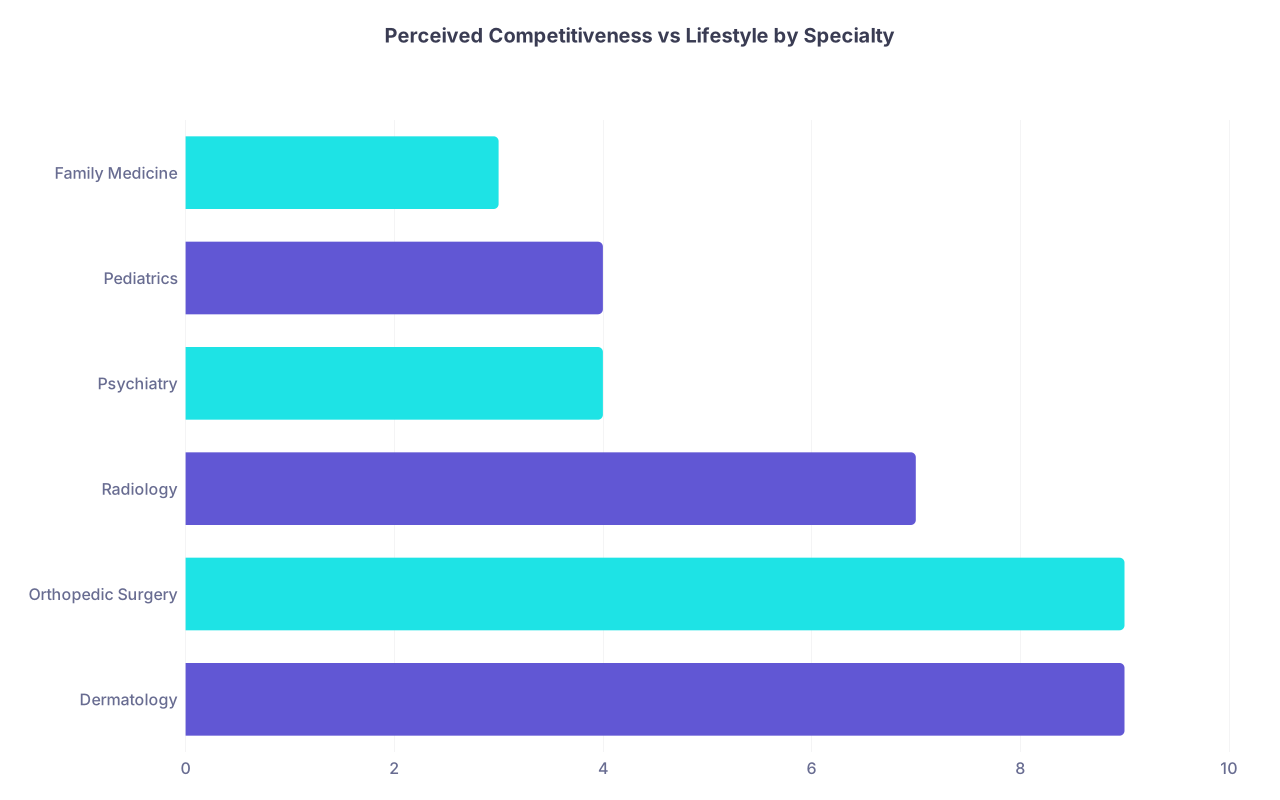
| Category | Value |
|---|---|
| Dermatology | 9 |
| Orthopedic Surgery | 9 |
| Radiology | 7 |
| Psychiatry | 4 |
| Pediatrics | 4 |
| Family Medicine | 3 |
You end up in:
- Family medicine
- Psych
- Peds
- PM&R
- Maybe prelim year, planning something else
And the narrative in your head starts writing itself:
- “If this is ‘easy,’ then why do I feel lost half the time?”
- “If I’m struggling, I must be way below average.”
- “Everyone else here chose this. I… ended up here.”
It’s not just imposter syndrome. It’s imposter syndrome with an asterisk: You don’t even have the excuse of being in something hard.
That’s the part that stings.
Where this flavor of imposter syndrome actually comes from
Let’s be blunt: a lot of this garbage gets baked in during med school.
You internalize a hierarchy:
- “Smart people” go into competitive subspecialties and procedures.
- “Chill people” or “less strong” applicants go into primary care and some cognitive fields.
- If you’re in an “easy” specialty, it must mean something about your ability or worth.
You hear attendings joke:
- “If this doesn’t work out, there’s always family.”
- “Worst case, you can just do psych.”
You hear classmates:
- “I’ll apply EM as my backup.”
- “If I don’t get rads, I’ll settle for peds.”
Even if you genuinely loved family medicine since day one, it’s almost impossible not to absorb the subtext: “My field is what people choose when they fail somewhere else.”
Now pair that with:
- A less competitive match on paper (lower average scores, fewer publications).
- Rotations where people openly say, “This is just common stuff.”
- A culture of “bread and butter” cases.
And when you’re on call at 2 a.m., staring at a patient you don’t know how to manage yet, your brain goes straight to: “I’m not just behind. I’m behind in an ‘easy’ field. So what does that make me?”
The cruel mental math you’re doing
I’ve seen residents do this exact calculation in their head:
- “If others got 220 and matched here and I barely scraped 210, I must be bottom of the bottom.”
- “Other people in psych did research and I barely passed Step 1. Why did they rank me?”
- “If they knew how little I know, I’d be out.”
That mental model is trash, but it feels so real when:
- You freeze on rounds.
- You forget basic guidelines.
- You miss an obvious diagnosis and someone has to catch it.
You don’t think: “I’m a trainee learning in a steep environment.”
You think: “I am the error in the system that somehow slipped through.”
The reality: “Easy” is a lie people tell themselves
Let me be direct: no residency that hands you a DEA number, a pager, and human beings’ lives is “easy.”
The label “easy” usually means:
- Less competitive to match, statistically.
- Fewer malignant personalities in training (though plenty of exceptions).
- Fewer 100-hour call weeks or massive OR days.
It does not mean:
- Easier decisions.
- Less cognitive demand.
- Less emotional labor.
- Less responsibility.
Look at it this way:
| Aspect | Stereotype in 'Easy' Fields | Reality in Practice |
|---|---|---|
| Competitiveness | Only weaker students match | Wide range of talent, interests, backgrounds |
| Cognitive load | Simple, common problems | High complexity, multi-morbidity, ambiguity |
| Emotional burden | Low, patients are 'stable' | Chronic suffering, family dynamics, burnout |
| Responsibility | Minimal risk | Gatekeeping referrals, meds, safety, systems |
| Training difficulty | Relaxed, less intense | Different intensity, not absence of it |
A “simple” family med clinic can be:
- A 15-minute slot with a suicidal teenager.
- A non-English speaking patient with chest pain and zero follow-up.
- A 10-medication, 5-comorbidity, 3-hospitalizations-in-6-months geriatric trainwreck.
Psych isn’t easy when you’re deciding:
- Does this patient need inpatient?
- Will they hurt themselves if I discharge them?
- Am I missing a medical cause?
Peds isn’t easy when:
- The baby is febrile and no one is sure why.
- Parents are angry and terrified.
- Dosing errors could be catastrophic.
The fact that preclinical gunners don’t appreciate this doesn’t make it any less true.

Why imposter syndrome hits harder in “easy” specialties
Here’s the twisted part: you’re not crazy for feeling like this hits you harder. There are real structural reasons.
1. The bar is invisible
In Ortho, you know the stereotype: “crush Step 2, be an athlete, research, letters from big names.”
In Derm, everyone’s obsessed with being perfect on paper.
In family, psych, peds? The message is often:
- “We’re holistic.”
- “We care more about fit.”
- “We’re less numbers-heavy.”
That sounds nice… until you try to judge yourself.
What does “good enough” even mean? No one can tell you concretely, and your brain fills in the gap with: “Probably not me.”
2. Your worst fear: “Did they just need to fill spots?”
This thought is brutal and common:
“What if they ranked me just to meet quota? What if they’d have preferred someone else but didn’t have options?”
You then twist every benign moment into confirmation:
- Attending is rushed → they’re disappointed in me.
- Co-resident knows more → I don’t belong here.
- Program director says “you’re doing fine” → pity.
Reality check: programs don’t knowingly take people they think can’t finish. It’s a massive risk to them:
- Accreditation.
- Coverage.
- Reputation.
Could you be in the lower half academically? Sure. Someone has to be. That alone doesn’t equal “mistake.”
3. The “if it’s easy, why am I drowning?” spiral
This one I see constantly.
You’re:
- Working 60–70 hours.
- Barely keeping up with notes.
- Googling guidelines between rooms.
- Missing social life, missing sleep.
And yet your internal narrative says: “Everyone says my specialty is laid-back. If I’m maxed out, I must be fundamentally not cut out for medicine.”
But training is hard period.
The competitiveness of matching in has nothing to do with the cognitive and emotional hit of actually doing the job. The fact that you struggle means you’re human, not a fraud.

| Step | Description |
|---|---|
| Step 1 | Match into easy specialty |
| Step 2 | Hear people downplay field |
| Step 3 | Face normal new-resident struggles |
| Step 4 | Think If this is easy, why am I struggling? |
| Step 5 | Assume you are below average |
| Step 6 | Avoid asking questions or seeking help |
| Step 7 | Struggle more, make small mistakes |
| Step 8 | More shame and imposter thoughts |
What actually helps (that isn’t just “believe in yourself” nonsense)
I’m not going to say “just be confident.” If you could flip that switch, you already would’ve.
Here’s what actually moves the needle when you feel like the dumbest person in the easiest field.
1. Get real feedback that isn’t just vibes
Imposter syndrome thrives on vagueness.
Ask for:
- Concrete, behavior-based feedback.
Stuff like: - “In your last rotation, what do you think I did well? What should I focus on over the next month?”
- “Am I at the level you expect for this PGY year? If not, where exactly am I behind?”
Push for specifics:
- “You’re doing fine” → useless.
- “Your differential is too narrow” → something you can work on.
Once you see: “Actually, my main issue is documentation clarity and time management,” the story in your head shifts from “I’m a mistake” to “I have gaps, like everyone.”
2. Normalize how behind everyone feels
You’re comparing your internal chaos to everyone else’s curated performance.
You don’t see:
- The psych resident crying in the stairwell after a tough discharge.
- The family med intern re-checking UpToDate before every rounding point.
- The peds resident second-guessing every fever discharge.
When you start hearing real stories from co-residents, it punctures the illusion.
Ask directly:
- “What was the moment you felt most in over your head this year?”
- “What did you struggle with most as an intern?”
You’ll realize you’re not the outlier; you’re the average who thinks they’re the outlier.
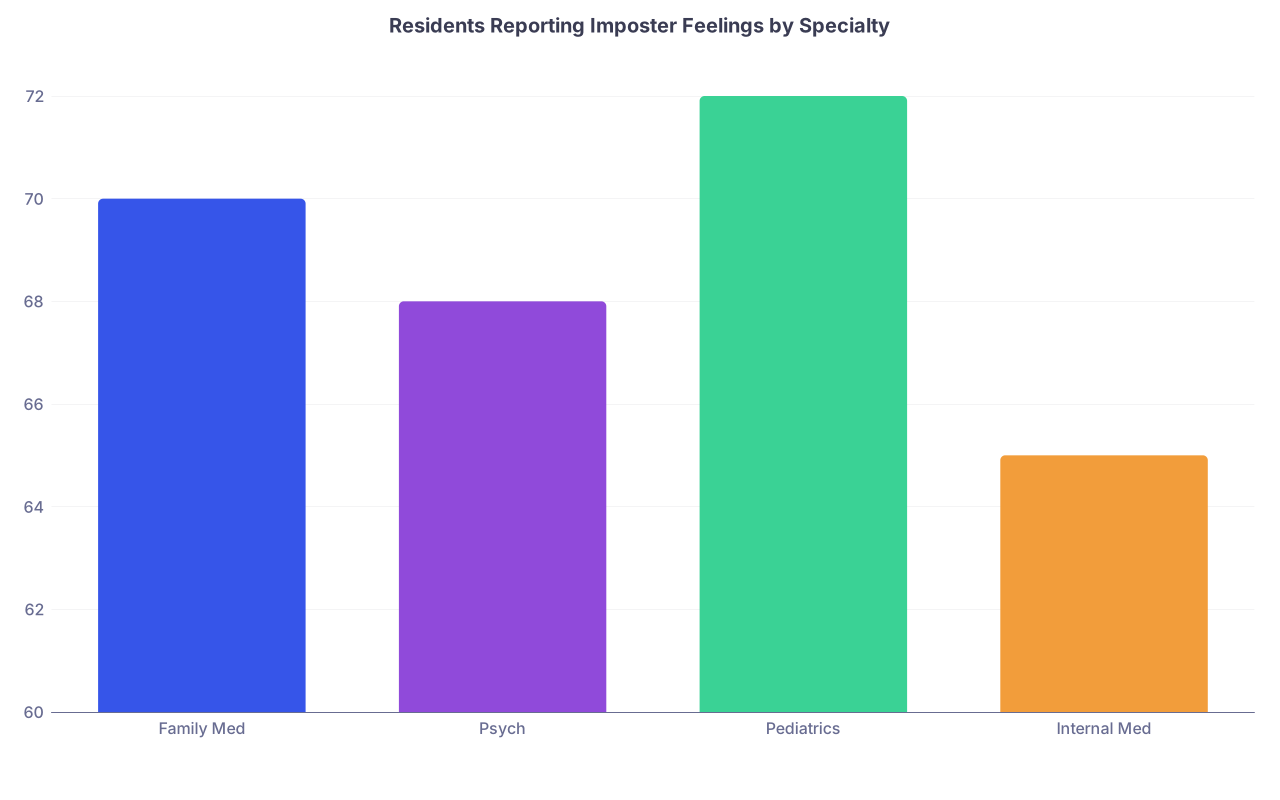
| Category | Value |
|---|---|
| Family Med | 70 |
| Psych | 68 |
| Pediatrics | 72 |
| Internal Med | 65 |
(Yes, even in less competitive fields, the majority feel this way.)
3. Stop letting preclinical culture define your worth
The med school culture that worships:
- Step scores
- Match lists
- Research prestige
…is not the culture you’ll practice in long term.
Ten years out, nobody cares that you:
- Didn’t honor medicine.
- Matched FM in a mid-tier program instead of a big-name IM.
- Switched from a “hard” specialty to “easy.”
They care:
- Do you follow through?
- Do you own your mistakes?
- Do you listen to patients?
- Do you work well with the team?
I’ve watched “average” students in “easy” specialties become the attendings everyone trusts implicitly. I’ve also seen golden CVs flame out because they couldn’t function on a real team.
4. Build a tiny, boring, repeatable competence loop
Stop trying to fix your entire self-image. Work on one small thing:
Examples:
- “On this rotation, every day I’ll read 10 minutes on one patient problem from a legit source.”
- “I’ll write down 3 things I didn’t know each shift and look them up that night.”
- “I’ll ask one clarifying question on rounds instead of pretending I understand.”
It’s boring. It’s not Instagram-inspirational.
But it does one crucial thing: it builds evidence that you are learning and improving. Imposter syndrome’s favorite food is your lack of visible progress. Starve it.

5. Say the quiet part out loud to someone safe
You need at least one person who’s heard you say it directly:
“I feel like I only got into this program because they needed to fill spots, and I’m scared I’m going to hurt someone because I’m not good enough.”
Say it:
- To a trusted senior resident.
- To a faculty member you actually like.
- To a therapist (highly recommend, especially during PGY1–2).
You’ll usually hear some version of:
- “I thought that too.”
- “We don’t take people we don’t believe in.”
- “Here’s where you’re actually strong.”
And if you hear nothing supportive? That’s data about them, not you.
The hard truth you probably need to hear
If you’re this anxious about failing your patients, that already puts you ahead of some people who should be worried and aren’t.
Truly unsafe physicians usually have:
- Overconfidence.
- Lack of insight.
- No anxiety about their performance.
You:
- Ruminate about missing something.
- Feel sick at the thought of harming someone.
- Obsess about whether you deserve to be here.
That doesn’t mean you’re perfect or safe by default. It does mean you have the one trait that predicts long-term growth: self-scrutiny.
Feeling like an imposter in an “easy” specialty doesn’t mean:
- You chose wrong.
- You weren’t good enough for something else.
- You’re secretly incompetent.
It usually means:
- You absorbed a toxic hierarchy message.
- You care deeply about doing good work.
- You haven’t yet seen enough proof of your own competence to believe in it.
You will, if you stay in the game long enough. And yeah, the game is exhausting.
Years from now, you won’t remember which specialties your classmates called “easy.” You’ll remember the faces of your patients and whether you showed up for them—especially on the days you were most afraid you didn’t belong.