
It’s 11:47 p.m. You’ve got a half-eaten protein bar on your desk, your Step score report on one side, and a Google tab open to “least competitive residency specialties” on the other. You keep bouncing between Reddit doom posts and program websites, convinced some invisible door just slammed shut on every “good” specialty.
You’re not just wondering what you can match into. You’re wondering if you’ve already failed. If your score basically sentenced you to whatever’s left over after everyone else gets what they want.
Let’s talk about that. Honestly. With all the anxiety and worst-case scenarios on the table.
Because I’ve seen this spiral before:
“One low board score = lifetime of misery in a specialty I hate.”
That’s the story your brain is telling you right now. It’s also wrong. But we’ll get to that.
First: Are You Actually “Forced” Into Low-Competition Specialties?
Let me be blunt: almost nobody is literally “forced” into the absolute least competitive specialties off a single score. But it can feel that way when you’re staring at:
- A Step 1 fail or low pass
- A Step 2 in the low 210s–220s
- A non-US grad label
- Or a mix of these
And you’ve got classmates talking about derm, ortho, plastics, rads, as if those are just standard options.
Your brain hears:
“If I’m not top tier, I only get the crumbs: FM, psych, IM in the middle of nowhere. Maybe pathology if they’ll even take me.”
Reality is more complicated.
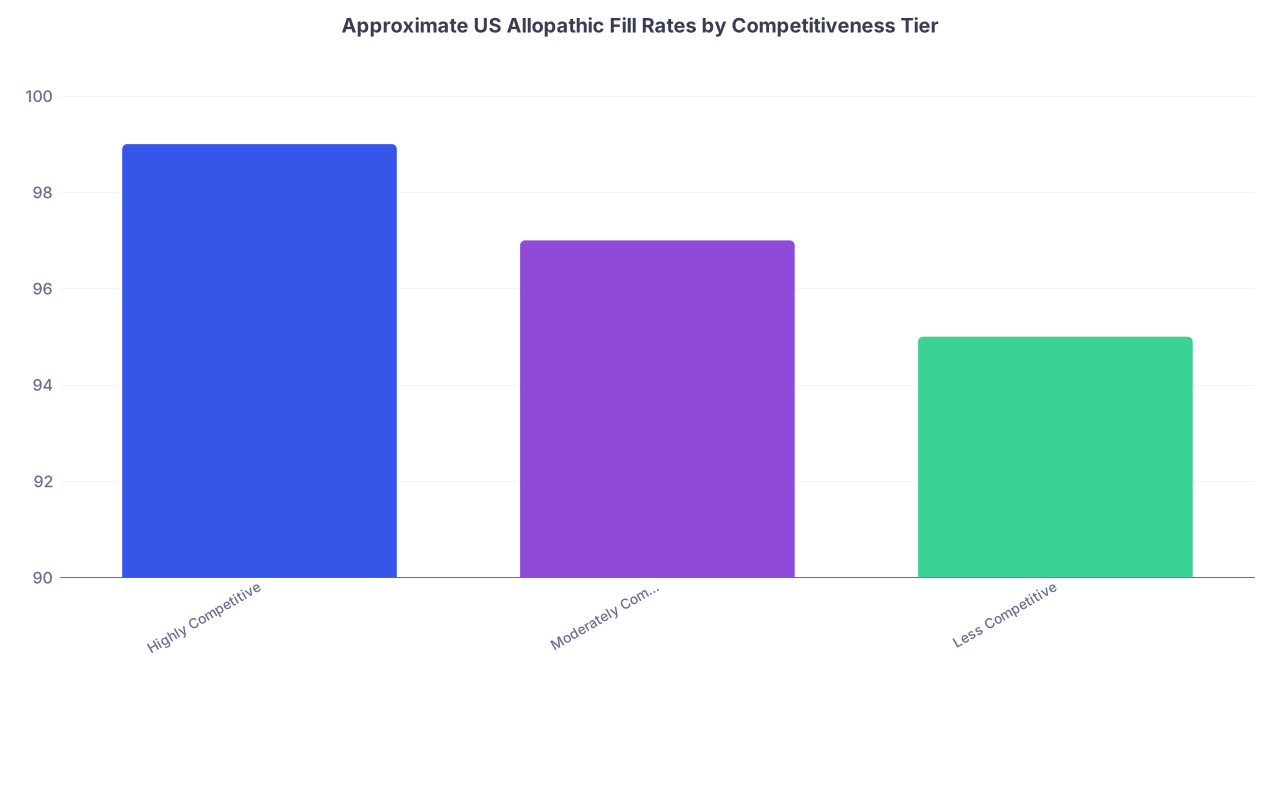
| Category | Value |
|---|---|
| Highly Competitive | 99 |
| Moderately Competitive | 97 |
| Less Competitive | 95 |
Even the “least competitive” specialties still fill most of their spots. Which means:
- There is competition.
- People in those specialties chose them on purpose, not just by default.
- Programs still use more than just Step scores.
But I get what you’re really asking:
“Given my scores, do I have to* give up the specialties I actually want, and go for ones I don’t?”
The honest answer:
Sometimes yes, your score narrows your realistic shot at the ultra-competitive ones.
But no, it doesn’t automatically shove you into misery.
The danger is you panic and:
- Flee into a specialty you barely understand, just because “it’s easier to match”
- Or cling desperately to an unrealistic top-tier specialty and end up unmatched
Both are avoidable. If you slow down and actually look at what “least competitive” means in practice.
What Are Considered “Least Competitive” Specialties Right Now?
Let’s name what you’re probably worried about. The usual “less competitive” basket looks something like:
- Family Medicine
- Psychiatry
- Internal Medicine (non-competitive academic tracks)
- Pediatrics
- Pathology
- PM&R (though this is creeping up)
- Neurology (varies by region/program)
- Some community-based OB/GYN and gen surgery programs, depending on region
Are these truly “easy”? No. Are they often more forgiving of lower scores? Yes.
Here’s a sanity-check style table. It’s broad, approximate, not gospel. But it gives you a feel:
| Category | Step Flexibility (very rough) | How Much Other Stuff Matters |
|---|---|---|
| Derm, Plastics, Ortho, ENT | Very low | Research, connections huge |
| EM, Gen Surg, Anesth, Rads | Low–moderate | Rotations, letters critical |
| IM (academic), OB/GYN, Neuro | Moderate | Mix of scores + letters |
| FM, Psych, Peds, Path, PM&R | Higher | Fit, story, letters, red flags management |
You can absolutely build a great life and career in any of those “least competitive” ones. I know, I know—right now that sentence just sounds like forced optimism. But I’ve watched people end up genuinely happy in specialties they once swore were “backup only.”
The more useful question is:
“Given my scores and application, where do I still have agency?”
Worst-Case Scenarios You’re Probably Running in Your Head
Let’s drag the ugliest ones out into the light.
1. “If I don’t match into a flashy specialty, I’ve failed.”
I’ve seen this exact pattern:
- M3 wants ortho. Scores: 205 Step 1 (back when it was scored), 214 Step 2.
- Advisors gently push: “Consider backup plans.”
- They hear: “You’re not good enough for the real doctor specialties.”
- They feel humiliated and start doom-scrolling match stats.
End result? They apply to like 15 ortho programs and 3 prelim medicine spots. Don’t match. Sink into a brutal year of “should I even keep going?”
Then they re-apply. To PM&R. With a tightly written story about function, pain, rehab, sports, continuity of care. Get 11 interviews. Match. Now, three years later, they’re doing sports/Spine PM&R and love their life.
Did the score narrow doors? Yeah.
Did it force them into misery? No. Their strategy almost did.
2. “If I go into a less competitive specialty, everyone will assume I wasn’t smart enough.”
Here’s the thing: people in “less competitive” fields often… chose them. On purpose. The stereotype that “FM/psych/peds are just for weaker applicants” is lazy and honestly kind of gross.
Attendings are not standing around whispering, “Yeah, she’s ‘just’ psych because she bombed Step.” They’re mostly thinking: “Does this resident show up prepared and take care of patients or not?”
Your classmates bragging about ortho and derm? Half of them are bragging because they’re insecure. That’s their problem, not your measure of value.
3. “If I pick a less competitive specialty and hate it, I’m stuck forever.”
Residency isn’t a binding lifelong prison sentence. Switching is hard, but people do it every single year. Often from “less competitive” to “more competitive” and the other way around.
You’re not picking your forever-identity. You’re picking your next best realistic step given:
- Your application
- Your mental health
- Your risk tolerance
- Your actual daily life preferences
That’s it.
How to Decide if You Should Pivot to a Less Competitive Specialty
You want a clear decision tree. Not vibes. Not shame. Let’s outline it.

| Step | Description |
|---|---|
| Step 1 | Start - Current Scores |
| Step 2 | Talk to advisor with data |
| Step 3 | Plan dual-application |
| Step 4 | Apply primarily desired |
| Step 5 | Pivot to less competitive |
| Step 6 | Build targeted app for both fields |
| Step 7 | Go all-in on less competitive field |
| Step 8 | Optimize for desired specialty |
| Step 9 | Desired specialty realistic? |
| Step 10 | Willing to risk going unmatched? |
Here’s how to run this without gaslighting yourself or being delusional.
Get program director–level honesty.
Not just your friendly preclinical advisor who says “follow your dreams.” You want the stone-cold “If you were my kid, I’d say…” honesty.Ask them directly:
- “With my scores and CV, what’s your realistic percentage guess of me matching into [X] first try?”
- “Would you recommend:
- Single-field application
- Dual-application
- Or pivot fully?”
Match that answer to your anxiety profile:
- If your risk tolerance is low and the field is cutthroat → a full pivot might genuinely protect you.
- If you’d always wonder “what if” and your app isn’t terrible → dual application might be better.
You’re not weak for pivoting. You’re not reckless for trying once. You’re only in danger if you ignore data.
Making “Low-Competition” Not Equal “Low-Options”
Here’s the core fear: that these specialties equal “less money, less respect, less freedom, less interesting work.” You’re scared you’ll wake up 10 years from now resentful and stuck.
Let’s gut-check that with reality.
Family Medicine
Scared of: “Clinic mill, burned out, no money.”
Reality range:
- You can work inpatient, outpatient, OB, urgent care, sports med, addiction, academic teaching.
- Salaries in many regions are not “poor” at all. Often solid six figures.
- You can heavily shape your schedule and niche if you’re intentional.
Psychiatry
Scared of: “Endless paperwork, no real medicine, everyone thinks it’s fake.”
Reality range:
- High demand, lots of private practice and telehealth flexibility, good pay.
- Strong niche options (forensics, child, addiction, interventional like TMS/ketamine).
- Lifestyle control can be very high compared with most fields.
Pediatrics
Scared of: “All vaccines and runny noses, low pay, no respect.”
Reality range:
- Hospitalist, NICU, PICU, subspecialty fellowships (cards, heme/onc, GI, etc.).
- Yes, baseline general peds pay is lower. But fellowships, leadership, or academic roles can shift that considerably.
Pathology
Scared of: “Basement dungeon, no patients, dead-end.”
Reality range:
- Central to literally every cancer diagnosis.
- Subspecialties: heme, dermpath, cytology, forensics, molecular.
- Less direct patient drama, more focused analytical work. Great for certain personalities.
PM&R
Scared of: “Glorified PT, no real procedures, niche and weird.”
Reality range:
- Spine, pain, sports, EMG, brain injury, stroke rehab.
- Combines neuro + MSK + longitudinal care.
- Procedure-heavy paths exist. Pain fellowship is competitive but real.
Point is: “least competitive” ≠ “minimal upside.” It just means the barrier to entry is lower, not that the ceiling is low.
What To Do If You Pivot: How To Not Look Like You Settled
If you do decide, “Okay, I think I should go for a less competitive field,” your new enemy is the vibe of: “I’m only here because nothing else wanted me.”
Program directors smell that from a mile away. And they hate it.
You need to build a coherent story that:
- Admits your academic reality without dramatics
- Shows a real, positive reason you’re choosing this field
- Backs it up with actions, not just words
Concrete steps:
Get 2–3 strong letters in the new field.
Not lukewarm “they were fine on rotation.” Ask:
“Do you feel you can write me a strong letter?”
If they hesitate, that’s a no.Do at least one away or elective that screams commitment.
For FM: rural, underserved, continuity-heavy site.
For Psych: CL psych, addiction, child.
For PM&R: inpatient rehab + outpatient MSK/spine.Fix the obvious holes.
- Failed Step? Address it briefly in the personal statement: what changed, what improved.
- Big gap? Explain the context like an adult.
Not tearful, not defensive. Just: “Here’s what happened, here’s what I learned, here’s why it won’t repeat.”
Write a personal statement that’s not a eulogy for your original dream.
Don’t write: “I wanted ortho but sadly my scores…”
That’s suicide.
Write:- What parts of medicine light you up (relationships, complex psychopharm, function, rehab, systems-level care, etc.)
- How this specialty lets you do that every single day
- What you’ve actually done that aligns with it
Apply broadly and realistically.
There is no prize for “fewest applications sent” if you’re at high risk.
Consider community programs, less trendy geographic areas, newer programs.
Coping With the Identity Hit
This part nobody wants to talk about: grieving.
If you’ve spent 3 years saying “I’m going to be a surgeon/derm/ortho person” and then pivot to FM or psych, it can feel like a death. Of the imagined future you.
Let yourself be sad about that. Ashamed, even, for a bit. Then do something useful with it.
Things that actually help:
- Talk to residents in the “less competitive” specialties who love their lives. Ask them what they thought as M3s.
- Unfollow or mute the classmates whose “Matched into [insert fancy specialty]!!!” posts push you into a shame spiral. At least temporarily.
- Limit the doom-scrolling through NRMP charts. Set a time box: 30 minutes, then stop. Screenshots if you need them later.
You’re not weak for feeling this loss. You’re human. But you can’t let that feeling choose your specialty for you.
A Quick Reality Check on Outcomes
You want to know: “If I go this route, what does my life actually look like?”
Here’s the unsexy truth I’ve seen play out over and over:
- The psych resident with a 215 Step 2 who graduates, works 4 days a week, has time to see their kids, and makes more than they ever thought they would.
- The FM doc who’s basically the town hero in a rural area, knows every patient by name, and quietly pays off their loans in 7–8 years.
- The peds hospitalist who adores their colleagues and has a stable, predictable schedule and a fellowship under their belt.
- The gen IM doc who went into hospitalist work, then transitioned to admin/quality roles and now rarely does nights.
And the flip side:
- The derm resident who hates outpatient clinic but feels trapped because they spent a decade building this identity.
- The ortho attending who barely sees their family and can’t quit because their overhead and lifestyle are chained to the high salary.
Your score shapes what’s easiest for you to get into. It doesn’t define what’s meaningful to you 5–10 years from now. You need to stop reading it like a personality test.
FAQ (Exactly 4 Questions)
1. With a Step 2 score in the low 220s, is something like anesthesia, EM, or radiology totally off the table?
Not automatically, but the margin is thin and program-dependent. For moderately competitive specialties like those, a low 220s score means you’re going to need:
- Strong home/away rotation evaluations
- Great letters
- Little to no other red flags
You’re not categorically barred, but you may need to apply very broadly and seriously consider a backup (either dual-apply or accept a more forgiving field). A good PD or advisor can tell you if your overall file has enough strength to justify trying once vs. pivoting now.
2. Is dual-applying viewed negatively by programs in less competitive specialties?
They expect it. Especially in fields that are common “backups.” The issue isn’t that you dual-apply; the issue is if you look like you don’t actually care about their field.
If your entire application screams “I only want [flashy specialty]” and your FM or psych application looks like an afterthought, they’ll pass. If, on the other hand, you can articulate a clear, believable reason why both fields would genuinely work for you—and your actions back that up (rotations, letters)—you’re fine.
3. How do I talk about a failed Step exam without tanking my chances, even in less competitive specialties?
Keep it short, factual, and growth-focused. One paragraph in your personal statement or a brief explanation in the ERAS “other” section is enough. Example structure:
- One sentence about the circumstance (no excuses, just context)
- One to two sentences on what you changed (study strategy, time management, getting tested for ADHD, whatever is true)
- One sentence pointing to evidence it worked (improved Step 2 score, shelf scores, clinical evaluations)
Programs in less competitive specialties have seen this a lot. They mostly care if you’ve stabilized, not if you were perfect.
4. If I go into a less competitive specialty now, can I realistically switch to a more competitive one later?
Possible? Yes. Easy? No. People do it, but it usually takes:
- Stellar performance in your current residency
- Strong advocacy from faculty
- Sometimes an extra research year or targeted electives in the new field
You shouldn’t pick a specialty only as a stepping stone unless you’d be genuinely okay staying. If you’d be absolutely devastated to remain in that field, that’s a risky plan. But if you see it as, “I can live with this, and if a door opens later, I’ll take it,” then it can be reasonable.
Today, do one concrete thing:
Email one person (PD, trusted advisor, or resident in a “less competitive” specialty you’re considering) and ask for a 20–30 minute brutally honest conversation about your competitiveness and options. No more guessing, no more Reddit-based career planning. Get actual data from someone who’s sat in the selection room.