
What do you do when your Step score is average, the match stats are terrifying, and your classmates keep saying, “I’m just going to pick something less competitive so I don’t go unmatched”?
Here’s the honest answer: choosing a “least competitive specialty” purely to avoid going unmatched is usually a bad strategy. Not always. But usually.
Let’s walk through this in a structured way so you can actually make a smart call, not a fear-based one.
The Short Answer: No, But You May Need a Risk Strategy
If you just want the punchline:
No, you should not pick a specialty you do not like, only because it’s “less competitive,” just to increase your chances of matching.
You should:
- Understand your actual competitiveness (data, not vibes).
- Decide your true risk tolerance.
- Use backup strategies (safeties, dual-apply, program targeting) instead of selling your career happiness for a perceived margin of safety.
I’ve watched people do both:
- The student who loved EM but panicked and switched last minute to family medicine “just to match” — and then hated clinic and tried to re-apply to EM later. Brutal.
- The student who applied wisely to a competitive field with a realistic backup plan and matched into their first choice because they took targeted, data-based risks.
Fear-driven specialty choice is how you end up 5 years in, staring at the clinic schedule, thinking: “I traded my 20s for this?”
You’ve got better options.
What Does “Least Competitive Specialty” Actually Mean?
People toss this phrase around with no precision. They’ll say “FM is easy” or “Psych is a backup” based on vibes, not data. That’s lazy.
Competitiveness depends on at least four things:
- Number of applicants vs number of positions.
- Average Step 2 scores.
- IMG vs US grad fill rate.
- Percentage of unmatched applicants.
Here’s a rough comparison of relatively less competitive core specialties in the U.S. (this shifts year to year, but the structure stays the same):
| Specialty | Overall Competitiveness* |
|---|---|
| Family Medicine | Lowest |
| Internal Med (categorical) | Low–moderate |
| Pediatrics | Low–moderate |
| Psychiatry | Low–moderate, rising |
| Pathology | Low, variable by program |
*Relative to derm, ortho, plastics, ENT, ophtho, neurosurg, etc.
“Least competitive” doesn’t mean “anyone can match.” Weak applicants absolutely still go unmatched in these fields if they apply foolishly (too few programs, poor geography strategy, bad letters, red flags).
On the flip side, these specialties include some incredibly rigorous academic programs that are very competitive (e.g., big-name IM programs, top psych programs). So you are not “settling for easy mode” by choosing them. You’re just working with a different competitive landscape.
The Core Question: Are You Avoiding Risk or Avoiding Reality?
Before you bail on your dream field for a “safer” one, you need to answer a few blunt questions.
1. Do you genuinely like your “backup” specialty?
Not “I could tolerate it.” Not “people seem nice.” Do you actually like the work?
Ask very concrete questions:
- Do you enjoy the kinds of patients you’d be seeing daily?
- Are you okay with the lifestyle reality (not the myths) of that specialty?
- Does the training path and long-term job look like a life you’d want at 40?
If you cannot see yourself happily practicing that specialty for decades, it is a terrible idea to pick it just to improve match odds.
2. Are you actually non-competitive for your preferred specialty, or just anxious?
I’ve seen this pattern way too often:
Student: “I’ll never match anesthesia; it’s too competitive.” Me: “What’s your Step 2?” Student: “246.” Me: “Any fails?” Student: “No.” Me: “Good letters?” Student: “Yeah, from two anesthesiologists.” Me: “You’re fine. You need a strategy, not a specialty change.”
You’re not competing against a spreadsheet of dream stats. You’re competing against the actual applicant pool, including average students with messy stories and imperfect CVs. Like you.
Get real feedback:
- Ask your dean or advisor who actually sees match lists.
- Talk to PDs or APDs during rotations.
- Use NRMP Charting Outcomes, not Reddit threads.
Your feelings of doom are not data.
When Choosing a Less Competitive Specialty Does Make Sense
Sometimes picking a less competitive specialty is the smart move. But that’s only true in certain scenarios.
It makes sense to seriously consider a less competitive field if:
You have major objective red flags:
- Multiple exam failures
- Very low Step 2 score well below norms
- Required remediation, professionalism issues, extended leaves without a clean narrative
You truly enjoy one of the less competitive fields:
- You loved your FM, IM, peds, psych, or path rotations.
- You can see a satisfying career there, not just “I’ll suck it up.”
Your preferred specialty is highly competitive and your application is clearly below the typical range:
- You want derm, ortho, plastics, ENT, neurosurg, etc.
- Your scores, research, letters, and school pedigree are all substantially weaker than typical matched applicants despite realistic optimization.
This is where a lot of people need a reality check. Wanting ortho with a 215 Step 2, no research, no ortho letters, and no home program isn’t “being passionate.” It’s denial.
In those cases, yes: you should probably re-evaluate your primary target AND strongly consider a less competitive specialty that you can be happy in.
A More Intelligent Approach: Risk Management, Not Panic Switching
Instead of “I’ll just go into something easy,” build an actual risk strategy.
1. Tier your specialty choices
Think of your plan in tiers, not all-or-nothing:
- Tier 1: Dream specialty (even if decently competitive).
- Tier 2: Acceptable, genuinely interesting backups.
- Tier 3: Last-resort options only if absolutely necessary.
You should never be gunning for Tier 3 as your actual plan. That’s where long-term burnout lives.
2. Use dual-application strategically
Dual-apply is not weakness. It’s risk management.
Common smart dual-apply setups:
- EM + IM (or FM) when EM volatility is concerning.
- Competitive IM programs + community IM programs.
- Anesthesia + IM or FM if your scores are borderline.
The trick is: don’t split your efforts so much that you look mediocre in both. You still need a coherent narrative for each.
3. Apply broadly and flex on geography
This is where students tank themselves in “less competitive” fields:
- Applying to 30 FM programs all in one desirable city? Dangerous.
- Applying to 80+ across multiple states, including community and mid-tier academic programs? Much safer.
The less competitive the specialty, the more geography and program type matter. Lots of people go unmatched not because of their specialty choice, but because they refuse to leave one metro area.
The Real Cost of Choosing a Specialty You Don’t Like
You’re not choosing a one-year contract. You’re choosing:
- 3–7 years of training
- Then 20–30+ years of practice
So what does it actually cost to pick something you don’t like?
Chronic dissatisfaction
You’re in clinic, or the OR, or the reading room, day after day, doing work that doesn’t fit you. That trickles into everything: home, relationships, health.Higher burnout risk
Burnout isn’t just about hours. It’s about misfit. Wrong specialty + moderate workload can feel worse than right specialty + worse hours.Locked-in identity
Changing specialties after residency is possible but very hard:- Reapplying
- More exams
- Income hit
- Moving again
You are much better off spending one extra year (research year, SOAP, re-applying smartly) than spending 30 years in the wrong field.
Hard Truths: When Safest-Path Thinking Backfires
Safe on paper doesn’t mean safe in real life.
I’ve seen:
- An anxious but strong applicant bail from anesthesia to IM “for safety,” then match into a community IM program they didn’t like, with limited fellowship options. They absolutely could have matched gas with a focused application.
- A student pick FM “because it’s easy” and then discover they hate chronic outpatient management and business-side primary care. They wanted procedures and acute care. They should have looked at EM, IM with hospitalist focus, or anesthesia.
The common pattern? Decisions driven by fear, not by honest self-assessment plus strategic planning.
How to Decide: A Simple Framework
Use this framework instead of Reddit panic or hallway gossip.

| Step | Description |
|---|---|
| Step 1 | Identify Top Choice Specialty |
| Step 2 | Assess Objective Competitiveness |
| Step 3 | Apply Primarily to Top Choice |
| Step 4 | Add Strategic Backup Specialty |
| Step 5 | Explore Less Competitive Fields You Like |
| Step 6 | Apply Broadly and Targeted |
| Step 7 | Commit to Field You Can Enjoy Long Term |
| Step 8 | Within Typical Range? |
Step-by-step:
- Identify your true first-choice specialty.
- Get data-based feedback on your competitiveness.
- If you’re roughly in range:
- Apply to it as your main focus.
- Use geography and program tier as your safety valves.
- If you’re borderline:
- Consider dual-apply with a field you legitimately like.
- If you’re clearly not competitive:
- Redirect early to specialties you could actually enjoy that have lower barriers.
Notice what’s missing: “Panic and pick something you don’t like because it seems easy.”
Match Safety Without Selling Your Soul
If your anxiety is sky-high, do these three things:
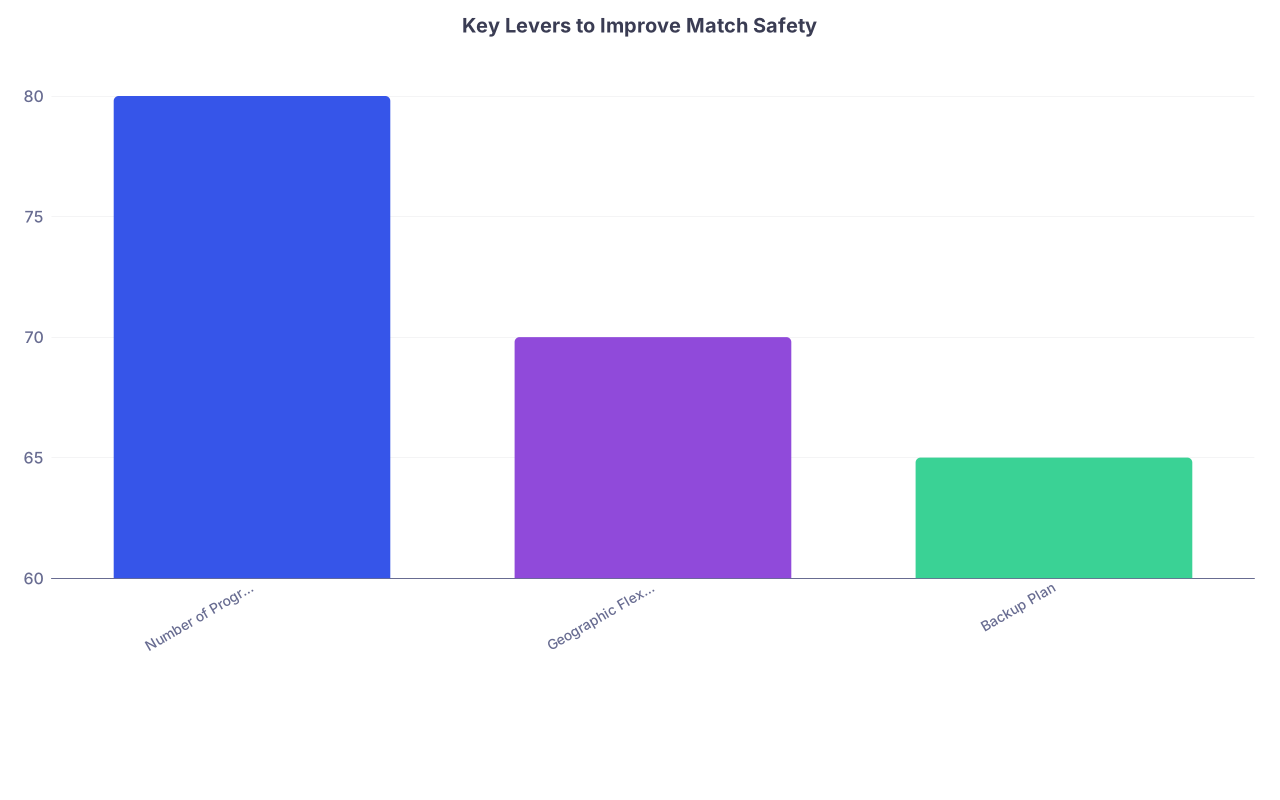
| Category | Value |
|---|---|
| Number of Programs | 80 |
| Geographic Flexibility | 70 |
| Backup Plan | 65 |
The biggest levers are:
Number and type of programs applied to
Broad > narrow. Include community, mid-tier academics, non-coastal areas.Geographic flexibility
Open to “less sexy” states? Your match odds go up fast.Backup structure
Dual-apply where appropriate, or have a clear re-apply plan if needed.
Common “Least Competitive Specialty” Myths
Let’s kill a few bad ideas.

Myth 1: “I’ll just switch later if I don’t like it.”
Reality: Switching specialties after finishing or even during residency is possible but complex, competitive, and disruptive. Don’t plan on it as your primary strategy.
Myth 2: “Less competitive = easy lifestyle.”
Reality: Family med and IM outpatient can be grueling. Psych call at some hospitals is rough. Path can be high volume and high stakes. Lifestyle depends far more on practice setting than the NRMP match rate.
Myth 3: “If I don’t match my dream field the first time, my life is over.”
Reality: Plenty of people:
- Do a research year and reapply.
- SOAP into a prelim year and re-strategize.
- Shift to another field and end up happier than they expected.
You’re stacking decades of practice on this choice. One extra year to get it right is not a catastrophe.
Practical Steps You Can Take This Month
Here’s what I’d have you actually do, not just think about.
| Week | Key Task |
|---|---|
| 1 | Get honest feedback on your stats |
| 2 | Do 2+ days of real shadowing in top 2–3 fields |
| 3 | Map primary and backup specialty strategy |
| 4 | Build a target program list (broad, tiered) |
And if you’re early in training (MS1–MS2): explore widely, document what energizes vs drains you, and stop treating “least competitive” as a synonym for “lesser.” It is not.
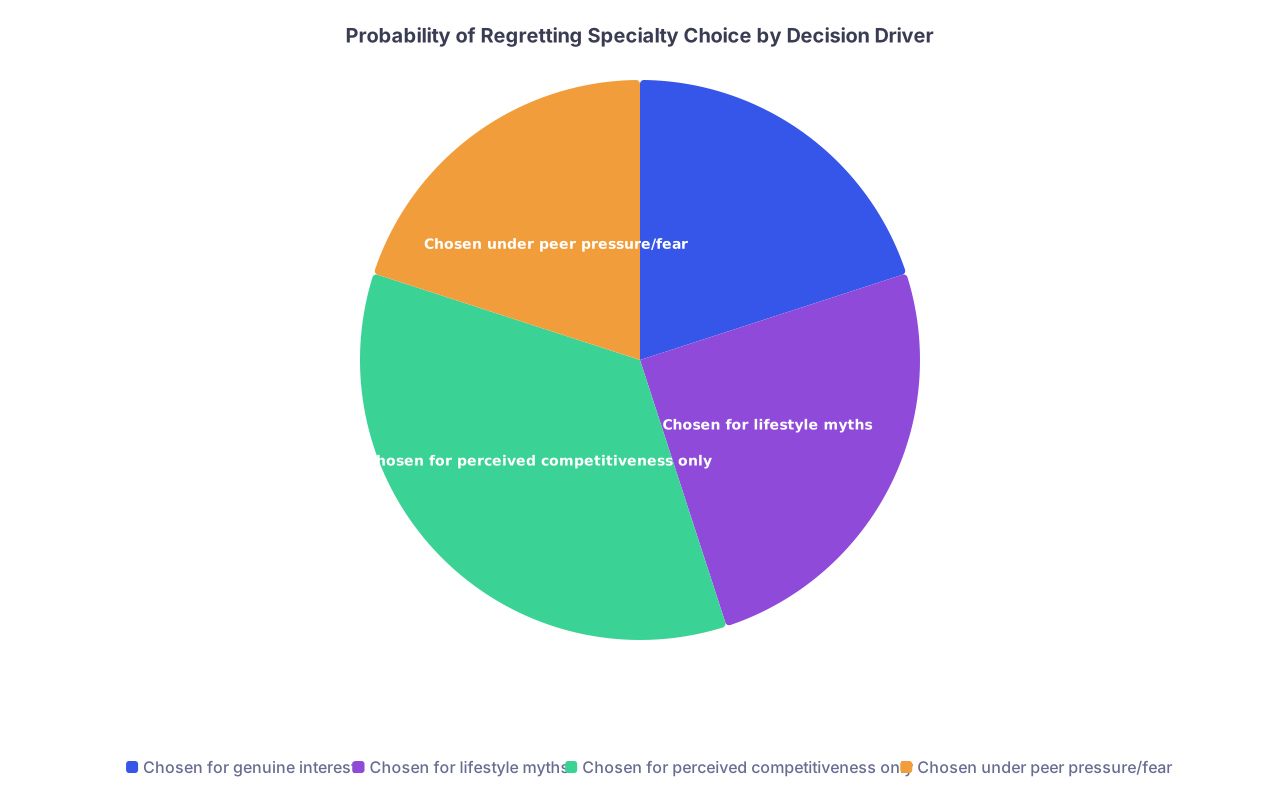
| Category | Value |
|---|---|
| Chosen for genuine interest | 20 |
| Chosen for lifestyle myths | 25 |
| Chosen for perceived competitiveness only | 35 |
| Chosen under peer pressure/fear | 20 |
No, those percentages are not real NRMP data. They’re illustrative. But they match what I’ve watched happen: the more your choice is driven by fear and myths, the more likely you are to regret it.
FAQ: Least Competitive Specialties & Match Strategy
1. If I really want a super competitive specialty, should I still apply to it or just go straight to a safer field?
Apply if you can build a plausible, coherent application and you’re willing to accept the risk of going unmatched or needing a re-application year. But do it with:
- A realistic understanding of your chances.
- A concrete backup (dual-apply or re-apply plan). If you are wildly below the usual floor for that specialty, then no — that’s wasted time and money. Aim for something where you can actually be in the conversation.
2. How do I know if I should dual-apply versus commit to one specialty?
Dual-apply if:
- You genuinely can see yourself happy in either field.
- Your competitiveness for your first-choice is borderline, not clearly strong or clearly impossible. Commit to one if:
- You’re a solid or strong candidate for that field with no major red flags.
- Or your second field would be purely “I hate this but it’s safer.” That’s a sign you should not use it as a backup; you should rethink the whole plan.
3. Is family medicine just the “dumping ground” for people who can’t match other fields?
No, and that mindset is ignorant. FM has:
- Broad scope (procedures, inpatient, outpatient, OB in some places).
- Huge variation in practice styles and income.
- Some extremely competitive academic and rural tracks. Yes, some use it as a safety net. But plenty of people choose FM deliberately and are happier and more flexible than many “prestige” specialties.
4. Can I go into a competitive fellowship if I pick a less competitive core specialty like IM or FM?
Yes, with caveats. From IM, you can aim for cards, GI, pulm/crit, etc. From FM, some fellowships (sports, geri, hospice, OB, EM in some tracks) are realistic. What matters:
- Quality of your residency.
- Your performance, research, and letters. Don’t assume your “less competitive” core automatically blocks you. But don’t be naive either — some paths are much harder from certain cores.
5. I’m an IMG with average scores. Should I just pick the least competitive specialty to maximize match odds?
You should pick from the specialties where IMGs realistically match in decent numbers: FM, IM, peds, psych, pathology, some anesthesia and neurology, depending on year and region. Among those, choose the ones you like and then apply aggressively and broadly. “Least competitive” helps, but your strategy (program list, geography, networking) will matter more.
6. What if I truly don’t know what I like and I’m already late in third year?
Stop theorizing and start experiencing. In the next 4–6 weeks:
- Do focused shadowing days in FM, IM, psych, and one more field you’re curious about.
- Ask residents, “What does a bad day in this job look like?” and see which bad version you can tolerate. If you still can’t choose, lean toward a broad-base field (IM or FM) that keeps doors open, rather than a niche “backup” you barely understand.
7. I’m terrified of going unmatched. What’s the single most protective thing I can do besides picking an “easy” specialty?
Apply broadly and intelligently. That means:
- Many programs (often 60–100+ in primary care fields if you’re not stellar).
- Wide geographic spread, not just coasts and big cities.
- A strong, coherent application in a field you can genuinely stand behind. Switching to a “least competitive specialty” won’t save you if your strategy is sloppy. But a smart strategy can often save you without sacrificing your career fit.
Open a blank page and write down:
- your true first-choice specialty,
- one or two backups you could actually live with,
- whether your current plan is driven more by fear or by data.
If the answer is “fear,” today’s job is to fix the plan — not your dream.