
The biggest myth about “least competitive” residencies is that your metrics do not matter. They do. They just matter differently—and in a different order—than they do for derm or ortho.
You’re not trying to impress a committee that screens out 80% of applicants at Step cutoffs. You’re trying to look like a safe, reliable, trainable resident who will show up, get along, and not cause headaches. That changes which numbers and “scores” matter most.
Here’s the straight breakdown.
The Metrics That Actually Matter Most (In Order)
If you are aiming at the least competitive specialties—think family medicine, internal medicine at community programs, pediatrics at mid-tier institutions, psychiatry at non-name-brand places, pathology at many sites—the priority stack usually looks like this:
- Are you going to graduate and get licensed?
- Are you a headache or are you dependable?
- Are you at least minimally competent on exams?
- Do you fit what this specific program needs this year?
That vague language maps to specific, trackable metrics. Roughly in this order:
- Professionalism / red flags (narratives, dean’s letter, MSPE comments)
- USMLE/COMLEX passage status and timing (Step 1 Pass, Step 2 CK score)
- Clinical grades and sub-internship performance
- Letters of recommendation (especially from core rotations)
- School type and visa status (for IMGs/FMGS)
- Number of programs applied to and geographic alignment
- “Bonus” metrics (research, leadership) – helpful, not central
Let me unpack each with some nuance so you stop obsessing over the wrong numbers.
1. The Hidden Metric: Red Flags and Reliability
Programs in less competitive specialties are not drowning in 260+ applications. They’re drowning in applicants with inconsistent stories, professionalism issues, and vague red flags.
So the first “metric” that matters is: can they trust you?
They judge this through:
- MSPE / Dean’s Letter language
- Narrative comments on clinical rotations
- Any failures, leaves of absence, remediation
- Pattern of late Step exams or repeated gaps
Concrete examples of red flags that hurt even in the least competitive programs:
- “Required remediation of professionalism concerns” in MSPE
- Course failures (especially repeated) with weak explanation
- Step 1 or Step 2 CK/COMLEX Level failures without clear recovery
- Multiple LOAs that aren’t cleanly explained
If you’ve got any of this, your most important “metric” isn’t raising your Step 2 CK by 5 points. It’s:
- Showing a clear upward trajectory
- Getting very strong, specific LORs that say “reliable, works hard, no issues”
- Explaining gaps cleanly and briefly in your application
Programs will absolutely take a lower scorer with no drama over a high scorer with messy professionalism language.
2. Step Scores for Least Competitive Programs: How Much Is Enough?
For the least competitive specialties, Step scores are more like a safety check than a weapon.
Most community programs just want to see:
- Step 1: Passed (preferably on first try)
- Step 2 CK: Solid enough to suggest you’ll pass your specialty boards
For US MDs:
- Step 2 CK ≥ 220 is usually “fine”
- 230–240 is good and can offset mediocre grades
- Below ~215 gets more variable—some programs worry, some don’t if everything else is strong
For DO/IMG/FMGS, the bar shifts slightly:
- DO with COMLEX only: Level 1/2 passes are key, but a USMLE Step 2 CK score helps at many non-DO-heavy programs
- IMGs/FMGs: programs often quietly have higher informal score expectations (e.g., Step 2 CK ≥ 230–235) even for “non-competitive” specialties
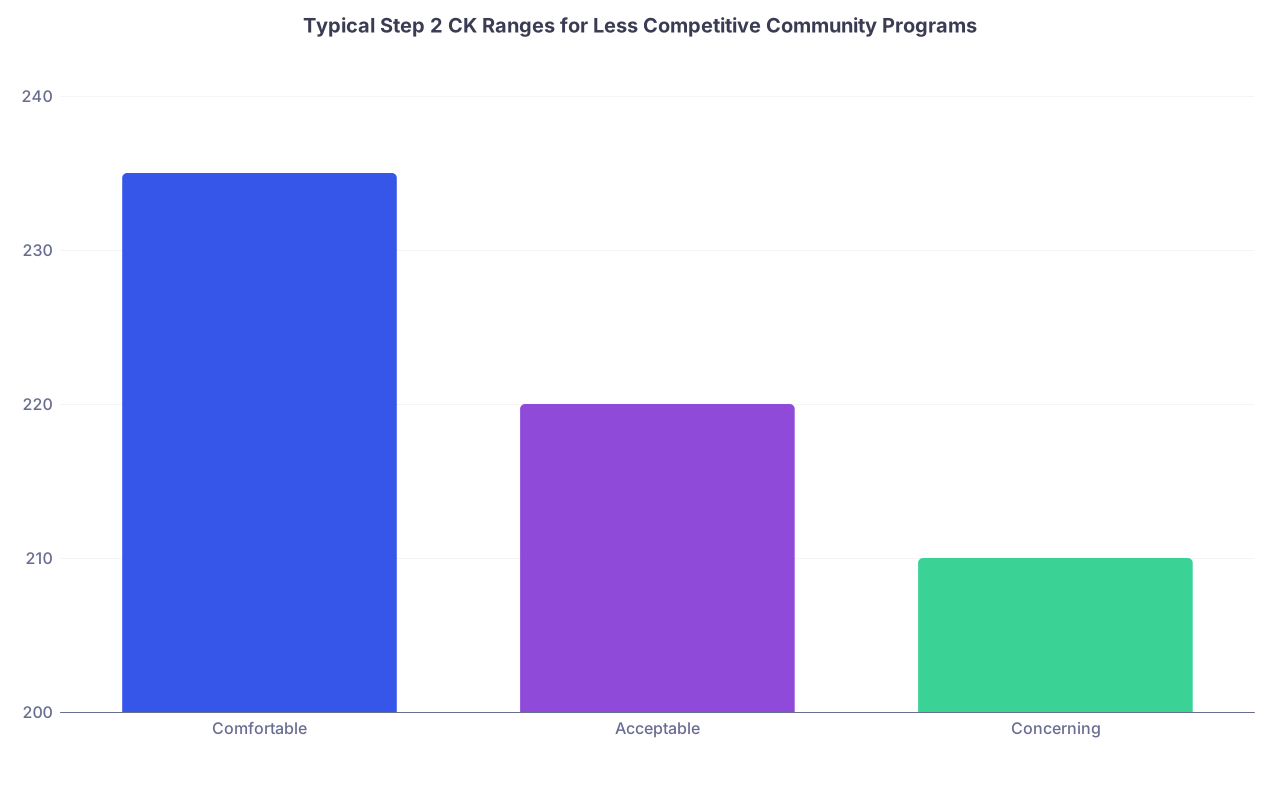
| Category | Value |
|---|---|
| Comfortable | 235 |
| Acceptable | 220 |
| Concerning | 210 |
You don’t need a monster score. But you do need to avoid creating anxiety about board passage. That’s the operative concept.
If you’ve already taken Step 2 CK and it’s mediocre, your energy is better spent on LORs, rotations, and a smart application strategy than on handwringing.
3. Clinical Performance: Your Real “Competence Metric”
In less competitive specialties, clinical evaluations often carry more weight than students realize.
Programs look at:
- Core clerkship grades (IM, FM, Peds, Psych, Surgery, OB/GYN)
- Sub-internship / acting intern evaluations, especially in the target field
- Narrative comments: “works well with team,” “takes ownership,” “excellent rapport with patients”
Patterns that help:
- Strong evaluations and/or honors in the specialty you’re applying to
- Upward trend: early mediocre grades → later strong clinical performance
- Comments about reliability, communication, and work ethic
Patterns that hurt, even with okay test scores:
- Repeated “needs reminders to be on time” / “inconsistent follow-through”
- Poor grades in the target specialty (e.g., Pass in IM when applying IM, with no explanation)
- No sub-I in the specialty at all (suggests you’re not committed or were blocked)
If your transcript is average but clean, you’re not sunk. Many least competitive programs are very happy with a “solid, middle-of-the-pack” student who is pleasant and teachable.
If you’re weaker on paper, you must:
- Crush your sub-I or away rotation in the field
- Get a letter from that rotation that clearly says, “This person functions at or above intern level”
That one rotation can outweigh a lot of earlier mediocrity.
4. Letters of Recommendation: The Tie-Breaker Metric
In top-tier fields, program directors sometimes use LORs as decoration—they’re all glowing, nobody cares. In less competitive fields, LORs function more like a background check.
They’re reading for:
- “Would I want this person on my team at 3 a.m.?”
- Any subtle red flags
- Any strong, specific praise that stands out from the usual fluff
Letters that matter most:
- From core faculty in the specialty (e.g., FM chair for family medicine, IM faculty for internal medicine)
- From your sub-I or away rotation mentor
- From someone who knows you very well (even from another field) and can speak concretely
Red flag LOR patterns:
- Vague, template-sounding letters with no examples
- Short letters with generic praise and no enthusiasm
- Hints like “with appropriate supervision, should do well” without stronger backing
If your metrics are average, powerful LORs can move you from “maybe” to “interview.”
5. School Type, IMG Status, and Visa: The Brutal Reality Metrics
For least competitive specialties, the biggest “competitiveness” filter often isn’t score—it’s category:
- US MD
- DO
- US-IMG
- Non-US IMG
And for IMGs: Visa vs no visa.
Programs absolutely look at these “meta-metrics” because they correlate with paperwork burden and perceived training reliability.
Here’s how this plays out for community programs in low- to mid-tier specialties:
| Applicant Type | Typical Baseline Chance* | Notes |
|---|---|---|
| US MD | Highest | Can match with modest scores/grades |
| DO | High | Strong in FM, IM, psych, peds |
| US-IMG | Moderate | Needs cleaner scores/records |
| Non-US IMG, no visa needed | Moderate | Depends on program history with IMGs |
| Non-US IMG, visa required | Lowest | Needs higher scores, strong support |
*Baseline chance assumes no major red flags and reasonable application strategy.
If you’re an IMG aiming at a “least competitive” specialty, your Step 2 CK and failure history matter more, not less. Programs may be more forgiving of US MD 215s than IMG 215s.
This is why IMGs sometimes match into internal medicine or family medicine with 240+ scores but get rejected from less competitive US MD peers with 220: the bar is simply different by category.
6. Application Strategy Metrics: How Many Programs and Where?
Here’s a metric almost nobody tracks but programs care about: signal of commitment.
Programs see:
- How many programs you applied to
- Whether you’re in their region or have geographic ties
- Your personal statement and ERAS entries for alignment
For least competitive specialties, overdoing it or being random hurts you less than in derm—but it still sends a message.
Smart numbers (rough ranges, non-IMG):
- Family Medicine: 20–40 programs
- Internal Medicine (community-focused, not elite academic): 25–40
- Pediatrics: 20–35
- Psychiatry (non-elite): 20–35
- Pathology: 20–30
IMGs may reasonably go higher (40–70) depending on background and visa.
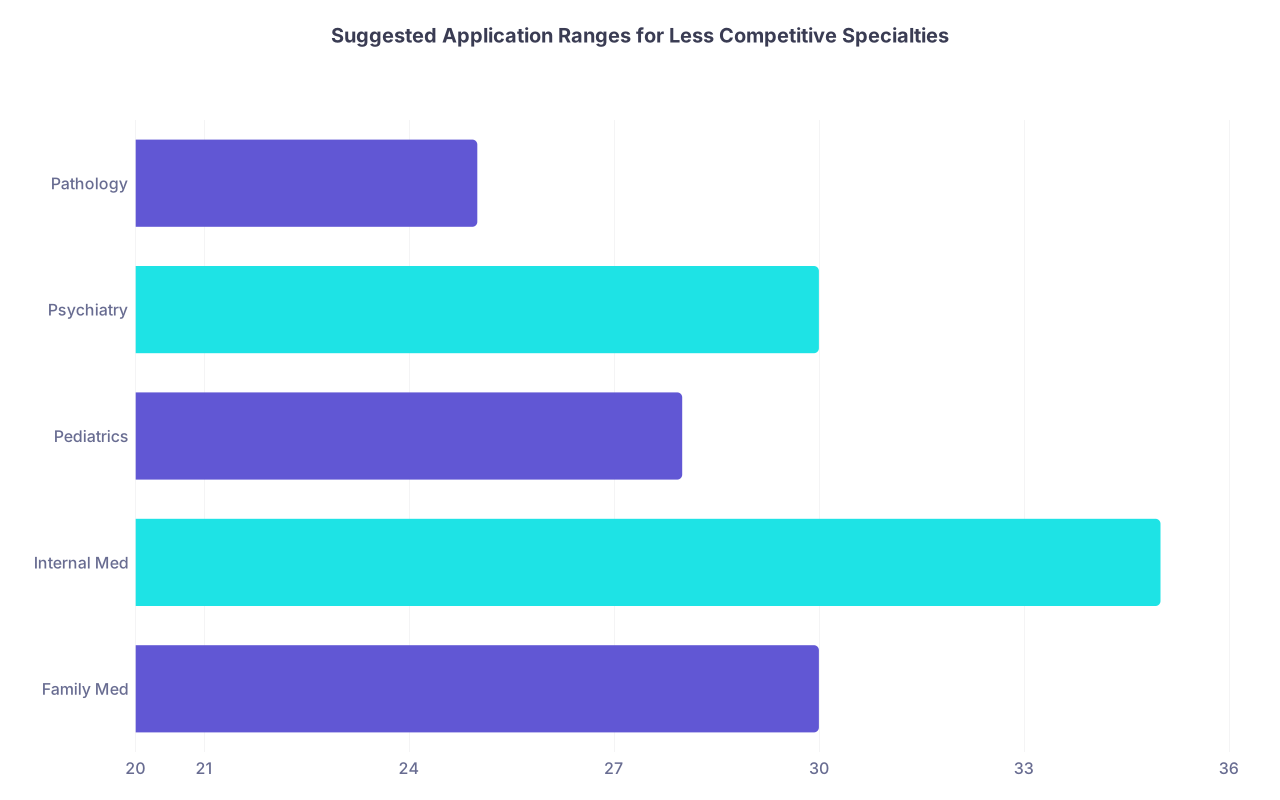
| Category | Value |
|---|---|
| Family Med | 30 |
| Internal Med | 35 |
| Pediatrics | 28 |
| Psychiatry | 30 |
| Pathology | 25 |
Blindly applying to 80+ programs in “any specialty” is a red flag for some PDs. It screams: “I have no idea what I want and I’m panicking.”
Better metric to watch: number of realistic programs on your list that actually:
- Have taken applicants like you before (check current residents)
- Are in regions you can credibly say you’ll live in
- Sponsor visa if needed
7. What Matters Less Than You Think
Let me be blunt. For least competitive specialties at non-elite programs, these things usually sit lower on the priority list:
Research:
- Nice-to-have, rarely decisive unless academic-leaning program
- One or two posters or small projects are plenty
“Leadership” roles:
- Good for color, not a core hiring metric
- Over-inflated titles with no real responsibility impress no one
Fancy electives:
- An away at Big-Name Institution matters mainly if you’re applying there
- Community programs care more about how you did on your home sub-I
Perfect personal statement:
- Needs to be coherent, honest, and not weird
- Nobody is matching because they used the word “empathy” in a great sentence
If you are weak in scores, you will not dig out solely with a cute research poster and an “I love primary care” essay.
8. How to Prioritize Right Now Based on Your Situation
Use this as a decision framework. Pick the category that fits you and focus there.
If you have failing scores or professionalism issues
Priority:
- Solid, honest, concise explanation in ERAS
- Strong recent clinical performance and LORs that specifically address growth
- Broad but targeted applications to less competitive specialties/programs
- Take and pass Step 2 CK with a respectable score (if not done)
If you have low but passing scores, clean record
Priority:
- Crush your sub-I in your desired specialty
- Get 2–3 excellent LORs emphasizing reliability and clinical skills
- Apply broadly to community programs in regions where you can realistically live
- Fine-tune your personal statement to show a coherent interest in the specialty
If you’re an IMG with decent or strong scores
Priority:
- Confirm your Step 2 CK is competitive (ideally ≥ 230)
- Maximize US clinical experience with strong letters
- Build a program list focused on IMG-friendly sites (look at current residents)
- Be realistic: lean into IM/FM/psych/peds/path where your profile fits
Key Takeaway: Your “Match Metric Stack” for Least Competitive Programs
If I have to boil it down, programs in the least competitive specialties ask:
- Can this person pass boards and be safe with patients?
- Are they reliable, decent to work with, and free of drama?
- Do they actually want this specialty and our type of program?
The metrics that best answer those questions—Step 2 pass and not terrible score, clean MSPE, solid clinical comments, credible LORs, and a sensible application list—matter more than one magical number.
Do not hide from your weak spots. Decide which of these metrics you can still improve, and which you must instead explain and surround with strengths.
FAQ: Least Competitive Specialties and Match Metrics
What are actually the least competitive specialties right now?
In broad strokes: family medicine, internal medicine at community/non-elite university programs, pediatrics (outside of big-name children’s hospitals), psychiatry at many non-top-tier programs, and pathology at several institutions. Physical medicine & rehab (PM&R) and neurology are in the middle—not derm-level, but not “easy.” Competitiveness varies by geography; California FM is not the same as rural Midwest FM.Can I match into a least competitive specialty with a Step 1 or Step 2 CK failure?
Yes, but only if you recover cleanly. You’ll need: a clear explanation, a solid Step 2 CK (if Step 1 failed) or Step 3 (if already graduated), strong recent clinical performance, and excellent LORs that say you’re reliable and capable. Programs will forgive a past failure if your recent trajectory screams “safe bet.”Is research necessary for family medicine, community internal medicine, or pediatrics?
No. A lack of research will not keep you out of the vast majority of these programs. Research helps mostly at academic-heavy places or if you have a clear scholarly interest. One or two small projects can round you out, but they do not compensate for poor clinical performance or professionalism issues.How low can my Step 2 CK be and still have a decent shot?
There’s no absolute cutoff, but as rough guidance for US MD/DOs: ≥ 220 is usually workable for many community programs if everything else is solid. 230–240 gives you cushion. Below 215 gets trickier and you’ll need strong clinical metrics, broader applications, and possibly leaning harder into the least competitive specialties and regions.Do program directors really care what medical school I went to for these specialties?
They care more about category (US MD vs DO vs IMG) than exact rank of school for least competitive programs. A mid-tier US MD at an average school with clean performance will outcompete a high scorer with red flags from anywhere. For IMGs, they do pay attention to school reputation and track record, but your USMLE scores and US clinical experience weigh heavily.Are away rotations important if I’m aiming at these less competitive programs?
Away rotations are helpful but not mandatory for many least competitive specialties. They matter most if: you’re trying to break into a specific region, you’re an IMG needing US letters, or you have weaker metrics and want one standout evaluation. If you do an away, treat it like a month-long interview and push for a strong letter.What is the single most impactful thing I can do this month to improve my chances?
If you’re still in clinical rotations: identify the attending who knows you best and can write a strong, specific LOR—then actively earn that letter with reliability and initiative. If you’re done with rotations: audit your program list against your actual profile (scores, status, visa needs) and add at least 10–15 programs where residents look like you on paper.
Open your ERAS (or draft list) right now and rank your own metrics in this order: red flags, Step 2 CK, clinical evaluations, letters, background/visa, and program list. Then pick the weakest fixable one and commit to improving it this week.