
It’s November. You’re staring at your ERAS dashboard. You’ve got 70 applications out in a very competitive specialty… and suddenly you’re asking yourself: “Did I just torpedo my match chances because I didn’t apply to any easier specialties as backup?”
Or you’re earlier in the game, still deciding: “Should I hedge with FM? IM? Psych? How many? How far down the ladder do I go?”
Here’s the answer you’re looking for: the number of “easier” backup specialties you should apply to is not random. It depends on your competitiveness, your risk tolerance, and how genuinely willing you are to train in those backups.
I’ll walk you through this like I would with a fourth-year sitting in my office asking the same question.
The Short Answer: Typical Ranges
Let me start bluntly.
For most US MD/DO seniors:
- If you’re reasonably competitive for your primary specialty:
Apply to 0–1 backup specialties. Often 0 is fine. - If you’re borderline / moderate risk: Plan on 1 true backup specialty, sometimes 2 in very specific cases.
- If you’re high risk for not matching: You need 1 solid backup specialty, and in some cases, consider dual-applying across 2 related fields, but that’s usually primary + 1 backup, not 3+.
If you are thinking about 3–4+ backup specialties, your problem isn’t the number. Your problem is that you have no clear strategy.
Most people should be in the primary specialty + 1 serious backup camp. The rest of this is about figuring out if that “1” should actually be 0 or 2.
Step 1: Know Where You Actually Stand
You cannot answer “How many backups?” if you have no clue how competitive you are. So start there.
Here’s how I mentally triage applicants:
| Risk Level | Step Scores | Red Flags | Research/Letters | Typical Backup Need |
|---|---|---|---|---|
| Low | ≥ national mean for that specialty | None | Solid | 0–1 backups |
| Moderate | Slightly below specialty mean | Minor issues | Mixed | 1 backup |
| High | Well below, or no score in exam-heavy fields | Major issues | Weak/limited | 1 strong backup, maybe broaden within field |
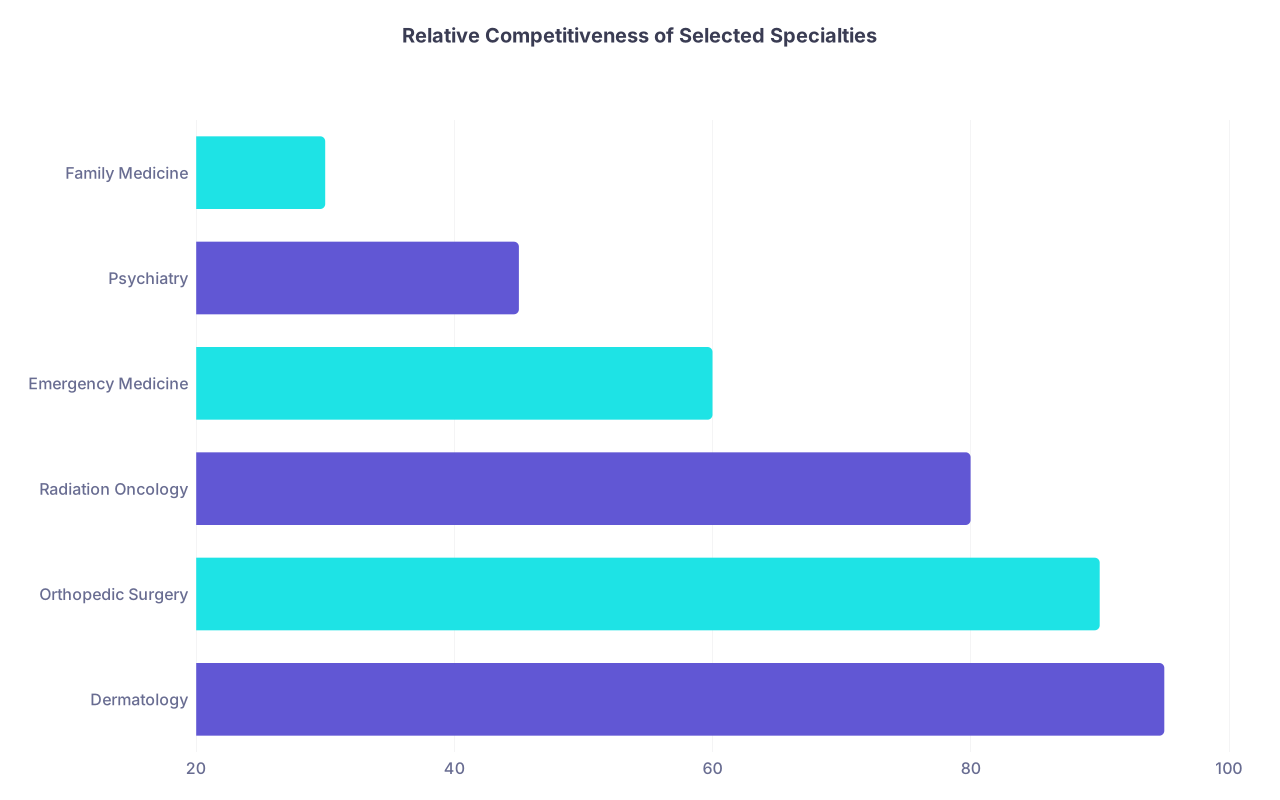
Now layer in specialty competitiveness:
| Category | Value |
|---|---|
| Dermatology | 95 |
| Orthopedic Surgery | 90 |
| Radiation Oncology | 80 |
| Emergency Medicine | 60 |
| Psychiatry | 45 |
| Family Medicine | 30 |
(Think of that rough scale as “difficulty to match” scores, not exact numbers.)
Very competitive: derm, plastics, ortho, ENT, neurosurgery, rad onc, ophtho, urology.
Moderate: EM, anesthesia, gen surg, OB/GYN, neuro.
Less competitive (relatively): IM, FM, psych, peds, pathology, PM&R, neurology in many regions.
If you’re:
- A mid-pack student gunning for derm with limited research → you’re high risk.
- A solid student going for internal medicine with decent scores → you’re low risk.
Different worlds. Different backup strategies.
Step 2: Decide Your Risk Category for This Match
Here’s a simple but honest mental checklist. If you answer “yes” to multiple in a row, you’re not in the low-risk club.

| Step | Description |
|---|---|
| Step 1 | Choose primary specialty |
| Step 2 | 0 to 1 backup specialty |
| Step 3 | 1 strong backup specialty |
| Step 4 | Focus on broad primary apps |
| Step 5 | Very competitive field? |
| Step 6 | Scores and CV above average? |
| Step 7 | Any major red flags? |
| Step 8 | Willing to train in backup? |
You’re low risk if most of these are true:
- Your scores (or class performance for pass/fail tests) are around or above the typical matched applicant in your specialty.
- You have at least average research / letters for that field.
- No major professionalism red flags or significant failures.
- You’re applying broadly enough (geographically and number of programs).
You’re moderate risk if:
- You’re slightly below the typical metrics for your chosen specialty.
- You have some gaps (late decision, weaker letters, limited home support).
- You are applying to a competitive field but with some strengths.
You’re high risk if:
- You’re far below typical metrics for that field.
- You have exam failures, remediation, serious red flags.
- You’re restricting geography (e.g., “only California programs”) in a competitive field.
Your risk tier + your specialty’s baseline competitiveness = how many backup specialties you realistically need.
Step 3: The Real Question – Primary vs Backup Balance
You’re not just asking “how many backup specialties.”
You’re asking: “How do I spread my chips?”
For Low-Risk Applicants
If you’re competitive for your primary specialty (even if that specialty is somewhat competitive):
- Number of backup specialties: Usually 0, occasionally 1.
- Strategy:
- Apply broadly in your primary field.
- If you do any backup, it should be a single related field you’d be OK living in.
Examples:
- Strong student, applying IM with solid scores and letters → I’d say 0 backups. Waste of time and money.
- Strong student applying EM in the current more competitive climate → maybe a handful of IM programs as true safety if you’re anxious or geographically limited, but not another full specialty campaign.
For Moderate-Risk Applicants
You’re not a slam-dunk, but you’re not doomed.
Here, I almost always recommend 1 serious backup specialty.
Key word: serious. Not a random “oh I threw in a few psych apps just in case.” Programs can smell “tourists.”
Your breakdown might look like:
- 60–80% of apps in your primary specialty
- 20–40% of apps in your single backup specialty
For example:
- Borderline ortho applicant:
- Ortho: 40–60 programs
- Backup: 25–40 IM/FM/PM&R depending on your true interests
- Borderline EM applicant:
- EM: 35–45 programs
- Backup: 20–30 IM, or psych if that’s genuinely acceptable to you
For High-Risk Applicants
This is where people panic and decide they need three backups. That’s almost always a mistake.
If you’re high risk for your primary specialty, you don’t need five backup specialties. You need:
An honest conversation:
Should that “primary” specialty be your backup, and you re-center on a less competitive field as your new primary?One genuine backup specialty you actually want to train in and can sell convincingly.
Most high-risk applicants who match do:
- 1 main realistic specialty they care about and can justify,
- plus aggressive breadth within that world (community programs, less desirable locations).
Not: derm + plastics + rad onc + IM + FM all in the same cycle. That looks incoherent.
Step 4: How to Choose the Right Backup (Not Just “Easy”)
“Easier” is relative. The backup has to make sense from your story and your application.
You want at least one of these to be true for your backup:
- It’s clinically adjacent to your primary (ortho ↔ PM&R, gen surg ↔ anesthesia, EM ↔ IM).
- Your rotations + letters already support it (you have strong IM or FM letters, for example).
- You can give a straight-faced answer to “Why this specialty?” without sounding like you ended up there by accident.

Common Pairings: What Actually Works
Here are realistic primary + backup combos that don’t look absurd:
| Primary Specialty | Common Backup | Why It Makes Sense |
|---|---|---|
| Ortho | PM&R | Musculoskeletal focus, shared patients |
| EM | IM or FM | Acute care, broad medicine overlap |
| Gen Surg | IM or Anes | Operative exposure, perioperative care |
| ENT | IM or Neuro | Head and neck, neuro overlap possible |
| Derm | IM | Immunology, rheum/derm overlap possible |
So how many of these backups? Generally one.
I see people get into trouble when they try:
- Ortho + EM + IM + FM as applications.
Program directors will absolutely notice.
Pick the one backup that aligns best with your prior rotations, letters, and actual interests. Then commit to it.
Step 5: Numbers – How Many Programs Per Specialty?
Let’s talk concrete numbers. Because that’s what you want.
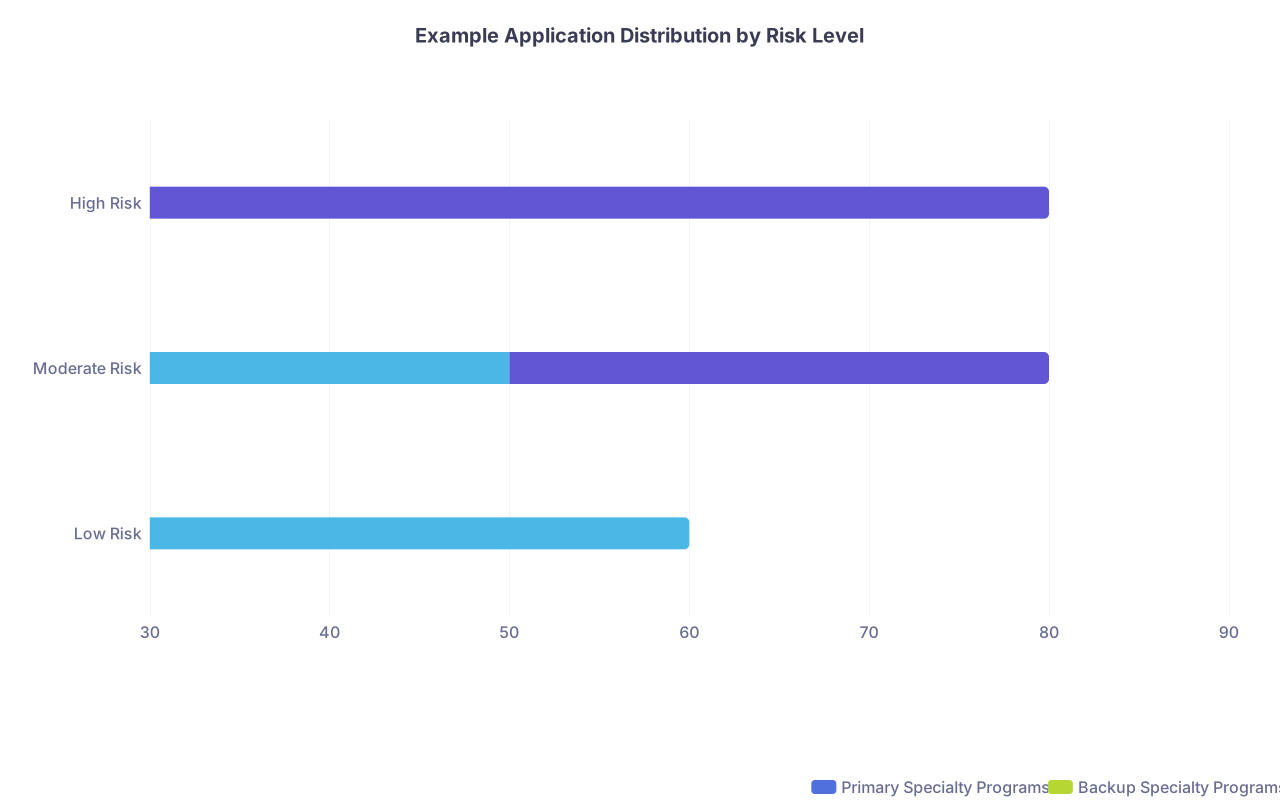
These are rough, but very workable starting points for US MD/DO applicants:
| Category | Primary Specialty Programs | Backup Specialty Programs |
|---|---|---|
| Low Risk | 60 | 0 |
| Moderate Risk | 50 | 30 |
| High Risk | 30 | 50 |
For low-risk applicants in moderately competitive specialties:
- 40–60 programs in your primary.
- 0–10 programs in a backup if you’re anxious or very location-restricted.
For moderate-risk applicants in competitive specialties:
- 40–70 primary specialty programs.
- 20–40 backup specialty programs (one backup specialty).
For high-risk applicants who are realistically shifting into a less competitive field:
- 20–40 reach programs in the “dream” field (if you insist).
- 40–80 in the realistic backup, which basically becomes your new primary.
You’ll notice what’s missing: “10 programs in three different backup specialties.” That’s a classic way to end up unmatched or in a field you hate.
The Psychological Trap: “I’ll Just Toss in a Few”
Here’s where people fool themselves.
They say: “I’ll just throw in 10 psych, 10 IM, and 10 FM as backups. Cover my bases.”
No. This is how that usually plays out:
- You don’t tailor your personal statement or letters properly.
- Programs see a generic, unfocused applicant who clearly isn’t committed.
- You don’t get many (or any) interviews in those backups anyway.
If you’re going to use a backup specialty, you treat it like a real plan, not a lottery ticket:
- A separate, honest personal statement for that specialty.
- At least one relevant letter.
- Enough programs (usually 25–40+) to actually have a shot.
- A coherent answer in interviews about why that field.
Doing that well for more than one backup specialty is almost impossible in a single cycle.
Special Situations Where 2 Backups Might Be Reasonable
There are a few narrow cases where having two “backup layers” isn’t crazy, but even then it’s more like primary + tiered versions, not three unrelated fields.
Examples:
Primary: Super competitive; Backup 1: mid-competitive; Backup 2: true safety.
Example:- Primary: ENT
- Backup 1: Anesthesia (or IM)
- Backup 2: FM in locations you’d accept if it comes to that
This is rare and requires very careful advising so you don’t look scattered.
Regional + specialty backup combination.
Some people treat “backup” as “community programs in less desirable cities” within the same specialty, plus one other true specialty backup. That’s reasonable.
But 90% of students do not need two backup specialties. They need:
- One backup specialty, done seriously, or
- A better-calibrated primary choice.
How to Know If You Actually Need a Backup Specialty At All
Two sanity checks you should run:
What does your home department say?
- If your primary specialty’s faculty say, “You’ll be fine if you apply broadly,”
you probably don’t need backups. - If they start sentences with “Have you thought about…”
they’re gently telling you to line up a backup.
- If your primary specialty’s faculty say, “You’ll be fine if you apply broadly,”
Look at NRMP’s Charting Outcomes type data (for your year and type).
- If your stats look like the typical matched applicant in that specialty, no backup is totally reasonable.
- If you’re below across multiple metrics, a backup is not optional.

What You Should Never Do With Backups
I’ve seen these mistakes over and over:
Applying to a backup specialty you’d hate, just because it’s “easy.”
That’s how you end up burned out and resentful three years later.Writing one generic personal statement and sending it to multiple specialties.
Programs talk. And they can read. They’ll notice.Applying to dozens of backup programs with zero genuine effort (no tailored letters, no interest).
That’s just burning money and emotional energy.
If you cannot imagine yourself honestly selling that backup specialty in an interview, you shouldn’t apply in it. Better to re-think your primary plan before submitting.
FAQs
1. I love a very competitive specialty (like derm or ortho) but I’m not a superstar. How many backups should I apply to?
If you’re not clearly near the top of your class with strong research and letters in that ultra-competitive field, you should treat a less competitive specialty as a serious parallel plan, not a last-minute backup.
Concretely, that usually means:
- 30–50 programs in the dream field
- 40–80 programs in the realistic backup (IM, FM, PM&R, etc.)
That’s still one backup specialty, not three. The backup needs enough volume and sincerity to actually protect you.
2. Can I apply to two very competitive specialties and then one easy backup?
You can, but it’s usually a bad idea. Example: plastics + derm + FM.
You’ll look unfocused, your letters will be diluted, and you’ll struggle to tell a coherent story to any of them. If you insist on exploring two competitive fields, at least decide which one is primary and which is “reach,” then consider one lower-competitiveness backup.
But three distinct tiers in one cycle is rarely defensible.
3. Is applying to more programs in the same specialty better than adding a backup specialty?
Often yes.
If you’re in IM, FM, peds, psych, or even EM in some cycles, broadening within your specialty (more community programs, more regions) is often higher-yield than dabbling in a backup field you don’t care about.
For truly competitive specialties, at some point you hit diminishing returns – then a single serious backup specialty makes more sense. But “just toss in another 50 in my own field” is often the first move.
4. What if my advisor says I probably do not need a backup, but I’m very anxious?
Then do a light but real backup strategy:
- One backup specialty, not two or three.
- 15–25 programs in that backup.
- A real, honest personal statement and at least one solid letter.
This gives you a safety net without sabotaging your main application’s narrative. But if your advisors consistently say, “You’ll match,” trust the data more than your anxiety.
5. If I dual-apply, how do I handle personal statements and letters?
You need to commit to a clean split:
- One personal statement tailored to your primary specialty.
- A second personal statement clearly tailored to the backup specialty.
- Letters:
- At least 2–3 strong letters for your primary field.
- 1–2 letters that make sense for the backup field (could be gen IM/FM/EM letters for multiple fields).
Do not send a clearly niche surgical letter to a psych program, and do not send a psych “he cares deeply about mental health” letter to ortho. Match the content.
Key takeaways:
- Most students need at most one real backup specialty, not a scattershot of three.
- The weaker you are for your primary field, the more that “backup” should actually become your main focus.
- A backup only works if you treat it as a real path: enough programs, real statements, and genuine willingness to train in it.