
The idea that “you can fix any red flag by choosing a less competitive specialty” is dangerously oversimplified.
Some red flags really are best handled by pivoting toward lower-competition fields. Others will follow you no matter what you apply to—and trying to hide in a “backup specialty” just wastes time, money, and rank slots.
Let me walk you through which is which.
The Core Truth: Competitiveness Fixes Some Problems, Not All
Here’s the blunt version:
- Red flags that make programs nervous but not allergic? Lower-competition specialties can absolutely help.
- Red flags that scream “professionalism risk,” “unreliable,” or “unsafe”? Those are hard stops, even in the least competitive specialties.
So you need to sort your red flag into the right bucket before you start saying “I’ll just do FM or psych and be fine.”
To anchor this, here’s a rough comparison of how much “application forgiveness” you get in different specialty tiers.
| Specialty Tier | Examples | Typical Flexibility for Red Flags |
|---|---|---|
| Ultra-competitive | Derm, Plastics, Ortho, ENT | Almost none |
| Competitive | EM (post-crash), Anesthesia, Rad | Very limited |
| Mid-competitive | IM, OB/GYN, Gen Surg | Some, depends on context |
| Less competitive | Psych, Peds | Moderate, if explained well |
| Least competitive | FM, Path, PM&R (many programs) | Highest, but not unlimited |
Red Flags That Can Be Helped by Targeting Less Competitive Fields
These are the issues where “go toward the less competitive end of the spectrum” is actually smart strategy. Not magic—but smart.
1. Low or Below-Average Step 2 CK (With a Pass)
You have:
- Step 1: Pass (or low pre-pass score)
- Step 2 CK: 205–220 range, maybe 225 if you’re aiming high
- No failures, just… underwhelming numbers
In derm or ortho, you’re dead in the water. In IM at a strong academic program, you’re significantly behind. But in family medicine, psych, many peds and community IM programs? People match with these scores every year—if the rest of your app makes sense.
Here’s when a low-competition field helps:
- You’re willing to cast a wide net (community, non-urban programs, newer programs)
- You align your story: “I genuinely want FM/peds/psych”—with evidence
- You have at least one or two green flags (great letters, strong clinical comments, track record of reliability)
If your main issue is “not numerically impressive,” the fix is: avoid score-obsessed specialties and aim where holistic review actually happens.
2. Modest or Uneven Clinical Grades
Scenario I see over and over:
- No AOA, mostly Pass/High Pass, maybe one or two Honors
- One key rotation (IM, Surgery, Psych) as “Pass” with lukewarm comments
- No narrative that screams “toxic,” just “not top 10% in the class”
In super competitive fields, programs are cherry-picking people with rockstar clerkship narratives. In lower-competition specialties, good-enough clinical performance plus clear commitment is fine.
Low-competition fields can help when:
- Your performance was average, not disastrous
- You have at least one rotation in the target field with strong comments/letter
- Your MSPE doesn’t contain “major professionalism concerns”
Family medicine, psych, peds, path, and many community IM programs will happily take solid-but-not-perfect students who show up, work hard, and fit the mission.
3. Limited Research or Academic Productivity
Research is over-valued for some specialties and borderline irrelevant for others.
If your app looks like this:
- One poster or low-impact project
- No first-author anything
- Nothing especially tied to a specific competitive specialty
Then:
- Don’t try to “backdoor” academic neurology with zero neuro exposure.
- DO consider fields where clinical fit and service track record matter more than publications.
Fields where lack of research is usually not a deal-breaker (especially outside top-tier academic places):
- Family Medicine
- Psychiatry (outside elite academic programs)
- Pediatrics (community heavy)
- Pathology (though some academic path programs really do want research)
- Many PM&R programs
Low-competition fields help here because they honestly don’t need 10 pubs from someone who’s going to spend their career doing outpatient primary care or inpatient psych.
4. Older Age / Nontraditional or Prior Career
Age itself isn’t a red flag, but let’s be honest: some specialties are much less excited about a 40-year-old intern with kids than others.
If you’re:
- Late 30s or 40s+
- Prior career, long training path, or big gaps
- Need predictable schedule or a specific region
Then lower-competition, lifestyle-friendlier fields are usually more receptive:
- Family Medicine
- Psychiatry
- Pathology
- PM&R
- Many community IM programs
They’re used to nontraditional applicants, second careers, and people who actually want longevity and sane call schedules.
Picking a less competitive field absolutely can soften concerns like “Will this person survive my heavy surgical internship?” or “Are they really going to do 5-7 years of brutally intense training?”
5. US-IMG / Non-US IMG Status (With Reasonable Scores)
Being an IMG isn’t a moral failing; it’s an objective filter. Many competitive specialties and big-name academic centers fill entirely with US MD/DOs.
If you’re a US-IMG or non-US IMG with:
- Passing, decent Step 2 (ideally 220+)
- No failures
- Solid clinical experience, maybe US clinical experience or observerships
- Good letters
Then strategizing around less competitive specialties is often the only rational move.
Historically more IMG-friendly fields:
- Internal Medicine (especially community and smaller university affiliates)
- Family Medicine
- Pediatrics
- Psychiatry (though less open than FM/IM in some regions)
- Pathology
Here, competitiveness matters a lot. You’re not going to radiology, ophthalmology, derm, or ENT from most offshore schools unless you’re an absolute outlier. But FM, IM, peds? Very realistic with a smart plan.
Red Flags That Usually Are Not Fixed by “Just Pick FM or Psych”
Now the part no one likes hearing: there are categories where competitiveness doesn’t save you. Programs in any specialty want to avoid massive headaches and risk.
1. Repeated Exam Failures (Especially Step 2 CK)
One fail that’s explained and followed by a strong pass? You can sometimes salvage that in a lower-competition field (FM, psych, path) if the rest of your app is solid.
But patterns like:
- Step 1 fail + Step 2 fail
- Multiple COMLEX fails
- Failing Step 2 late in fourth year
- Barely passing after multiple attempts
This raises a different question: “Can this person safely pass boards?” Every specialty, even the least competitive, needs residents who can become board-certified. Their accreditation, funding, and reputation depend on it.
Low-competition fields don’t magically ignore board pass risks. They might tolerate one stumble with strong growth. They won’t embrace someone who consistently doesn’t test well even with time.
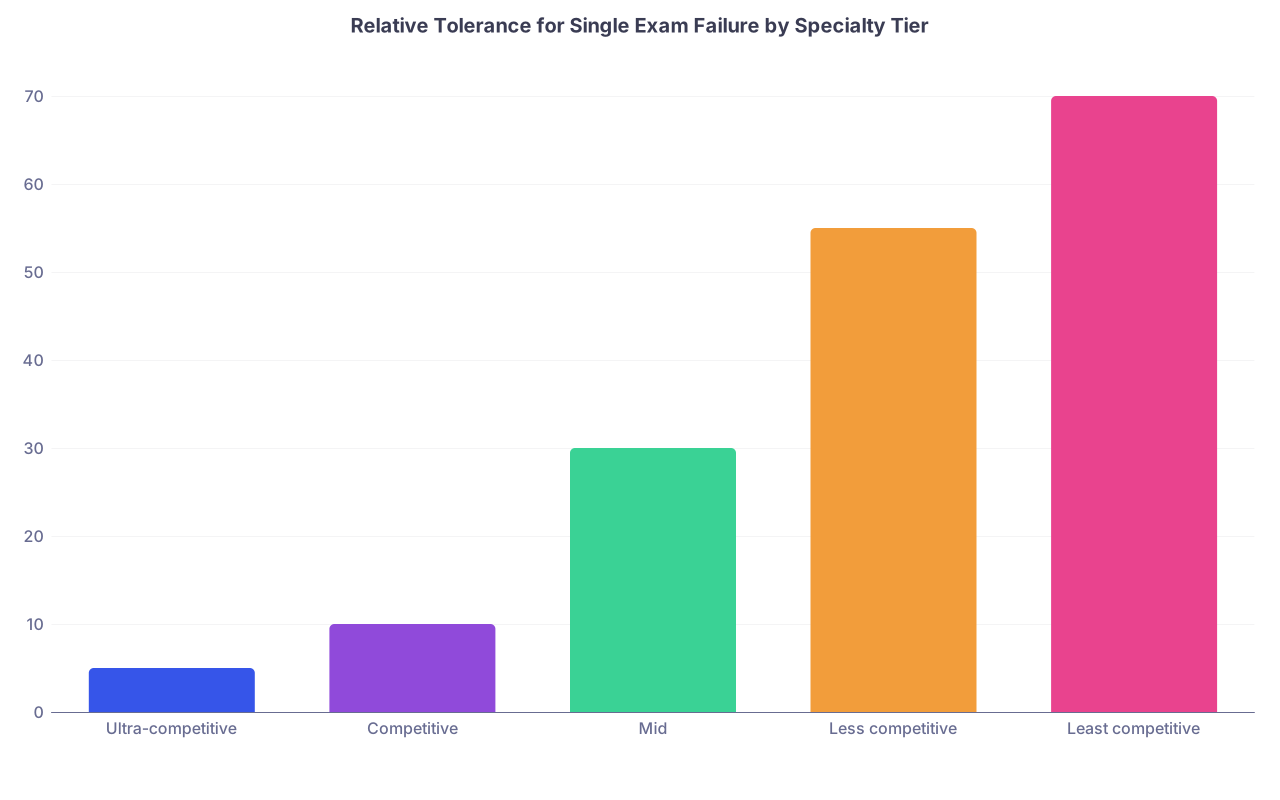
| Category | Value |
|---|---|
| Ultra-competitive | 5 |
| Competitive | 10 |
| Mid | 30 |
| Less competitive | 55 |
| Least competitive | 70 |
(Think of those numbers as “rough % of programs that might still consider you with a single fail if the rest is strong.” Not exact, but captures the pattern.)
2. Documented Professionalism or Behavioral Problems
This is the true poison in an application.
Examples:
- MSPE language about “unprofessional behavior,” “dishonesty,” “boundary violations”
- Dismissal or required repetition of a year for professionalism, not academics
- Prior suspension for harassment, substance impairment on duty, abusive conduct
No specialty wants to train someone who triggers HR weekly or puts patients/staff at risk. I’ve seen programs in very non-competitive fields auto-screen out apps the second they see phrases like “unprofessional” or “lacked integrity.”
Here the fix is not “pick an easier field.”
The real work:
- Documented remediation
- Sober, honest, accountable explanation in your personal statement
- Powerful advocacy from faculty who can say, “Yes, this was real, but they are different now—and I trust them.”
If that case can’t be made convincingly, FM, psych, peds, path—none of them are safe havens.
3. Severe Interpersonal Toxicity (Hidden in Letters/MSPE)
Sometimes your “red flag” isn’t scores—it’s your reputation.
MSPE lines like:
- “Feedback not consistently well received.”
- “At times, challenged by team dynamics.”
- “Colleagues sometimes found working with the student difficult.”
Letters that are short, vague, or faint praise for every rotation. Or the infamous “damning with faint praise”: “X completed their duties.”
Lower-competition specialties can’t fix that. Every program, regardless of field, is protecting its residents and culture. If you have a pattern of being hard to work with, that’s an everywhere problem.
You address this with:
- Real behavior change
- Better, more recent rotations with strong team-based letters
- Away rotations in your target field where you consciously over-communicate, help, and sync with the team
Then apply where holistic review exists—but don’t expect any specialty to overlook toxic patterns.
4. Chronic Unreliability / Poor Work Ethic
If your app whispers, “This person doesn’t show up,” it’s game over in almost any field.
Signals:
- Narrative of frequent absences or lateness
- Comments about missed deadlines, incomplete tasks
- Rotations repeated for clinical performance or professionalism
- Failed sub-I performance
Low-competition fields can tolerate “not a superstar,” but they won’t take “actively unreliable.” Residents are the backbone of service. In FM, IM, psych, peds—if you’re on call, patients must be seen. Period.
To fix this, you don’t switch specialties. You prove—over time—that you can be reliable. New rotations, new mentors, new letters that explicitly contradict the old story.
Matching Red Flag Type to Specialty Strategy
Here’s a simple decision frame.

| Step | Description |
|---|---|
| Step 1 | Identify main red flag |
| Step 2 | Target less competitive fields |
| Step 3 | Consider extra prep, backup nonclinical |
| Step 4 | Focus on remediation and narrative |
| Step 5 | Apply broadly, any specialty, with realism |
| Step 6 | Target IMG friendly low competition fields |
| Step 7 | Optimize for true interest and realistic range |
| Step 8 | Score based? |
| Step 9 | Single fail or low score? |
| Step 10 | Professionalism or behavior? |
| Step 11 | IMG or nontraditional? |
Some practical mappings:
- Low numbers only → lower-competition field CAN help
- Weak research only → lower-competition field CAN help
- Nontraditional/older → certain less competitive fields are more welcoming
- IMG status → often must target the least competitive and IMG-friendly fields
- Hard professionalism problems → specialty choice doesn’t solve this
Examples: Where “Go Less Competitive” Is the Right Move
Let me spell out a few concrete, realistic scenarios.
US MD, Step 2 = 214, no fails, decent clinical comments, one psych rotation with a stellar letter, no research
→ Apply broadly in Psychiatry + maybe FM. Very defensible.US DO, average COMLEX, zero research, strong FM letters, rural background, wants small town
→ Lean fully into Family Medicine, target community and rural programs. Low competitiveness works for you here.US-IMG, Step 2 = 228, one fail on Step 1, multiple USFMG letters, great story of resilience
→ Target community IM, FM, maybe peds. Lower-competition specialties with higher IMG intake.MD reapplicant, initially aimed at anesthesiology with mediocre scores and no interviews, now with new strong outpatient rotations and letters
→ Pivot to FM or psych with a clear narrative of “my interests evolved” and evidence to back it.
Where People Get This Completely Wrong
Common bad takes I’ve actually heard:
“I bombed Step 2 and failed twice; I’ll just do psych.”
No. Programs still care deeply about board pass rates.“I had a professionalism suspension, but FM will take anyone.”
False and insulting to FM. They see this as clearly as derm does.“I don’t like primary care at all, but I’ll do it just to match.”
Terrible move. You’ll be miserable and it’ll show in your interviews.
Your specialty choice has to make internal sense with your story, not just be “the place losers go.” That mindset leaks through everything you write and say.
Actionable Next Steps
Here’s what I’d do if I were you, today:
- Write down, in one sentence each, your top 1–2 red flags. Be brutally honest. “Low Step 2,” “IMG,” “professionalism comment,” etc.
- Categorize them based on this article: solvable by competitiveness, or not.
- If your main issues are scores / research / IMG / nontraditional → seriously consider shifting toward FM, psych, peds, path, PM&R, community IM.
- If your main issues are professionalism / repeated failures / reliability → your priority is remediation and narrative, not just “easier” specialties.
- Talk to one person who actually sits on a residency selection committee in your field of interest and ask, “Given X and Y, which specialties would you target in my shoes?”
Open your CV and MSPE right now and circle every potential red flag. Then next to each, write one of two words: “field” (meaning this can be helped by specialty choice) or “behavior” (meaning you have to fix the underlying issue). That’s your real starting point.
FAQ (Exactly 6 Questions)
1. If I have a single Step 1 or Step 2 failure, is Family Medicine my only realistic option?
No. A single failure with subsequent strong performance can still be compatible with IM, peds, psych, path, and FM, especially in community or less competitive programs. But you’ll need a clear explanation, strong clinical performance, and broad applications. FM just tends to be the most forgiving across the board, not the only option.
2. Does choosing a less competitive specialty mean I’m giving up on a “good” career?
Not at all. Some of the happiest physicians I know are in FM, psych, peds, and PM&R. What you’re giving up is the prestige game and certain procedural or niche paths, not a meaningful or financially stable career. If you choose a less competitive field that actually fits your personality and interests, you’re not settling—you’re being strategic.
3. I’m an IMG with 240+ on Step 2 and no failures. Do I still need to aim for the least competitive specialties?
Not necessarily. With that score, you can be competitive for many community IM programs, some smaller university-affiliated IM spots, and in some regions, peds and psych. But the distribution of IMG positions is still skewed toward lower-competition and community programs, so your safest strategy is to include those heavily, even if you also reach higher.
4. Can strong letters of recommendation compensate for low scores in a competitive specialty?
Rarely enough to make a huge difference. A phenomenal letter might get you looked at or pulled off the reject pile at a mid-tier program, but in ultra-competitive specialties, score cutoffs are brutal. Those same letters can be game-changing in less competitive fields, where holistic review is real and numbers aren’t the first and last filter.
5. Is Pathology really still “low competition,” and is it a good place to hide with red flags?
Pathology is generally less competitive than surgical or lifestyle fields, but it isn’t a dumping ground for problem applicants. Programs still care a lot about exam performance (you need to pass boards) and professionalism. If your red flag is modest scores or limited clinical enthusiasm for other fields, path can be a great fit. If your red flag is chronic failure or unprofessional behavior, it won’t save you.
6. How do I talk about my red flag in a personal statement when I’m also changing to a less competitive field?
Be direct and concise. Own what happened, show what changed, and then pivot quickly to why the new field genuinely fits you. For example: briefly explain your Step failure and what you changed, then spend the majority of the statement on your authentic exposure to FM/psych/peds and what you like about the work. Programs can smell “I’m only here because I have to” from a mile away—your job is to make your pivot feel thoughtful, not desperate.