
The common advice to “just do a prelim year and reapply” is overrated — and often flat-out bad strategy.
If you’re realistically competitive only for the least competitive specialties, you usually shouldn’t burn a year on a prelim spot hoping for a miracle. You should target a low-competition categorical field intentionally and treat prelim as a backup, not the plan.
Let me break this down the way program directors actually think about it, not how panicked MS4s talk about it in group chats.
The Real Question: What Problem Are You Trying to Solve?
Before comparing prelim vs. going straight for a low-competition field, you’ve got to be honest about why you’re even considering a prelim year.
Here are the usual scenarios I see:
- You didn’t match your desired competitive specialty (ortho, derm, ENT, plastics, etc.).
- You’re an MS4 with weak stats and worried you won’t match at all.
- You’re an IMG/FM G looking for any U.S. training foothold.
- You started med school thinking “I’ll do something competitive,” and now reality (scores, class rank, no research) is catching up.
Each of these has a different “best move.” But for most people hovering in the “average applicant” zone, it’s smarter to aim directly for a low-competition categorical field than to do a prelim and re-roll the dice.
Let’s define the playing field.
What Counts as a “Low-Competition” Field?
We’re talking about specialties where:
- Step scores are generally lower than the national average of the top competitive fields.
- There are lots of positions relative to applicants.
- Programs are more forgiving about gaps, average scores, or non-traditional paths.
Common low(er)-competition categorical options:
- Family Medicine (FM)
- Internal Medicine (community / academic mid-tier)
- Pediatrics
- Psychiatry
- Pathology
- Neurology (borderline; some places competitive, but overall manageable)
- PM&R (less competitive than people think, but moving up slowly)
Here’s a rough comparison of how these stack against prelim paths:
| Option | Match Probability (Typical Applicant) | Stability After Match | Future Flexibility |
|---|---|---|---|
| FM categorical | High | Very high | Fellowships + jobs |
| IM categorical | High | Very high | Many fellowships |
| Peds categorical | High | High | Some fellowships |
| Psych categorical | High | High | Growing market |
| Prelim medicine | Moderate | Low (1-year only) | Must reapply again |
| Prelim surgery | Moderate to low | Very low | Brutal hours, reapply |
If you can land FM, IM, Peds, or Psych categorical, that’s almost always a better long-term move than planning on a prelim unless you’re very specifically trying to pivot into one of a few things (more on that later).
What a Prelim Year Actually Gets You (and Costs You)
A prelim year isn’t magic. It’s one year of service. The value is entirely dependent on your situation and what you do with it.
Benefits of a prelim year (when used well)
A prelim medicine or surgery year can:
- Prove you can function as a physician in the U.S. system.
- Get you strong new letters from attendings who actually saw you working.
- Buy you time to fix specific weaknesses:
- Step 2/3 scores
- No U.S. clinical experience (for IMGs)
- Red flags like failed courses or gaps
- Set you up to slide into:
- An open PGY-2 spot
- An advanced specialty (radiology, anesthesia, PM&R, neuro, derm, rad onc) if you have the underlying competitiveness
When prelim is smart:
- IMG with decent scores trying to break into U.S. internal medicine or neurology.
- You already have interviews in a moderately competitive advanced specialty (anesthesia, radiology, PM&R, neuro), and you’re pairing it with a prelim year.
- You just barely missed matching in something like anesthesia or rads and have strong support from faculty telling you you’re re-matchable.
Costs and risks of a prelim year
People dramatically underestimate these:
- You still have to reapply, re-interview, and re-stress in PGY-1.
- No guarantee of a PGY-2+ spot, even if you “did everything right.”
- You may get trapped:
- No categorical offer.
- No open PGY-2 positions.
- Visa issues (for IMGs) if you can’t secure a longer program.
- Burnout risk is real:
- Especially in surgical prelims with horrible call schedules and no future security.
- Program directors know “chronic reapplicant” when they see one. That label sticks.
If you’re already a marginal candidate and not targeting a field that routinely uses prelim years (like anesthesia, radiology, neuro, PM&R), using a prelim as a “redo” year is usually inefficient at best and delusional at worst.
When It’s Smarter to Aim Directly for a Low-Competition Field
Let’s be blunt. If any of these describe you, going directly for a low-competition categorical program is usually the smarter play:
- Step 1 (if numeric) was at or below national average, and Step 2 is not stellar.
- No meaningful research in a competitive field.
- Few or no home mentors in competitive specialties willing to go to bat for you.
- You’d be happy in FM, IM, Psych, Peds, Path, or Neuro long-term.
- You’re a DO or IMG without standout stats aiming at things like derm, ortho, ENT, plastics, urology, rad onc, etc. with no serious track record.
Because here’s what a categorical low-competition program gives you that a prelim year does not:
- Guaranteed training to full board eligibility.
- Predictable income and life for 3–4 years.
- The option to pursue fellowships:
- IM → cards, GI, pulm/crit, heme/onc, ID, endo, etc.
- FM → sports, OB, geriatrics, hospitalist tracks, outpatient leadership.
- Peds → NICU, PICU, cards, etc.
- Psych → addiction, child and adolescent, forensic, consult-liaison.
- Built-in institutional loyalty. Programs invest in their categorical residents; prelims are often temporary labor.
For a lot of people who “dreamed” of something hyper-competitive, reality looks like this: you can either spend years chasing a long shot, or go into a solid, employable field with actual jobs everywhere and the ability to sub-specialize.
If FM, IM, or Psych are on your “I could actually enjoy this” list, that’s not settling. That’s being strategically adult.
The Key Distinction: Prelim as Backup vs. Primary Plan
This is where people get lost in the weeds.
There are two very different uses of a prelim year:
Paired with an advanced specialty as part of a coherent plan
Examples:- You match anesthesia advanced and rank prelim medicine years separately.
- You’re applying radiology and prelim medicine together.
- You’re legitimately competitive for PM&R or neuro and use prelim as part of that package.
Here, prelim is normal and expected. It’s a tool, not a fallback fantasy.
Using prelim as a “let me prove myself and then I’ll magically get derm/ortho/etc.”
This is the trap. This usually ends with:- Another unmatched cycle.
- Or settling again into low-competition fields, but now with:
- More debt
- More burnout
- Less control over where you end up
If you’re thinking, “I’ll do a prelim surgery year and then I’ll be a stronger ortho applicant,” stop. Ortho programs rarely backfill from random prelims unless there’s some deep connection, and those spots are often spoken for before they even go public.
Specific Situations: What Should You Actually Do?
Let’s go scenario by scenario. Assume you care about getting trained, staying employable, and not burning five years chasing ghosts.
Scenario 1: US MD, average stats, no strong competitive profile
- Step 2 somewhere in the mid-220s–230s (if numeric), average MSPE, nothing crazy.
- You like the idea of anesthesia, rads, or derm, but have no research or mentors there.
My honest advice:
- Pick FM, IM, Psych, or Peds and apply hard and early.
- Use away rotations and personal statements to signal genuine interest.
- Keep competitive fields out of your actual ERAS if you’re not truly in range.
- Do not burn a prelim year hoping to pivot into a field you’re not already close to qualifying for.
Scenario 2: You went all-in on a competitive field and didn’t match
You applied ortho, ENT, or derm only and got wrecked.
If you:
- Didn’t match at all, and
- Don’t have strong scores / research for that specialty
Then usually:
- Use SOAP aggressively for categorical IM, FM, Psych, or Peds.
- If you land one, commit and move forward.
- Only consider a prelim if:
- You got specific feedback that you were close and fixable (e.g., needed a stronger Step 2 or better letters), and
- Faculty from the field are actively willing to support a reapplication.
Otherwise, you’re just pressing “repeat” with no meaningful upgrade.
Scenario 3: IMG or DO with moderate stats, wants U.S. entry
Here prelim can make sense.
Smart path might be:
- Apply broadly to categorical IM, FM, Neuro, Psych.
- Also apply to prelim medicine spots at programs known to promote prelims into categorical when they open spots.
- If you only get prelim offers at decent programs, it may be worth it as a beachhead into U.S. training — but go in knowing:
- You must work your tail off.
- You need to network constantly.
- You should be watching for PGY-2+ openings from day 1.
Better still: if you can get FM or IM categorical anywhere reputable, that’s almost always a better deal.
How Program Directors Actually View Prelim vs Categorical
PDs care about three main things:
- Will you be safe with patients?
- Will you make my life easier, not harder?
- Do you actually want this specialty?
A categorical FM or IM PD looking at:
- A fourth-year who applied directly to FM, did an FM rotation, wrote a FM-personal statement, and has a letter from an FM chair.
versus
- A surgery prelim who clearly wanted ortho, did a year of random general surgery rotations, and now says, “Actually I love FM.”
Who’s more convincing? You know the answer.
Prelim can help show you can work. But it can also scream, “I’m only here because Plan A died.”
If you already know low-competition fields are your realistic zone, it’s much cleaner to signal commitment up front.
Quick Decision Framework: Should You Aim for Prelim or Low-Competition Categorical?
Use this as your sanity check.

| Step | Description |
|---|---|
| Step 1 | Start |
| Step 2 | Apply advanced + prelim together |
| Step 3 | Apply directly to categorical low competition fields |
| Step 4 | Consider targeted prelim with strong mentorship |
| Step 5 | Reassess specialty choice and favor categorical stability |
| Step 6 | Are you competitive for an advanced specialty that uses prelim years? |
| Step 7 | Would you be genuinely happy in FM, IM, Psych, Peds, Path, Neuro? |
| Step 8 | Did PDs/mentors tell you you almost matched and are fixable? |
If you land at E or H in that diagram, you’re in the “go categorical in a low-competition field” camp.
How to Maximize a Low-Competition Strategy (So It Doesn’t Feel Like Settling)
If you decide, “Yeah, it’s smarter to aim directly for a less competitive field,” then don’t half-commit. Make yourself a strong applicant for that field.
Things that actually move the needle:
- Clinical excellence in that specialty:
- Crush your FM/IM/Psych rotations.
- Be the resident’s favorite student: reliable, prepared, not annoying.
- Strong, field-specific letters:
- From faculty who know you well.
- One from a program director or chair if possible.
- A clear story:
- Your personal statement and interviews should sound like, “I chose this,” not “I landed here.”
- Signal honestly:
- If you want IM → talk about inpatient, continuity of care, subspecialty interest.
- If you want FM → talk about longitudinal care, broad scope, community impact.
- If you want Psych → talk about specific exposures, not just “I like talking to people.”
You can absolutely have a fulfilling, flexible, well-paying career in these so-called “least competitive” fields. The people who are miserable are often the ones who never mentally committed.
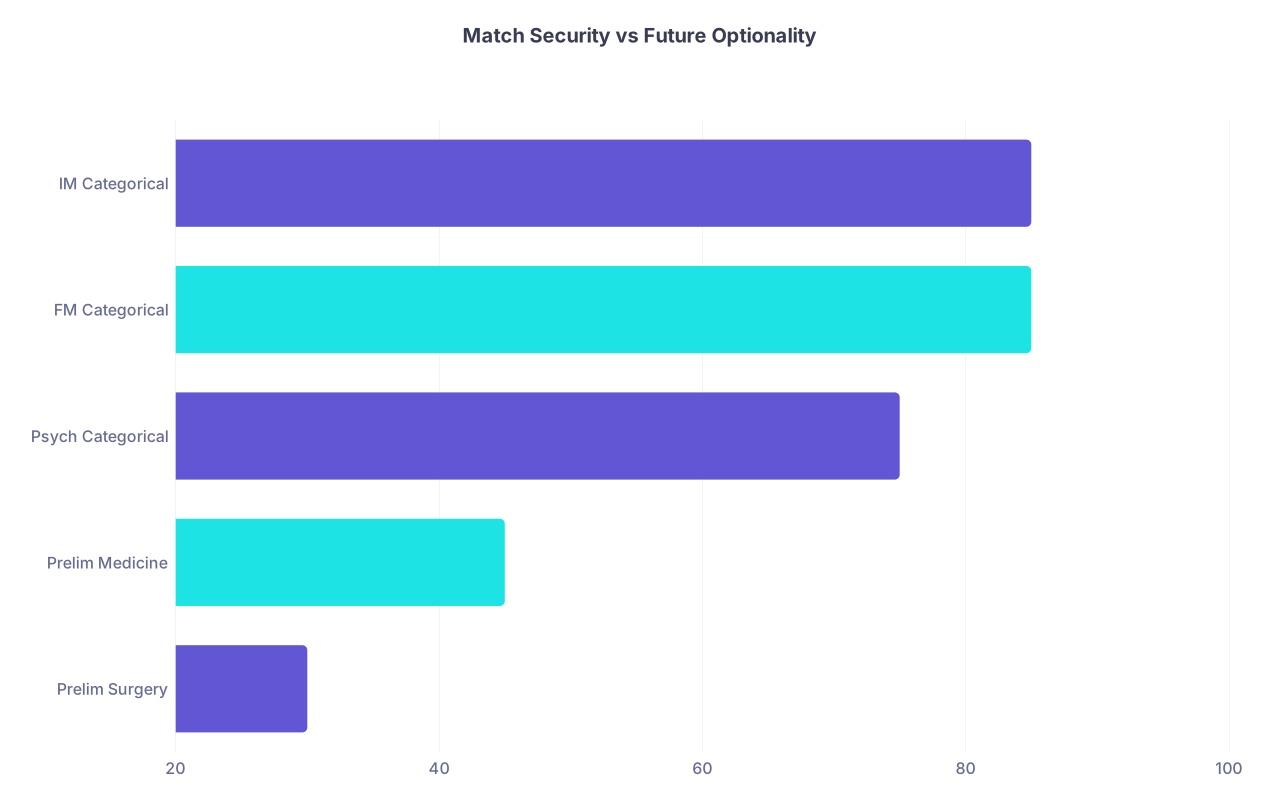
| Category | Value |
|---|---|
| Prelim Surgery | 30 |
| Prelim Medicine | 45 |
| Psych Categorical | 75 |
| FM Categorical | 85 |
| IM Categorical | 85 |
(Think of those numbers as a rough “career security + flexibility score,” not percentages. The categorical tracks almost always win.)
Bottom Line: What’s Actually Smarter?
If you:
- Are realistically best suited for a low-competition specialty, and
- Don’t already have a strong, coherent pathway into an advanced or ultra-competitive field
Then it is smarter, strategically and emotionally, to aim directly for a low-competition categorical residency.
Use prelim as:
- A tool to pair with advanced specialties, or
- A very targeted second chance when mentors and PDs specifically tell you it’s worth it
Not as a vague, hopeful “maybe this will fix my application somehow” plan.
Today’s next step:
Open a blank document and write two paragraphs — one arguing for you doing a prelim year, one arguing for you going straight into a low-competition categorical field. When you read them side by side, which one actually sounds like a life you want to live? That’s your answer.