
The myth that “least competitive” specialties are career dead-ends is flat-out wrong.
Some of the best, highest-impact, and even highest-paying fellowships actually sit on top of relatively less competitive residencies.
If you’re a med student or prelim resident with average scores or a non-linear path, you do not have to sentence yourself to a miserable career just because you are not matching derm, plastics, or ortho. You have options. Good ones.
Here’s the straight answer: there are a handful of moderately or less competitive core residencies that still open doors to prestigious, subspecialized fellowship routes—with solid job markets and strong earning potential.
Let’s walk through them, then I’ll give you a decision framework at the end.
Big Picture: “Least Competitive” Does NOT Mean “No Upside”
You’re asking the right question. The trap I see students fall into:
- They chase prestige (neurosurgery, ortho, derm) and get burned.
- Or they overcorrect and pick something like prelim medicine with no long-term plan.
- Or they assume “community-friendly” fields like FM or psych lock them out of subspecialty.
Reality is more nuanced.
There are three categories you should think in:
- Broad-core specialties with strong fellowship ladders
(IM, pediatrics, general surgery, anesthesia) - Less-competitive specialties with selected high-yield fellowships
(family medicine, psychiatry, PM&R, pathology) - Fields that are “terminal” for most people
(EM in the current market, radiology without interventional, some surgical prelim traps)
We’ll focus on #1 and #2 — where your “least competitive” label still leads to powerful fellowships.
Internal Medicine: The Workhorse with the Deepest Fellowship Bench
Internal medicine is not the sexiest specialty. It is also not hyper-competitive at most programs. But it’s the single strongest gateway to high-end subspecialties.
If you want maximum optionality from a relatively accessible match, IM is still king.
What IM opens up (ACGME-accredited fellowships)
Common and powerful:
- Cardiology (including interventional, EP, imaging)
- Gastroenterology (and advanced endoscopy)
- Pulmonary & Critical Care
- Hematology/Oncology
- Nephrology
- Endocrinology
- Infectious Disease
- Rheumatology
- Geriatrics, Palliative, Hospital Medicine pathways
Interventional cards and advanced GI are as “procedural-prestige-pay” as many surgical fellowships. And you start from a residency that is, frankly, nowhere near as cutthroat to match as ortho or neurosurgery.
Is IM “least competitive”? Not at top academic programs. But community IM programs, lower-tier academic programs, and many university-affiliated IM programs remain accessible to applicants with:
- Mid 220s–230s Step 2 CK (or pass on Step 1)
- Solid but not spectacular research
- Decent letters and clinical performance
From there, if you:
- Excel clinically
- Crush your in-training and Step 3
- Show up in the subspecialty (research, QI, electives, mentor relationships)
—you can absolutely land strong fellowships.
| Fellowship | Lifestyle Range | Typical Compensation | Notes |
|---|---|---|---|
| Cardiology | Moderate to intense | Very high | Procedures, call heavy |
| GI | Moderate to intense | Very high | Endoscopy, procedures |
| Pulm/CC | Intense | High | ICU, ventilators, nights |
| Heme/Onc | Moderate | High | Cancer care, longitudinal |
| Endocrine | Good lifestyle | Moderate | Outpatient-focused |
Bottom line: If you want big upside with realistic entry, IM is your best bet.
Family Medicine: Underrated Gateway to Procedural & Niche Fellowships
Family medicine is one of the most forgiving specialties from a competitiveness standpoint. People treat it like a fallback. That’s a mistake if you’re strategic.
If you choose FM at a strong program and are deliberate, you can carve out some surprisingly powerful niches:
Fellowship options from Family Medicine
Accredited or well-recognized:
- Sports medicine
- Geriatrics
- Palliative care
- Addiction medicine
- Sleep medicine
- Obstetrics (FM OB / maternal-child health)
- Lifestyle medicine
- Rural/underserved medicine tracks
Sports medicine is the big one people miss. I’ve seen FM grads doing:
- Team physician roles for colleges and even pro teams
- High-volume MSK and procedures (injections, ultrasound)
- 4-day clinic weeks with very robust income
FM sports is less competitive than ortho sports, but the work overlaps heavily on the outpatient side.
FM OB fellowships can position you to practice full-scope family medicine in rural areas with deliveries, C-sections (in some tracks), and broad procedural scope. If you like variety and autonomy, this is gold.
The trick with FM: choose a residency with strong procedural and fellowship placement culture. You do not want a program where everyone just goes to generic outpatient clinic jobs and no one talks about advanced training.
Psychiatry: Easier Entry, Surprisingly Powerful Subspecialties
Psych has gotten more competitive recently, but it’s still not at the derm/ortho/ENT level, and many community and mid-tier academic programs are very attainable.
Here’s what psych opens up:
- Child & Adolescent Psychiatry
- Addiction Psychiatry
- Consultation-Liaison Psychiatry (psychosomatic)
- Forensic Psychiatry
- Geriatric Psychiatry
- Sleep Medicine (through psych or other cores)
- Interventional Psychiatry (TMS, ketamine, ECT) – often via practice, not ACGME fellowship
Why this matters:
- Child psych is in insane demand. Waitlists everywhere. Pay is usually higher than general psych with a lot of control over schedule.
- Addiction is growing fast, with crossover into policy, public health, and medical leadership roles.
- Forensics can be very lucrative; court evaluations, expert testimony, niche consulting.
Psych gives you a relatively humane residency and strong job security. With fellowship, you’re not just employable—you’re hard to replace.
PM&R (Physiatry): Low-Key Path to Interventional & Sports
Physical Medicine & Rehabilitation flies under the radar for most students. Which is crazy, because it’s one of the best-kept secrets for people who:
- Want procedures
- Don’t want 7-year ortho or neurosurg brutality
- Like neuro/MSK/functional medicine
PM&R itself is moderately competitive at a few top programs but broadly accessible. Fellowship routes:
- Pain medicine (big one)
- Sports medicine
- Spinal cord injury
- Brain injury medicine
- Neuromuscular medicine
- Pediatric rehab
- Cancer rehab
Pain through PM&R can get you into interventional procedures: epidurals, RF ablation, spinal cord stim, etc. This often comes with high compensation, though yes, the regulatory environment is always evolving.
Sports through PM&R looks a lot like sports through FM, with a different training lens (more neuro/MSK, less primary care).
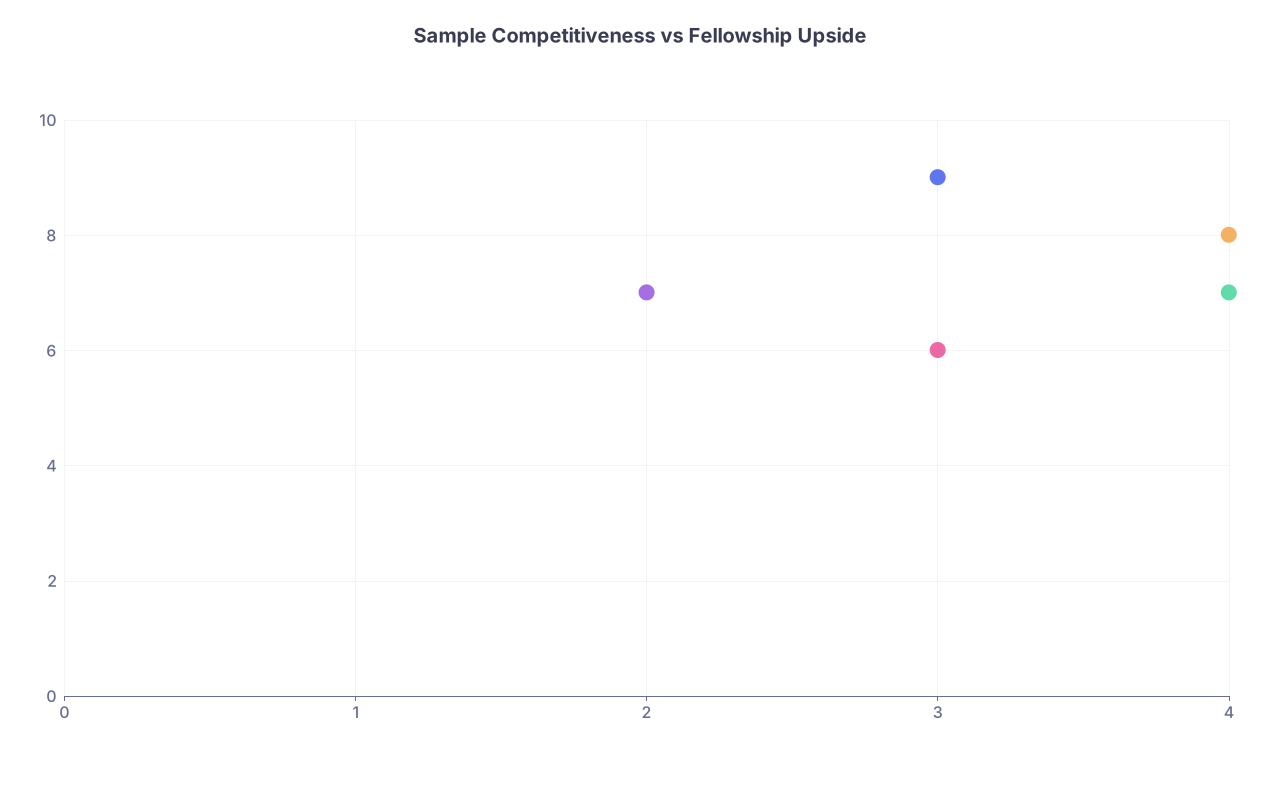
| Category | Value |
|---|---|
| Internal Med | 3,9 |
| Family Med | 2,7 |
| Psych | 4,7 |
| PM&R | 4,8 |
| Pathology | 3,6 |
(Where x = rough competitiveness, y = fellowship career upside on a 1–10 gut scale.)
Pathology: Low Competition, Niche Power
Pathology has become one of the easiest matches in many cycles. But that doesn’t mean it’s career purgatory.
Fellowships from pathology include:
- Cytopathology
- Hematopathology
- Surgical pathology subspecialties (GI, breast, GU, GYN, etc.)
- Forensic pathology
- Transfusion medicine / blood bank
- Molecular genetic pathology
- Dermatopathology (shared with derm)
The game in pathology is niche expertise. You’re not gunning for RVUs the same way a cardiologist is. You’re gunning for:
- Academic niche roles
- High-value subspecialty reads
- Reference lab/industry/diagnostics positions
If you’re lab-oriented, detail-obsessed, and allergic to the chaos of the ED, this can be a very rational choice: low-competition entry, then build a rare skillset via fellowship.
Pediatrics: Lower Competition, High-Impact Subspecialties
Pediatrics is generally less competitive than IM at top levels, and much easier at the community/mid-tier range. The lifestyle in residency can be tough (kids always get sick at night), but from there you can pivot into:
- Pediatric cardiology
- Pediatric hematology/oncology
- Pediatric critical care
- Neonatology (NICU)
- Pediatric GI, endo, pulm, ID, etc.
- Palliative, adolescent medicine, complex care
Neonatology and PICU are intense but very high-acuity, high-impact fields with good compensation and strong job demand, especially outside of saturated metro areas.
If your heart’s in peds but you fear “just general clinic shots and ear infections forever,” fellowships fix that.
Anesthesiology: Mid-Competitiveness, Strong Fellowships
Anesthesia isn’t “least competitive,” but compared with ortho, derm, ENT, it’s very reasonable — especially at community and non-elite university programs.
Fellowships off anesthesia:
- Critical care (ICU)
- Cardiac anesthesia
- Pain medicine
- Pediatric anesthesia
- Regional anesthesia/acute pain
- OB anesthesia
Critical care and pain are the big ones here. Pain overlaps with PM&R and neurology pathways; anesthesia gives you a procedural and OR comfort base that transitions smoothly into interventional pain.
Cardiac anesthesia is highly specialized, and you become essential in any center doing big heart cases.

What About EM, Neurology, Radiology, and Surgery?
You’re probably wondering about a few other fields. Quick, honest takes:
Emergency Medicine
Used to be a golden ticket. Right now the job market is rough, corporate groups dominate, and fellowships (toxicology, ultrasound, critical care, etc.) do help but do not fully solve the structural issue. I would not choose EM primarily for fellowship upside in 2026.Neurology
Fairly accessible still. Fellowships like stroke, epilepsy, neuromuscular, neurocritical care are strong, and interventional neuroradiology exists but is highly competitive and not guaranteed. Neurology can be a smart play if you genuinely like the field.Radiology
Not “least competitive,” more mid-range. But fellowships (IR, MSK, neuroradiology, breast, body) are essential. If you can get into rads, IR is a powerhouse, but IR itself is now very competitive—don’t count on it if your application is already borderline.General Surgery
Not low competition. Hard field. Fantastic fellowships (trauma, vascular, surg onc, MIS/bariatric, transplant, etc.), but this is not the “easier entry” route for most applicants who are already worried about competitiveness.
How to Choose: A Simple Decision Framework
You want something concrete. Here it is.

| Step | Description |
|---|---|
| Step 1 | Start - You want fellowships |
| Step 2 | Internal Medicine or Anesthesia |
| Step 3 | PMR or Psychiatry |
| Step 4 | Family Medicine |
| Step 5 | Psych or Pathology |
| Step 6 | Target cards, GI, pulm or ICU, pain |
| Step 7 | Target pain, sports, addiction, CL |
| Step 8 | Target sports, OB, palliative |
| Step 9 | Target child psych, heme path, etc |
| Step 10 | Need lots of procedural work? |
| Step 11 | Comfortable with ICU and sick patients? |
| Step 12 | Prefer outpatient and clinic focus? |
Ask yourself:
- Do you want heavy procedures?
- Yes → IM, anesthesia, PM&R, FM with sports, maybe neurology.
- Do you want inpatient high acuity?
- Yes → IM (ICU, cards), anesthesia (ICU), peds (NICU/PICU).
- Do you want mostly outpatient with high specialization?
- Psych (child, addiction, forensics), FM (sports, lifestyle), endo, rheum, allergy (via IM or peds).
- Are you okay with low patient contact?
- Pathology and some radiology tracks.
Then pick a core that is realistically matchable for you and still has a strong fellowship tree.
Practical Tips to Actually Land the Fellowship Later
Matching a less-competitive residency does not automatically guarantee a plum fellowship. You have to play the long game:
- Pick a residency with documented fellowship placements in what you care about.
- Start early — you want subspecialty mentors by PGY-1 or early PGY-2.
- Do at least one project (research or QI) directly tied to your fellowship target.
- Crush clinical performance on subspecialty rotations; these people will write your letters.
- Do away rotations strategically if you’re aiming at a competitive fellowship niche.
You do not need to become a research robot. But you cannot be invisible either.
FAQ: Least Competitive Specialties with Strong Fellowship Options
1. If I know I want cardiology, should I still consider family medicine or PM&R?
No. If you’re dead-set on cardiology, your path is internal medicine → cardiology fellowship. FM and PM&R do not lead to cards. Don’t get cute here. Go IM and commit fully.
2. Can I match a top fellowship from a community residency in IM or FM?
Yes, but it’s harder. I’ve seen community IM grads match cards and GI. The ones who do this have: stellar evaluations, strong letters from subspecialists, a few solid publications or abstracts, and they network aggressively. For FM sports, community programs with established sports tracks can still place you well.
3. Is it smarter to choose a more competitive specialty with no fellowship than a less competitive one with fellowship options?
Usually no. You want a field that gives you a second bite at the apple. A less competitive core that opens multiple fellowships is often safer than pinning your hopes on matching one competitive specialty and then being stuck.
4. Are fellowships from family medicine viewed as “worse” than from IM or ortho?
Sometimes by snobs, but practically, not always. FM sports docs get excellent jobs. FM palliative or addiction docs are heavily recruited. What matters more: your competence, reputation, and local/regional networks than the initials on your diploma.
5. If I’m interested in pain medicine, what’s the best less-competitive core residency?
PM&R is a very logical route. Anesthesia and neurology are also common. From a competitiveness standpoint, PM&R often hits the sweet spot: attainable match, solid MSK and neuro base, and a natural fit for pain fellowships.
6. How late is “too late” to pivot into a less competitive specialty with good fellowship options?
You can pivot as late as MS4 or even after a preliminary year. People switch from surgery prelim to IM categorical, from EM to psych, from FM to IM. The later you switch, the more your story has to make sense and your letters must be strong. But you’re not locked in until you’ve finished a full residency.
Key takeaways:
- Internal medicine, family medicine, psychiatry, PM&R, pathology, pediatrics, and anesthesia all offer relatively accessible matches with real fellowship power behind them.
- You’re not choosing a job. You’re choosing a core platform that unlocks a set of advanced roles later.
- If your stats are average, stop chasing unicorns. Pick a realistic core with a deep fellowship ladder and commit to being excellent once you are in.