
The belief that you must match dermatology or ortho to have an academic career is flat‑out wrong.
You can absolutely start in a so‑called “low‑competition” specialty and end up as program director, division chief, NIH‑funded PI, or the go‑to educator at a strong academic center. It happens every year. The catch is this: your specialty choice is only half the story. How you use residency and the first 3–5 years after matters far more.
Let’s walk through what’s actually possible, what’s hard, and how to be intentional if you want academics without chasing the most competitive specialties.
1. The Real Question: Are You Chasing Status or a Career?
Let me be blunt: a lot of anxiety around “low-competition specialties” isn’t about academics. It’s about prestige.
You’ve probably heard some version of:
- “Real academics are in derm, neurosurg, or cards.”
- “Community IM is where careers go to die.”
- “If you do family, you’ll never be at a big-name place.”
All of that is lazy thinking.
Here’s what actually matters for an academic career:
- Do you have a niche (clinical, research, or educational)?
- Can you produce something: papers, curricula, QI projects, grants, leadership outcomes?
- Are you in a system that rewards and promotes academic work?
Your specialty is the platform. Not the ceiling. Even in the so‑called least competitive fields, there are professors, fellowship directors, and national society leaders.
Where people get stuck is not the specialty—it’s drifting into a purely service/volume role and never carving out protected time or academic output.
2. What Counts as a “Low-Competition” Specialty?
I’ll anchor this in what students usually mean when they say “low competition”:
- Core fields: Internal Medicine, Pediatrics, Family Medicine, Psychiatry, Neurology
- Some transitional/prelim programs (but that’s not a terminal specialty)
- Certain combined programs (Med-Peds is more niche but not wildly competitive at most places)
Not all of these are truly “easy,” but compared to derm, plastics, ENT, and ortho, they’re accessible for most solid applicants.
And here’s the irony: some of the highest density of academic roles exists exactly in these fields.
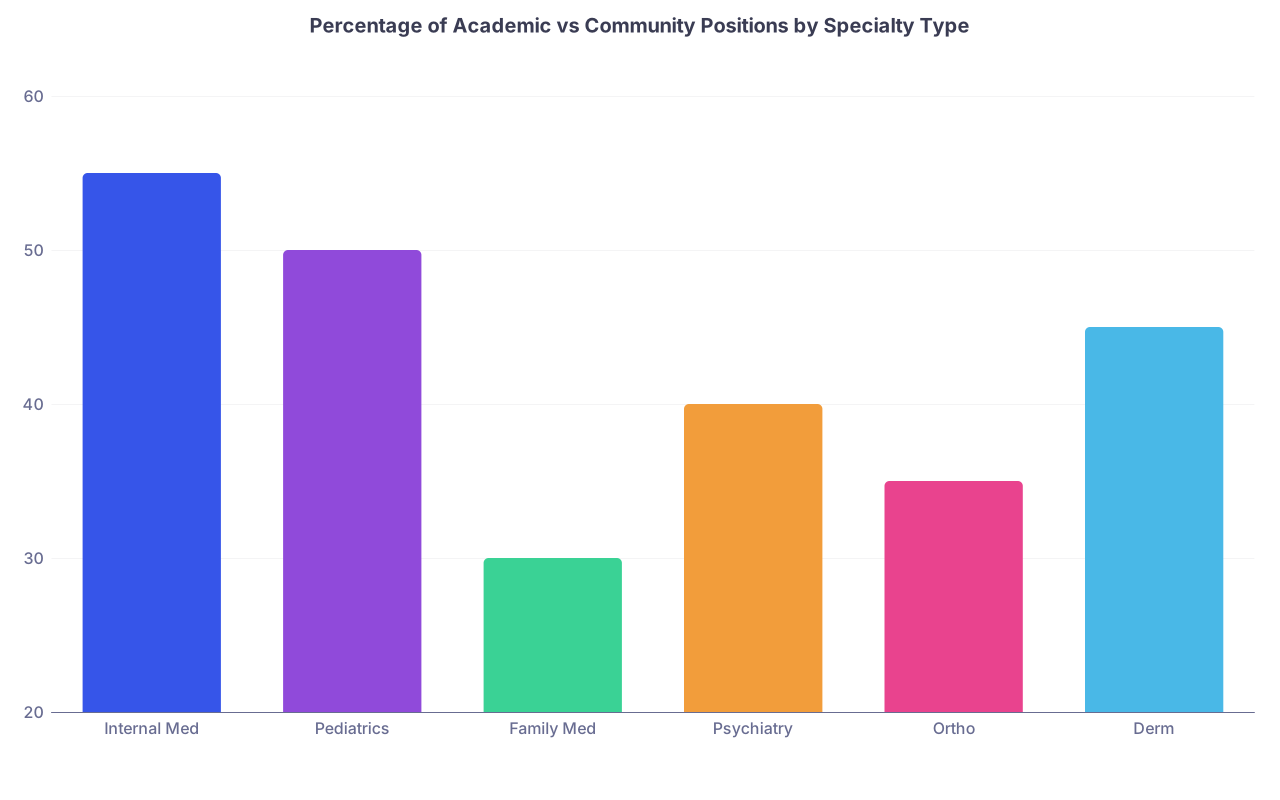
| Category | Value |
|---|---|
| Internal Med | 55 |
| Pediatrics | 50 |
| Family Med | 30 |
| Psychiatry | 40 |
| Ortho | 35 |
| Derm | 45 |
Do not take these numbers as literal national statistics; treat them as conceptually accurate: internal medicine and pediatrics, in particular, have a huge footprint in academic centers.
Why? Because:
- Every med school and teaching hospital needs core clerkships.
- IM and peds run massive inpatient services and continuity clinics.
- Residents and students rotate through them constantly, creating huge teaching demands.
That translates directly into faculty jobs.
3. What “Academic Career” Actually Means (And What You Probably Want)
You need to define your target. “Academics” is not one job.
Broadly, you’re talking about one or more of these:
Clinician-Educator
- Majority clinical.
- Also teaches students/residents, runs small-group sessions, leads clerkships, maybe does some QI or education research.
- Titles you’ll see: Assistant Professor, Clerkship Director, Associate Program Director.
Clinician-Researcher
- Split time between clinical and research (anywhere from 20–80% research).
- Writes grants, publishes regularly, presents at conferences.
- Titles: Assistant Professor, Research Faculty, Principal Investigator.
Pure Educator/Leader
- GME/UME heavy: Program Director, DIO, Dean-level roles.
- Heavy on curriculum design, accreditation, administration.
All three tracks exist in “low-competition” specialties. In fact, they may be easier to break into there because:
- Less crowding by ultra-competitive peers.
- Programs are hungry for people willing to do teaching, QI, and educational leadership.
- It’s often easier to get meaningful roles early.
If your goal is “I want to teach, have residents, publish a bit, be at an academic center” — you do not need a hyper-competitive specialty.
4. Academic Prospects by Common Low-Competition Specialties
Internal Medicine
IM is probably the single best launchpad for an academic career if you’re not chasing raw competitiveness.
Paths:
- Hospitalist with academic appointment
- General IM clinician-educator
- Subspecialist via fellowship (cards, GI, pulm/crit, ID, etc.)
- Health services research, QI, medical education, informatics
I’ve watched average Step 1/2 takers match solid IM programs, do a chief year, crush a couple of QI projects, and walk into junior faculty roles at major universities. Not rare. Routine.
If you want a heavy research career, target:
- University-based IM residency with strong research output.
- A research mentor early, ideally PGY1.
- Extra research or MPH/PhD if you’re serious about grants.
Pediatrics
Very similar to IM structurally, with less pay but massive need for:
- Academic general pediatrics
- Hospital medicine
- Subspecialties (heme/onc, NICU, cards, etc.)
- Education and advocacy work
Many children’s hospitals are deeply tied to med schools and prioritize faculty who want to teach. A resident willing to take on projects and assume leadership roles can move up quickly.
Family Medicine
This is where people are most wrong.
Family medicine is full of academic careers:
- FM residency faculty (every FM residency needs a decent-sized academic core)
- Clerkship directors / course directors for med school preclinical and clinical courses
- Leaders in community-oriented primary care, public health, behavioral health integration
- Medical education research, rural health research, health equity work
The trick: you must go to a residency that is clearly academic-leaning if you want this path. That means:
- University-based or community-university affiliate program
- Residents routinely present at STFM, AAFP, NAPCRG
- Faculty with publication records and educational titles
Psychiatry
Psych has exploded in interest, but it’s still not derm-level competitive across the board. Academic psych is huge:
- Residency and fellowship programs are expanding.
- Research opportunities in neuroscience, psychopharm, addiction, health services.
- Strong demand for clinicians who also teach and supervise therapy/consult services.
If you like education and mentoring, academic psych is actually one of the easiest spaces to carve out a niche because there’s ongoing need and burnout among faculty.
Neurology
Neurology sits in that middle ground—competitive at top places, not impossible overall.
Academic doors:
- Stroke, epilepsy, neuroimmunology, movement disorders.
- Heavy research potential (clinical trials, imaging, basic science).
- Chronic shortage of neuro faculty at many teaching hospitals.
You don’t need to be at UCSF to do academic neurology. A solid university-affiliated program plus ongoing research with a mentor is enough.
5. How Low-Competition Can Still Equal High Academic Impact
Here’s the core formula you should be thinking about:
Specialty competitiveness ≠ academic ceiling.
Mentorship + niche + output = academic career.
Three levers you control:
-
- If you want academics, rank programs where:
- Residents regularly match to fellowships or become faculty.
- There are clear scholarly expectations: required QI, capstone, or research project.
- The website and interview day actually talk about mentorship and protected time.
- If you want academics, rank programs where:
Early Buy-In
- First year: find a mentor, join a project.
- Second year: present at a regional or national conference.
- Third year: lead something—curriculum, QI team, resident teaching series.
Visible Contributions
- Publish case reports and small series early. They’re not glamorous, but they build a track record.
- Volunteer for teaching: small groups, skills workshops, OSCEs.
- Sit on committees: Curriculum, QI, Diversity, GME Council.
You can be a completely average applicant on paper and still emerge as “the resident everyone wants to hire” if you do those three aggressively at a halfway decent program.

| Step | Description |
|---|---|
| Step 1 | Choose Specialty |
| Step 2 | Community Focus |
| Step 3 | Pick Academic-Leaning Residency |
| Step 4 | Find Mentor PGY1 |
| Step 5 | Join Research or QI Projects |
| Step 6 | Present and Publish |
| Step 7 | Take Teaching Roles |
| Step 8 | Apply for Academic Faculty |
| Step 9 | Want Academics? |
6. But What About Research-Heavy Academic Careers?
Now the honest counterpoint.
If your dream is:
- Running an NIH-funded basic science lab
- Spending 70–80% time in research
- Being a household name in your subspecialty
Then yes, specialty and institution start to matter more.
You’re looking for:
- Very strong research infrastructure
- MD/PhD colleagues
- Formal research tracks and protected time
- Heavyweight mentors with track records of K/R awards
Can you still do this in internal medicine, pediatrics, psychiatry, neurology? Absolutely. In fact, those are some of the main scientific specialties.
Can you do it from a random low-academic-intensity family medicine program with no research culture? That’s going to be extremely hard.
This is less about “low-competition specialty” and more about “weak research environment.”
So if you’re research-ambitious:
- Don’t just choose a specialty. Choose a residency with proven research output.
- Ask hard questions on interview day: how many residents publish? How many go on to research fellowships? Are there K-awardees on faculty?
- Consider adding an MPH, MS, or postdoc-like research fellowship if needed.
7. Concrete Examples: How This Plays Out
Here’s what I’ve actually seen in practice.
| Starting Specialty | Typical Resident Profile | Academic Outcome |
|---|---|---|
| Internal Medicine | Mid-tier US MD, average scores | Hospitalist, APD at university hospital |
| Pediatrics | US DO, few publications | General peds faculty, clerkship director |
| Family Medicine | US MD, no research in med school | FM residency faculty, program director |
| Psychiatry | IMG, solid Step scores | Academic psych attending, inpatient unit director |
| Neurology | US MD, strong interest in teaching | Epilepsy specialist, medical school course co-director |
None of those people matched their “dream” hypercompetitive field. All of them have clear academic titles now.
Notice the pattern: they chose programs that valued academics and then leaned in hard.
8. How to Position Yourself Now (Med Student or Early Resident)
If you’re still in med school:
- Stop obsessing over specialty competitiveness as your proxy for future status.
- Target specialties you actually like that also have academic ecosystems (IM, peds, psych, FM, neuro).
- On rotations, pay attention: which attendings talk about residents, curricula, research? Those are your academic role models.
If you’re already in a low-competition specialty:
- Identify one or two faculty who are clearly “academic”: published, hold titles, run programs.
- Ask to get involved. Do not say, “Any research?” Say, “I’d like to help move forward something you’ve already started.”
- Start teaching as soon as you’re allowed: med student teaching, simulations, skills labs.
And one tactical point: keep a simple academic CV updated from day one. Sections for:
- Publications
- Posters/presentations
- Teaching activities
- Leadership/QI/committees
You’ll be surprised how quickly it grows if you’re intentional.
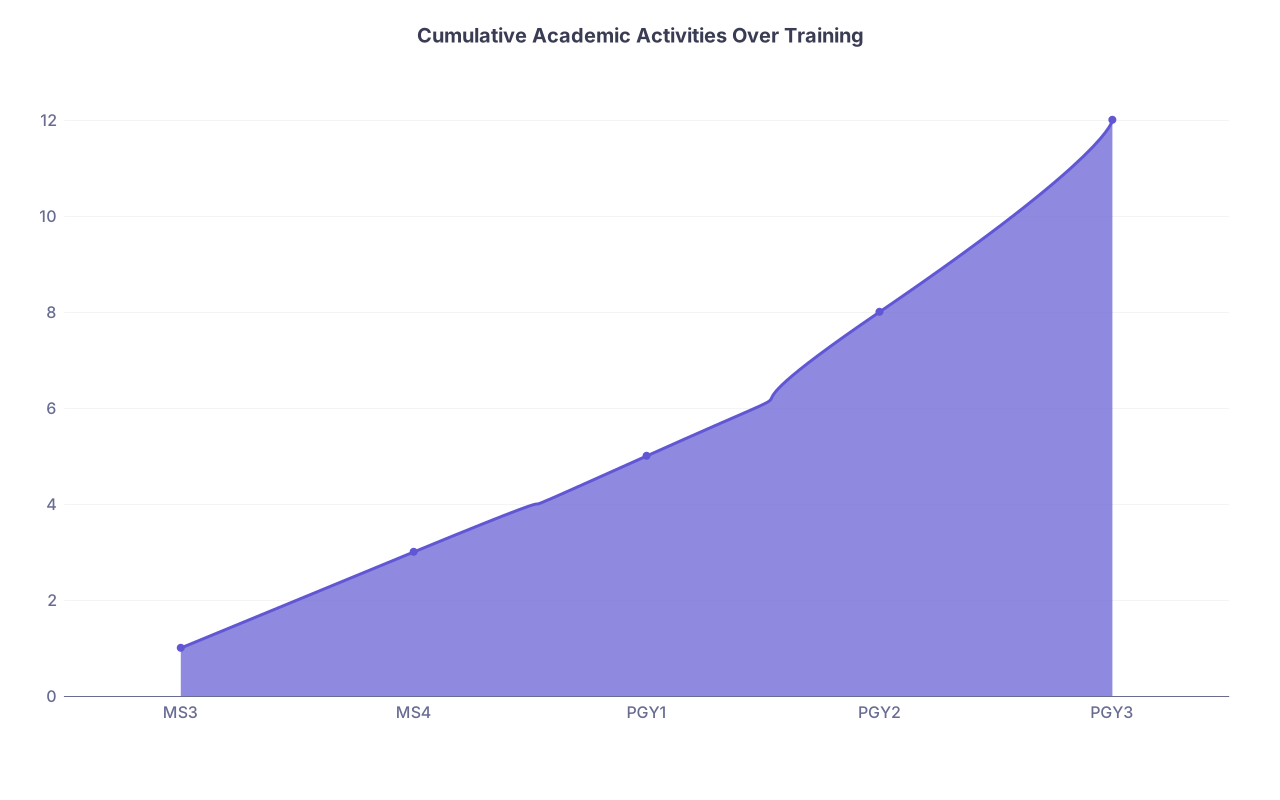
| Category | Value |
|---|---|
| MS3 | 1 |
| MS4 | 3 |
| PGY1 | 5 |
| PGY2 | 8 |
| PGY3 | 12 |
9. When a Low-Competition Specialty Might Truly Limit You
There are a few narrow scenarios where the specialty itself can box you in:
- You want a specific procedure-heavy academic niche that simply doesn’t exist in your field (e.g., you love complex structural interventions but went into psych).
- You’re in a small market where the only academic spots are in one or two specialties.
- You matched a purely community program with zero academic ties and don’t put in any effort to build a bridge (moonlighting at academic centers, adjunct roles, etc.).
But these are edge cases. The bigger risk is passivity: doing your 3 years, not building any niche, and then being surprised when your only offers are volume-heavy community jobs.

10. Practical Checklist: Turning “Low-Competition” into Academic Leverage
If you want a simple decision framework, use this during residency selection and training:
During applications:
- Does the program have clear academic titles among faculty (PD, APD, clerkship director)?
- Do current residents have posters/publications listed on the website?
- Is there a track record of recent grads staying as faculty or matching academic fellowships?
During residency:
- By 6 months: identify your likely niche (education, QI, clinical topic, research area).
- By 12 months: be meaningfully involved in at least one project.
- By 24 months: present at a regional or national meeting.
- By graduation: have at least one publication or major institutional role (resident leader, curriculum lead, committee work) that you can clearly describe.
That’s enough to make you highly recruitable for many academic positions in IM, peds, psych, FM, and neurology.
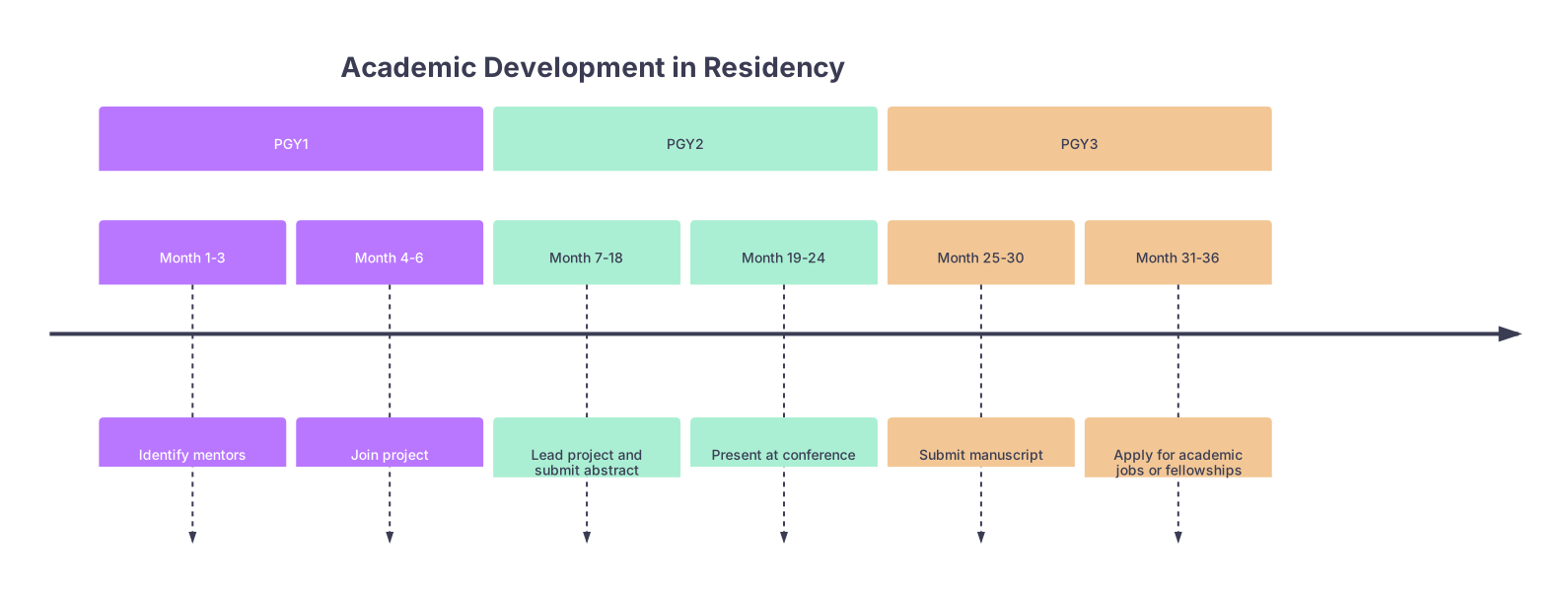
| Period | Event |
|---|---|
| PGY1 - Month 1-3 | Identify mentors |
| PGY1 - Month 4-6 | Join project |
| PGY2 - Month 7-18 | Lead project and submit abstract |
| PGY2 - Month 19-24 | Present at conference |
| PGY3 - Month 25-30 | Submit manuscript |
| PGY3 - Month 31-36 | Apply for academic jobs or fellowships |

11. Bottom Line
Choosing a low-competition specialty does not shut the door on an academic career. Not even close.
Three key points you should walk away with:
Your environment and actions matter more than specialty competitiveness. Internal medicine, pediatrics, family medicine, psychiatry, and neurology all have robust academic ecosystems if you pick the right programs.
Academic careers are built on mentorship, niche, and output. Plug into faculty who are already doing what you want to do, contribute early, and make your work visible through presentations, publications, and teaching.
If you intentionally choose an academic-leaning path, “less competitive” can actually be an advantage. There’s often more room to step up, lead, and grow into faculty-level roles quickly.
So yes—choosing a low-competition specialty can absolutely still lead to an academic career. The real question is whether you’ll treat residency as a job, or as your launchpad.