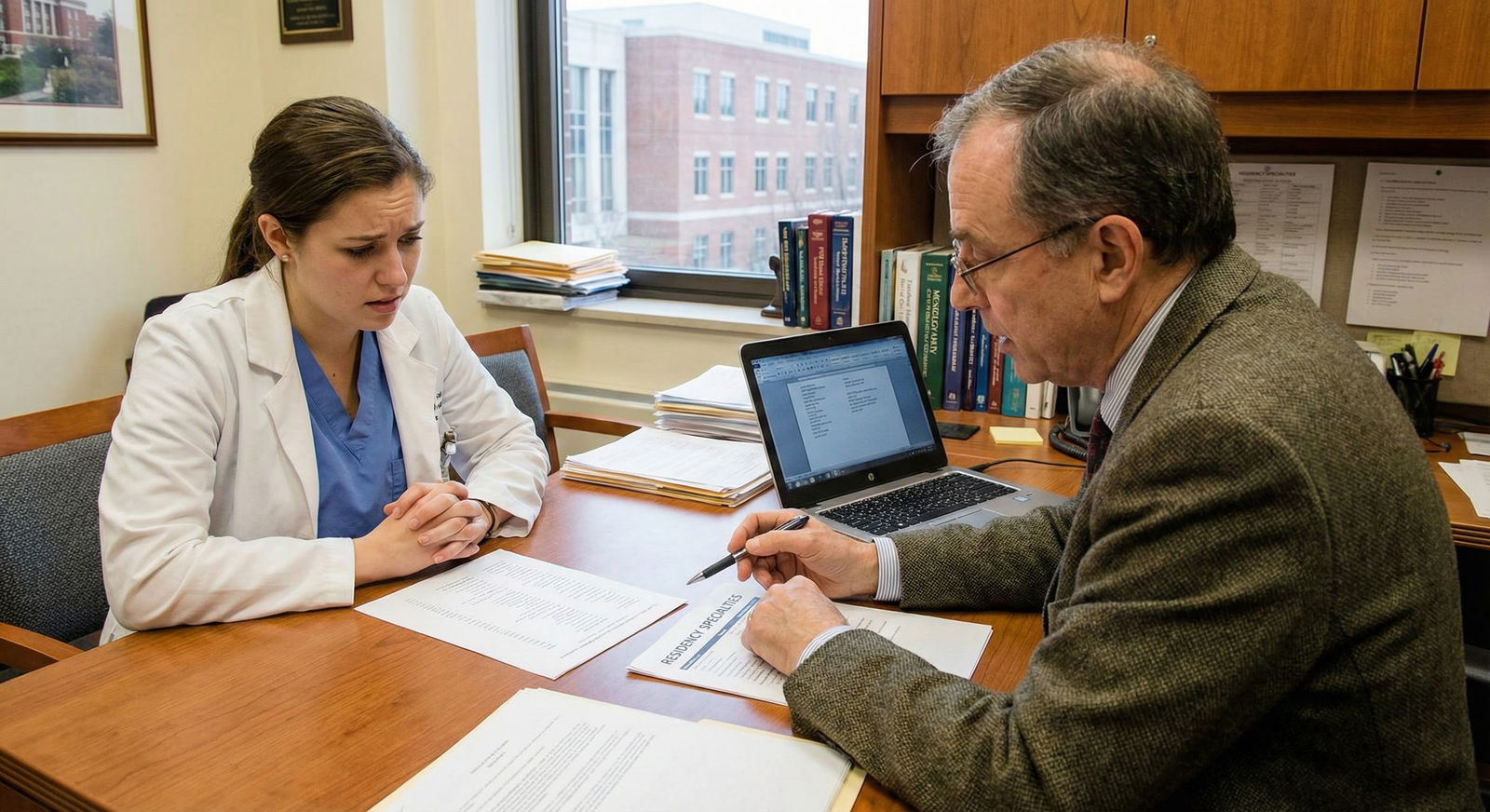
The belief that you’re “stuck forever” in the specialty you matched into is wrong. You can move from a less competitive residency into a more competitive one—but it’s harder, slower, and way less glamorous than online success stories make it sound.
Here’s the actual landscape and what works in real life.
The Short Answer: Yes, But It’s an Uphill Climb
You can transition from a less competitive specialty (family medicine, internal medicine, psych, peds, etc.) into a more competitive one (derm, ortho, ENT, plastics, radiology, anesthesia, EM in some markets, etc.). People do it every year.
But three things decide whether it’s realistic for you:
- Your academic record (Step/Level scores, med school reputation, prior red flags)
- Your timeline (PGY level, contract obligations, visa status, finances)
- Your proof of commitment to the new field (research, letters, rotations)
If you’re thinking “I’ll just do FM then slide into derm,” that’s fantasy. If instead you’re thinking “I’m a solid IM resident with decent scores, willing to grind for 1–2 years of research and start over,” that can work.
What “Less Competitive” to “More Competitive” Actually Looks Like
Let’s put some concrete structure on this.
| Current Specialty (Less Competitive) | Target Specialty (More Competitive) |
|---|---|
| Family Medicine | Dermatology |
| Internal Medicine | Cardiology Fellowship (high tier) |
| Psychiatry | Neurology or PM&R (mid-competitive) |
| Pediatrics | Pediatric Radiology |
| Transitional/Prelim Year | Ortho, ENT, Radiology |
This isn’t exhaustive, but it matches what I’ve seen residents actually attempt.
Big pattern: moving into a more competitive residency is harder than moving into a more competitive fellowship from a core residency (like IM → GI/cardio; peds → NICU). If you’re early in training, you’re probably thinking about switching residencies. If you’re PGY-2+ in IM, you might be thinking about chasing a competitive fellowship instead. Different games.
The Three Main Paths to Transition
There are really only three credible routes.
1. The “Reapply as a New Applicant” Route
This is the cleanest but also the most painful. You basically restart the match.
You:
- Finish your current PGY year (or more)
- Build a competitive application in the new field (research, rotations, letters)
- Apply through ERAS like a fourth-year again
- Start over as a PGY-1 in the new specialty if you match
This is how IM → derm, FM → radiology, or psych → anesthesia transitions usually work.
Pros:
- Programs treat you more like a standard applicant
- You can rebrand fully and present a cohesive story
- You avoid the politics of “off-cycle” transfers
Cons:
- You probably lose training time and years of income
- You may have to explain to your current PD why you’re bailing
- Visas, contracts, and life logistics get messy
Who this works for:
- Residents with solid board scores (e.g., Step 1 ≥ 235–240, Step 2 CK ≥ 245+ if aiming for derm/ortho/ENT)
- People early in training who can tolerate starting over
- Those willing to do 1–2 years of research in the new field
2. The “Transfer into an Open PGY Slot” Route
This is the backdoor: mid-training transfers into unfilled or new positions. These spots come from:
- Residents who quit, get fired, or switch out
- Programs that expand and get extra positions approved
- New programs that grow faster than the match can fill
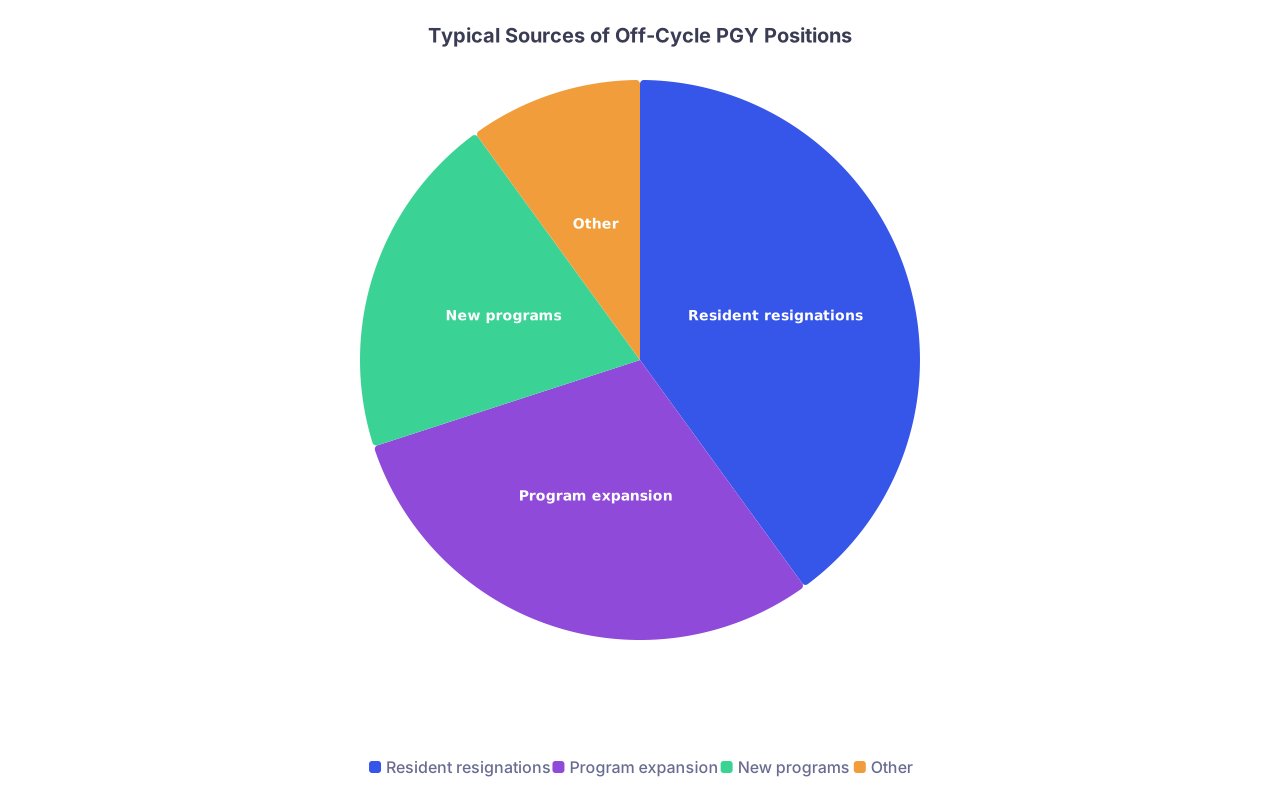
| Category | Value |
|---|---|
| Resident resignations | 40 |
| Program expansion | 30 |
| New programs | 20 |
| Other | 10 |
How it plays out in practice:
- You quietly reach out to program coordinators/PDs in your target specialty
- You ask about “unexpected vacancies” or “off-cycle PGY-2/3 spots”
- You send a focused CV, personal statement, and strong letters
- If lucky, you slide into a PGY-2 or PGY-3 slot and don’t fully restart
Pros:
- You might preserve some PGY credit
- Less formal than the match; decisions can be quicker
- You may avoid taking another Step 2/3 right away
Cons:
- Open spots in competitive specialties are rare and often have dozens of applicants
- Timing is chaotic; opportunities pop up and disappear fast
- You still need to be very competitive and well-networked
Who this works for:
- Residents with strong academic records and at least neutral PD support
- People with enough flexibility to move mid-year or off-cycle
- Those who’ve already done electives/research in the target field
3. The “Stay in Core, Go Big on Fellowship” Route
Sometimes the smartest pivot is not another residency. It’s choosing a tougher fellowship out of a core field you already started.
Examples:
- IM → cardiology, GI, heme/onc
- Peds → NICU, peds cardiology
- Psych → child psych (less about competitiveness, more about subspecialty fit)
This isn’t technically “less competitive to more competitive residency,” but it solves the same underlying problem: you want more specialized, higher-demand, often higher-paid work.
Pros:
- You don’t throw away your current residency
- You can still end up in a high-paying, high-impact niche
- Programs understand this path; it’s standard
Cons:
- If you truly hate your current core field, this may feel like a band-aid
- You still need research, strong letters, and often high board scores
- Some fellowships are nearly as competitive as the big-name residencies
Hard Reality Check: Your Starting Position Matters
Let me be direct: not everyone can or should make this jump.
These are the real filters programs use.
1. Scores and Transcript
For top-competitive specialties, programs will look at:
- Step 1 (even if pass/fail now, your numeric score is still in ERAS if you took it earlier)
- Step 2 CK or Level 2-CE
- Any failures or repeats (Step, shelf, course)
- Class rank/AOA if available
If you’re sitting on a 220 Step 1 and 225 Step 2 trying to break into derm or plastics from FM, you are fighting gravity. Not impossible, but extremely uncommon.
2. Current Performance as a Resident
Program directors will ask each other bluntly:
“Would you rehire this person? Would you sign them again?”
If your current evals say you’re chronically late, weak clinically, bad with notes, or difficult to work with, no PD in a more competitive specialty will risk taking you—no matter how strong your “passion” story is.
On the flip side: strong multisource comments like “top 10% resident I’ve worked with” carry a lot of weight.
3. Story Coherence
If your CV looks like:
- MS1–3: nothing in derm
- Matched into FM, PGY-1: no derm exposure
- Suddenly PGY-2: “deep love for dermatology”
…programs will roll their eyes.
You need a story that makes sense:
- Reasonable motivation for original specialty
- Specific experiences that shifted your interest
- Concrete actions you took before reaching out (research, clinics, electives)
Step-by-Step: How to Actually Do This
Let’s assume you’re serious and not just daydreaming on a bad call night.

| Step | Description |
|---|---|
| Step 1 | Decide You Want to Switch |
| Step 2 | Reality Check With Mentor |
| Step 3 | Assess Scores and Record |
| Step 4 | Build Targeted CV |
| Step 5 | Adjust Goals or Focus on Fellowship |
| Step 6 | Talk to Current PD |
| Step 7 | Choose Path - Reapply or Transfer |
| Step 8 | Apply Strategically |
| Step 9 | Interview and Negotiate Timing |
| Step 10 | Competitive Enough? |
Step 1: Quiet Reality Check
Before you tell anyone, sit down with:
- A trusted attending in your current specialty
- A mentor in the target specialty (even if you barely know them)
- Possibly your med school dean or advisor if they know you well
Have them look at your scores, CV, and give you an unfiltered impression of your odds. If three honest people are all hesitant, listen.
Step 2: Build Evidence for the New Field
You need to look like a real applicant in that specialty, not a tourist.
That usually means:
- Get at least 1–2 rotations in the new field (inpatient, clinic, or electives)
- Produce some research: retrospective chart review, case series, review article; anything with your name on it
- Secure at least one strong letter from someone established in the target specialty
- Go to their conferences or local meetings, present a poster if possible
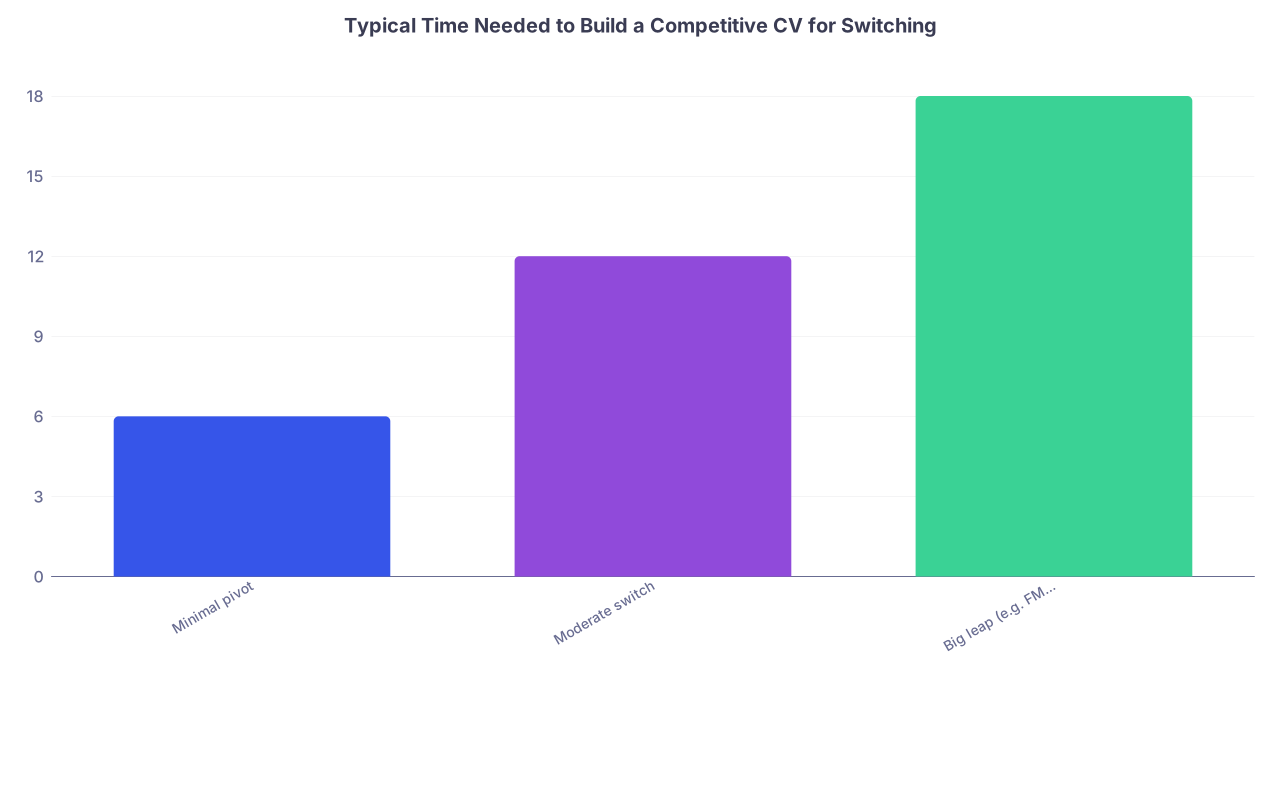
| Category | Value |
|---|---|
| Minimal pivot | 6 |
| Moderate switch | 12 |
| Big leap (e.g. FM to Derm) | 18 |
(Values are months of focused work. Yes, it takes that long.)
Step 3: Talk to Your Current PD (Strategically)
You don’t lead with “I’m out of here.” You lead with honesty plus professionalism:
- “I’ve realized I may be a better fit for X field based on Y experiences.”
- “I want to do this in a way that doesn’t burn bridges or harm the program.”
- “Would you be willing to support me if I pursue this path?”
Best case: they support you, give you time for away rotations/research, and write a neutral-to-positive letter.
Worst case: they become obstructive. If that’s the vibe, you need to be careful with timing, but sabotaging you outright is rare—PDs talk, and toxic behavior gets around.
Step 4: Decide: Reapply vs Transfer
Here’s a simple mental framework.
| Factor | Favors Reapply | Favors Transfer |
|---|---|---|
| Desired PGY level | OK starting as PGY-1 | Want PGY-2+ credit |
| Timing | Can wait for next Match | Need sooner change |
| Specialty rarity | Very few off-cycle spots | Many programs, some turnover |
| Visa constraints | Need structured pathway | Have flexibility |
| Risk tolerance | Can handle all-or-nothing | Prefer opportunistic openings |
You can hedge: prepare for both match reapplication and keep an eye on open PGY-2+ positions.
Step 5: Apply Smart, Not Just Wide
Target programs where you actually have leverage:
- Places where you rotated or did research
- Institutions that know your mentors
- Programs that historically accept non-traditional applicants or transfers
- Geographic regions with less competition compared to hot cities
And be explicit in your personal statement:
- Why you’re leaving your current specialty
- Why this isn’t just “prestige chasing”
- What you’ve already done that shows you’ll be an asset on day one
Common Mistakes That Kill Your Chances
I see the same errors repeatedly.
Waiting until PGY-3 in a categorical program to start thinking about switching. By then, sunk costs are massive and programs ask, “Why now?”
Doing zero research in the target specialty, then applying with a generic story. You will lose to med students with research every time.
Trashing your current specialty or program in your narrative. Makes you look immature and risky.
Ignoring visa or contract realities. If you’re on a J-1/H-1B, you can’t hand-wave that away.
Underestimating finances. Switching often means extra years on resident salary, delayed attending income, and sometimes repayment complications.
When Switching Is Probably a Bad Idea
You can do hard things. But not all hard things are smart.
Think twice if:
- Your main reason is “money” or “status,” not fit or burnout. You’ll carry the same dissatisfaction with you.
- Your scores and performance are average or below average and the target field is top-tier competitive. You’re setting yourself up for repeated rejections.
- You’re already mid/late in residency with significant family and financial responsibilities. The tradeoff might not be worth it.
Sometimes the right move is to:
- Finish your current residency
- Find a niche you genuinely like within it
- Optimize for job location, work-life balance, and environment rather than trying to “escape”
Quick Specialty-Specific Notes
A few patterns I’ve seen repeatedly:
- IM → Radiology/Anesthesia: Highly possible with good scores and early moves. These are common crossovers.
- FM → EM: Used to be easier; now much harder as EM has become oversaturated. Still possible through off-cycle or community programs.
- FM/IM → Derm/Plastics/Ortho/ENT: Rare. The people who pull this off usually have high Steps, major research, and 1–2 years dedicated to the new specialty.
- Psych → Neuro or PM&R: Doable, especially early, often through transfer spots.
- Prelim surgery → Radiology/Anesthesia/EM: Fairly common, especially if the resident realizes early that they dislike OR life.
FAQ (Exactly 6 Questions)
1. Is it easier to switch specialties during intern year?
Yes. PGY-1 is the sweet spot. Programs are more flexible with credit transfer, you have less sunk time, and your story (“I discovered X fits me better”) is more believable. After PGY-2, you’re fighting both logistics and skepticism.
2. Do I lose all my years if I change residencies?
Not always. Some specialties can give you partial credit for prior training (e.g., IM → neurology may give 1 year credit). Extremely competitive fields like derm or ortho typically won’t. Expect to lose at least a year, often more, if you’re making a big jump.
3. Do I need new Step scores to be competitive when switching?
Usually no, but strong Step 2/3/Level 2/3 scores help if your earlier exams were weaker. Some people strategically take Step 3 and crush it to show improvement. It’s not magic, but it can mitigate a mediocre Step 1 a bit.
4. How honest should I be about why I’m switching?
You should be honest but professional. Saying “I hated my current field” is sloppy. Saying “After exposure to X, I realized my strengths and interests align more with Y for these specific reasons” is better. Programs want insight, not drama.
5. Can I switch if my current PD won’t support me?
It’s harder, but not impossible. A hostile PD can tank you with bad backchannel comments. A neutral one who just doesn’t actively help is manageable if you have strong letters from others. If you suspect real obstruction, you need careful mentor guidance before moving.
6. What’s the single most important thing to do first if I’m considering a switch?
Stop guessing alone. Get an honest read from someone in the target specialty who sees your full application—scores, CV, evaluations. If they say your odds are very low for that field, either adjust your expectations (different specialty or fellowship) or accept a long, uncertain grind.
Bottom line:
You can move from a less competitive residency to a more competitive one, but it takes three things: a realistic appraisal of your current competitiveness, visible proof you belong in the new field, and a willingness to accept extra years and risk.
If you’re ready for that trade, start early, get real mentorship, and be deliberate.