
It’s January. You’re scrolling through FREIDA at midnight, coffee gone cold, sorting by “least competitive” just to feel like you have some control. FM, Psych, IM, Peds, maybe Path or Neurology. The “easier” side of the match.
But then reality hits: there are hundreds of programs that will probably interview you. You cannot tell them apart. The websites all say the same fluff: “collegial,” “supportive,” “strong clinical training.” You know some of it is nonsense. You just don’t know which parts.
Here’s the answer you’re looking for: in less competitive specialties, the name on the door matters less; the details of your daily life and training matter more. You need a clear framework for what actually moves the needle.
Let’s build that.
Step 1: Know What “Easier Match” Actually Buys You
In the least competitive specialties (think: Family Medicine, Psychiatry, Pediatrics, many Internal Medicine programs, low-tier Pathology, some Neurology), getting a spot is often easier. Getting a good spot is not automatic.
So you aren’t just asking “Will they rank me?”
You’re asking “Where will I be happy and well-trained for 3+ years?”
The top-tier programs in “easier” fields can be just as selective as mid-tier in competitive ones. But the spread is wide. That’s good news for you: it means you have room to prioritize features that actually fit your life and goals, not just “whatever will take me.”
First filter: understand what you care about after residency:
- Outpatient vs inpatient heavy job?
- Academic vs community?
- Fellowship vs straight to practice?
- Geographic must-haves (partner job, family, immigration, etc.)?
Those answers drive which program features matter most for you.
Step 2: The Features That Matter Way More Than People Admit
In the least competitive specialties, here’s the hierarchy I use when advising students. I’m blunt about this because I’ve seen too many people chase the wrong things.
1. Training Quality You Can Actually Feel
Forget mission statements. Look at:
- Clinical volume: Are residents busy enough to graduate competent, but not drowning?
- Autonomy: Do senior residents actually run things, or are attendings doing all the work?
- Graduates’ jobs: Are they getting the type of jobs you want?
If you’re looking at FM, Peds, Psych, IM, etc., you don’t need a “prestige brand” to be employable. You need to be competent and confident. That comes from reps + responsibility.
Red flags: PGY-3s saying “I still don’t feel comfortable managing X,” or they constantly talk about being “just service, no teaching.”
2. Workload and Schedule Reality (Not the PR Version)
This is huge and chronically under-discussed. How much your day-to-day life sucks (or doesn’t) will shape everything: learning, mood, relationships, even whether you burn out.
You want specifics from residents:
- Average hours per week on wards (not “we comply with ACGME”).
- How often 28-hour calls vs night float vs no overnight.
- Number of ICU months.
- How much scut: transport, phlebotomy, scheduling.
Programs in “easier” specialties can still destroy you with bad scheduling and poor support. And here’s the kicker: because they’re easier to match into, some of those programs feel less pressure to improve.
If they dodge quantitative answers, I mentally downgrade that program.
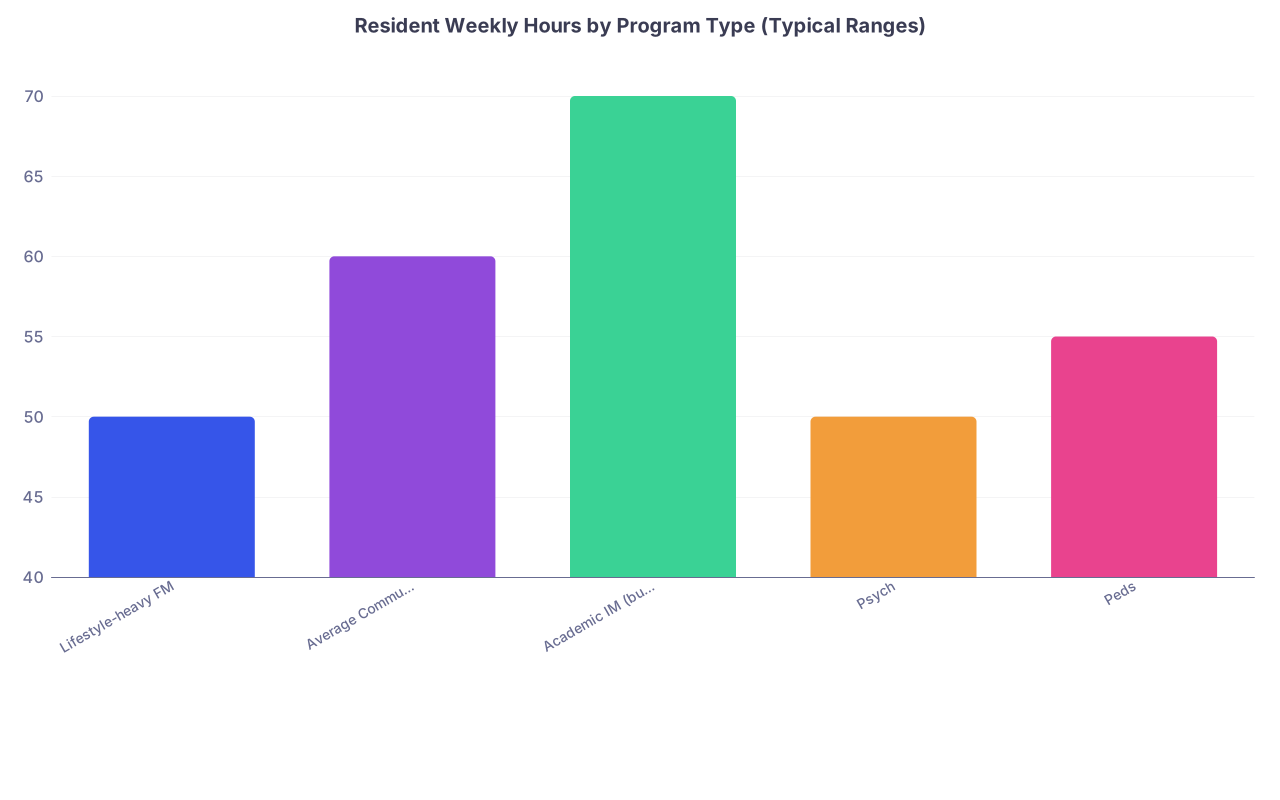
| Category | Value |
|---|---|
| Lifestyle-heavy FM | 50 |
| Average Community IM | 60 |
| Academic IM (busy) | 70 |
| Psych | 50 |
| Peds | 55 |
You’re not looking for “easy.” You’re looking for sustainable.
3. Culture: How They Treat Their Lowest-Power People
In low-competition fields, you will have a lot of options that “meet the bar.” Culture is the tiebreaker that actually matters.
Listen closely to how residents talk:
- Do they say “we” or “they” when talking about leadership?
- Do they mention retaliation, fear, or “you just keep your head down and get through”?
- Are they defending the program constantly, or can they admit downsides without sounding terrified?
Watch for how faculty and seniors interact with interns in conference and on interview day. Dismissive? Interrupting? Sarcastic edge? That doesn’t magically go away when you show up as a PGY-1.
Bottom line: A medium-strong program with a sane, supportive culture beats a “name brand” with a toxic director. Every time.

| Step | Description |
|---|---|
| Step 1 | Identify Specialty |
| Step 2 | Prioritize academic placement |
| Step 3 | Prioritize workload and location |
| Step 4 | Look for strong fellowship match list |
| Step 5 | Solid, not elite programs okay |
| Step 6 | Focus on culture and schedule |
| Step 7 | Shortlist 5-10 programs |
| Step 8 | Need Fellowship? |
| Step 9 | Competitive fellowship? |
Step 3: Features That Matter If You Want Options After Residency
Now let’s talk outcomes. Even in less competitive specialties, some programs reliably open more doors than others.
4. Fellowship and Job Placement
Not everyone in “easier” specialties plans on fellowship, but many change their minds during residency. Do not kill your future options by choosing a dead-end program.
Look at:
- Fellowship match list for the past 3–5 years.
- Where grads get jobs: academic centers, big groups, rural solo practice, etc.
- Subspecialty exposure: are there actual faculty in areas you might care about?
If you’re in IM, this is obvious: cards, GI, pulm/crit, heme/onc.
In FM: sports, OB-heavy practice, addiction, geri, palliative.
In Psych: child/adolescent, addiction, forensics, consult-liaison.
In Peds: NICU, PICU, cards, heme/onc, etc.
You do not necessarily need “top 10” anything. You do need a track record of grads who did what you might want to do.
5. Reputation Where It Actually Counts
For FM/Psych/Peds/IM, you do not need universal name-recognition. You need targeted respect:
- In the city/region where you plan to work
- In the niche you care about (e.g., strong inpatient-heavy IM for hospitalist career, or outpatient-focused FM for clinic jobs)
Ask faculty at your med school: “In [this region], which FM/Psych/IM/Peds programs produce really solid grads?” That answer will be more useful than USNWR rankings.
| Goal After Residency | Most Important Features | Less Important Features |
|---|---|---|
| Community outpatient job | Clinic experience, schedule, local reputation | NIH funding, big research projects |
| Academic career | Research support, mentorship, name recognition | Perfect lifestyle schedule |
| Competitive fellowship | Fellowship match list, subspecialty exposure | City amenities, super light workload |
| Rural practice | Broad scope, procedures, autonomy | University brand name |
| Lifestyle-focused career | Workload, culture, call schedule | Tertiary-care complexity |
Step 4: Features That Matter For Your Actual Life
You’re not a robot grinding out RVUs; you’re a person trying to keep your relationships and sanity. In less competitive specialties, you actually have the leverage to prioritize this.
6. Location and Support System
In hyper-competitive specialties, people often sacrifice location just to match. You might not need to.
Think hard about:
- Proximity to family or partner
- Cost of living vs salary (FM in San Francisco on a resident salary is… not pretty)
- Commuting time and parking (sounds minor now; stops being minor when you’re post-call)
A decent program in a city where you have support will almost always beat a “better” program where you are isolated and miserable.
7. Salary, Benefits, and Moonlighting
Within the least competitive specialties, compensation differences can actually matter because your hours may be more manageable, so moonlighting is realistic in PGY-2/3.
Check:
- Base PGY-1–3 salaries
- Overtime rules and how strictly they enforce them
- Moonlighting: allowed? usable? or fake (lots of programs “allow” it then make it structurally impossible)
Higher pay + realistic moonlighting can mean paying off loans faster or not living in constant financial stress.
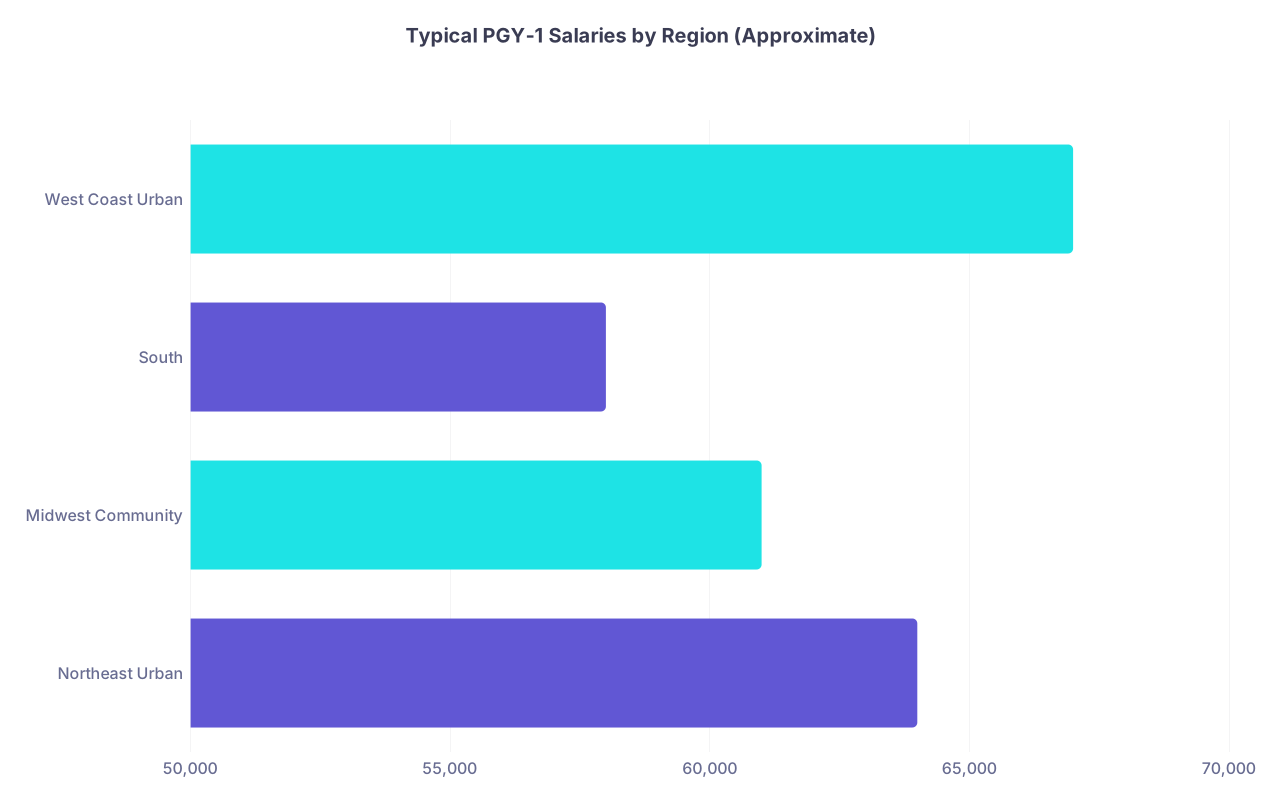
| Category | Value |
|---|---|
| Northeast Urban | 64000 |
| Midwest Community | 61000 |
| South | 58000 |
| West Coast Urban | 67000 |
These aren’t huge ranges, but with cost-of-living differences, the real impact is substantial.
Step 5: Features That Look Shiny But Are Overrated
Here’s where people waste time and stress.
Overrated in Easier Match Specialties
Big-name university when you don’t want academics
Training can be excellent, but if you hate research, conferences, constant evaluation, you’ll be miserable. A strong community program may suit you better.Minor differences in “prestige” between mid-tier programs
In FM/Psych/Peds especially, employers rarely split hairs between mid-tier residencies. They care more about references, interview impression, and whether you can actually do the job.Website buzzwords
“Wellness,” “resiliency,” “family feel” – sometimes real, often copy-paste. Anything can be claimed on a landing page.City “coolness” if you’ll never see it
Living in Chicago or LA is irrelevant if you’re too exhausted to leave your apartment and can’t afford anything anyway. Better to be in a “boring” town with a humane schedule and lower stress.
Step 6: How to Actually Compare Two Real Programs
Let’s say you’re ranking two Internal Medicine programs that are both easy-ish matches for your stats.
Program A: Midwestern university-affiliated community program
Program B: Big coastal name, more competitive, but you barely got an interview
Ask yourself:
- Which program has a saner schedule based on what residents say (not what the PD says)?
- Where do grads go? Hospitalist? Fellowship? Academic?
- Do you see yourself living there for 3 years—price, safety, climate, support system?
- How did residents talk about their leadership? Fearful or collaborative?
Then force-rank the following for you:
- Training quality / outcomes
- Culture and workload
- Location & life outside hospital
- Future options (fellowship, jobs)
- Prestige / brand name
Write that order down. When two programs are tied in overall “vibe,” defer to your own hierarchy.

Step 7: What You Should Ask Residents On Interview Day
Stop asking “Do you like your program?” Everyone lies or glosses.
Ask questions that force specifics:
- “What are the three worst parts of this program?”
- “How many hours did you work last week?” (ask 2–3 different residents)
- “If you had to choose again, would you still come here? Why or why not?”
- “Which rotations are brutal, and does leadership listen to feedback?”
- “Where did the last few grads go? Any recent fellowships?”
Watch their faces as they answer. The hesitation, eye contact, the sigh before they talk. That’s your real data.
Step 8: A Quick Side Note By Specialty
Very briefly, since this is “least competitive specialties” focused, here’s what I weight slightly differently by field:
- Family Medicine: outpatient experience, procedures, OB exposure (if you care), community ties, broad scope.
- Psychiatry: therapy vs med management balance, inpatient vs outpatient mix, subspecialty rotations (addiction, forensics, child), call burden.
- Pediatrics: NICU/PICU balance, inpatient vs outpatient, fellowship track record if sub-specializing.
- Internal Medicine (non-elite programs): hospitalist prep, ICU experience, fellowship matches if you might sub-specialize.
- Pathology: case volume, subspecialty exposure, board pass rates, job placement.
None of these require a top-10 program to have a great career. But they do require that you not sleepwalk into a weak or miserable one.
FAQ: Exactly 7 Questions
1. If a specialty is “easy to match,” does program prestige matter at all?
Yes, but not as much as people think. For most FM, Psych, Peds, and community IM jobs, being a competent, well-trained grad with good references matters more than brand name. Prestige matters more if you want academics or competitive fellowships. For a straightforward community job, I’d take better culture and training over a slightly fancier name.
2. Should I always pick the program with the lightest workload?
No. Ultra-light programs can leave you underprepared and anxious as graduation approaches. You want a “solid but livable” workload—busy enough that you see a broad range and build confidence, but not so brutal that you’re constantly drowning. If you feel like you’re on vacation during residency, that’s a bad sign.
3. How do I evaluate culture if everyone smiles on interview day?
You listen for what they say when you ask about negatives and change. Do residents feel comfortable criticizing anything? Do they say leadership is responsive or “it is what it is”? Also, compare how interns talk versus seniors. If seniors seem burned out and bitter while interns are still in the honeymoon phase, culture probably isn’t great.
4. Is it a mistake to stay at my home program in an easier specialty?
Not automatically. Staying home can be a smart move if: you like the culture, training is solid, and the location works for your life. The downside is insularity—you see one way of doing things. If your home program is mediocre or has known toxicity, do not stay just because it’s comfortable.
5. How much do fellowship match lists really matter in non-competitive fields?
If you have even a 20% chance you’ll want a competitive fellowship (cards, GI, heme/onc, some psych/peds subspecialties), they matter a lot. You don’t need 10 people a year matching at Harvard, but you do want to see some grads getting solid fellowships on a regular basis. If almost no one ever does, that’s data.
6. Should I avoid any program that is “easy to match into”?
No. Some excellent community or smaller programs are relatively easy to match simply because they’re in less popular locations or not flashy. What you should avoid are programs with: chronically unhappy residents, high attrition, no supervision or mentorship, or terrible job/fellowship outcomes. “Easy match” is not the problem; “bad training or toxic environment” is.
7. What if two programs seem basically equal—how do I break the tie?
Use this order to break ties:
- Culture and how residents feel day to day,
- Location and your support system,
- Training quality and outcomes,
- Schedule and workload details,
- Everything else.
If it’s still a tie, trust your gut feeling from interview day. Where did you feel more relaxed and like yourself?
Today’s next step: pick three programs you’re seriously considering and write a one-page comparison for each, using these headings: “Training Quality,” “Culture,” “Schedule,” “Outcomes,” and “Life Outside Hospital.” Force yourself to write at least one concrete pro and one concrete con under each heading. Your rank list will get clearer fast.