
The moment you fail a major exam, your specialty dreams do not vanish. But your margin for fantasy does.
This is the article most people wish they’d read the week they got that “Fail” notification for Step 1, Step 2, COMLEX, or a major in‑house exam. Not the “you can do anything!” pep talk. The, “Here’s what this actually means for neurosurgery vs family medicine, and when you should start thinking about least competitive specialties instead of clinging to a dead plan” talk.
That’s what we’re doing here.
1. First: What Failure Really Signals (And What It Doesn’t)
You failed a major exam. That means something real, but not everything people dramatize at 2 a.m. group chats.
It does not automatically mean:
- You are dumb
- You can never match
- You must now do an MPH, two gap years, and 14 papers to “fix your app”
- You’re doomed to “the bottom” of medicine
It does usually mean:
- Some doors just got narrower or closed
- You must be more strategic, earlier, and less delusional than your classmates
- You’ve lost the luxury of ignoring least competitive specialties as a serious option
- Your future success depends much more on fit and pattern of improvement than a one‑time score
I’ve watched people fail Step 1 and still match EM at solid programs. I’ve also watched people with the same failure end up unmatched after applying to 80+ surgery programs that were never going to rank them.
Guess who was more miserable?
Not the one in EM.
The question is not “Is my life over?”
The question is: “Given this data point, how should I adjust my specialty expectations?”
2. Step One: Know Where You Actually Stand (Not Where You Hope You Stand)
Before you even think “least competitive specialty,” you need a hard, unflinching look at your trajectory.
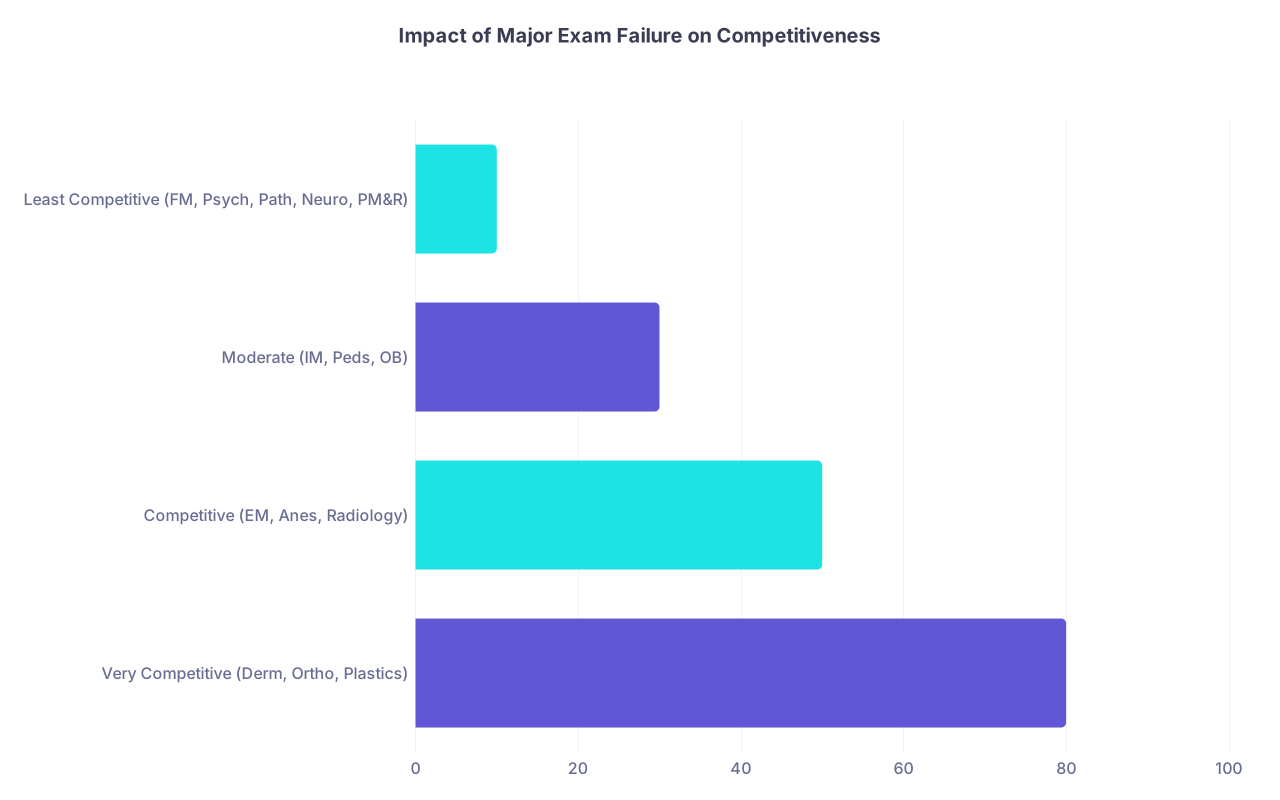
| Category | Value |
|---|---|
| Very Competitive (Derm, Ortho, Plastics) | 80 |
| Competitive (EM, Anes, Radiology) | 50 |
| Moderate (IM, Peds, OB) | 30 |
| Least Competitive (FM, Psych, Path, Neuro, PM&R) | 10 |
These percentages aren’t literal; they’re a feel for relative impact. The point: the higher up that list your dream specialty sits, the more a fail really matters.
Ask yourself:
What did I fail, and what does my retake look like?
- Failed Step 1, then scored 235 Step 1 and 245 Step 2? That’s recovery.
- Failed Step 1, barely passed Step 1 on second try, then 210 Step 2? That’s a pattern. Programs notice patterns.
What’s the story of your transcript?
- Mostly Honors/High Pass on rotations, strong narrative evals, one big standardized-test failure? Different story than:
- Multiple marginal passes, remediation of a clerkship, and a failed board.
Any other red flags?
Things like:- Course remediations
- Professionalism citations
- Gaps without explanation
- Multiple exam failures (not just one)
One failure with an upward trajectory = salvageable for a lot of specialties.
Multiple failures or consistently weak test performance = you need to start putting least competitive specialties on the table right now, not a month before ERAS opens.
3. What “Least Competitive” Actually Means (And What People Get Wrong)
Most students hear “least competitive” and immediately think “worse” or “consolation prize.” That’s lazy thinking.
Least competitive, in our world, usually means:
- Historically lower Step score cutoffs
- More programs and positions nationwide
- More IMG/DO representation
- Programs willing to look beyond a score if the fit is clear
Common examples:
| Tier | Typical Specialties | Board Score Sensitivity |
|---|---|---|
| Very Competitive | Derm, Ortho, Plastics, Neurosurgery | Extremely High |
| Competitive | EM, Anesthesia, Radiology, ENT, Urology | High |
| Moderate | IM, Peds, OB/GYN, Gen Surg | Moderate-High |
| Least Competitive | FM, Psych, Path, Neuro, PM&R | Lower-Moderate |
Are there competitive programs within “least competitive” specialties? Of course. Try matching PM&R at Kessler or Psych at MGH with weak scores. Not happening.
But as a category, FM, Psych, Pathology, Neurology, PM&R tend to give re‑take stories and late bloomers a fairer shot than neurosurgery or derm.
So “least competitive” isn’t a life sentence. It’s often the most rational move once your record has enough dings.
4. When You Should Seriously Consider a Least Competitive Specialty
Here’s the part nobody spells out. The actual “If this, then that.”
A. Single Failure, Strong Recovery – You Still Have Options
Scenario:
- Failed Step 1
- Passed on second attempt with decent score (say, 220–230 range)
- Step 2: 235–245
- Clerkships: Mostly High Pass, some Honors
- No professionalism issues
In this situation, you still have a shot at:
- IM (even academic, maybe not top‑10)
- Peds
- OB/GYN at mid‑tier
- Anesthesia or EM at more mid‑tier/community programs, especially if the rest of your app fits
Here’s where least competitive specialties fit in:
They become your safety net, not your only option.
If you’re gunning for Anesthesia or EM, I’d tell you:
- Build a parallel plan in something like FM, Psych, or PM&R
- Do away rotations in the competitive field, but quietly build strong letters in a less competitive backup as well
- Be very realistic about geographic flexibility
When you lock yourself into one moderately competitive specialty after a failure, with no backup, you’re gambling. Hard.
B. Multiple Failures or Weak Pattern – Time to Pivot Early
Scenario:
- Failed Step 1
- Repeat: barely above the pass line
- Step 2: <220
- A clerkship remediation or shelf failures
- Or: Failed Step 2 after previously passing Step 1 marginally
At this point, any advisor who tells you “You can do anything if you’re passionate enough” is lying to your face or protecting their own need to be liked.
This is where you should:
- Move least competitive specialties into the “primary plan” category
- Stop chasing Gen Surg, EM, Anesthesia, Radiology, OB, etc. unless your school has a crystal‑clear track record of placing people like you in them (hint: they probably don’t)
You should start thinking:
- Family Medicine
- Psychiatry
- Pathology
- PM&R
- Community‑focused Neurology
Not as a punishment. As your highest probability path to being a practicing physician instead of an unmatched graduate burning out on research fellowships.
C. DO/IMG + Failure = Different Math
If you’re DO or IMG and have a major exam failure, the bar is different. I’ve seen:
- DO + Step 1 fail + 230 Step 2 + strong FM letters → matched FM solidly
- IMG + Step 1 fail + 240 Step 2 + multiple US rotations → matched Psych at a community program
- DO + two exam failures + 210 Step 2 → unmatched 2 years in a row despite 100+ FM applications
For DO/IMG, a failure pushes you much more rapidly toward the least competitive set. You can still match. But you must be more aggressive about pivoting early and being geographically flexible.
5. How To Decide: Structured Reality Check, Not Vibes
You don’t make this decision alone in your apartment at midnight. You do it methodically.
Step 1: Map Your Data to Specialty Tiers
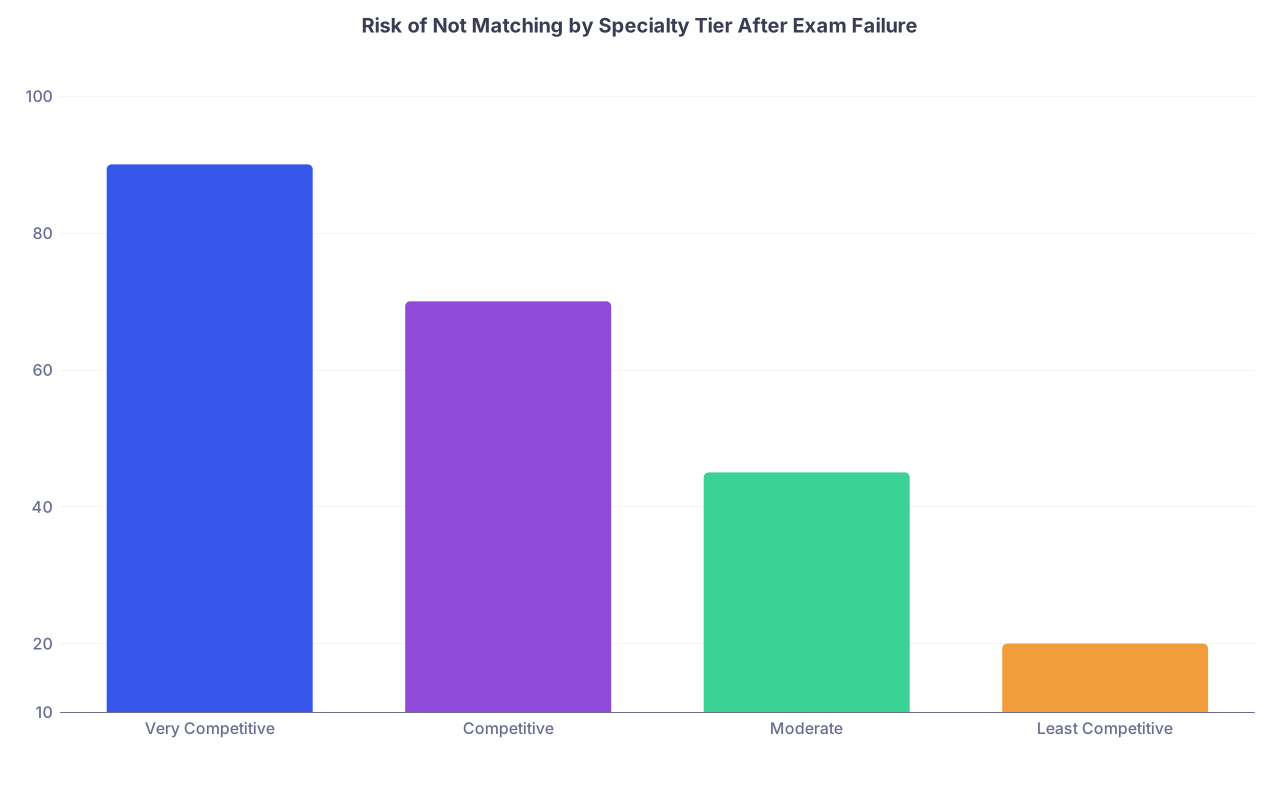
| Category | Value |
|---|---|
| Very Competitive | 90 |
| Competitive | 70 |
| Moderate | 45 |
| Least Competitive | 20 |
Again, not literal percentages, but conceptually right: your risk of going unmatched post‑failure is dramatically higher in the top tiers.
Now lay out your actual numbers on paper:
- Step 1: Pass/Fail? Any fail?
- Step 2: Score? Any fail?
- COMLEX: Any failures or low scores?
- Clerkships: Any remediations or marginal passes?
Compare this against publicly available data (NRMP Charting Outcomes, FREIDA filters, your school’s match list patterns). If your scores are below the 25th percentile for a specialty and you have a failure, it’s not a smart primary target.
Step 2: Reality Check with Brutally Honest People
Talk to:
- A trusted faculty advisor who actually knows NRMP data
- A PD or APD in your home department(s)
- A recent grad two or three years ahead of you who matched with a non‑perfect record
Ask them direct, uncomfortable questions:
- “With my record, what percentage chance would you give me of matching EM vs FM?”
- “Would you be comfortable writing in a letter that you strongly recommend me for [specialty], not just that I am ‘competent’?”
- “If you were me, what would be your Plan A and Plan B?”
If they hesitate, dance around it, or say “You never know,” push harder. “I’m asking for your real opinion, not the nice one.” Make them choose.
Step 3: Decide How Much Risk You’re Willing to Tolerate
This is personal.
Some people would rather:
- Aim for Anesthesia or EM, accept 30–40% risk of not matching, and do a SOAP scramble or research year if necessary.
Others would rather:
- Aim straight for FM or Psych, accept living in a less desirable city for residency, and virtually guarantee becoming a practicing doctor.
Neither is morally superior. But you must choose consciously. Not by inertia.
6. Building a Strong Application in a Least Competitive Specialty (This Is How You Win)
If you pivot, do not do it half‑heartedly. Programs can smell that. “I guess I’ll do FM” with no real commitment reads as “I didn’t get what I wanted so now I’m settling.”
You want to come across as: “I understand my record, I’ve thought deeply about where I fit, and I’m all‑in on this specialty.”
A. Family Medicine
Best for:
- Broad interests, decent people skills, comfort with outpatient, not obsessed with procedures
What to do:
- Strong FM rotation at your home program + sub‑I in FM
- Letters from FM faculty who can point to concrete examples of your patient care and reliability
- Show continuity interest: clinic projects, QI work, community health, underserved care
- Personal statement that clearly answers: “Why primary care, long‑term relationships, and broad scope?”
FM will often take:
- Single or even multiple exam failures if you show growth, humility, and consistent clinical performance
- DOs/IMGs with solid US clinical exposure and clear commitment
B. Psychiatry
Best for:
- Good communication, able to sit with ambiguity, interested in stories as much as labs
What to do:
- At least one Psych sub‑I where you’re known and seen
- Letters from psychiatrists who can speak to your insight, judgment, and how you handle difficult conversations
- Any Psych research, case reports, or QI is a nice bonus but not mandatory
- Be ready to explain your failure as part of a resilience story without sounding like a victim
Psych programs increasingly pay attention to Step 2, but they’ll overlook a failure if the rest of your package screams “This person will be a good psychiatrist and a reliable resident.”
C. Pathology
Best for:
- People who like cognitive work, pattern recognition, and do not need constant patient interaction
What to do:
- Path electives, ideally both AP and CP exposure
- One or two strong path letters
- If you have a history of struggling with clinical workloads but excel in structured, analytic tasks, pathology can be a great genuine fit, not a consolation prize
Be honest with yourself though: if you hated histology and never liked being away from patients, this is not the move.
D. PM&R (Physiatry)
Best for:
- Interest in neuro, MSK, rehab, function, and multidisciplinary teamwork
What to do:
- PM&R rotations at rehab hospitals
- Letters from physiatrists who can talk about your team behavior and patient advocacy
- Show you like function‑focused care: sports, neuro rehab, spine, chronic pain, etc.
PM&R can be surprisingly competitive at top programs, but broadly it still sits in the “more forgiving” tier.
E. Neurology (Community‑Oriented)
Neurology at top programs is moving up in competitiveness, but many community and mid‑tier programs still offer room for applicants with weaker scores but good clinical performance.
Focus on:
- Excellence in Neuro rotations
- Letters from neurologists
- Interest in stroke, epilepsy, etc., that looks thought‑through, not random
7. How to Talk About Your Failure Without Sinking Yourself
You will be asked about the failure. On ERAS. In personal statements. In interviews.
Here’s the rule:
Own it, explain it, show the correction, move on.
Good pattern:
- One sentence: What happened (factually, no drama)
- Two to three sentences: What you changed (study method, health, time management, seeking help, therapy if relevant)
- One or two sentences: Concrete evidence of improvement (better scores, stronger clinical evaluations, no repeated issues)
Bad pattern:
- Long story about how unfair it was
- Blaming the exam, school, pandemic, or faculty
- Overdisclosing personal medical/psychiatric details that make PDs worry about your ability to function reliably on call
- Dodging responsibility entirely
You’re not trying to prove you’re perfect. You’re trying to prove you can recover and function.
8. Application Strategy When You Pivot: Numbers, Geography, Backup
Once you commit to a least competitive specialty, you still need to respect the process.
A. Apply Broadly. Broader Than You Think.
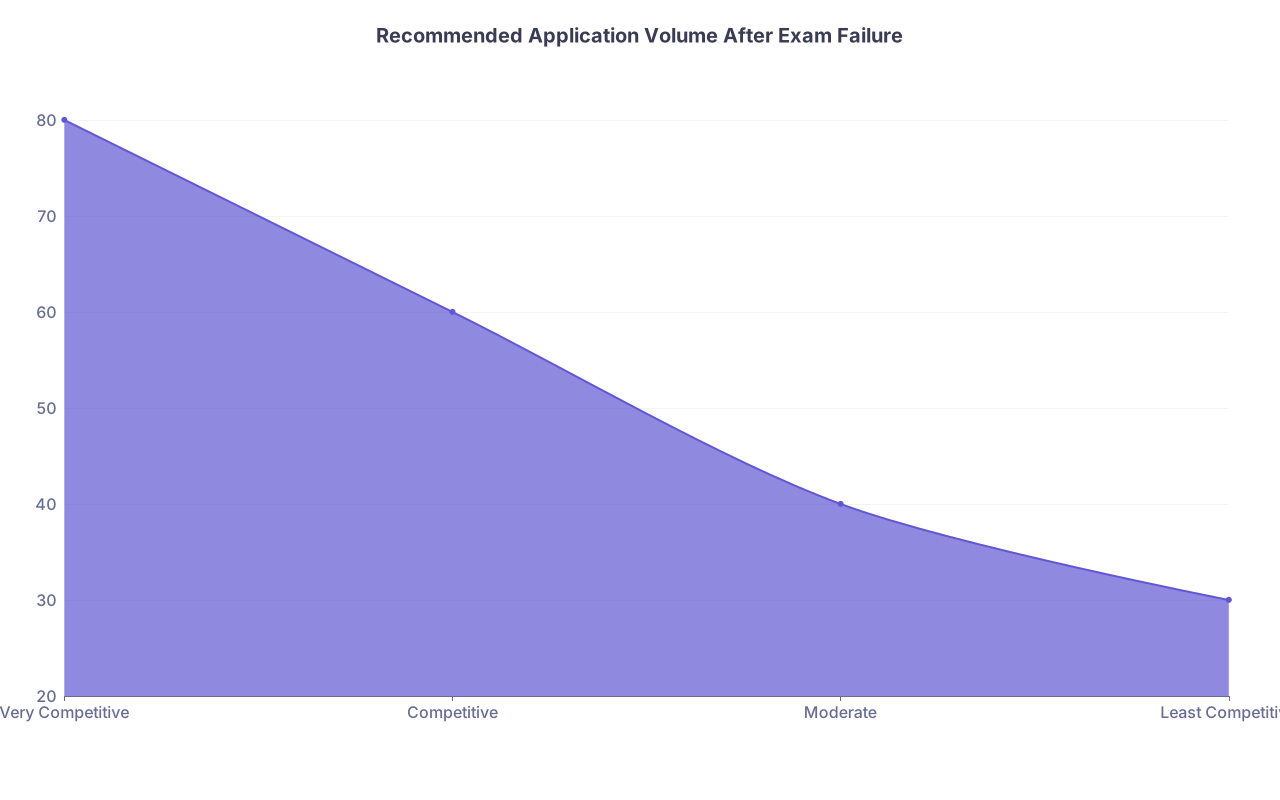
| Category | Value |
|---|---|
| Very Competitive | 80 |
| Competitive | 60 |
| Moderate | 40 |
| Least Competitive | 30 |
If you have a major exam failure:
- For FM/Psych/Path/PM&R/Neuro:
30–60 programs is not crazy, especially if:- You are DO/IMG
- You have multiple red flags
- You need a specific region
Skip the fantasy of “I’ll only apply to Boston, NYC, and California.” This is where you buy your future with flexibility.
B. Use Your Home Institution Aggressively
If your home department in FM/Psych/PM&R likes you, that can heavily cushion your risk.
Things to do:
- Be known by the PD, APD, and core faculty
- Ask explicitly: “Do you think I’m competitive for your program?”
- Get someone there to be your internal advocate when your file comes up
Home‑field advantage is real. I’ve seen weak‑on‑paper applicants get ranked higher because multiple attendings could vouch: “This student shows up, works hard, and is coachable.”
C. Don’t Overplay “I Settled”
Never say:
- “I wanted X but after failing I chose Y.” Even if it’s true.
- “This was kind of my backup.”
You can say:
- “Earlier in training I explored X, but as I spent more time in Y, I realized the day‑to‑day work and patient population fit me better.”
- “This specialty aligns with how I like to think and how I like to work with patients.”
You’re not lying; you’re describing a genuine pivot. PDs don’t need your tortured soul story. They need to know you’ll show up at 6 a.m. and not be bitter for three years.
9. When Not to Pivot (Yet)
Let me be clear: a single exam failure is not automatic grounds to abandon every competitive specialty dream.
You should not immediately run to FM/Psych/Path if:
- You failed one exam but since then:
- Crushed the retake
- Crushed Step 2
- Have strong clinical grades and strong mentorship in a moderately competitive field
- You’re a US MD without other red flags and your school historically places your “type” into that field
In that case, you do this:
- Keep your target specialty as Plan A
- Act like your life depends on Step 2 and clinical performance (because now it does)
- Quietly line up at least one least competitive specialty as a serious Plan B—letters, rotations, and all
The line where you pivot is not the same for everyone. But waiting until September of application year to admit you might need a backup? That’s how you end up in the SOAP crying in a hallway.
10. The Actual Bottom Line
If you failed a major exam, you don’t need motivational posters. You need strategy. Here it is, stripped down.
One failure with strong recovery = constrained options, not zero options.
You can still aim moderate/competitive if the rest of your record is strong, but least competitive specialties should be on your radar as backup.Multiple failures or a weak overall trajectory = pivot early.
Family Medicine, Psychiatry, Pathology, PM&R, and Neurology (many programs) remain absolutely viable and respectable careers. They’re not punishment. They’re your best route to actually practicing.Commit to whichever path you pick.
Whether you stay the course or pivot, go all‑in: targeted rotations, real relationships, honest explanations of your failure, and broad, flexible applications.
You can build a good life and a good career in a least competitive specialty. The only real disaster here is pretending nothing has changed—and then being shocked when Match Day proves you wrong.