
The myth that “strong applicants always have amazing letters” is lazy and wrong. Plenty of solid applicants end up with weak or limited LOR options—especially in competitive fields or at smaller schools. The difference is what they do next.
You’re here because you’re staring at your potential letter writers and thinking: “This is it? Seriously?” Maybe you changed your mind on specialty late. Maybe your home program is tiny. Maybe you had a rough clerkship or a personality clash with the one big-name attending. Whatever the reason, you have fewer or weaker LOR options than the Instagram success stories.
You can still build a workable application. But you do not have the luxury of wishful thinking. You need a backup plan, and you need to be tactical.
Let’s walk through exactly what to do if you have limited LOR options in a competitive field—frames like derm, ortho, ENT, plastics, optho, rad onc, urology, anesthesia, EM, even some “least competitive” fields at hyper-competitive programs.
Note: The category says “least competitive specialties,” but the situation you’re in is actually this: your application is less competitive within your chosen field because of your letters. So I’m treating this as a “how to survive with weak LORs in any field, plus how to think about safer specialty choices.”
Step 1: Get Brutally Honest About What You Actually Have
Before you fix anything, you need a clean inventory of your current LOR reality. No sugarcoating.
Make a simple list:
| Writer | Specialty | Knows You How Well? | Likely Strength | Type |
|---|---|---|---|---|
| Dr. A (clerkship) | IM | Saw you 4 weeks | Average | Clinical |
| Dr. B (research PI) | Derm | 1 year research | Strong | Research |
| Dr. C (elective) | Family | 2 weeks | Lukewarm | Clinical |
| Dr. D (course dir) | Surgery | Knows by name only | Weak | Academic |
Now ask yourself:
- Do I have at least one specialty-specific letter?
- Do I have at least one person who actually knows me well and likes me?
- Are any of these letters likely to be bad (not just “meh,” but actually negative)?
If you suspect a letter might be weak or mixed, do not use it unless you have zero alternatives. A tepid letter can sink you more quietly than a low Step score.
You’re looking for three things:
- One or two people in your chosen field (or adjacent) who can speak to your potential in that type of work
- Anyone who can credibly speak to your work ethic, reliability, and character
- People you can still realistically go back to and upgrade the relationship before they write
If you only have one decent letter and the rest are “they barely know me,” you are not doomed. But you need to start acting like someone on a tight budget: every interaction with potential letter writers must now be intentional.
Step 2: Understand What Programs Actually Care About (Not What Reddit Says)
Programs don’t sit in a dark room plotting how to punish you for not having a letter from a celebrity attending. They’re looking for a few specific signals:
- You function well on a team.
- You are safe with patients and not a liability.
- Your work ethic is solid; you show up, do the work, and do not melt down.
- For competitive fields: some sign that someone in that field thinks you’re worth training.
If your LOR situation is weak or limited, your job is to get those four things covered across your letters, even if none of them are “Dr. Famous Name, National Chair.”
I’ve seen people match solid programs in supposedly competitive fields with:
- One strong research letter from a mid-tier academic
- One solid clinical letter from IM or surgery
- One specialty letter that was more “they’re fine and reliable” than “best student of my career”
Not ideal. But enough, if the rest of the app is consistent and your story matches.
Your backup planning starts with this mindset: you’re not chasing mythical “glowing” letters; you’re trying to assemble a coherent, reassuring picture of you as a resident.
Step 3: Extract Maximum Value From the Relationships You Do Have
If you’re late in MS3 or already in MS4, you don’t have time for big personality overhauls. You do have time, however, to tighten up existing relationships.
For each potential writer you listed, ask:
- Can I schedule a 15–20 minute meeting to discuss my goals and ask for feedback?
- Did I ever send a thoughtful thank-you email with specific examples from the rotation?
- Do they know my scores, CV, and personal story for this specialty?
Here’s how you upgrade a lukewarm or “they barely know me” relationship:
- Email them and say something like:
- “I’m applying to X this year and really valued working with you on Y. I’d love to get your honest feedback on my performance and talk briefly about my plans—would you have 15 minutes in the next couple weeks to chat?”
- In the meeting:
- Ask: “If you were to write a letter for me, what would you feel comfortable highlighting?”
- Watch their face. If they hesitate, that’s a red flag.
- If they’re positive, explicitly say: “Would you feel comfortable writing me a strong letter of recommendation for X?”
The word “strong” matters. It gives them an exit if they don’t feel that way. If they dodge, you thank them and do not press. That is not one of your three LORs.
Then you make it easy for them to write well:
- Send a short, targeted “brag sheet” (one page max: bullet list of 6–10 concrete things you did with/for them: patients you followed, projects, specific feedback you got).
- Attach your CV and a short paragraph on why you’re going into this field and what kind of resident you hope to be.
Will this magically turn a 5/10 writer into a 10/10? No. But I’ve watched it move letters from “generic” to “this student consistently followed through on tasks and was a reliable member of the team” — which is often enough.
Step 4: If You’re Early Enough – Design Rotations Around Letters
If you still have time to choose MS4 electives or sub-Is, you need to stop picking rotations like a tourist.
You are no longer looking for “cool experiences.” You’re looking for:
- Attendings who work closely with students (not just fellows and residents)
- Settings where you can be seen repeatedly over time
- Services where your presence actually helps them
This is where least-competitive specialties can be your ally. For example:
Let’s say you want anesthesia at a strong academic place, but you only have one anesthesia letter and it’s average. Doing:
- A medicine sub-I with a notoriously hands-on attending who loves teaching
- A critical care elective where attendings see you running lists and handling sick patients
…can give you powerful cross-specialty letters that programs respect.
Look for rotations where:
- The attending pre-rounds with you
- You present directly to them
- They see you manage your own patient load
Then do the obvious but underused things:
- Show up early.
- Own your patients. Know every lab, every med, every overnight change.
- Ask for in-the-moment feedback: “Is there anything I can do tomorrow that would make me more helpful to you and the team?” Then actually do it.
People remember that. And that’s how you turn a “random elective attending” into “this student is one of the most reliable and prepared students I’ve worked with.”
Step 5: Decide If You Need a Specialty Backup Plan
Let’s be blunt. Some combinations are rough:
- No home program + no specialty letter + mediocre Step/COMLEX + late decision for a very competitive field
- A truly bad rotation in your chosen field and no one willing to write for you
- A failed exam or remediation on your record plus weak letters
If that’s you, you should at least seriously consider a parallel or backup specialty.
This doesn’t mean giving up. It means hedging.
Two questions to ask:
- If I don’t match this year, do I actually want to take a gap year, do a prelim year, or scramble, and fight this battle again?
- Is there a related, less competitive specialty where:
- My current letters would actually look normal or strong?
- My narrative still makes sense?
For example:
- Weak derm letters but solid medicine/IM support? IM with an eventual derm-heavy career (rheum, allergy, complex med-derm clinics) is not fake—it’s a real path.
- Limited EM letters but great FM and IM support? FM with strong urgent care/ED coverage later is an honest story.
- Borderline ortho application but great general surgery and ICU letters? General surgery or prelim surgery with a clear plan is better than magical thinking.
You don’t need to decide this alone. This is where you drag in:
- Your school’s specialty advisor (yes, even if they annoy you)
- Someone from the field you want, even if it’s via email or Zoom from another institution
- A PD or APD willing to give you 10 minutes of straight talk
Ask them this very pointed question:
- “If I apply this year to [specialty] with this letter situation and my scores, what kind of range of programs should I realistically expect interviews from? Would you tell your own student to dual-apply?”
If two people you trust say “I would absolutely dual-apply if I were you,” listen. Pride doesn’t match.
Step 6: Use Research and Non-Clinical Letters the Right Way
If your only truly strong letter is from research, that’s not a disaster. It just needs to be used intelligently.
Research letters help when they:
- Show long-term commitment (6–12+ months)
- Describe reliability, ownership, problem-solving
- Come from someone with a real academic reputation (but even non-superstars help if they know you well)
They hurt when:
- They’re the only letter and your clinical performance is a total black box
- They’re written by someone who barely interacted with you while a postdoc did all the supervision
If you’re in a competitive field and your strongest letter is research, your letter set might look like:
- 1 specialty research letter
- 1 strong general clinical letter (IM, surgery, whatever)
- 1 okay specialty clinical letter or another general clinical letter
Is that perfect? No. Is it survivable? Yes—if the rest of your app is aligned and you apply widely.
Non-physician letters (PhD course directors, MPHs, etc.) are fine as an extra letter at programs that allow four. They’re rarely acceptable as one of the core three unless the program explicitly says so. Do not rely on them to prove you can function as an intern.
Step 7: Choose Programs With Your LOR Reality in Mind
Here’s where people in your situation often sabotage themselves: they build a dream-heavy, reality-light program list.
You need to bias your list toward places that:
- Actually read applications carefully (many community and mid-tier academic programs)
- Take more residents per year (more spots = more forgiving)
- Have a track record of taking students from a wide range of schools
A simple, very rough framework:
| Applicant Type | Reach | Target | Safer |
|---|---|---|---|
| Very strong, solid LORs | 40% | 40% | 20% |
| Middle of the pack | 25% | 45% | 30% |
| Weak LORs / red flags | 10–15% | 40% | 45–50% |
If your letters are limited or weak, you should be living in that bottom row. That might mean applying to 60–80+ programs in some specialties. Expensive and annoying, yes. But less painful than a complete shutout.
Also: read program websites carefully. Some explicitly say:
- “We require at least two letters from faculty in [specialty]” → if you only have one, accept that this is an uphill climb.
- “We accept letters from any clinical faculty who supervised you” → that’s where your IM and surgery letters suddenly get more valuable.
Step 8: Let Your Personal Statement and MSPE Do Some Heavy Lifting
You can’t directly see your letters. But there are two places where you can control how the rest of your story balances them.
Personal Statement
You’re not confessing “I have bad letters.” You’re doing this:- Tell a clear story about your interest in the field.
- Emphasize the strengths you know your better writers will echo: hard work, consistency, teachability, team play, persistence over brilliance.
- If your exposure to the specialty was limited, explain briefly and coherently (school structure, lack of home program, etc.) without sounding like you’re blaming.
MSPE (Dean’s Letter) Add-ons
You don’t write this, but you can influence it.- If you had a specific rotation where you improved dramatically after early feedback, mention this to whoever is compiling your MSPE.
- If there were structural reasons you didn’t work with big-name attendings, make sure your advisor knows that context.
You want the overall message across all documents to be: “This person may not have the flashiest letters, but they are steady, safe, and serious about this field.”
Step 9: Psychological Reality Check – How to Stay Functional
This situation messes with people more than they admit. Watching classmates collect gushing letters while you’re begging someone who barely remembers your name to write feels awful.
There are two traps here:
- Tunnel vision: “If I don’t match this exact field at this level of program, my career is ruined.”
- Learned helplessness: “My letters suck, so what’s the point of trying?”
You don’t have time for either.
Instead:
- Focus on variables you can still influence this year: how many programs you apply to, how you prep for interviews, how you show up on your remaining rotations.
- Set a clear “if–then” backup plan:
- “If I get fewer than X interviews by [month], I will [dual apply / make a prelim plan / talk to PDs about a research year].”
Knowing your contingency before the chaos starts keeps you from making desperate, bad decisions in November.
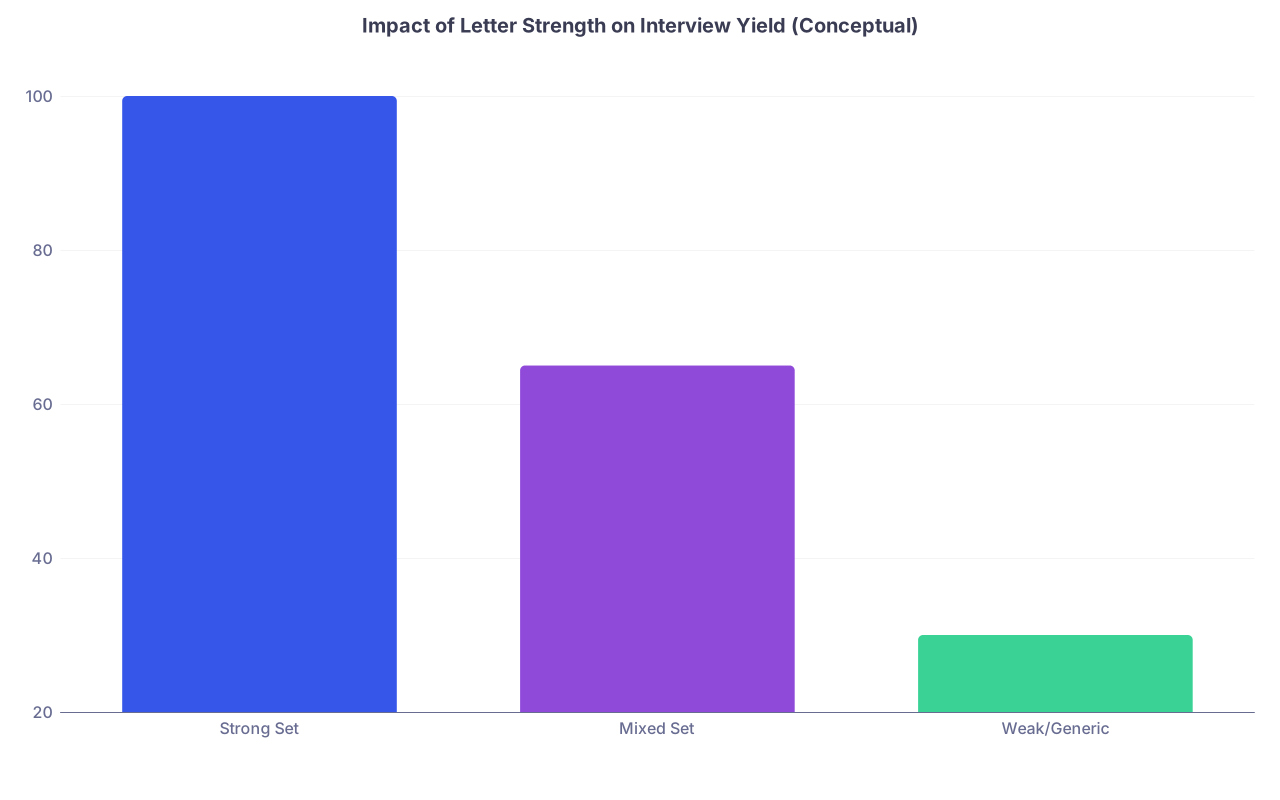
| Category | Value |
|---|---|
| Strong Set | 100 |
| Mixed Set | 65 |
| Weak/Generic | 30 |
Quick Specialty-Specific Angle for “Least Competitive” Fields
Since you’re in the “least competitive specialties” category, let me say this plainly: even in “easier” fields like family medicine, psych at many places, peds at broad programs, or path at non-elite centers, letters still matter.
Your backup specialty choice should be one where:
- General clinical letters (IM, surgery, FM, peds) are fully acceptable as primary evidence.
- Programs are used to training a wide range of students from community and international schools.
- One strong letter from “anywhere” can carry a lot of weight.
Family medicine, psych (outside the ultra-competitive coastal programs), peds, and internal medicine at non-elite places fit this description. If your heart is set on a more competitive niche, these can be realistic parallel paths that do not feel like “giving up on medicine.”

| Step | Description |
|---|---|
| Step 1 | Limited LOR Options |
| Step 2 | Strengthen other clinical letters |
| Step 3 | Seek new rotations or electives |
| Step 4 | Choose rotations with letter potential |
| Step 5 | Consider backup specialty early |
| Step 6 | Apply broadly with current plan |
| Step 7 | Dual apply or use safer specialty |
| Step 8 | Have 1 strong specialty letter |
| Step 9 | Competitive scores? |
| Step 10 | Time for more rotations? |
FAQ (Exactly 4 Questions)
1. Should I ever ask to see my letter before they submit it?
Usually no—most systems expect confidential letters, and many attendings are uncomfortable sharing. What you should do is ask, “Would you feel comfortable writing me a strong letter?” If they say yes, you trust that or you find someone else. If a faculty member offers to show you a draft, fine, but don’t push for it.
2. Is it better to have a big-name attending who barely knows me or a community doc who loves me?
Take the community doc who loves you, 99 times out of 100. Programs know the canned, two-paragraph “I vaguely remember this student” letter when they see it. A concrete, specific letter from someone who actually supervised you is far more valuable than a name-drop, especially in less ultra-competitive specialties.
3. Can a single bad or lukewarm letter ruin my match?
One truly negative letter can hurt a lot, especially in small specialties where PDs call each other. A lukewarm, generic letter is less catastrophic but can drag your overall impression down. That’s why you should try to avoid any writer who hesitates when you ask for a strong letter. Better three “solid” letters than two strong and one quietly toxic.
4. If I’m forced to dual-apply, how do I explain that later if I match my backup?
You tell the truth, framed with maturity. Something like: “I was initially interested in [competitive field], but as I learned more and talked with mentors, I realized that [backup specialty] actually fit my strengths and long-term goals better. Applying to both helped me clarify what kind of doctor I want to be, and I’m glad I matched here.” No need to confess “my letters were weak.” Focus on fit and growth.
Bottom Line
Three things to keep in your head:
- You’re not trying to win a beauty contest; you’re trying to assemble enough credible voices saying: “This person will be a safe, reliable intern in our field.”
- Weak or limited LORs don’t end your chances, but they do mean you must be aggressive about program choice, letter strategy, and backup planning.
- Pride doesn’t match. A thoughtful parallel or backup specialty is strategy, not surrender.